

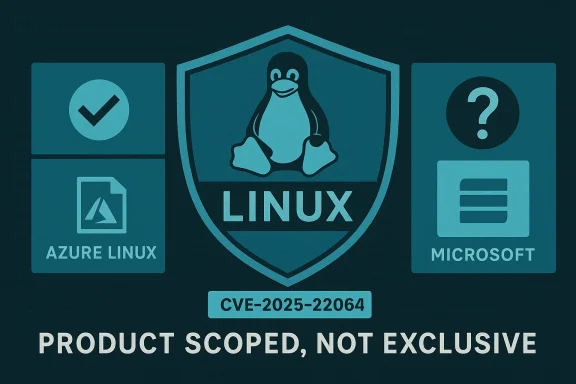
Microsoft’s short public attestation that “Azure Linux includes this open‑source library and is therefore potentially affected” is accurate and actionable for Azure Linux customers — but it is not a technical guarantee that no other Microsoft product can or does include the same vulnerable netfilter/nf_tables code.
CVE-2025-22064 has been assigned to a netfilter/nf_tables kernel defect described as “don’t unregister hook when table is dormant.” The issue sits in the Linux kernel’s packet‑filtering layer (netfilter), which implements nftables hooks used by firewalls, NAT, and various packet-processing subsystems in the kernel. Microsoft’s public guidance for this CVE explicitly calls out Azure Linux as a product that “includes this open‑source library and is therefore potentially affected,” and Microsoft has committed to publish machine‑readable attestations (CSAF/VEX) and to update the CVE if additional Microsoft products are identified.
That short, product‑scoped statement answers one narrow question — “Has Microsoft found the upstream component inside Azure Linux?” — and the answer is yes. It does not, by itself, resolve the broader inventory question many defenders face: “Could other Microsoft products, images, or artifacts also carry the same vulnerable kernel code?” Multiple independent analyses and community guidance make clear that the correct operational posture is to treat Microsoft’s attestation for Azure Linux as authoritative for that product, but not as an exclusivity guarantee for the rest of Microsoft’s portfolio.
Several vendor advisory analyses emphasize the same point: the attestation is valuable and actionable for the named product, but it does not preclude the vulnerable component from existing elsewhere in vendor artifacts (for example, container images, SDKs, telemetry agents, appliance images, or other Linux-based products). Microsoft’s commitment to publish CSAF/VEX attestations and to update mappings if more products are affected is the right operational approach, but until that mapping is complete, customers should not assume exclusivity.
Defenders should therefore prioritize Azure Linux remediation as Microsoft directed, but simultaneously perform artifact-level verification across Microsoft images, containers, agents, and build pipelines. Adopt SBOM- and CSAF-driven automation where possible, and treat vendor product attestations as a strong signal for immediate action — not as a blanket exclusion for every other product in the vendor’s portfolio.
Source: MSRC Security Update Guide - Microsoft Security Response Center
 Background / Overview
CVE-2025-22064 has been assigned to a netfilter/nf_tables kernel defect described as “don’t unregister hook when table is dormant.” The issue sits in the Linux kernel’s packet‑filtering layer (netfilter), which implements nftables hooks used by firewalls, NAT, and various packet-processing subsystems in the kernel. Microsoft’s public guidance for this CVE explicitly calls out Azure Linux as a product that “includes this open‑source library and is therefore potentially affected,” and Microsoft has committed to publish machine‑readable attestations (CSAF/VEX) and to update the CVE if additional Microsoft products are identified.That short, product‑scoped statement answers one narrow question — “Has Microsoft found the upstream component inside Azure Linux?” — and the answer is yes. It does not, by itself, resolve the broader inventory question many defenders face: “Could other Microsoft products, images, or artifacts also carry the same vulnerable kernel code?” Multiple independent analyses and community guidance make clear that the correct operational posture is to treat Microsoft’s attestation for Azure Linux as authoritative for that product, but not as an exclusivity guarantee for the rest of Microsoft’s portfolio.
What Microsoft’s wording actually means
Product-scoped attestation versus exclusivity
When a large vendor like Microsoft publishes the phrase “Product X includes component Y and is therefore potentially affected,” they are stating the result of an inventory for that named product. That is a discrete, useful deliverable: it tells customers running Azure Linux that Microsoft has checked and found the vulnerable upstream component in that distribution and that operators should treat Azure Linux images as in‑scope for remediation. However, this kind of statement is not the same as a global, exhaustive proof that no other Microsoft product contains the same code. The distinction is important and often misunderstood.Several vendor advisory analyses emphasize the same point: the attestation is valuable and actionable for the named product, but it does not preclude the vulnerable component from existing elsewhere in vendor artifacts (for example, container images, SDKs, telemetry agents, appliance images, or other Linux-based products). Microsoft’s commitment to publish CSAF/VEX attestations and to update mappings if more products are affected is the right operational approach, but until that mapping is complete, customers should not assume exclusivity.
Why vendors publish product‑scoped statements first
- Large vendors maintain thousands of build artifacts and images; performing exhaustive, artifact-level inventory across every single image and binary takes time.
- A confirmed inventory for one product can be published quickly and helps customers who run that product to prioritize mitigation.
- Vendors often promise to expand the mapping as additional checks complete, which minimizes the risk of overlooking affected artifacts but creates a window of uncertainty in the short term.
Technical summary: what “don’t unregister hook when table is dormant” implies
The nf_tables / netfilter context
Netfilter is the Linux kernel framework that implements packet filtering and manipulation. nftables is the modern in-kernel library and userland interface that replaced iptables backends in many deployments. A “hook” in this context is an entry point the kernel uses to call packet-filtering code at specific points in the network stack (for example, pre-routing, forward, post-routing). The bug title suggests a lifecycle/cleanup error: when an nftables table goes dormant (no active rules or the table is being torn down), the kernel code may fail to properly unregister a previously registered hook. That kind of error can lead to dangling references, use‑after‑free conditions, kernel oopses, or unpredictable kernel behavior — all of which are serious because they occur in kernel context.Practical impact and exploitability (generic kernel‑lifecycle pattern)
- A missed unregister can leave callback pointers in place while the table or its data structures have been freed or invalidated. If the kernel later calls that hook, it may access freed memory and crash or expose a memory‑corruption primitive.
- Exploitability depends on multiple factors: kernel configuration, module load/unload sequences, runtime usage (are the nftables hooks actually in use), and the attacker’s ability to cause the relevant code paths to run.
- Many kernel defects of this category are rated high because a reliable memory‑corruption primitive in kernel space can lead to local privilege escalation or full system compromise. Distribution and vendor advisories typically prioritize such fixes.
Is Azure Linux the only Microsoft product that includes this code?
Short answer: No — not necessarily. Microsoft has publicly confirmed Azure Linux as a Microsoft-maintained distribution that includes the upstream netfilter/nf_tables component referenced by the CVE, and therefore Azure Linux images are in-scope. But Microsoft’s attestation for Azure Linux does not, on its own, prove that no other Microsoft product contains the same vulnerable component. That determination requires artifact-level verification across Microsoft’s broad set of releases and images.Why you cannot infer exclusivity from the Azure Linux statement
- Shared artifacts: vendors often reuse the same kernel trees, container base images, or library builds across multiple products and images. The same vulnerable upstream code can therefore appear in more than one product artifact.
- Build-time vs. runtime inclusion: even if a product’s published image omits the vulnerable module, a product’s build pipeline, SDKs, or marketplace images might still include it in a separate artifact.
- Binary embedding and linkage: a product that contains a Linux kernel or boots Linux containers may indirectly include the same kernel component via third‑party images or appliance builds.
- Inventory completeness: a product-scoped attestation confirms checks were done for the named product; it is not a global scan of the vendor’s entire artifact surface. Microsoft has committed to expand CSAF/VEX attestations over time to cover more products, which is the right path, but until that mapping is complete, defenders should verify artifacts across their estate.
Where to look — practical inventory checklist
If your organization uses Microsoft products or images, prioritize Azure Linux, but also conduct targeted checks across other potential carriers:- Azure Linux images and Azure Marketplace VM images based on Microsoft-maintained distributions. Start here because Microsoft already flagged it.
- Windows Subsystem for Linux (WSL) images or other Microsoft-distributed Linux images used for developer tooling or CI runners.
- Containers and Kubernetes base images published by Microsoft (including official and marketplace container images).
- Microsoft management agents, telemetry agents, or orchestration tooling that ship Linux-based images or embedded kernels.
- Appliance images (for example, virtual appliances Microsoft distributes or partners ship through Microsoft channels).
- Build pipelines and CI images that your teams use to produce cloud images or VM templates (older toolchains or cached build artifacts can reintroduce vulnerable libraries).
- Any third-party or partner software bundles that are redistributed through Microsoft channels — these can carry independent kernel builds.
How to verify presence for your environment (step‑by‑step)
- Inventory: enumerate all Microsoft-supplied images and artifacts in use (VM images, WSL distros, container images, marketplace images, management agents).
- Extract SBOM or package lists where available: check package manifests (dpkg -l, rpm -qa) inside images to find kernel package versions or nftables-related packages.
- Check kernel configuration and modules: inspect kernel config (zcat /proc/config.gz) or module lists (lsmod) for nftables/netfilter components.
- Static artifact scanning: run container and image scanners that check for known CVE references and kernel module versions; prefer tooling that inspects package metadata, not just filenames.
- Binary/build provenance: for custom-built images, inspect build logs or toolchains to see if an upstream kernel tree that carries the affected commit was used.
- Use vendor attestations and machine-readable CSAF/VEX artifacts once Microsoft publishes them — cross-check their mappings against your artifact inventory.
Immediate mitigations and operational priorities
- Prioritize patching Azure Linux images and hosts running those images. Microsoft’s attestation makes this a high-priority, actionable item.
- For other Microsoft artifacts, perform the artifact-level verification steps above immediately. If you find the vulnerable component, plan for the same urgency as for Azure Linux.
- Where kernel livepatching is available, evaluate temporary livepatch solutions from your vendor or cloud provider to reduce reboot windows while you schedule maintenance.
- If you cannot patch immediately, harden hosts by reducing attack surface: disable unnecessary modules, restrict unprivileged users from loading kernel modules, and limit network exposure of hosts that may be able to trigger nftables hooks.
- Monitor kernel logs and oops signatures, and alert on repeated kernel stack traces or module unload failures that could indicate a lifecycle bug.
Risk analysis: strengths and potential risks of Microsoft’s public approach
Strengths
- Concrete, fast mitigation: Microsoft’s product-level attestation for Azure Linux provides customers running that distribution with immediate, authoritative guidance they can act on.
- Commitment to machine-readable attestations: publishing CSAF/VEX enables automation-driven customers to consume vulnerability-exposure information at scale across product inventories once the mappings are complete. Microsoft’s stated intent to publish and update these artifacts improves long-term transparency.
Potential risks and downsides
- Window of uncertainty: until Microsoft’s CSAF/VEX mapping covers more products or customers perform artifact-level verification, defenders must assume potential wider exposure and invest time to scan many artifacts.
- Misinterpretation risk: some teams may read the Azure Linux statement and incorrectly assume no other Microsoft products are affected; that complacency would increase risk if other artifacts actually contain the vulnerable code. Multiple advisory analyses warn against this misinterpretation.
- Inventory completeness versus speed: publishing an attestation for one product quickly is good for targeted mitigation, but it can create an expectation mismatch — customers still need to run their own discovery to be safe.
Recommended actions for defenders (concise checklist)
- Immediate (hours)
- Patch Azure Linux instances and images first.
- Start an artifact inventory for Microsoft images and containers in your estate.
- Block or isolate high‑risk systems from untrusted networks where possible.
- Short term (days)
- Scan all Microsoft-supplied images (Marketplace, container registries, developer images) for nftables/netfilter presence.
- Apply vendor kernel updates or livepatch where available; schedule reboots if required.
- Harden module loading and restrict users from loading kernel modules.
- Medium term (weeks)
- Ingest Microsoft’s CSAF/VEX attestations when published and reconcile them with your inventory.
- Automate SBOM and image-scanning into CI/CD pipelines to prevent vulnerable artifacts from re-entering production.
- Audit build pipelines and cached toolchains for stale kernel trees.
- Long term (months)
- Implement SBOM-driven policies and enforce proven‑clean base images for production.
- Ensure Microsoft-sourced images are validated before deployment and add attestation checks into image promotion gates.
What to expect next from Microsoft and the ecosystem
Microsoft’s stated path — publish a product attestation for Azure Linux immediately and then expand CSAF/VEX mappings — is consistent with how large vendors manage complex artifact inventories. Expect Microsoft to:- Publish machine-readable attestations (CSAF/VEX) that enumerate the products and artifacts Microsoft has checked. Use those artifacts to automate reconciliation.
- Update the CVE entry to list additional Microsoft products only after internal inventories and scans confirm presence.
- Coordinate with distribution and cloud partners where the vulnerable kernel component has been backported or where packaging differs.
Conclusion
Microsoft did the right thing by publicly confirming that Azure Linux includes the open‑source netfilter/nf_tables component referenced by CVE‑2025‑22064 and by committing to publish CSAF/VEX attestations and update the CVE if more Microsoft products are affected. That attestation is authoritative and actionable for Azure Linux customers. However, it is not a proof that Azure Linux is the only Microsoft product that could include the vulnerable library. The technical realities of shared builds, container images, and artifact reuse mean the same upstream code can appear in multiple products or images unless explicitly excluded by comprehensive vendor attestations or by your own artifact scanning.Defenders should therefore prioritize Azure Linux remediation as Microsoft directed, but simultaneously perform artifact-level verification across Microsoft images, containers, agents, and build pipelines. Adopt SBOM- and CSAF-driven automation where possible, and treat vendor product attestations as a strong signal for immediate action — not as a blanket exclusion for every other product in the vendor’s portfolio.
Source: MSRC Security Update Guide - Microsoft Security Response Center
