

Microsoft’s advisory naming Azure Linux as a carrier of the upstream Linux component implicated by CVE‑2024‑26948 is accurate — but it is a product‑scoped attestation, not a guarantee that no other Microsoft product can include the same vulnerable code. Microsoft’s public wording confirms Azure Linux as a known carrier and commits to expanding machine‑readable attestations (CSAF/VEX) over time if additional Microsoft products are found to ship the affected upstream component.
CVE‑2024‑26948 is a Linux kernel vulnerability in the AMD display stack (drm/amd/display) where a missing defensive check could let code attempt to release a NULL dc_state pointer; upstream maintainers fixed this by adding a NULL check in dc_state_release. The vulnerability is classed as a NULL pointer dereference (CWE‑476), and its practical impact is primarily stability/availability (kernel oops / denial of service), though any kernel‑level crash can carry broader operational risk in shared or multi‑tenant environments. The official vulnerability records (NVD, OSV) and multiple distribution advisories track the fix and reference the kernel commits that contain the defensive change.
Two practical consequences follow:
Put simply:
If you manage Microsoft‑supplied Linux artifacts, prioritize: (1) applying the patched kernel images where Microsoft has attested exposure; (2) triaging other Microsoft kernels in your environment using the quick checks above; and (3) automating consumption of Microsoft’s CSAF/VEX attestations as they become available so you learn quickly when Microsoft expands product scope.
Source: MSRC Security Update Guide - Microsoft Security Response Center
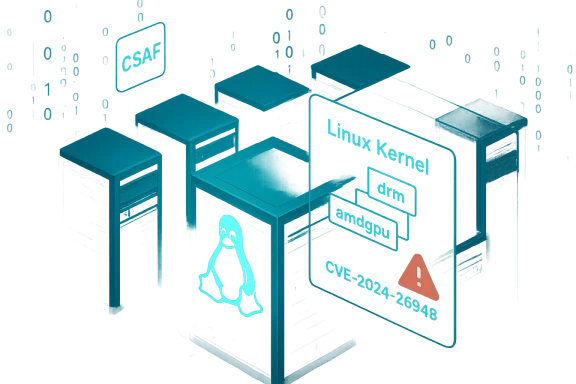 Background / Overview
CVE‑2024‑26948 is a Linux kernel vulnerability in the AMD display stack (drm/amd/display) where a missing defensive check could let code attempt to release a NULL dc_state pointer; upstream maintainers fixed this by adding a NULL check in dc_state_release. The vulnerability is classed as a NULL pointer dereference (CWE‑476), and its practical impact is primarily stability/availability (kernel oops / denial of service), though any kernel‑level crash can carry broader operational risk in shared or multi‑tenant environments. The official vulnerability records (NVD, OSV) and multiple distribution advisories track the fix and reference the kernel commits that contain the defensive change.Two practical consequences follow:
- If a given kernel binary includes the drm/amd/display code from the upstream range that lacked the check, that kernel is potentially affected.
- Whether a Microsoft product is affected depends on whether Microsoft’s delivered kernel binary or image actually contains that upstream code (based on version, backports, and build/config flags).
Why Microsoft named Azure Linux — what the wording means
Microsoft’s MSRC practice for third‑party CVEs (the CSAF/VEX program) intentionally begins with a limited, verifiable inventory: they inspect a specific product family and declare if the upstream component is present in that product. Microsoft’s October 2025 transparency blog explains this phased approach: start with a product where end‑to‑end inventory is available (Azure Linux), publish machine‑readable attestations, and then expand coverage to other product families as inventories complete. That means Microsoft will update CVE/VEX records when additional Microsoft artifacts are identified as carriers of an upstream component.Put simply:
- “Azure Linux includes this open‑source library and is therefore potentially affected” = Microsoft has found the upstream component inside Azure Linux artifacts and is telling customers to treat Azure Linux as in‑scope.
- It is not the same as “no other Microsoft product contains this library”; absence of an attestation for another product is not evidence that the product is safe.
Technical mechanics: how the same kernel code shows up across products
Understanding whether other Microsoft products could contain the vulnerable drm/amd/display code requires looking at how kernel code is propagated and packaged:- Kernel version and upstream commit range: The specific commits that include or fix the issue determine which kernel versions are vulnerable. Vendors often backport fixes, rebase, or ship their kernels on different upstream trees; those choices decide exposure.
- Kernel configuration (CONFIG_* flags): Many driver families are optional builds. Whether the AMD DRM/DC subsystem (CONFIG_DRM_AMDGPU, CONFIG_DRM_AMD_DC, etc.) is compiled into the kernel or as a module depends on build configuration. If the driver is not present in a given kernel build, that build cannot be affected by that DRM NULL dereference. Practical inspection steps (below) show how to verify.
- Packaging and distribution: Microsoft ships kernels in multiple places — Azure Linux images, the Microsoft WSL2 kernel binary, Marketplace VM images, kernels inside distribution images Microsoft publishes, and even the linux‑azure kernels used by cloud images maintained by distro vendors. Any of these artifacts that contain the vulnerable upstream range and have the display code enabled are plausible carriers. Distribution advisories (for example Ubuntu’s linux‑azure updates) show vendors mapping these upstream fixes into their own kernel packages, including kernels used on Microsoft cloud infrastructure.
Where Microsoft kernels and images commonly appear — plausible Microsoft carriers
Administrators should treat the following Microsoft‑supplied artifacts as plausible places to find the vulnerable code unless proven otherwise:- Azure Linux images (Microsoft’s attested product family) — explicitly listed by MSRC for the CVE. Treat these as in‑scope and patch per Microsoft guidance.
- WSL2 (Windows Subsystem for Linux) — Microsoft ships a maintained Linux kernel binary for WSL2. That kernel may include or exclude amdgpu/DC code depending on the WSL kernel branch and configuration; the presence of an AMD DRM driver in a given WSL kernel build would make it a potential carrier. Check your WSL kernel binary/version.
- Azure Marketplace VM images and curated images — Marketplace images often include the vendor’s kernel packages; if Microsoft or a marketplace image includes the vulnerable kernel, your VM will be affected.
- AKS node images, managed node pools and specialized GPU‑enabled node images — GPU node kernels are more likely to include AMD GPU drivers if they're aimed at GPU‑accelerated workloads.
- linux‑azure kernels packaged by distributions (Ubuntu linux‑azure) — distribution kernels built specifically for Azure (linux‑azure) may be updated or remediated by the distro maintainers, and the distro advisories show these kernels receiving fixes.
How to verify if a specific host / Microsoft artifact is affected — practical triage
Below are direct, short checks you can run on a Linux host or an image to determine exposure. These are practical forensic steps you can script or run on fleets.- Identify the kernel binary and version:
- uname -r
- Confirm whether AMD DRM / DC code is present in the kernel:
- Check for module files: ls /lib/modules/$(uname -r)/kernel/drivers/gpu/drm/amd
- See if module is loaded: lsmod | grep -i amdgpu
- Inspect dmesg / journalctl for amdgpu or drm messages: dmesg | egrep -i 'amdgpu|drm'
- Inspect kernel config for relevant flags:
- If /proc/config.gz exists: zcat /proc/config.gz | egrep 'CONFIG_DRM_AMDGPU|CONFIG_DRM_AMD_DC'
- Or check /boot/config-$(uname -r) if present.
- Map your kernel package to upstream commits:
- For packaged kernels (apt/yum/zypper), consult package changelog or distro security notice to find which upstream commits were included or backported.
- For WSL2:
- Check which kernel WSL uses (the Microsoft-supplied kernel or a custom kernel via .wslconfig) and inspect that kernel’s config/tree for AMD DRM.
- For VM or Marketplace images:
- Obtain the SBOM or package manifest; if unavailable, spin the image in a test instance and perform the checks above.
Mitigation and remediation guidance
If you determine a Microsoft artifact in your environment is affected (or if Microsoft has attested a product that you run, such as Azure Linux), follow these steps:- Apply the vendor kernel update or patched image immediately:
- For Azure Linux: install the updated Azure Linux kernel packages or use the patched VM image Microsoft publishes.
- For distro kernels on Azure (e.g., linux‑azure): follow distro advisories (Ubuntu, SUSE, etc.) and install the fixed kernel package and reboot if required.
- For WSL2 users:
- Update to the latest WSL kernel package pushed via Windows Update or use a vetted custom kernel; if uncertain, check which kernel WSL is using and whether that kernel contains the patched commit.
- Reduce attack surface while patching:
- Restrict access to GPU device nodes (e.g., /dev/dri/*) to trusted users only.
- If you do not need AMD DRM functionality, consider blacklisting the driver or building a kernel without the driver for targeted workloads.
- Implement host‑level microsegmentation and limit unprivileged container or user access to kernel device nodes.
- Audit images and pipelines:
- Ensure build pipelines and Marketplace images are rebuilt with patched kernel packages and updated SBOMs.
- Add kernel config inspection to your image build verification steps so such issues are discovered earlier.
- Use vendor attestations and SBOMs:
- Consume Microsoft’s CSAF/VEX data programmatically to know when Microsoft expands attestations to additional products; combine that with your own artifact scans. Microsoft has committed to publish VEX attestations and to update CVE records when additional products are identified.
Cross‑checking the facts — what we verified and what remains to be confirmed
We cross‑checked the CVE description across multiple independent vulnerabilittlists the CVE description and notes the drm/amd/display NULL check remediation.- OSV and other vulnerability feeds (cvefeed/cvedetails) record the same fix and reference kernel stable commits that include the NULL‑check changes.
- Distribution advisories (for example Ubuntu’s linux‑azure updates) demonstrate that kernels used in Microsoft cloud contexts (linux‑azure) are tracked and patched by distribution vendors, highlighting that cloud kernels are actively maintained and remediated.
- Caveat — commit retrieval: the canonical kernel commit references live on kernel.org; vulnerability records point to those commits. In some cases direct retrieval of a kernel.org stable commit URL via automation may be blocked or rate‑limited; vulnerability aggregators copy and reference the commit metadata so the remediation trace is still verifiable through those sources. Where a direct upstream commit link is referenced in public CVE metadata, treat that as the authoritative technical fix pointer.
- Caveat — product scope versus exclusivity: Microsoft’s Azure Linux attestation is authoritative for Azure Linux, but it is a scoped inventory statement. Lack of a Microsoft attestation on another Microsoft product does not equal proof of non‑exposure; you must verify artifacts you run. The WindowsForum community and multiple independent analysts have repeatedly emphasized this distinction.
- Transparency note: Microsoft’s published commitment to CSAF/VEX means customers should expect more machine‑readable attestations in the future; ses and consume VEX files to automate detection of newly attested products.
Practical checklist for administrators (short action list)
- For Azure Linux customers: apply Microsoft’s Azure Linux kernel update now (treat Azure Linux as in‑scope per Microsoft’s attestation).
- For any Linux images running on Microsoft platforms (WSL2, Marketplace, AKS nodes, VM images): run the triage checks (uname, lsmod, /lib/modules, kernel config) to confirm driver presence.
- If amdgpu/DC code is present and you cannot immediately update:
- Restrict access to /dev/dri devices,
- Consider temporary driver blacklisting if safe for workloads,
- Schedule patch deployment and test reboots in a controlled window.
- Integrate CSAF/VEX into your patching automation and image‑scanning CI pipelines to get notified when Microsoft attests additional products.
Conclusion
To answer the core question directly and precisely: No — Azure Linux is not necessarily the only Microsoft product that could include the vulnerable drm/amd/display code. Microsoft has publicly attested that Azure Linux includes the implicated open‑source library and is therefore potentially affected; that attestation is authoritative for Azure Linux and should be acted on. However, because the Linux kernel code can appear in multiple Microsoft artifacts (Microsoft‑built WSL kernels, Marketplace images, linux‑azure packages used on Azure VMs, GPU node images, etc.) the absence of a Microsoft attestation for another product does not prove that product is unaffected. Operators must verify the kernel binary and configuration of the specific Microsoft artifacts they run, apply vendor patches, and follow the triage and mitigation steps above.If you manage Microsoft‑supplied Linux artifacts, prioritize: (1) applying the patched kernel images where Microsoft has attested exposure; (2) triaging other Microsoft kernels in your environment using the quick checks above; and (3) automating consumption of Microsoft’s CSAF/VEX attestations as they become available so you learn quickly when Microsoft expands product scope.
Source: MSRC Security Update Guide - Microsoft Security Response Center
