

Microsoft’s short answer on its CVE page — that “Azure Linux includes this open‑source library and is therefore potentially affected” — is technically correct for the product Microsoft has inspected, but it is not an exclusivity guarantee and should not be read as proof that other Microsoft‑distributed artifacts are free of the same vulnerable code.
The vulnerability tracked as CVE‑2022‑27651 affects container tooling (Buildah and Moby/Docker Engine) and stems from incorrect handling of Linux process capabilities and default permissions when containers are started. In short, some containers were started with a non‑empty inheritable capability set or non‑empty default permissions, which can allow binaries that rely on file capabilities to inadvertently escalate those inheritable bits into the permitted set on execve(2), undermining confidentiality and integrity in affected deployments. This technical summary and CVSS scoring are reflected across vendor advisories and distribution trackers.
Why this matters: capabilities and permission bits are core parts of the Linux security model. An unexpectedly non‑empty inheritable set in a containerized process creates a surprising environment for code running inside the container — and that surprise can be leveraged by an attacker with access to a program that has inheritable file capabilities. The practical exploitability and severity vary by context (what binaries are present in the image, whether those binaries are reachable, bounding sets configured for containers, and runtime confinement), but the issue has been taken seriously by distributors and patched in the upstream projects and affected distributions.
“One of the main benefits to our customers who choose to use the Azure Linux distro is the commitment to keep it up to date with the most recent and most secure versions of the open source libraries with which the distro is composed. Microsoft is committed to transparency in this work which is why we began publishing CSAF/VEX in October 2025. … If impact to additional products is identified, we will update the CVE to reflect this.” (archive.ph)
Put simply:
Two independent, authoritative sources confirm the CVE technical details (Ubuntu and SUSE advisories) and document the same vulnerability symptoms and mitigations that the upstream project fixed. Those distribution advisories provide concrete package‑level remediation guidance for images that include Buildah/Moby components.
The practical takeaway for administrators and security teams is straightforward: patch Azure Linux immediately, inventory all Microsoft‑supplied artifacts you run (WSL, Marketplace images, AKS nodes, container base images), scan and rebuild images where necessary, and subscribe to Microsoft’s VEX/CSAF feeds for automated updates as Microsoft expands its attestations. That combined approach — vendor attestation plus artifact‑level verification — is the only reliable way to reduce blind spots and close the window of exposure.
Source: MSRC Security Update Guide - Microsoft Security Response Center
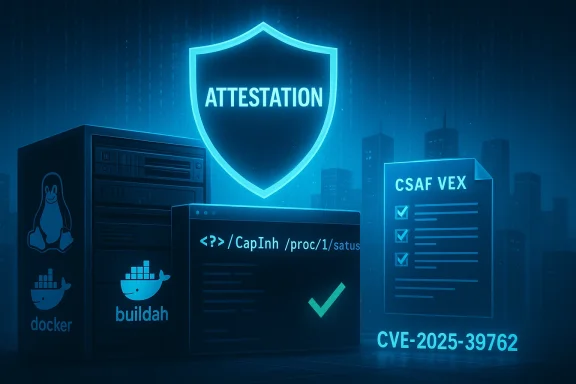 Background / Overview
The vulnerability tracked as CVE‑2022‑27651 affects container tooling (Buildah and Moby/Docker Engine) and stems from incorrect handling of Linux process capabilities and default permissions when containers are started. In short, some containers were started with a non‑empty inheritable capability set or non‑empty default permissions, which can allow binaries that rely on file capabilities to inadvertently escalate those inheritable bits into the permitted set on execve(2), undermining confidentiality and integrity in affected deployments. This technical summary and CVSS scoring are reflected across vendor advisories and distribution trackers.Why this matters: capabilities and permission bits are core parts of the Linux security model. An unexpectedly non‑empty inheritable set in a containerized process creates a surprising environment for code running inside the container — and that surprise can be leveraged by an attacker with access to a program that has inheritable file capabilities. The practical exploitability and severity vary by context (what binaries are present in the image, whether those binaries are reachable, bounding sets configured for containers, and runtime confinement), but the issue has been taken seriously by distributors and patched in the upstream projects and affected distributions.
What Microsoft actually published (and the plain meaning)
Microsoft’s Security Response Center (MSRC) pages increasingly use short, machine‑readable inventory attestations when a product has been inspected and found to include an implicated open‑source component. For a number of Linux‑related CVEs the MSRC FAQ line follows the pattern:“One of the main benefits to our customers who choose to use the Azure Linux distro is the commitment to keep it up to date with the most recent and most secure versions of the open source libraries with which the distro is composed. Microsoft is committed to transparency in this work which is why we began publishing CSAF/VEX in October 2025. … If impact to additional products is identified, we will update the CVE to reflect this.” (archive.ph)
Put simply:
- Attestation = Microsoft inspected the Azure Linux build outputs and found the implicated open‑source component there. That makes Azure Linux a confirmed carrier for the purposes of that CVE; Azure Linux customers should prioritize remediation according to Microsoft’s guidance.
- Attestation ≠ exclusivity. Microsoft’s wording does not assert that Azure Linux is the only Microsoft product that can include the vu states the current scope of Microsoft’s inventory mapping and reserves the right to update that mapping if additional Microsoft products are later found to include the same upstream code. This is deliberate: large vendors publish attestations product‑by‑product as inventories are completed.
Technical mechanics: why “only Azure Linux?” is the wrong simplification
Whether a given Microsoft artifact (or any vendor artifact) contains a specific upstream piece of code is an artifact‑level, build‑time property. For kernel or low‑level library CVEs this depends on:- The exact upstream commit range used to build the artifact (did the build include the vulnerable code or a backport of the fix?).
- The build configuration (which kernel drivers or library features were compiled in or enabled).
- Whether the component was vendored/statically linked into a binary or left as a packaged/shared dependency.
- Any local patches or backports the vendor applied during their packaging process.
Two independent, authoritative sources confirm the CVE technical details (Ubuntu and SUSE advisories) and document the same vulnerability symptoms and mitigations that the upstream project fixed. Those distribution advisories provide concrete package‑level remediation guidance for images that include Buildah/Moby components.
The practical blast radius inside a Microsoft environment
When Microsoft attests Azure Linux as a carrier, the operational blast radius is clear for Azure customers who run those images: patch and update the named images or kernels. For the broader Microsoft ecosystem the true blast radius is determined by where the vulnerable component could have been included:- Azure Linux VM images and kernels (explicitly attested — highest priority).
- Azure Marketplace images and partner appliances (image-based distribution; may include vulnerable packages).
- AKS node images and managed node pools (if node images include the vulnerable component).
- WSL2 kernel binaries distributed by Microsoft (Microsoft publishes kernel binaries for WSL and those kernels are independent artifacts that must be checked).
- Microsoft‑published container base images, SDK images, and sample images used in developer tooling and CI pipelines.
- Any Microsoft agents, tooling, or SDKs (for example telemetry or management agents) that were built or packaged with the vulnerable versions.
Strengths and limitations of Microsoft’s attestation approach
Strengths
- **Actionable, product‑scoped Azure Linux explicitly, Microsoft gives customers a straight remediation path for a known carrier instead of leaving all artifacts ambiguously in scope. That helps reduce triage ambiguity and speeds patching for Azure customers.
- Machine‑readable VEX/CSAF commitment. Microsoft’s rollout of machine‑readable VEX/CSAF attestations (announced as beginning in October 2025) promises better automation for enterprise patch orchestration once coverage expands.
Limitations and risks
- Inventory incompleteness. Microsoft ships many discrete artifacts; a single product attestation is not a full inventory of everything Microsoft publishes. Until additional as Not Affected or Fixed, they remain unknown and merit verification.
- Operator complacency. There’s a real operational hazard in reading “Azure Linux includes…” as “only Azure Linux includes it.” That misreading leaves blind spots in estates that rely on multiple Microsoft images and components.nce.** Two otherwise identical products can vary depending on the exact build inputs used at build time (different churn and patch sets across regions, variants, or packaging flows). That means automated inventory alone can miss artifacts created outside the canonical build pipeline.
What defenders should do now — prioritized, practical guidance
If you run Microsoft artifacts anywhere in your environment, follow this prioritized sequence. The steps are actionable in almost any environment (cloud, hybrid, on‑prem):- Prioritize Azure Linux images immediately.
- Apply Microsoft‑published updates or replace affected images as directed in the MSRC advisory for the CVE. Azure Linux is a confirmed carrier — treated as highest priority.
- Inventory and classify all Microsoft‑provided artifacts in your estate.
- Identify WSL2 installations, Azure Marketplace images in use, AKS node pools, Azure‑curated base images, and any Microsoft‑published container images deployed in your pipelines.
- Mark artifacts as “Attested Affected,” “Attested Not Affected,” or “Unknown.”
- Scan artifacts and images for the vulnerable component.
- Use image scanners and SBOM inspection tools (container image scanners, package vulnerability scanners, binary dependency analyzers) to detect the presence of the specific Buildah/Moby versions or vulnerable library artifacts.
- For container images: inspect packaged versions of buildah, moby, or the relevant binary packages inside the image (pkg managers: apt, rpm, apk).
- Check runtime process capability bits where feasible.
- On a running Linux process, capability sets are visible in /proc/[pid]/status (fields like CapInh, CapPrm, CapEff). For container root processes you can inspect /proc/1/status inside the container. A non‑zero CapInh where you expected zero is a clear signal to investigate the image that started the process.
- Example quick check (run inside a container or namespace): grep CapInh /proc/1/status
- Rebuild or replace suspect images.
- If an image includes the vulnerable package or a vendored vulnerable dependency, rebuild the image with the fixed upstream component and redeploy.
- Rebuild CI/CD pipeline base images that were used to produce production artifacts during the vulnerable window.
- Update and patch vulnerable hosts and orchestrator nodes.
- For AKS node pools or VM scale sets using Microsoft images, apply updated images or kernel packages as Microsoft or the distribution vendor publishes them.
- Use compensation controls where patches are not immediately available.
- Restrict access to containers and images that include programs with inheritabl - Harden runtime policies (AppArmor/SELinux, seccomp, dropping capabilities explicitly in runtime configs) to minimize the likelihood the inheritable set can be leveraged.
- Subscribe to MSRC VEX/CSAF feeds and vendor advisories.
- Automate ingestion of Microsoft’s VEX outputs once available, but keep artifact‑level scanning enabled as a defense‑in‑depth measure.
Detection, monitoring, and incident response notes
- Detection signals to watch for:
- Unexpected or non‑zero inheritable capability sets observed in container init processes (CapInh non‑zero in /proc/[pid]/status).
- New or modified files with file capabilities (check getcap on suspicious binaries inside images).
- Execution of privileged helper binaries that rely on file capabilities inside container images.
- Response actions:
- If you find images or hosts with the vulnerable configuration, isolate them from sensitive networksrebuilt fixed variants, and rotate any credentials or secrets that may have been accessible to those containers during the exposure window.
- For CI systems: assume artifacts built with a vulnerable base image or build tool could be contaminated; rebuild critical artifacts in known‑good build environments after patching build images or toolchains.
Cross‑checking the public record: what independent sources say
To be confident in both the vulnerability facts and Microsoft’s inventory claim, I checked multiple independent sources:- Distribution advisories (Ubuntu and SUSE) documenting the CVE, its technical summary, and remediation steps for distribution packages. These confirm the vulnerability description and CVSS assignment used across vendors.
- Public CVE aggregators and vulnerability trackers that list affected projects (Buildah, Moby/Docker Engine) and link to project fixes and GitHub advisories describing the exact code paths fixed. These confirm where upstream fixes were applied and which project releases address the problem.
- Microsoft’s own MSRC advisory language (the short product attestation and MSRC’s published commitment to expand CSAF/VEX) — this is Microsoft’s authoritative statement about what was inspected and attested.
- Independent forum and analysis writeups that explain the operational interpretation of MSRC attestation language (why “includes” is an accurate but scoped claim and why the absence of other product names is not a proof of non‑inclusion). These analyses align with best practices for artifact‑level verification.
Critical analysis: strengths, weaknesses, and the path forward
Microsoft’s attestation model is a pragmatic compromise between total transparency and operational reality. Large vendors cannot instantly attest every binary and image they distribute; mapping the entire product portfolio to every upstream component is a non‑trivial engineering and governance exercise. Microsoft’s decision to start with Azure Linux and expand CSAF/VEX makes sense operationally, but it introduces three important tradeoffs:- Positives:
- It gives Azure customers a clear triage path and allows automation for that product family.
- Machine‑readable attestations reduce confusion when implemented across the ecosystem.
- Negatives / residual risk:
- Organizations with mixed estates that include WSL, Marketplace images, Azure services, and Microsoft‑provided container images cannot safely assume “not named = not vulnerable.” The attestation only tellsroduct families were checked, not which ones were omitted.
- A phased roll‑out creates a time window where important artifacts remain un‑attested and likely under‑inspected by downstream automation.
Checklist: Concrete steps you can run this week
- High priority (Azure Linux)
- Apply the updates Microsoft published for Azure Linux images and kernels.
- Reboot and validate workloads where required.
- Medium priority (other Microsoft artifacts)
- Inventory WSL2 instances and check the WSL kernel version.
- Inspect AKS node images and any custom Marketplace VM images in use.
- Scan Microsoft‑published container images used in development or CI.
- Tactical verification (quick commands and checks)
- Inside a running container: grep CapInh /proc/1/status — verify inheritable capability bits are expected.
- In images built from Debian/Ubuntu: dpkg -l | grep buildah or dpkg -l | grep moby.
- In RPM‑based images: rpm -qa | grep -E 'buildah|moby|docker'.
- Longer term
- Automate SBOM collection for all images and VMs; ingest Microsoft VEX/CSAF attestations when available to reduce manual triage overhead.
- Enforce build hygiene: pin dependencies, vendor critical modules, and rebuild base images promptly after security fixes.
Conclusion
To answer the user’s question directly and precisely: No — Azure Linux is not the only Microld include the open‑source library referenced by CVE‑2022‑27651. What Microsoft has published is a product‑scoped attestation that Azure Linux includes the implicated open‑source component and is therefore potentially affected. That attestation is authoritative and actionable for Azure Linux customers, but it does not prove that other Microsoft artifacts are free of the vulnerable code. Until Microsoft publishes additional CSAF/VEX attestations or you perform artifact‑level discovery across your estate, other Microsoft‑disinaries should be treated as unknown and verified accordingly.The practical takeaway for administrators and security teams is straightforward: patch Azure Linux immediately, inventory all Microsoft‑supplied artifacts you run (WSL, Marketplace images, AKS nodes, container base images), scan and rebuild images where necessary, and subscribe to Microsoft’s VEX/CSAF feeds for automated updates as Microsoft expands its attestations. That combined approach — vendor attestation plus artifact‑level verification — is the only reliable way to reduce blind spots and close the window of exposure.
Source: MSRC Security Update Guide - Microsoft Security Response Center
