

Microsoft’s public advisory for CVE‑2025‑40913 confirms a vulnerability in the Perl module Net: ropbear (versions up through 0.16) that stems from an embedded, vulnerable copy of the libtommath library — and Microsoft’s statement that “Azure Linux is the product that includes the open‑source library and is therefore potentially affected” reflects a product‑level attestation, not a blanket assurance that no other Microsoft artifacts could include the same code.
Net:ropbear is a Perl distribution that, in affected releases, ships an embedded copy of the libtommath bignum implementation. The reported issue is not an original bug inside Net:ropbear’s Perl glue; it is a dependency problem — an integer overflow in the embedded libtommath code inherited from a prior tracked vulnerability (the root issue was previously catalogued and remediated in libtommath upstream). The practical consequences of the overflow depend on how the library is used by a consumer, but integer overflows in numeric/bignum routines can lead to memory corruption, denial of service, or, in specific exploit chains, arbitrary code execution.
Security databases assigned a moderate severity (CVSS v3.1 ≈ 6.5) and catalogued Net:ropbear 0.01 through 0.16 as affected versions. Open advisories and the CPAN distribution source show the vulnerable bn_mp_grow implementation embedded in the Net:ropbear package, which is the proximate cause of the CVE assignment.
ropbear/libtommath artifact in the published VEX data — but that is not the same as saying Azure Linux is the only Microsoft product that could ever ship the same vulnerable code.
ropbear/libtommath occurrences. Choose the steps appropriate to the OS and packaging system you run.
CVE‑2025‑40913 is a textbook example of a dependency‑supply‑chain vulnerability: the risk comes not just from an upstream bug but from how and where that upstream code is packaged and redistributed. Microsoft’s Azure Linux VEX attestation improves transparency and is a positive step, but defenders must pair vendor attestations with local verification and an SBOM‑aware process to maintain sound security posture.
Source: MSRC Security Update Guide - Microsoft Security Response Center
ropbear (versions up through 0.16) that stems from an embedded, vulnerable copy of the libtommath library — and Microsoft’s statement that “Azure Linux is the product that includes the open‑source library and is therefore potentially affected” reflects a product‑level attestation, not a blanket assurance that no other Microsoft artifacts could include the same code.
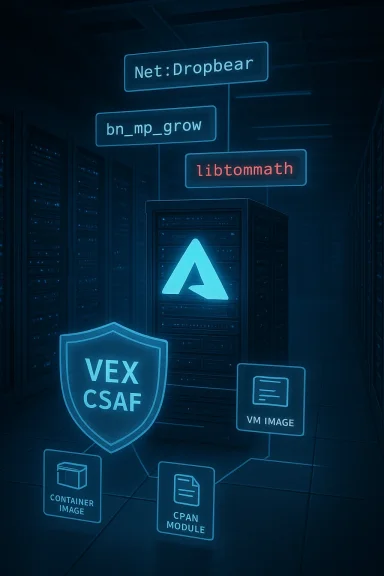 Background: what CVE‑2025‑40913 actually is
Net:ropbear is a Perl distribution that, in affected releases, ships an embedded copy of the libtommath bignum implementation. The reported issue is not an original bug inside Net:ropbear’s Perl glue; it is a dependency problem — an integer overflow in the embedded libtommath code inherited from a prior tracked vulnerability (the root issue was previously catalogued and remediated in libtommath upstream). The practical consequences of the overflow depend on how the library is used by a consumer, but integer overflows in numeric/bignum routines can lead to memory corruption, denial of service, or, in specific exploit chains, arbitrary code execution.Security databases assigned a moderate severity (CVSS v3.1 ≈ 6.5) and catalogued Net:
ropbear 0.01 through 0.16 as affected versions. Open advisories and the CPAN distribution source show the vulnerable bn_mp_grow implementation embedded in the Net:ropbear package, which is the proximate cause of the CVE assignment.Microsoft’s message: what they said — and what it means
The literal statement
Microsoft’s MSRC advisory and related machine‑readable VEX/CSAF attestation identify Azure Linux as the Microsoft product that includes the implicated open‑source library and therefore is “potentially affected.” Microsoft also expressly noted that they began publishing CSAF/VEX attestations as a programmatic transparency mechanism in October 2025, and that they will update the CVE/VEX records if additional Microsoft products are found to carry the same upstream code.How to read that wording
There are two separate claims bundled in Microsoft’s advisory:- A definitive, product‑scoped attestation: Microsoft has inspected Azure Linux artifacts and found the implicated upstream code there. That is an authoritative statement for Azure Linux.
- A process commitment: Microsoft is rolling out machine‑readable VEX/CSAF attestations and will expand those attestations to other product families over time. This explains why Azure Linux appears first in many of Microsoft’s attestations.
ropbear/libtommath artifact in the published VEX data — but that is not the same as saying Azure Linux is the only Microsoft product that could ever ship the same vulnerable code.Why “attested” ≠ “exclusive”: technical reasons
Artifact-by-artifact builds
Large vendors ship many distinct Linux artifacts: distribution images, kernel builds for VM SKUs, WSL2 kernel binaries, container base images, Azure Marketplace images, specialized appliances, and more. Each of these artifacts is built from a particular upstream snapshot, with its own configuration choices and backports.- Kernel and distribution components are chosen at build time, driven by the exact upstream commit range and compile‑time options.
- A vendor may backport a patch or replace a component in one image family but not in another.
- An upstream dependency compiled into a packaged artifact will exist in that artifact only if it was included in the specific build tree.
Inventory and phased VEX rollout
Publishing reliable VEX/CSAF attestations is operationally heavy: it requires artifact inventory, deterministic mapping from CVE to a product’s component list, and validation that the component in the artifact is the exact vulnerable upstream code. Large vendors typically roll this out in phases and start with a product family that is easier to inventory; Microsoft began with Azure Linux, and that likely explains why Azure Linux appears as the first attested Microsoft product for several CVEs.Does Microsoft’s wording mean only Azure Linux is affected?
No — not necessarily. Microsoft’s wording means:- Azure Linux is a confirmed carrier of the vulnerable code for CVE‑2025‑40913 (i.e., Microsoft has attested that the Azure Linux images they inspected contain the implicated Net:ropbear/libtommath code).
- Microsoft has not claimed, at the time of the advisory, to have completed a company‑wide inventory or attestation across every product or artifact.
- If Microsoft later identifies other Microsoft products that include the same upstream code, they will update the CVE and VEX/CSAF records accordingly.
Practical implications for customers and defenders
If you run Azure Linux images
- Treat Azure Linux as in‑scope for remediation: apply Microsoft’s Azure Linux update advisories and follow the vendor‑published remediation steps. Microsoft’s VEX/CSAF attestation and the update guidance indicate that Azure Linux images were validated and that patched packages or guidance are available.
- Inventory any Azure Marketplace images, custom VM images, or node images that rely on Azure Linux 3.x artifacts — they may require patching or image rebuilds.
- If you consume vendor images from partners or third parties in Azure Marketplace, confirm whether those images are based on Azure Linux artifacts and whether the vendor has applied the necessary fixes.
If you run other Microsoft artifacts (WSL, Linux for Azure, marketplace images, appliances, etc.)
- Do not assume you are safe because the MSRC advisory names only Azure Linux. Absence of attestation is not proof of absence.
- Verify locally: inspect installed packages and embedded libraries, and if possible, compare artifact checksums or content manifest against the vendor’s VEX/CSAF manifest once available for your product family.
- If you cannot quickly verify, apply compensating controls: restrict network exposure for affected hosts, enforce tighter access control, and accelerate patching windows for Linux artifacts in your environment.
If you run non‑Microsoft distributions
- Net:ropbear is a CPAN module; it may also be shipped or bundled by distribution maintainers or included in custom builds. Check your distribution’s security advisories and package metadata.
- For major Linux distributors, vendor advisories (Red Hat, Debian, Ubuntu, etc.) are the authoritative place to determine whether a specific distribution package is affected and whether a vendor patch is available.
- If a distribution reports “not affected,” that is typically because downstream packaging did not include the vulnerable embedded copy or the vendor backported a fix.
How to verify whether your systems include the vulnerable component
Below are practical, artifact‑level steps administrators can use to locate Net:ropbear/libtommath occurrences. Choose the steps appropriate to the OS and packaging system you run.1. Check for CPAN/Perl module presence
- Use Perl’s introspection to find the module path:
- Run: perl -MNet:ropbear -e 'print $INC{"Net/Dropbear.pm"} . "\n"'
- If the module loads and the path prints, inspect the source for an embedded dropbear/libtommath directory and the bn_mp_grow.c file.
- If your Perl environment is isolated (virtualenv-like), check each environment you run.
2. Inspect package managers
- RPM‑based systems (Azure Linux, RHEL, CentOS, Fedora):
- rpm -qa | grep -i dropbear
- rpm -ql <package‑name> | grep -i libtommath
- DEB‑based systems (Debian, Ubuntu):
- dpkg -l | grep -i dropbear
- dpkg -L <package‑name> | grep -i libtommath
3. Search the filesystem for the vulnerable source snippet
- Use a targeted content search for unique strings from the vulnerable function (e.g., “bn_mp_grow” or specific code lines from the bn_mp_grow implementation) to find embedded copies:
- grep -R --line-number --exclude-dir={proc,sys,tmp} "bn_mp_grow" /usr /opt /var 2>/dev/null
4. Container and image inspection
- If you use container images, run a quick container content inspection:
- docker run --rm -it --entrypoint /bin/sh <image> -c 'grep -R "bn_mp_grow" / || true'
- For OCI images in registries, use tools that extract and scan image layers for file presence.
5. Binary artifact inspection
- For kernel or other compiled artifacts, presence of libtommath is unlikely unless statically linked; however, if you suspect a vendor binary includes an embedded component, request the vendor’s VEX/CSAF manifest or use binary diffing/strings scanning to look for characteristic code identifiers.
Mitigation, remediation and policy recommendations
Immediate mitigation steps
- Prioritize patching Azure Linux hosts using Microsoft’s published updates and guidance for the product family.
- If an immediate vendor patch is not available for another artifact you control, consider isolating affected systems, restricting inbound access to SSH‑related services, and applying network ACLs or host firewalls to reduce attack surface.
- For Perl applications that bundle Net:ropbear, update the CPAN distribution to a fixed version (if one is available) or remove/replace the dependency with a maintained alternative.
Medium‑term remediation
- Establish or accelerate an inventory program that maps CVEs to installed third‑party components at the artifact level.
- Deploy dependency scanning in your build pipelines (static and dynamic analyses) to catch embedded libraries inside downstream packages before image publication.
- Require machine‑readable SBOMs and manifest fingerprints for third‑party images and vendor artifacts you consume.
Long‑term policy and supply‑chain controls
- Adopt a supplier attestation policy: require vendors to publish VEX/CSAF attestations and SBOMs for images and kernels they ship to you.
- Integrate VEX data and vendor attestations into your vulnerability management pipeline so that you can automatically treat “attested vulnerable” products as highest priority.
- Where possible, prefer vendor images that do continuous upstream syncs and have a strong, published security maintenance program.
What defenders should expect from vendors (and what to ask for)
When a vendor publishes a product‑level attestation, ask these follow‑up questions:- Which specific builds/image versions were inspected? Provide exact product version numbers or build IDs.
- What was the detection method? (file presence, symbol match, SBOM scan, source manifest)
- Have fixes been backported to the product’s in‑service branches, or are updated packages available for automatic update paths?
- Will the vendor publish machine‑readable attestations for other product families and images? If so, what is the expected cadence?
Risk analysis: how serious is CVE‑2025‑40913 for most organizations?
- The underlying flaw is an integer overflow in a bignum routine, a type of error that can be leveraged in severe exploits but often requires a specific exploitation chain and hostile input paths that reach the vulnerable code. That technical detail tends to reduce the immediate exploitability compared to simpler memory errors in exposed daemons.
- The assigned CVSS score in public databases is moderate (≈6.5). That reflects realistic but not highest‑severity risk for a generic environment.
- The overall organizational risk depends heavily on two variables:
- Exposure: whether the affected Net:ropbear code is reachable over networks you expose or reachable via untrusted inputs.
- Presence: whether the vulnerable code is actually present in artifacts you run (which is what Microsoft’s Azure Linux attestation confirms for that product).
- Attackers typically prioritize vulnerabilities that are both widespread and easy to weaponize. Because this is an inherited dependency issue and not an immediately trivial remote RCE in a default service, it is medium priority for most defenders — high priority for those who run Azure Linux or who embed Net:ropbear into network‑facing services.
How to track updates and verify vendor claims
- Monitor vendor advisories and the published VEX/CSAF manifests for your vendor products. Microsoft has committed to updating CVE entries and VEX attestations as their inventory work progresses; rely on those attestations for authoritative per‑product carrier status.
- If you rely on third‑party images or marketplace appliances, obtain the vendor’s attestation or SBOM and reconcile it with your internal inventory.
- Integrate upstream vulnerability feeds into your vulnerability management tooling and configure automatic re‑scans after vendor updates.
Final assessment and recommended action plan
- The short, accurate answer to the user’s question: Azure Linux is the only Microsoft product Microsoft has publicly attested as including the vulnerable Net:ropbear/libtommath artifact for CVE‑2025‑40913 at the time of the advisory. That is an authoritative attestation for Azure Linux, and Microsoft has committed to updating the CVE and VEX records if additional Microsoft products are found to be carriers.
- That same statement should not be read as an exclusive guarantee that other Microsoft artifacts cannot include the vulnerable code. Absence of a VEX/CSAF attestation for a given product equals “not yet attested,” not “proven clean.”
- Actionable steps for affected organizations:
- Immediately apply Microsoft’s Azure Linux updates for the CVE to any Azure Linux hosts in your estate.
- Inventory and scan other Microsoft artifacts you run (WSL images, linux‑azure kernels, Marketplace images) and treat unverified artifacts as potentially at risk until proven otherwise.
- For custom Perl applications or hosted images, locate and update any Net:ropbear CPAN modules or embedded libtommath copies.
- Harden network exposure and apply compensating controls where immediate patching is not feasible.
- Request VEX/CSAF attestations or SBOMs from vendors whose images you consume and integrate those attestations into your vulnerability prioritization.
CVE‑2025‑40913 is a textbook example of a dependency‑supply‑chain vulnerability: the risk comes not just from an upstream bug but from how and where that upstream code is packaged and redistributed. Microsoft’s Azure Linux VEX attestation improves transparency and is a positive step, but defenders must pair vendor attestations with local verification and an SBOM‑aware process to maintain sound security posture.
Source: MSRC Security Update Guide - Microsoft Security Response Center
