

Microsoft’s public attestation that Azure Linux is the product currently mapped to the open‑source component tied to CVE‑2025‑37976 is authoritative for Azure Linux — but it is not a technical guarantee that no other Microsoft product contains the vulnerable code. Treat Microsoft’s VEX/CSAF attestation as a positive confirmation for Azure Linux; treat the absence of attestations for other Microsoft artifacts as absence of attestation, not proof of absence. This distinction matters for defenders who must inventory and secure heterogeneous estates containing Microsoft‑provided images, kernels, and appliances.
In spring 2025 a change to the Linux kernel’s ath12k wireless driver (an upstream commit intended to fix an invalid entry fetch in ath12k_dp_mon_srng_process) generated a flurry of vendor advisories and CVE activity. The kernel patchset began appearing in April 2025, and the issue was recorded in public vulnerability trackers in May 2025. Shortly thereafter the CVE metadata became messy: an entry (CVE‑2025‑37976) was created, widely mirrored by scanners and distro trackers, then later marked Rejected/Withdrawn by the CVE Numbering Authority. At the same time, the upstream patching and backporting process in stable kernel trees produced reverts and re‑backports, which left downstream distributors and their security teams to reconcile which releases — if any — were vulnerable and which contained correct backports.
At the vendor level, Microsoft has taken a product‑scoped approach to publishing machine‑readable vulnerability attestations (CSAF/VEX) starting with the Azure Linux Distribution. Microsoft’s public guidance for these incidents states that Azure Linux is the product they have attested to include the implicated open‑source component, and that if additional Microsoft products are found to include the vulnerable code Microsoft will update the CVE/VEX information accordingly.
This article walks through what happened with CVE‑2025‑37976, explains why the simple question “Is Azure Linux the only Microsoft product that includes this open‑source library?” does not have a yes/no binary answer for many organizations, and gives practical, technical guidance for operators to verify exposure and remediate risk across Microsoft‑supplied artifacts.
Practical implications:
Strengths of Microsoft’s approach:
For defenders the practical rule is simple and actionable: treat Microsoft’s VEX/CSAF attestation as a trusted, product‑scoped signal; do not treat the absence of an attestation as evidence of safety. Automate artifact checks (kernel version, module presence, config flags, and commit IDs), prioritize remediation using vendor patches where available, and maintain an inventory that ties deployed images back to vendor artifact identifiers so VEX data can be ingested meaningfully.
In short: Azure Linux is the only Microsoft product Microsoft has publicly attested as including the implicated code at the time of their attestation — but it is not necessarily the only Microsoft artifact that could contain that upstream driver. Your security decision should be governed by what your specific deployed artifacts contain, not by the administrative status of a single CVE identifier.
Source: MSRC Security Update Guide - Microsoft Security Response Center
 Background / Overview
In spring 2025 a change to the Linux kernel’s ath12k wireless driver (an upstream commit intended to fix an invalid entry fetch in ath12k_dp_mon_srng_process) generated a flurry of vendor advisories and CVE activity. The kernel patchset began appearing in April 2025, and the issue was recorded in public vulnerability trackers in May 2025. Shortly thereafter the CVE metadata became messy: an entry (CVE‑2025‑37976) was created, widely mirrored by scanners and distro trackers, then later marked Rejected/Withdrawn by the CVE Numbering Authority. At the same time, the upstream patching and backporting process in stable kernel trees produced reverts and re‑backports, which left downstream distributors and their security teams to reconcile which releases — if any — were vulnerable and which contained correct backports.At the vendor level, Microsoft has taken a product‑scoped approach to publishing machine‑readable vulnerability attestations (CSAF/VEX) starting with the Azure Linux Distribution. Microsoft’s public guidance for these incidents states that Azure Linux is the product they have attested to include the implicated open‑source component, and that if additional Microsoft products are found to include the vulnerable code Microsoft will update the CVE/VEX information accordingly.
This article walks through what happened with CVE‑2025‑37976, explains why the simple question “Is Azure Linux the only Microsoft product that includes this open‑source library?” does not have a yes/no binary answer for many organizations, and gives practical, technical guidance for operators to verify exposure and remediate risk across Microsoft‑supplied artifacts.
What happened with CVE‑2025‑37976 (short technical timeline)
- April 2025: An upstream kernel commit intended to correct a ring‑entry fetch in the ath12k driver was proposed and applied upstream. The change targeted the function ath12k_dp_mon_srng_process, replacing a call intended for source rings with the correct function for destination rings.
- April 2025 (later): Backporting the fix into stable kernel trees produced a mistaken backport in at least one branch; maintainers reverted an incorrectly backported commit and prepared a corrected re‑backport.
- May 20, 2025: Public vulnerability databases and tracking sites began listing CVE metadata referencing the ath12k fix. That CVE record circulated through NVD mirrors and vendor trackers.
- June 18, 2025: The CVE entry for CVE‑2025‑37976 was marked as Rejected/Withdrawn by the CVE Numbering Authority; different tracking services and distro advisories reconciled the change in different ways. Some vendors assigned a separate CVE identifier to the same functional fix (or referenced the upstream commit directly) while others retained records mapping to the rejected ID.
- October 2025: Microsoft publicly accelerated its machine‑readable transparency work (CSAF/VEX) and began publishing VEX attestations starting with Azure Linux — a step intended to reduce noise and false positives for customers who run Microsoft images.
Why “attestation” ≠ “exclusive presence”: the Microsoft position explained
Microsoft’s public reply to the FAQ — that Azure Linux is the product Microsoft has attested to include the upstream component and therefore be potentially affected, and that Microsoft will update the CVE/VEX entry if impact to additional products is identified — is careful and deliberate. It does three important things:- It establishes authority for the attestation: Microsoft is the definitive source for the composition of Microsoft‑published Azure Linux images and the VEX/CSAF assertions they publish.
- It scopes the assertion: the attestation is product‑scoped (Azure Linux) rather than company‑wide. That is, Microsoft is asserting what they have validated (Azure Linux), not asserting that no other Microsoft‑distributed image or product could contain the same upstream code.
- It sets an operational expectation: Microsoft will update VEX/CSAF mappings if further Microsoft products are found to include the affected code.
Technical reasons why other Microsoft products might include the same upstream code
Whether any other Microsoft product includes the vulnerable ath12k code depends on a set of technical variables that differ across products and builds:- Kernel version and commit set: The presence of a particular upstream function is governed by the kernel version and which commits were included or backported into that kernel build. Two kernels with the same version string may differ if vendors applied different backports.
- Kernel configuration (CONFIG_*): Many drivers are conditionally compiled. If CONFIG_ATH12K or related kernel config flags are disabled in a given kernel build, the driver will not be present.
- Built‑in vs module: Drivers may be compiled as built‑in (part of the monolithic kernel image) or as loadable modules. Modules may be present in image repositories even if not loaded.
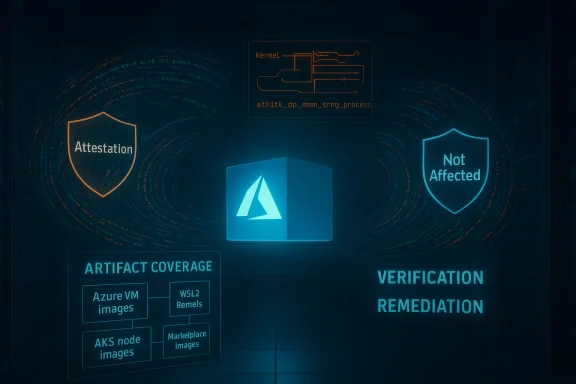
- Image lineage: Microsoft distributes a variety of Linux artifacts (Azure Linux, Azure Kernel builds for specialized images, WSL2 kernels, Marketplace images, container host images for AKS). These artifacts are sometimes built from different base trees or with different config sets.
- Packaging and backports: Linux distributions commonly backport fixes to stable kernel branches. A fix applied upstream may arrive in different distro kernels under different CVE IDs or with different commit hashes.
- Hardware targeting: ath12k is a wireless driver for specific Qualcomm hardware. Cloud and data‑center images often omit wireless drivers, while consumer or specialized device images may include them.
Practical checks to determine if a Microsoft product/image includes the ath12k code
Operators should verify presence directly rather than relying solely on a VEX absence. Below are concrete steps you can run on a system or image to detect the ath12k driver or the susceptible code path.- Identify kernel version and build metadata
- Run: uname -a or look at /proc/version
- Examine the kernel build string and build timestamp. If a vendor kernel uses a custom tag (for example “azure‑kernel‑…”) that is a signal to check vendor documentation or VEX for that artifact.
- Check kernel config for ath12k
- Search /boot/config-$(uname -r) (or /proc/config.gz) for CONFIG_ATH12K and related options.
- If CONFIG_ATH12K is unset the driver is not compiled in.
- Look for the module on the filesystem
- Check: lsmod | grep ath12k to see if it’s loaded.
- Check module files: find /lib/modules/$(uname -r) -name 'ath12k*' -print
- If modules exist in /lib/modules for the kernel version, inspect their modinfo: modinfo /lib/modules/$(uname -r)/.../ath12k.ko to see version strings and build tags.
- Inspect the kernel sources or package changelogs
- For distros, check package changelogs for kernel or module packages that mention the upstream commit or the specific function (ath12k_dp_mon_srng_process).
- Some organizations maintain separate kernel package metadata exposing the upstream commit IDs.
- Grep potential sources in the image
- If you have the kernel source tree or module C files available, search for the function names used in the upstream commit (ath12k_dp_mon_srng_process, ath12k_hal_srng_src_get_next_entry, ath12k_hal_srng_dst_get_next_entry).
- This is a low‑level but definitive test if the source is present in the artifact.
- For containers and images: perform static image inspection
- Extract the image layers and inspect /lib/modules and /boot for kernel artifacts.
- For containerized workloads, check whether the host kernel (not the container image) could be the vector — many container CVE detections are false positives if they look only at source package names rather than the actual in‑kernel modules.
- Leverage vendor‑provided VEX/CSAF files where available
- Use Microsoft’s VEX/CSAF feed to confirm Azure Linux’s status. For other Microsoft artifacts, check the vendor’s attestation or request a mapping.
If you find the driver/code present — mitigation options
If your systems or images include the ath12k driver or the specific code path, choose mitigations based on risk, attack surface and operational constraints.- Patch / update the kernel or modules
- The preferred mitigation is to apply a vendor‑supplied kernel update or module update that includes the corrected upstream fix or a validated backport from the vendor.
- For Azure Linux customers, Microsoft has published fixes for attested images; apply the vendor update immediately for affected nodes.
- Remove or blacklist the module if not required
- If wireless hardware is not used in the environment, consider blacklisting the module (e.g., add “blacklist ath12k” to /etc/modprobe.d/ and rebuild initramfs if necessary). This reduces attack surface in environments where loading the module is unnecessary.
- Note: in cloud images that don’t expose wireless hardware, the module may still be present in /lib/modules. Blacklisting prevents runtime loading but doesn’t change the on‑disk presence.
- Kernel hardening and access controls
- Restrict access to kernel module loading and local shell execution (use sudo controls, SELinux/AppArmor policies, and kernel lockdown features where appropriate).
- Limit local accounts and ensure least‑privilege.
- Compensating network controls
- Limit exposure of hosts by network segmentation; the ath12k issue is not remotely exploitable in many configurations, but reducing attack surface is still prudent.
- Image rebuild & reprovision
- For immutable infrastructure, rebuild images from a trusted base that includes the patched kernel and redeploy rather than performing live package updates.
- Monitor for errant behavior
- Add kernel OOPS/crash monitoring and alerting. Many of these ath12k issues result in system instability and will surface as kernel messages or crashes if triggered.
Operational guidance for organizations running Microsoft artifacts
- Do not assume “not attested” means “not affected”
- Microsoft’s VEX entry for Azure Linux is authoritative for Azure Linux images. However, absence of attestations for other Microsoft artifacts is not proof they are unaffected. Inventory and verify.
- Inventory Microsoft‑provided Linux artifacts you run
- This includes: Azure VM images, Marketplace images, container host images (AKS node images), WSL2 kernels, Azure IoT images, Azure Bastion or other managed appliances, and any Microsoft‑provided kernel packages used inside your environment.
- Prioritize based on exposure and criticality
- Publicly reachable hosts, jump hosts, and developer workstations with local user accounts should have higher priority for verification and remediation than isolated lab images.
- Automate verification
- Script the checks described earlier and run them periodically. Integrate results into your vulnerability management pipeline and ticketing system.
- Use the vendor VEX/CSAF feeds as authoritative sources for the artifacts they cover
- If Microsoft has attested Azure Linux, ingest Microsoft’s VEX feed for automation and to reduce false positives for that product. But keep your own checks for other artifacts.
- Keep incident response playbooks up to date
- Define a clear path: detect → confirm (binary/module presence) → patch/update or mitigate → verify → document. Ensure stakeholders know who owns each step.
Risk analysis: what the rejection of CVE‑2025‑37976 means in practice
The “Rejected/Withdrawn” label attached to a CVE identifier is a metadata artifact: it can mean the CNA retracted the identifier (for duplication, misassignment, or other administrative reasons), not that the underlying kernel bug didn’t exist or wasn’t patched upstream. In this case the kernel community’s backport/revert activity plus the CNA decision created a window where various scanners and vendors reported different mappings.Practical implications:
- Scanners that rely on CVE IDs alone may produce false negatives (because the CVE was rejected) or false positives (because some downstream vendors used a different CVE or a distro advisory).
- The underlying code path and upstream commit are the real source of truth. Detection grounded in actual artifact content (module presence, function names, commit IDs in packages) is more reliable than a single CVE identifier.
- For defenders, the operational risk is not the administrative status of a CVE but whether your deployed artifacts contain unpatched code that can be triggered in your environment.
Why Microsoft’s CSAF/VEX approach matters — and its limits
Microsoft’s move to publish CSAF advisories and VEX attestations (announced publicly in October 2025) improves the signal‑to‑noise ratio for customers. An authoritative VEX statement that “Product X is Not Affected / Known Affected / Fixed” frees operators from chasing noisy scanner results for that product.Strengths of Microsoft’s approach:
- Machine‑readable attestations enable automation in large environments.
- Explicit product mappings reduce false positive triage.
- Promises to extend attestations beyond Azure Linux over time will increase coverage.
- VEX coverage is phased; Azure Linux was the first product. Other Microsoft artifacts may not yet be covered.
- Vendor attestations apply only to vendor‑published artifacts — they do not reach into third‑party or user‑modified images you may have deployed.
- Attestations are only as useful as the inventory you maintain. If you do not know which Microsoft images you run, a VEX “Not Affected” statement is of limited practical benefit.
Recommended immediate actions (operational checklist)
- Identify all Microsoft‑supplied Linux artifacts in your environment:
- Azure VM images, Marketplace VMs, AKS node images, WSL2 kernels, Azure Linux images, Azure IoT and edge images.
- Run the presence checks on each artifact:
- uname -a, check /boot/config-*, lsmod, modinfo, search /lib/modules, grep for the function names in sources.
- For Azure Linux nodes:
- Follow Microsoft’s guidance and apply the vendor updates promptly for any Azure Linux images Microsoft has attested as affected.
- For other Microsoft artifacts:
- If the ath12k driver is present, follow the mitigation options above (patch, blacklist, rebuild image).
- If vendor documentation is absent, escalate through your Microsoft support channel to request an attestation or confirmation.
- Automate and centralize results:
- Ship results to your central logging/vulnerability platform and create tickets for remediation.
- Update vulnerability management rules:
- Where CVE IDs are rejected or disputed, prioritize artifact‑centric checks over CVE‑centric alerts.
- Communicate internally:
- Brief infrastructure, security operations, and platform teams about the difference between vendor attestations and artifact presence so remediation flows are consistent.
Conclusion
Microsoft’s statement that Azure Linux is the product they have attested as including the open‑source component tied to the ath12k fix (the item linked to public CVE activity in mid‑2025) is authoritative for Azure Linux images — act on it. However, this attestation does not guarantee that no other Microsoft product contains the same upstream code. The combination of kernel backports, differing build configurations, and multiple distribution pipelines means the only reliable way to know is by artifact inspection or by a vendor attestation that explicitly maps the artifact in question.For defenders the practical rule is simple and actionable: treat Microsoft’s VEX/CSAF attestation as a trusted, product‑scoped signal; do not treat the absence of an attestation as evidence of safety. Automate artifact checks (kernel version, module presence, config flags, and commit IDs), prioritize remediation using vendor patches where available, and maintain an inventory that ties deployed images back to vendor artifact identifiers so VEX data can be ingested meaningfully.
In short: Azure Linux is the only Microsoft product Microsoft has publicly attested as including the implicated code at the time of their attestation — but it is not necessarily the only Microsoft artifact that could contain that upstream driver. Your security decision should be governed by what your specific deployed artifacts contain, not by the administrative status of a single CVE identifier.
Source: MSRC Security Update Guide - Microsoft Security Response Center
