

Microsoft’s short public line — that “Azure Linux includes this open‑source library and is therefore potentially affected” — is correct for the product the company inspected, but it is not a technical guarantee that no other Microsoft product can include the same vulnerable kernel code. Treat Azure Linux as a confirmed, high‑priority carrier for CVE‑2025‑38180 and, at the same time, treat other Microsoft artifacts in your environment as unverified until you either (a) see a Microsoft VEX/CSAF attestation for them or (b) confirm their kernel/package contents yourself.
CVE‑2025‑38180 is a Linux kernel vulnerability in the ATM subsystem that was fixed in upstream kernels in mid‑2025. The bug stems from unsafe handling in the /proc/net/atm/lec interface: code paths made dev_put() calls without a corresponding dev_hold(), producing a reference‑count imbalance that can lead to a use‑after‑free (UAF). The vulnerability is locally triggered and can cause high‑impact outcomes (confidentiality, integrity and availability effects are recorded in vendor trackers).
Major vulnerability trackers and vendor advisories describe the same technical root cause and list distribution‑level fixes; Oracle Linux, Amazon Linux advisories and NVD entries record the CVE and map it to patched kernel snapshots. This cross‑vendor corroboration is important: the bug is upstream in kernel sources, and distributions vendor‑patch the upstream fix into their kernel packages on different schedules.
What the phrasing does not mean is: “no other Microsoft product contains the component.” Absence of a similar MSRC attestation for another Microsoft product is simply an absence of attestation, not a proof of absence. Microsoft has explicitly promised to update CVE mappings and VEX data when additional products are discovered to include the same upstream component. That is an operational promise, not a technical exclusion.
Practical guidance you can apply today:
Source: MSRC Security Update Guide - Microsoft Security Response Center
 Background / Overview
CVE‑2025‑38180 is a Linux kernel vulnerability in the ATM subsystem that was fixed in upstream kernels in mid‑2025. The bug stems from unsafe handling in the /proc/net/atm/lec interface: code paths made dev_put() calls without a corresponding dev_hold(), producing a reference‑count imbalance that can lead to a use‑after‑free (UAF). The vulnerability is locally triggered and can cause high‑impact outcomes (confidentiality, integrity and availability effects are recorded in vendor trackers).Major vulnerability trackers and vendor advisories describe the same technical root cause and list distribution‑level fixes; Oracle Linux, Amazon Linux advisories and NVD entries record the CVE and map it to patched kernel snapshots. This cross‑vendor corroboration is important: the bug is upstream in kernel sources, and distributions vendor‑patch the upstream fix into their kernel packages on different schedules.
What CVE‑2025‑38180 actually is (technical summary)
The vulnerable surface
- Component: Linux kernel, ATM subsystem — the /proc/net/atm/lec handling code.
- Root cause: imbalance between dev_put() and dev_hold() calls, leading to dereference of freed device structures (UAF).
- Trigger vector: local (requires local access or guest/namespace capabilities); not directly remotely exploitable without local foothold.
- Practical effect: kernel instability, crashes, or memory corruption caused by use‑after‑free; on shared or multi‑tenant hosts this can produce denial‑of‑service or facilitate other attacks that rely on kernel instability.
Confirming the upstream fix
Upstream kernel commits and stable‑tree merges include the targeted correction to ensure /proc/net/atm/lec code holds device references appropriately before calling dev_put(), and adds safety checks to prevent the referenced device array from being modified concurrently. Distribution advisories list the fixed kernel versions or backports relevant to each OS vendor. If your kernel predates these stable merges (or your distribution has not applied the backport), treat the host as potentially vulnerable.What Microsoft actually said — and why the phrasing matters
Microsoft’s Security Response Center (MSRC) has adopted a phased CSAF/VEX rollout for vendor attestations that began in October 2025. On many Linux‑related CVE pages MSRC uses the phrasing you quoted — that Azure Linux includes the implicated open‑source component and is therefore potentially affected — as a concise product‑level inventory statement. That wording means Microsoft’s Azure Linux maintainers checked their product artifacts (images, kernel builds, packages) and confirmed the upstream component was present. It is an authoritative, product‑scoped attestation for Azure Linux and an instruction to Azure Linux customers to prioritize remediation.What the phrasing does not mean is: “no other Microsoft product contains the component.” Absence of a similar MSRC attestation for another Microsoft product is simply an absence of attestation, not a proof of absence. Microsoft has explicitly promised to update CVE mappings and VEX data when additional products are discovered to include the same upstream component. That is an operational promise, not a technical exclusion.
Short answer: Is Azure Linux the only Microsoft product that could be affected?
No — Azure Linux is not necessarily the only Microsoft product that could include the vulnerable kernel code, but it is the only Microsoft product Microsoft has publicly attested (so far) to include the implicated component for this CVE. The practical takeaway:- If you run Azure Linux images, treat them as in‑scope and apply Microsoft’s fixes or updated images immediately. Microsoft’s attestation is authoritative for that product.
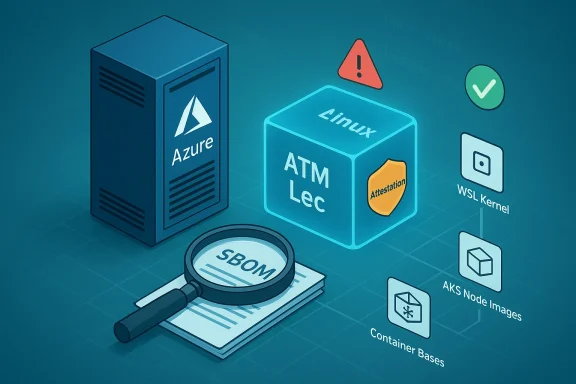
- If you run other Microsoft‑supplied artifacts (WSL kernels, Azure Marketplace VM base images, AKS node images, Microsoft‑published container base images, telemetry/agent binaries, or partner Marketplace appliances hosted via Microsoft channels), do not assume they are safe simply because MSRC did not mention them. Verify them by inventory, SBOM/image scanning, or by waiting for Microsoft’s VEX/CSAF attestation for those specific artifacts.
Why other Microsoft products could be carriers — the technical reality
The presence of vulnerable code is a build‑time property: it depends on the specific kernel source tree, the commit range, the kernel configuration, and vendor backports. Microsoft builds and publishes multiple Linux artifacts and kernels across its product set:- WSL2 kernel: Microsoft distributes a compiled WSL2 kernel binary; if that kernel build used a vulnerable upstream tree (and the bug path was compiled in), WSL hosts could be carriers until Microsoft releases an updated WSL kernel binary.
- Azure VM/Marketplace images and AKS node images: Microsoft publishes curated VM images and sometimes provides Azure‑tuned kernel builds. Marketplace images may be built from third‑party distributions or Microsoft‑tuned kernels; either artifact class may include the vulnerable code if their kernel commits/configs include it.
- Container base images: Microsoft‑published container images built from Azure Linux or CBL‑Mariner bases propagate packages in the base layer; a vulnerable kernel in the base image or a vulnerable user‑space package in the base image can propagate to derived containers.
- Binaries built with vendored code: if Microsoft or partner‑supplied binaries static‑link or vendor in userland code that references affected components, simply updating the host kernel or package may not remediate those binaries — a rebuild is required.
How to verify whether a given Microsoft artifact is affected (practical checks)
Below are practical, prioritized verification steps for operators and defenders. Use them to convert “potentially affected” into a definitive yes/no for each artifact.- Inventory first — find every Microsoft‑supplied image, host, or artifact you run.
- Check Azure Marketplace images, created VM templates, AKS node images, and hosted build images.
- Locate any WSL installations in endpoint fleets where the default Microsoft kernel is used.
- Check kernel release and patch level (hosts and images).
- Run uname -r and compare the release to the fixed stable kernel lines or distribution advisories.
- If you can, check the exact build tag or commit embedded in the kernel (dmesg at boot sometimes prints a build tag).
- Inspect kernel config and modules for ATM support.
- zgrep -i atm /boot/config-$(uname -r) or grep CONFIG_ATM /proc/config.gz (if available) to confirm whether the ATM/lec interfaces were compiled in.
- Search /lib/modules/$(uname -r) for atm‑related modules. If the ATM code is not built or present, exposure is unlikely.
- Use image and SBOM scanning for packaged kernels and container base images.
- Scan ACR (Azure Container Registry) images and Marketplace image manifests for known vulnerable kernel packages or for vendor kernel packages that match the distribution advisory list.
- If you have SBOMs for images or VMs, search for kernel package names and versions that map to the CVE.
- For WSL: check the WSL kernel binary version shipped by Windows.
- Confirm whether your Windows hosts are running the default Microsoft WSL kernel and whether an updated WSL kernel release has been posted by Microsoft that includes the upstream fix. If you run a custom WSL kernel, rebuild from patched sources.
- If you find a suspicious kernel/package, escalate to the vendor (Microsoft or the distro vendor) for an explicit VEX/CSAF mapping or a patched artifact if the vendor hasn’t published one yet.
Immediate remediation priorities (triage and mitigation)
- Priority 1 — Azure Linux images: If you run Azure Linux images, patch them immediately according to Microsoft’s guidance. Microsoft’s attestation makes these images a confirmed remediation target. Do not defer Azure Linux patching based on the assumption that “Microsoft will handle it later.”
- Priority 2 — Multi‑tenant and shared hosts: For hosts that accept untrusted tenant code (multi‑tenant VMs, container hosts, CI runners), accelerate kernel updates or, if immediate patching is impossible, isolate and reduce local access to those systems. The vulnerability is local but on shared hosts the attacker model is stronger.
- Priority 3 — WSL endpoints: If WSL2 on endpoints uses the Microsoft‑provided kernel, check for WSL kernel updates and plan rollout; for high‑value endpoints, consider restricting WSL usage until patched.
- Priority 4 — Image rebuilds: Rebuild containers and appliance images that were created from Microsoft‑provided base images if those bases contained the vulnerable kernel or userland package; updates to the base image do not retroactively fix existing derived images.
- Harden local access controls and isolate untrusted tenants.
- Enforce stricter sandboxing (seccomp, user namespaces) for workloads that could attempt to exercise local kernel interfaces.
- Monitor kernel logs and OOPS traces for repeated patterns indicative of attempted exploitation.
Operational recommendations: policies and automation
- Adopt SBOM‑first image management: require SBOMs for every base image and VM image you accept from Microsoft or partners. Use SBOMs to automate CVE mapping and triage.
- Enable image‑scanning gates in CI/CD pipelines so base images containing unpatched kernel packages or vulnerable userland packages are rejected prior to deployment.
- Subscribe to MSRC’s CSAF/VEX feeds and vendor advisories. Use VEX where available to automate “this product is in‑scope / not‑in‑scope / fixed” decisions for attested products like Azure Linux; for un‑attested artifacts, rely on your own image scans and SBOMs. Microsoft has documented that it started publishing CSAF/VEX in October 2025 and will expand attestations over time.
- Maintain a policy for rebuilding statically linked binaries: if an application vendor ships a binary compiled with vulnerable libraries packaged inside, patching the OS is insufficient — rebuild the binary with fixed sources or request a vendor rebuild.
Risk assessment and real‑world likelihood
CVE‑2025‑38180 is classified as a local‑vector, high‑impact bug (UAF in kernel device handling). In isolation, the need for local access reduces mass exploitation risk. However, real‑world risk amplifies in environments where:- Tenants or untrusted workloads can run code on the same host (public cloud hypervisor guests, container multi‑tenant nodes).
- The vulnerable kernel is present in widely distributed image templates, Marketplace images, or base container images, which multiplies potential exposure vectors.
What to watch for from Microsoft (and from vendors)
- Watch for new VEX/CSAF attestations from MSRC that expand the product mapping beyond Azure Linux. Microsoft has committed to updating CVE mappings when additional products are discovered to carry the same component; when MSRC publishes an updated VEX mapping for extra artifacts, treat that as authoritative for those artifacts.
- Watch distribution advisories (Debian/Ubuntu, Red Hat, SUSE, Amazon, Oracle) for fixed kernel package releases and map those package names/versions into your inventory. Multiple vendor advisories will likely list fixed kernel package names and CVE mappings that help you target upgrades.
- If you rely on third‑party Marketplace images or partner appliances, require SBOMs, or insist on vendor attestations that their images were rebuilt against patched bases.
Conclusion — a practical, defensible stance
Microsoft’s MSRC statement that Azure Linux includes the implicated open‑source component and is therefore potentially affected is a precise attestation for Azure Linux and a clear call to action for any customers running Azure Linux images. That attestation does not equate to an exclusive claim that only Azure Linux could be a carrier; other Microsoft artifacts that ship or run Linux kernels or that embed Linux userland packages can also include the same upstream code depending on their build inputs and kernel configurations.Practical guidance you can apply today:
- Patch Azure Linux images immediately.
- Inventory and scan every Microsoft‑supplied image or artifact you run (WSL kernels, Marketplace VM images, AKS nodes, container base images).
- Rebuild container images and statically linked binaries where the vulnerable code was vendor‑embedded.
- Subscribe to MSRC’s CSAF/VEX feed and vendor advisories; use SBOMs and image‑scanning to automate the long tail of verification across many artifacts.
Source: MSRC Security Update Guide - Microsoft Security Response Center
