

Microsoft’s brief MSRC attestation that “Azure Linux includes this open‑source library and is therefore potentially affected” is accurate for the Azure Linux product family, but it is not a technical proof that no other Microsoft product or image could carry the same vulnerable Linux kernel code.
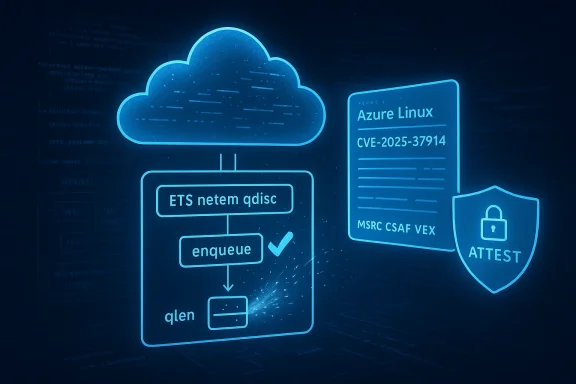
CVE‑2025‑37914 is a Linux kernel networking scheduler bug in the Enhanced Transmission Selection (ets) qdisc that was disclosed and fixed upstream in May 2025. The flaw appears when a netem child qdisc can cause the parent qdisc’s enqueue callback to become reentrant, which in the ets implementation allowed the same classifier or class structure to be added twice to an internal linked list. That double list‑add can produce memory corruption within the kernel’s traffic‑control path.
Multiple downstream vendors incorporated the upstream fixes and published advisories showing the vulnerability was broadly tracked in distribution kernels — Red Hat, SUSE, Amazon Linux and other enterprise vendors rolled patches or guidance into their kernel updates. The issue has been scored in the CVE registries and assigned an importance rating consistent with memory‑corruption risks in the networking stack.
Two important operational facts embedded in Microsoft’s approach:
Why this matters practically:
However, the attestation is limited by scope: it is a product‑level inventory statement. It does not — and cannot logically — prove the non‑presence of the same upstream code across the huge variety of Microsoft‑distributed kernel artifacts without explicit additional attestations or per‑artifact metadata. For operational security teams, the practical consequence is simple and immutable:
In short: Azure Linux is the only Microsoft product publicly attested so far to include the vulnerable kernel component tied to CVE‑2025‑37914 — and that attestation is authoritative for Azure Linux — but you should not assume exclusivity. Verify other Microsoft kernel artifacts in your environment (WSL kernels, linux‑azure builds, Marketplace/AKS images), patch promptly where necessary, and use Microsoft’s CSAF/VEX feed plus your distributors’ advisories to automate future triage.
Source: MSRC Security Update Guide - Microsoft Security Response Center
 Background
CVE‑2025‑37914 is a Linux kernel networking scheduler bug in the Enhanced Transmission Selection (ets) qdisc that was disclosed and fixed upstream in May 2025. The flaw appears when a netem child qdisc can cause the parent qdisc’s enqueue callback to become reentrant, which in the ets implementation allowed the same classifier or class structure to be added twice to an internal linked list. That double list‑add can produce memory corruption within the kernel’s traffic‑control path.Multiple downstream vendors incorporated the upstream fixes and published advisories showing the vulnerability was broadly tracked in distribution kernels — Red Hat, SUSE, Amazon Linux and other enterprise vendors rolled patches or guidance into their kernel updates. The issue has been scored in the CVE registries and assigned an importance rating consistent with memory‑corruption risks in the networking stack.
What the bug actually does
- The bug is not a classical use‑after‑free in the ets path; rather, the root defect is list corruption from adding the same list node twice when a reentrant enqueue path does not detect the element is already present.
- The upstream fix adds an idempotency check (cl_is_active or equivalent) before adding a class to the active list, on top of the existing qlen checks, to make the code robust in reentrant scenarios.
Microsoft’s public wording and what it means
Microsoft’s MSRC entry for the CVE (the advisory text you quoted) states in effect: “We checked Azure Linux and it ships the implicated upstream code; therefore Azure Linux is potentially affected and we will update CVE records if other Microsoft products are later found to include the same code.” This language is a product‑scoped inventory attestation, not a categorical statement that no other Microsoft product ships the same code.Two important operational facts embedded in Microsoft’s approach:
- Microsoft began publishing machine‑readable CSAF/VEX attestations for third‑party CVEs in October 2025 and is using that process to declare, per product or artifact, whether components are present, affected, fixed, or not present. That process improves automation and clarity for customers but isdescription, iterative — starting with Azure Linux and expanding over time.
- When MSRC says a single product “includes the library,” that is an authoritative confirmation for that product family — it is the correct, actionable signal for Azure Linux operators — but it does not eliminate the need to check other Microsoft‑distribus.
Is Azure Linux the only Microsoft product that could be affected?
Short answer: No — not necessarily. Azure Linux is the only Microsoft product Microsoft has publicly attested (so far) to include the specific upstream component tied to CVE‑2025‑37914, but that attestation is not an exclusivity guarantee. Other Microsoft artifacts that ship or distribute Linux kernel binaries could also carry the same vulnerable code depending on kernel version, configuration and the exact commits included at build time.Why this matters practically:
- Large vendors ship many independent kernel artifacts. The same upstream file or driver can be present in some artifacts and not in others depending on:
- Kernel version and commit range used for the build.
- Kernel configuration flags (which subsystems and qdiscs are enabled).
- Whether a particular downstream image includes that subsystem as a module or built‑in.
- Microsoft maintains several Linux‑kernel surfaces beyond Azure Linux:
- Linux kernels used by Azure VM images and “linux‑azure” / Azure‑tuned kernel builds (these are distinct artifacts often packaged for cloud VM SKUs).
- WSL2 (Windows Subsystem for Linux) — Microsoft ships and publishes the WSL2 kernel source and builds kernel binaries for WSL customers; that kernel is maintained and updated separately. If a WSL kernel build used in a Windows installation contains the vulnerable kernel code, that WSL instance could be affected until patched.
- Azure Marketplace images, managed images, and AKS node images — many images include kernels from different sources (vendor kernels, Azure‑tuned kernels); if an image uses a kernel version predating the fix, it may be in‑scope.
- Microsoft’s public VEX/CSAF roll‑out intentionally started with Azure Linux; absence of an attestation for other Microsoft artifacts is absence of attestation, not proof those artifacts are clean. Microsoft has stated it will update CVE records if further impact is found.
Technical verification and how to check your Microsoft‑supplied artifacts
If you operate Windows/WSL, Azure VMs, AKS nodes, or any Microsoft‑distributed images, you should verify whether the kernel you run includes the fix for CVE‑2025‑37914. Here is a practical, prioritized checklist to do that verification.1. Confirm the authoritative Microsoft attestation for Azure Linux
- If you run Azure Linux images, treat Microsoft’s VEX/CSAF attestation as authoritative for those images and apply the vendor’s updates immediately. Microsoft’s advisory marks Azure Linux as a confirmed carrier and indicates remediation status via their VEX artifacts.
2. Check kernel versions in your environment
- On a Linux host (VM or instance): run uname -r to capture the kernel version.
- Compare that version to the vendor advisories (your distribution’s kernel advisory or Microsoft’s VEX if the artifact is Microsoft‑built). Many downstream advisories list the kernel versions or package releases that include the upstream fix; use those to determine whether your build predates the patch.
3. Verify WSL/WSL2 kernels
- Inside a WSL2 instance run uname -r and check the kernel version; WSL kernel updates are delivered separately and can be updated or rebuilt — Microsoft publishes the WSL2 kernel source and release notes for the shipped kernel. If your WSL kernel predates the fix, update via the supported WSL update channels or apply the patched binary Microsoft publishes.
4. For Azure VMs and Marketplace images
- Identify whether a VM is using a vendor kernel (Canonical, Red Hat, SUSE) or an Azure‑tuned kernel (linux‑azure). Check the image SKU and the kernel package installed (package names often include “azure” or vendor kernel identifiers). If the image uses a kernel version prior to the fix, schedule patching and a reboot.
5. If you need absolute proof of prest the kernel build metadata or installed kernel package changelog: many vendors include commit or changelog references showing the backport that fixed the issue. When Microsoft updates VEX/CSAF for an artifact, that file will indicate the affected/fixed state for that artifact; use that as a machine‑readable check.
6. If you cannot patch immediately — mitigate
- Reduce exposure: limit who can create or modify traffic‑control configuration on network‑facing hosts, and avoid enabling complex qdisc stacks that include ETS/netem in multi‑tenant or exposed environments until you can patch. Document and monitor for anomalous kernel oopses or list corruption logs (the kernel will often log “list_add double add” or similar diagnostics when this condition is hit).
Why Microsoft’s wording has been repeated across advisories — and why defenders should care
Multiple vendor notices about CVE‑2025‑37914 and sibling net_sched fixes show two patterns worth noting:- Vendors historically treat kernel subsystems as per‑artifact problems. A distributor confirms the presence of upstream source in the artifacts it ships and issues fixes for those artifacts. That is precisely what Microsoft did for Azure Linux: confirm presence, publish attestation, and commit to expand coverage.
- A single upstream commit can be present in numerous kernel branches and LTS trees; downstream maintainers (Red Hat, SUSE, Amazon, Oracle) adopt the patch by backporting into their supported kernel releases. That means operators using vendor kernels must check the vendor advisory for the exact kernel package versions rather than relying solely on generic CVE text.
Risk assessment and exploitability — practical view
- The vulnerability enables kernel memory corruption within the traffic control path. Memory corruption in the kernel is a serious class of bug; however, exploitability depends on many factors: whether the vulnerable qdisc is present and configured, whether an attacker can trigger the precise reentrant path from an untrusted context, and whether additional primitives exist to convert corruption into code execution or privilege escalation.
- At the time of disclosure there was no widely reported exploit or proof‑of‑concept for remote exploitation. Vendors scored the issue as important and assigned CVSS values aligned with local attack vector and required privileges. Nevertheless, the presence of kernel memory corruption in a network subsystem makes remediation a high priority for exposed hosts and multi‑tenant surfaces.
Actionable recommendations (concise)
- If you run Azure Linux: apply Microsoft’s or your image maintainer’s patch immediately and reboot the affected hosts, following the remediation guidance listed in the MSRC attestation.
- Inventory Microsoft‑supplied kernels in your estate: WSL2 instances, linux‑azure kernels on VMs, AKS node images, and Marketplace images. For each, capture the kernel version and cross‑reference against vendor advisories or Microsoft VEX outputs.
- Monitor kernel logs for list corruption diagnostics (e.g., “list_add double add”) and unusual kernel oopses relatehat telemetry to prioritize patching of hosts that show symptoms.
- Automate future checks: subscribe to Microsoft’s CSAF/VEX feed (now available and still being expanded) and to your distribution vendor’s security advisories so you receive machine‑readable attestation updates when Microsoft adds product mappings.
- If you are a service provider or run multi‑tenant workloads, assume high priority for patching and consider temporary mitigation (reducing permissions for traffic‑control operations) until you can reboot with a patched kernel.
Closing analysis: what Microsoft’s one‑line attestation succeeds at — and where it falls short for defenders
Microsoft’s short attestation delivers two cls Azure Linux customers definitively that the upstream component is present in Azure Linux builds and it commits Microsoft to expanding attestations via CSAF/VEX so defenders can automate impact decisions. That is a measurable step forward in transparency and automation relative to older, text‑only advisories.However, the attestation is limited by scope: it is a product‑level inventory statement. It does not — and cannot logically — prove the non‑presence of the same upstream code across the huge variety of Microsoft‑distributed kernel artifacts without explicit additional attestations or per‑artifact metadata. For operational security teams, the practical consequence is simple and immutable:
- Trust Microsoft’s attestation for the product it names (patch Azure Linux now).
- Do not interpret the absence of additional product attestations as proof other Microsoft artifacts are free of the issue; verify or require attestations for any Microsoft kernel artifact you rely on (WSL, linux‑azure, Marketplace images, AKS nodes).
In short: Azure Linux is the only Microsoft product publicly attested so far to include the vulnerable kernel component tied to CVE‑2025‑37914 — and that attestation is authoritative for Azure Linux — but you should not assume exclusivity. Verify other Microsoft kernel artifacts in your environment (WSL kernels, linux‑azure builds, Marketplace/AKS images), patch promptly where necessary, and use Microsoft’s CSAF/VEX feed plus your distributors’ advisories to automate future triage.
Source: MSRC Security Update Guide - Microsoft Security Response Center
