

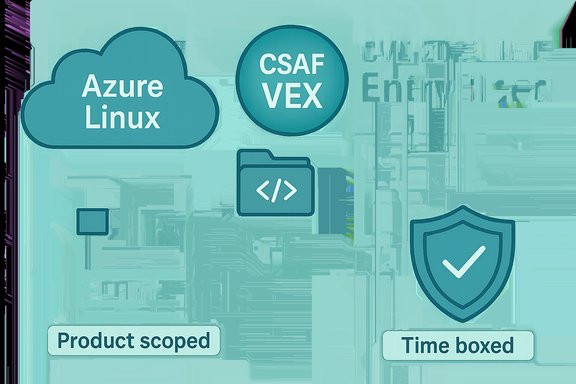
A short, plain statement from Microsoft’s Security Response Center — “Azure Linux includes this open‑source library and is therefore potentially affected” — has been interpreted by some as an admission that only Azure Linux is impacted by the Linux KPTI EntryBleed issue (CVE‑2022‑4543). That reading is too narrow. Microsoft’s wording is an authoritative, machine‑readable attestation that Azure Linux (the CBL‑Mariner / Azure Linux family and specific azl3 kernel builds) has been inventory‑checked and found to include the implicated upstream code, but it is not a technical guarantee that other Microsoft products cannot contain the same vulnerable kernel component. Microsoft has explicitly committed to update the CVE/VEX mapping if additional Microsoft products are identified as carriers — which, by design, means the attestation is product‑scoped and time‑boxed, not global or exhaustive.
CVE‑2022‑4543 (EntryBleed) is a Linux kernel KPTI‑related information disclosure: on vulnerable Intel systems a local attacker can use prefetch‑style side channels that exploit TLB timing differences to leak the kernel address space layout (KASLR) base. The vulnerability was publicly described in late 2022 and assigned the CVE entry in January 2023; vendor and distribution trackers have since classified and tracked the issue and published fixes and mitigations. Technical summaries from NVD, Debian and community posts all describe the same root cause — a KPTI mapping interaction that leaves a predictable kernel virtual address reachable to side channels. Microsoft’s public handling of this and similar upstream kernel CVEs has followed a new, phased model: the company publishes machine‑readable CSAF/VEX attestations that map which Microsoft products include a particular upstream component. That rollout began with Azure Linux, and for CVE‑2022‑4543 Microsoft published a VEX/CSAF attestation naming Azure Linux and its CBL‑Mariner lineage (and listing particular azl3 kernel builds) as products that include the upstream code and are therefore potentially affected. The attestation is actionable for Azure Linux customers — it provides a deterministic “known affected” signal — but it does not, by itself, say other Microsoft artifacts have been checked and found clean.
Long answer: Azure Linux is the only Microsoft product Microsoft has publicly attested (via CSAF/VEX) as including the vulnerable upstream component for this CVE at the time of the MSRC entry, but that attestation is product‑scoped and phased; other Microsoft artifacts that ship Linux kernels — notably WSL2 kernels, linux‑azure builds used in some VM images, Marketplace appliance images, AKS node images, and any Microsoft‑published kernel packages — may also include the vulnerable code depending on how those kernels were built. Microsoft has pledged to update VEX/CSAF and the CVE record if more Microsoft SKUs are discovered to be carriers. This distinction is important. A single VEX attestation reduces uncertainty for Azure Linux customers and enables automation, but it cannot be used to assert global absence across a multi‑artifact vendor footprint.
Source: MSRC Security Update Guide - Microsoft Security Response Center
 Background / Overview
CVE‑2022‑4543 (EntryBleed) is a Linux kernel KPTI‑related information disclosure: on vulnerable Intel systems a local attacker can use prefetch‑style side channels that exploit TLB timing differences to leak the kernel address space layout (KASLR) base. The vulnerability was publicly described in late 2022 and assigned the CVE entry in January 2023; vendor and distribution trackers have since classified and tracked the issue and published fixes and mitigations. Technical summaries from NVD, Debian and community posts all describe the same root cause — a KPTI mapping interaction that leaves a predictable kernel virtual address reachable to side channels. Microsoft’s public handling of this and similar upstream kernel CVEs has followed a new, phased model: the company publishes machine‑readable CSAF/VEX attestations that map which Microsoft products include a particular upstream component. That rollout began with Azure Linux, and for CVE‑2022‑4543 Microsoft published a VEX/CSAF attestation naming Azure Linux and its CBL‑Mariner lineage (and listing particular azl3 kernel builds) as products that include the upstream code and are therefore potentially affected. The attestation is actionable for Azure Linux customers — it provides a deterministic “known affected” signal — but it does not, by itself, say other Microsoft artifacts have been checked and found clean. What Microsoft actually published — and why wording matters
The literal content of Microsoft’s attestation
Microsoft’s CSAF/VEX artifact for CVE‑2022‑4543 explicitly maps the vulnerability to Azure Linux product entries (Azure Linux 3.0 and CBL‑Mariner 1.0/2.0 and particular azl3 kernel builds are listed in the VEX product tree). The VEX file is machine‑readable and intended to enable automation in enterprise VM/patch management systems. This is a precise inventory statement: Microsoft inspected these Azure Linux images and found the upstream code referenced by the CVE.Why that does not equal “only Azure Linux is affected”
- A vendor‑published attestation documents the result of a targeted inventory exercise. It tells you what the vendor has validated so far — nothing more.
- Large vendors ship many separate artifacts (VM images, kernels, managed node images, WSL kernels, Marketplace appliances). Whether any particular artifact includes a given upstream kernel file depends on per‑artifact build choices: kernel version, compile‑time CONFIG_* flags, modularization vs built‑in drivers, and backporting choices.
- Because product inclusion is an artifact‑level property, absence of a VEX attestation for product B is not proof product B is unaffected — it can only mean Microsoft has not yet attested product B. Microsoft’s public promise to update the CVE/VEX record if additional products are found to ship the component reinforces that interpretation.
Technical summary of CVE‑2022‑4543 (EntryBleed)
What EntryBleed is, in plain terms
- Component: Linux kernel Page Table Isolation (KPTI) implementation on x86/Intel.
- Impact: Local information disclosure (KASLR base leak) via a prefetch‑style side channel that uses TLB timing differences.
- Exploit model: Local attacker with ability to run native code on the host (not remote, not network wormable). The attack forces kernel entries into the TLB and uses prefetch timing to deduce kernel base addresses.
- Severity: Generally scored as medium in mainstream trackers (CVSS 3.x around 5.5), because the vector is local and the exploit is informational rather than code‑execution. Multiple vendors and trackers document the bug and the fact a reliable PoC exists.
Why leaking KASLR matters
KASLR raises the difficulty for local privilege escalation or kernel exploitation by randomizing kernel base addresses. If an attacker can reliably determine those addresses, subsequent exploitation (e.g., return‑oriented programming or kernel memory corruption attacks) becomes easier. Thus, KASLR leakage is a meaningful escalation of attacker capabilities on compromised or shared systems.Is Azure Linux the only Microsoft product that includes the library and is therefore potentially affected?
Short, direct answer: No — not necessarily.Long answer: Azure Linux is the only Microsoft product Microsoft has publicly attested (via CSAF/VEX) as including the vulnerable upstream component for this CVE at the time of the MSRC entry, but that attestation is product‑scoped and phased; other Microsoft artifacts that ship Linux kernels — notably WSL2 kernels, linux‑azure builds used in some VM images, Marketplace appliance images, AKS node images, and any Microsoft‑published kernel packages — may also include the vulnerable code depending on how those kernels were built. Microsoft has pledged to update VEX/CSAF and the CVE record if more Microsoft SKUs are discovered to be carriers. This distinction is important. A single VEX attestation reduces uncertainty for Azure Linux customers and enables automation, but it cannot be used to assert global absence across a multi‑artifact vendor footprint.
Cross‑checking and verification: what independent sources say
Key claims in Microsoft’s messaging were cross‑checked against independent trackers and upstream material:- The vulnerability description and exploitability are consistent with NVD and multiple vendor trackers: NVD lists EntryBleed and summarizes the KPTI/TLB prefetch side‑channel KASLR leak.
- Distribution security trackers (Debian security tracker, Debian/Ubuntu advisories) and community posts have cataloged the same issue, listed affected kernel versions and tracked fixes and backports. These distro advisories are practical sources for whether a given packaged kernel includes the fix.
- Community security mailing list posts and independent writeups (EntryBleed PoC writeups and technical analyses) document the exploitation technique and show PoC code was circulated; these corroborate the black‑box description in vendor CVE entries.
Which Microsoft products should you check (concrete list)
- Azure Linux (attested) — highest priority; Microsoft’s VEX lists specific azl3 kernel builds and the CBL‑Mariner lineage. Act immediately if you run these images.
- Windows Subsystem for Linux (WSL / WSL2) — WSL2 uses a Microsoft‑built Linux kernel binary and published source; if the WSL kernel version/configuration used by hosts predates the fix and was built with the vulnerable KPTI code path, WSL instances on affected Windows hosts could be impacted. Verify WSL kernel version and update via WSL update mechanisms.
- linux‑azure / Azure‑tuned kernels — some Azure VM images use Azure‑tuned kernels; those builds are separate artifacts and must be verified for the particular kernel versions in use.
- Marketplace VM images / partner appliances — third‑party images hosted in the Azure Marketplace may include their own kernel builds. These can be vulnerable if their kernel contains the upstream code and lacks the backport.
- AKS node images / managed images — managed Kubernetes node pools may run curated images; check the node image kernel builds and patch cycle.
- Microsoft‑published container base images that include a kernel (rare) — most containers don’t include a kernel, but any Microsoft artifact that bundles a kernel binary should be verified.
- Internal or partner artifacts distributed by Microsoft — Microsoft’s attestation process is phased; any artifact not listed in the VEX file should be treated as untested until verified.
How to verify whether a specific host or image is affected (practical steps)
- Identify the kernel build and vendor metadata:
- uname -a
- cat /proc/version
- For packaged systems: check package manager kernel package names and changelogs (dpkg/rpm).
- Check kernel configuration where available:
- If /proc/config.gz exists: zcat /proc/config.gz | grep -i pti
- If you have kernel source or .config: search for KPTI, CONFIG_PAGE_TABLE_ISOLATION or related flags.
- For WSL2: inside your WSL shell run uname -r and compare to Microsoft WSL release notes; use wsl --update to fetch WSL kernel updates.
- Map the kernel version to vendor advisories and upstream commits:
- Consult distribution advisories (Ubuntu, Debian, SUSE, RHEL) and the NVD to see whether your packaged kernel release includes the upstream fix.
- If you maintain custom kernels: compare your tree against the upstream commits that fixed EntryBleed (use the kernel commit IDs referenced in distro changelogs and NVD).
- uname -a
- cat /proc/version
- zcat /proc/config.gz | grep -i pti
- lsmod | grep -i pti (rare; KPTI is often built‑in rather than a module)
Recommended remediation and prioritization checklist
- Patch Azure Linux images first: apply Microsoft’s azl3 kernel updates or deploy updated Azure Linux images. Microsoft’s VEX attestation makes Azure Linux the highest‑priority Microsoft product to remediate.
- Patch distro kernels on Azure VMs that run non‑Azure‑Linux distributions (Ubuntu, RHEL, SUSE): apply the vendor kernel updates published in the distro advisories. These vendors mapped the same upstream fixes into their packages.
- Verify and update WSL2 kernels on Windows hosts where developers run untrusted code or CI jobs that could exercise low‑privilege kernel interfaces.
- For managed services (AKS node pools, VM scale sets): coordinate rolling node replacements after images are patched.
- Temporary mitigations:
- Avoid running untrusted local code on critical hosts.
- Restrict local user access and container runtime privileges.
- If you cannot patch immediately, minimize ability for local unprivileged attackers to execute native code (application sandboxing, container isolation).
- Automate VEX/CSAF ingestion: if you operate at scale, feed Microsoft’s CSAF/VEX outputs into your VM/patch orchestration so that product‑scoped attestations automatically influence prioritization.
Strengths and risks of Microsoft’s approach
Notable strengths
- Actionable automation: Publishing VEX/CSAF for Azure Linux gives defenders a machine‑readable, vendor‑backed signal to prioritize remediation and reduce noisy false positives from generic NVD hits. This materially improves enterprise triage efficiency.
- Transparency commitment: Microsoft’s public commitment to expand attestations as additional products are discovered is a procedural improvement in supply‑chain transparency; it creates an auditable trail of product‑level inventory work.
Residual risks and weak points
- Inventory completeness: A phased rollout necessarily leaves a window where many artifacts remain un‑attested. Absence of an attestation is not evidence of absence — customers must not conflate “not attested” with “not vulnerable.”
- Artifact divergence: Microsoft (like other large vendors) ships many kernel artifacts; those artifacts can diverge in configuration and version. Product‑level attestation for Azure Linux is valuable, but customers must still verify WSL, Marketplace images, and managed node images.
- Operational complexity: For hybrid Windows/Linux estates, responsibility for patching may be split among Microsoft (for Azure Linux, WSL kernels) and third‑party distro vendors (for Ubuntu, RHEL, SUSE images). Coordination is required to avoid gaps.
What could not be independently verified (and where to be cautious)
- Microsoft’s VEX/CSAF file explicitly lists the Azure Linux product tree and particular azl3 kernel builds; that is verifiable (MSRC VEX JSON). However, the absence of a VEX entry for a specific Microsoft SKU (for example an internal Marketplace appliance or a particular AKS node image) does not mean that SKU is unaffected — it only means Microsoft has not published an attestation for it yet. That is a procedural caution, not a factual contradiction. Customers should treat any Microsoft artifact that includes a kernel — or any image whose provenance is unclear — as a candidate for host‑level verification until the VEX feed or vendor advisories confirm otherwise.
Conclusion — what WindowsForum readers should take away
Microsoft’s statement that “Azure Linux includes this open‑source library and is therefore potentially affected” is valuable and correct for the Azure Linux product family — it is a vendor‑backed, machine‑readable attestation intended to help customers automate triage and remediation. However, it is not a blanket declaration that no other Microsoft product can include the vulnerable kernel code. The safe, defensible operational posture is:- Treat Azure Linux as confirmed in‑scope and patch it immediately per Microsoft guidance.
- Inventory and verify all other Microsoft‑distributed Linux artifacts you run (WSL2 kernels, linux‑azure/azure‑tuned kernels, Marketplace images, AKS nodes), and patch or redeploy as needed.
- Ingest Microsoft’s CSAF/VEX feeds into your vulnerability orchestration and corroborate vendor attestations with independent distro advisories, NVD, and upstream commit data to confirm fixes.
Source: MSRC Security Update Guide - Microsoft Security Response Center
