

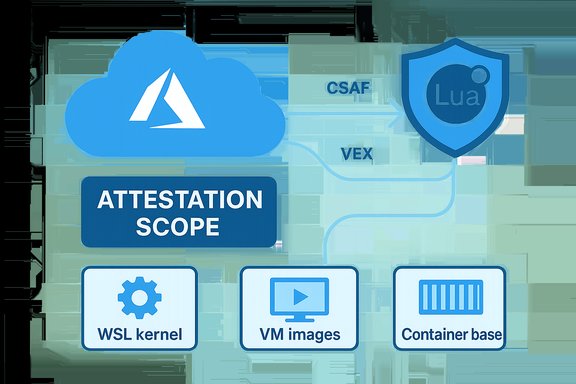
Microsoft’s short advisory that “Azure Linux includes this open‑source library and is therefore potentially affected” is accurate — but it is a product‑scoped attestation, not proof that no other Microsoft product can include the same vulnerable Lua runtime.
The vulnerability tracked as CVE‑2021‑44964 is a use‑after‑free in the Lua interpreter’s garbage collector and finalizer code (file lgc.c) that affects Lua 5.4.0 through 5.4.3. The defect allows a crafted Lua script to trigger a lifetime error in the interpreter and, in certain contexts, to escape the interpreter’s sandbox — potentially permitting code or data access beyond what the embedding application intended. The CVE entry and multiple downstream advisories describe the technical root cause and the affected upstream versions. Microsoft’s public messaging on this CVE and several similar third‑party CVEs follows a deliberate, phased model: the company has started publishing machine‑readable CSAF/VEX attestations beginning with the Azure Linux distribution, and for the CVE in question Microsoft’s update guide page notes Azure Linux as a product that “includes this open‑source library and is therefore potentially affected.” That statement reflects inventory work performed for the Azure Linux artifacts, and Microsoft has committed to update their VEX/CSAF entries if additional Microsoft products are later identified as carriers of the same upstream component.
This operational reality matters for defenders: do not assume a Microsoft‑supplied image or artifact is safe simply because Microsoft’s initial VEX release named only Azure Linux. Treat it as the only confirmed Microsoft product in scope, and verify other Microsoft artifacts you run or depend on.
However, that statement is not a categorical declaration that Azure Linux is the only Microsoft product that could include the vulnerable Lua runtime. The attestation reflects the scope of Microsoft’s completed inventory work; other Microsoft images and artifacts may still carry the component until they are individually checked or attested. Defenders should therefore prioritize patching Azure Linux, inventory any other Microsoft‑provided artifacts in their environment, request SBOM/VEX attestations for opaque Marketplace or vendor images, and apply mitigations (disable or restrict scripting, isolate workloads) until the presence or absence of the vulnerable Lua runtime can be verified. The new machine‑readable VEX/CSAF outputs are a practical step toward automation and clarity; they make it easier for security teams to triage affected artifacts. But effective defense will still depend on per‑artifact verification and good supply‑chain hygiene: inventory, confirm, patch, and, where necessary, contain.
Source: MSRC Security Update Guide - Microsoft Security Response Center
 Background
The vulnerability tracked as CVE‑2021‑44964 is a use‑after‑free in the Lua interpreter’s garbage collector and finalizer code (file lgc.c) that affects Lua 5.4.0 through 5.4.3. The defect allows a crafted Lua script to trigger a lifetime error in the interpreter and, in certain contexts, to escape the interpreter’s sandbox — potentially permitting code or data access beyond what the embedding application intended. The CVE entry and multiple downstream advisories describe the technical root cause and the affected upstream versions. Microsoft’s public messaging on this CVE and several similar third‑party CVEs follows a deliberate, phased model: the company has started publishing machine‑readable CSAF/VEX attestations beginning with the Azure Linux distribution, and for the CVE in question Microsoft’s update guide page notes Azure Linux as a product that “includes this open‑source library and is therefore potentially affected.” That statement reflects inventory work performed for the Azure Linux artifacts, and Microsoft has committed to update their VEX/CSAF entries if additional Microsoft products are later identified as carriers of the same upstream component. What the CVE actually is (technical overview)
- Vulnerable component: Lua interpreter (versions 5.4.0 — 5.4.3).
- Vulnerability class: Use‑after‑free in the garbage collector / finalizer path (lgc.c).
- Attack vector: Requires the target application to execute a crafted Lua script file; the exploit leverages GC/finalizer interactions to dereference freed memory or corrupt interpreter internal lists.
- Impact: Sandbox escape is the primary concern — upstream and distribution advisories treat this as a medium/important integrity/availability risk depending on embedding context.
Microsoft’s public wording: what it says and what it doesn’t
Microsoft’s phrase — “Azure Linux includes this open‑source library and is therefore potentially affected” — does three things:- It is an authoritative, product‑level attestation that Microsoft inspected the Azure Linux artifacts and found the implicated upstream component. Customers running Azure Linux should treat that attestation as a prompt to prioritize patching.
- It communicates Microsoft’s transparency program to publish CSAF/VEX attestations (machine‑readable, standardized statements about vulnerability exploitability), a rollout that began with Azure Linux in October 2025. That program is intended to expand to more Microsoft products over time.
- Crucially, it is not an exclusionary statement that “no other Microsoft product includes this component.” The absence of a VEX/CSAF attestation for another Microsoft SKU should be read as “not yet attested”, not as proof the SKU is unaffected. Microsoft explicitly said it will update the CVE/VEX records when additional products are discovered to ship the same upstream code.
Why that distinction matters (technical and supply‑chain reality)
Whether a given Microsoft artifact includes an upstream open‑source component is a per‑artifact, build‑time property.- Linux components (and userland libraries like Lua) can be compiled into a binary, built as an external shared object, or omitted entirely depending on build configuration and packaging choices.
- Microsoft’s ecosystem includes many different Linux‑based artifacts and images: Azure Linux (the distribution), marketplace VM images, specialized kernel packages, WSL2 kernels, container base images used in managed services, and vendor appliances in the Marketplace. Any of those artifacts could, in principle, carry an embedded Lua runtime — but each must be checked individually.
Cross‑verification: what independent trackers show
To validate the technical facts and remediation status, independent sources should be used. The National Vulnerability Database and distribution trackers describe the CVE and the fixed versions; Debian and Ubuntu both list the vulnerable Lua package versions and the fixed versions that include the patch. These independently corroborate the upstream details about affected Lua releases and the remediation path (upgrade to Lua 5.4.4 or later). Cross‑checking the CVE details in multiple trackers reduces the risk of relying on a single vendor’s mapping and clarifies where backports versus straight upgrades are required for particular distributions or appliance builds.Is Azure Linux the only Microsoft product that includes Lua and is affected?
Short answer: No — Azure Linux is the only Microsoft product Microsoft has publicly attested to include the vulnerable library so far, but that attestation is limited in scope and does not prove exclusivity. In other words, Microsoft confirmed Azure Linux as a carrier for the implicated upstream code, and promised to update attestations if other products are found to carry the same component. Absence of a public attestation for a product ≠ proof that product is not affected.This operational reality matters for defenders: do not assume a Microsoft‑supplied image or artifact is safe simply because Microsoft’s initial VEX release named only Azure Linux. Treat it as the only confirmed Microsoft product in scope, and verify other Microsoft artifacts you run or depend on.
How administrative teams should approach verification (practical checklist)
The following steps let administrators, platform owners, and security teams validate whether a specific Microsoft artifact they run includes the vulnerable Lua runtime and therefore needs remediation:- Inventory your artifacts.
- Make an explicit list of all Microsoft‑supplied images and packages in use: Azure Marketplace VM images, WSL2 instances, management/monitoring appliances, AKS/VM images, and any Microsoft‑provided container base layers.
- Check vendor attestations and SBOM/VEX feeds.
- Consult Microsoft’s CSAF/VEX feed and the product‑specific attestations the company has published. Microsoft’s VEX rollout started with Azure Linux and will expand; if you need a definitive answer for another Microsoft product, request the product’s VEX/CSAF or SBOM through official support channels.
- Inspect the runtime: identify the Lua binary or library.
- On live images, look for the Lua interpreter or shared library:
- Check packages: package manager queries (apt, rpm, yum) for lua, lua5.4, or liblua.
- Check filesystem for known Lua files: /usr/bin/lua, /usr/lib/liblua*.so, or statically linked binaries (strings /bin/yourapp | grep -i lua).
- If the artifact is a kernel or WSL2 kernel image, check the kernel config and modules to see if userland packaging was added to the image.
- For container images: examine image layers and package lists.
- Use local image inspection tools (docker history, skopeo/umoci, dive) to examine layers for package installs of Lua or static binaries. This is particularly important for Marketplace or community images that may bundle Lua inside an application.
- If you cannot confirm locally, ask the publisher.
- For Marketplace or vendor images, request an SBOM or VEX attestation from the publisher. Microsoft has committed to updating VEX/CSAF records as they expand their inventory, and third‑party image publishers should be able to supply equivalent documentation.
- If you find a vulnerable Lua runtime, remediate.
- Upgrade to a fixed Lua release (for example, 5.4.4 or newer) or apply vendor/backport patches per your distributor’s advisory. If immediate patching isn’t possible, implement containment: disable or restrict script execution in the embedding application, run the workload in a tighter sandbox or isolated VM, and apply principle of least privilege to accounts that can load/run scripts.
Recommended remediation and mitigation timeline
- Immediate (0–48 hours):
- Prioritize systems where untrusted users or remote inputs can reach Lua execution contexts (e.g., multi‑tenant services, hosted applications, CI runners).
- If the embedding application exposes script execution to untrusted users, either disable that feature or restrict it by ACLs and network controls.
- Short term (3–14 days):
- Inventory and patch Microsoft‑provided artifacts confirmed to carry the vulnerable Lua runtime (Azure Linux first by Microsoft’s attestation).
- Request SBOM/VEX attestations for other Microsoft images you run and validate.
- Medium term (2–8 weeks):
- Roll out upgrades or vendor backports across affected environments, test scripts and integrations against the patched Lua runtime, and update automation tooling to consume machine‑readable VEX/CSAF attestations as they become available.
Risk analysis: practical exploitability and real‑world considerations
- Exploit conditions: The vulnerability typically requires a crafted Lua script to be loaded and executed inside an embedding application. That means the attacker must be able to supply or influence the script content and the application must call into the vulnerable interpreter. Because of that precondition, the issue is commonly local or authenticated in nature rather than a broad unauthenticated remote RCE.
- Severity is embedding‑dependent: A sandbox escape in an application that runs as a privileged service or in a multi‑tenant environment becomes severe (possible data exposure or code execution); in other contexts it may only yield a denial‑of‑service crash. Distribution trackers and vendors rate severity by context, and CVSS values vary across trackers.
- Supply‑chain risk: Embedded Lua runtimes in appliances, proprietary binaries, and packaged vendor images may lag behind upstream fixes. Those invisible, third‑party carriers are the practical reason defenders must inventory and request SBOMs rather than rely solely on a single vendor’s attestation.
Strengths and limitations of Microsoft’s approach
Strengths:- Microsoft’s move to publish machine‑readable CSAF and VEX attestations (starting with Azure Linux) improves clarity and automation for defenders, enabling quicker triage and fewer false positives. The VEX approach explicitly enumerates Known Affected, Not Affected, Under Investigation, or Fixed per product, which is valuable for large customers.
- A product‑focused attestation is authoritative for the named product and helps customers prioritize remediation for those artifacts Microsoft has already checked.
- The initial rollout covering Azure Linux only leaves a window of ambiguity across Microsoft’s broader artifact set (WSL kernels, Marketplace appliances, other images). Absence of attestation is not evidence of non‑inclusion; defenders must still verify other artifacts they operate.
- A vendor attestation is only as good as the inventory scope it covers. Large vendors with diverse portfolios require time to perform per‑artifact checks; until that work is complete, defenders must assume unknowns could be in their estate.
Practical example: common Microsoft artifacts to check (non‑exhaustive)
- Azure Marketplace VM images (canonical and third‑party) — examine image package lists or request publisher SBOMs.
- WSL2 distributions and the WSL2 kernel shipped via Windows Update — check WSL kernel release notes and package lists for packaged userland components.
- AKS node images and curated container base images used in Microsoft managed services.
- Microsoft‑provided tooling appliance images and management VM images (for example, monitoring or backup appliances).
Each of these should be treated as a separate artifact: check, confirm, and remediate where necessary.
FAQ style clarifications (concise)
- Q: “If Microsoft named Azure Linux, can I assume Windows or WSL are safe?”
- A: No. Microsoft attested only the named product(s) it has checked. Other artifacts are not yet attested until Microsoft publishes a VEX for them or you independently verify.
- Q: “Does Microsoft promise to update the CVE if other products are affected?”
- A: Yes — Microsoft’s VEX/CSAF rollout statement commits to updating product mappings as more inventory is completed. That is a procedural commitment, not retroactive proof that every product has already been inspected.
- Q: “What’s the pragmatic immediate step?”
- A: Treat Azure Linux as confirmed in scope and patch; inventory other Microsoft artifacts you run and request SBOM/VEX attestations where you cannot self‑verify. If scripting is exposed to untrusted actors, restrict or disable it until patched.
Conclusion
Microsoft’s statement that Azure Linux includes the open‑source Lua library and is therefore potentially affected is a correct, authoritative product attestation: it tells customers precisely that Microsoft found the implicated upstream component in that product family and that Azure Linux customers should treat the CVE as in‑scope.However, that statement is not a categorical declaration that Azure Linux is the only Microsoft product that could include the vulnerable Lua runtime. The attestation reflects the scope of Microsoft’s completed inventory work; other Microsoft images and artifacts may still carry the component until they are individually checked or attested. Defenders should therefore prioritize patching Azure Linux, inventory any other Microsoft‑provided artifacts in their environment, request SBOM/VEX attestations for opaque Marketplace or vendor images, and apply mitigations (disable or restrict scripting, isolate workloads) until the presence or absence of the vulnerable Lua runtime can be verified. The new machine‑readable VEX/CSAF outputs are a practical step toward automation and clarity; they make it easier for security teams to triage affected artifacts. But effective defense will still depend on per‑artifact verification and good supply‑chain hygiene: inventory, confirm, patch, and, where necessary, contain.
Source: MSRC Security Update Guide - Microsoft Security Response Center
