

Microsoft’s public advisory naming Azure Linux as including the Undici library for CVE-2024-30260 is accurate — but it is a product-scoped attestation, not proof that Azure Linux is the sole Microsoft product that could possibly contain or be affected by the vulnerable code.
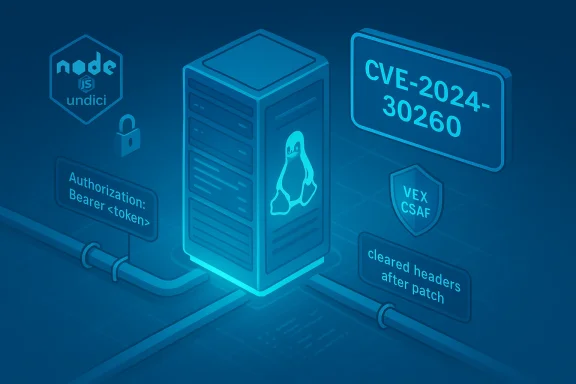
Undici is an open-source, high-performance HTTP/1.1 client library for Node.js that is widely used by server-side Node applications and, in some distros, packaged into Node runtime builds. The vulnerability tracked as CVE-2024-30260 arises because Undici cleared Authorization and Proxy-Authorization headers for the library’s fetch() implementation, but failed to do the same for other API surfaces (notably undici.request() and related dispatch/stream/pipeline calls). That omission could allow sensitive authorization headers to be forwarded to an unintended origin during a cross-origin redirect. The issue was fixed in undici v5.28.4 and v6.11.1.
The public severity assessments classify this as a low to moderate impact issue (CVSS ≈ 3.9), because exploitation requires specific conditions: the presence of sensitive headers on requests that produce cross-origin redirects, use of the vulnerable undici APIs rather than fetch(), and an attacker-controlled redirect target or intermediary. Nonetheless, the possibility of credential leakage is real enough that maintainers distributed patches and downstream packagers have issued updates.
Two separate but important points are conveyed by that sentence:
Source: MSRC Security Update Guide - Microsoft Security Response Center
 Background / Overview
Undici is an open-source, high-performance HTTP/1.1 client library for Node.js that is widely used by server-side Node applications and, in some distros, packaged into Node runtime builds. The vulnerability tracked as CVE-2024-30260 arises because Undici cleared Authorization and Proxy-Authorization headers for the library’s fetch() implementation, but failed to do the same for other API surfaces (notably undici.request() and related dispatch/stream/pipeline calls). That omission could allow sensitive authorization headers to be forwarded to an unintended origin during a cross-origin redirect. The issue was fixed in undici v5.28.4 and v6.11.1.The public severity assessments classify this as a low to moderate impact issue (CVSS ≈ 3.9), because exploitation requires specific conditions: the presence of sensitive headers on requests that produce cross-origin redirects, use of the vulnerable undici APIs rather than fetch(), and an attacker-controlled redirect target or intermediary. Nonetheless, the possibility of credential leakage is real enough that maintainers distributed patches and downstream packagers have issued updates.
What Microsoft actually said (and what that wording means)
Microsoft’s update guidance for the CVE explicitly states (in effect) that “Azure Linux includes this open-source library and is therefore potentially affected,” and notes Microsoft’s broader transparency work around publishing machine-readable CSAF/VEX attestations. Microsoft has also said it will update the CVE/VEX mapping if additional Microsoft products are identified as carriers of the same upstream component. That phrasing — short and deliberately scoped — is an attestation about the inventory work Microsoft has completed so far, not an exclusivity guarantee.Two separate but important points are conveyed by that sentence:
- It is an authoritative signal for Azure Linux customers: Microsoft inspected that distribution’s package set / runtime artifacts and found Undici in the versions mapped to the CVE. Users of Azure Linux should treat the attestation as a directive to remediate per Microsoft’s guidance or the distro’s updates. ([ten.tenable.com/cve/CVE-2024-30260/plugins)
- It is not a global statement that no other Microsoft product includes Undici. Microsoft’s VEX/CSAF rollout began with Azure Linux and will expand to other product families over time; absence of a VEX entry for a product equals “not yet verified,” not “not affected.”
Short answer to the user’s question
- Is Azure Linux the only Microsoft product that includes Undici and is therefore potentially affected by CVE-2024-30260?
- Factually: No — not necessarily. Azure Linux is the only Microsoft product Microsoft has publicly attested (so far) to include the Undici component for this CVE, but that attestation is scoped to Azure Linux and is not a technical proof that no other Microsoft artifact contains the vulnerable library. Treat Azure Linux’s VEX/CVE mapping as authoritative for Azure Linux only as of February 18, 2026.
- Operationally: Yes — for Azure Linux customers the MSRC entry is high-fidelity and actionable. If you run Azure Linux images, you should apply the available Node/Undici updates promptly.
Why the attestation-for-one-product model matters (technical reasoning)
Several practical reasons explain why Microsoft’s short line about Azure Linux should not be read as a global exclusivity claim:- Open-source components are reused widely and at many levels. Undici is an npm module / Node runtime component; any product that ships a Node runtime or bundles Node-based services can carry the module either directly or indirectly through packaged Node.js. The Undici project itself documents its usage as a packaged module for server-side Node applications.
- Microsoft publishes product-level attestations as Microsoft inventories artifacts per product family. The initial rollout focused on Azure Linux and related distro artifacts; Microsoft’s promise to expand VEX/CSAF means that attestations for other products will appear as Microsoft completes those inventory passes. In short: the attestation is a statement about what Microsoft has checked, not what itre.
- Microsoft manages multiple Linux-based images, kernels, and container stacks (Azure Marketplace images, AKS node images, linux-azure kernels, WSL kernels, CBL-Mariner derivatives, etc.). Whether any of those artifacts are carriers depends on build-time choices (which Node version, which packaged modules were installed, how images were produced). Absent a published VEX entry for each artifact, those remain unverified until scanned.
Practical impact scenarios and exploitation conditions
Understanding how an attacker could abuse CVE-2024-30260 helps prioritize remediations:- Typical vulnerable scenario:
- A server or service issues an outgoing request using undici.request() (or the vulnerable API surface) and includes an Authorization or Proxy-Authorization header.
- The request is responded to with a cross-origin redirect (3xx) to an attacker-controlled or third-party origin.
- Because the vulnerable API did not clear Proxy-Authorization (and Authorization in some call paths), the token or credentials may be forwarded to the redirect target, exposing them to an unintended party.
- Why that matters:
- Exposed credentials could be reused to perform further requests against resources that accept the leaked token.
- The vulnerability is less useful for unauthenticated remote code execution and more valuable for targeted credential leakage in systems that follow redirects and use the vulnerable APIs.
- Practical exploitable surface:
- Server-side Node applications, microservices, or schedulers that issue HTTP calls and follow redirects automatically.
- Systems deployed in multi-tenant or untrusted network contexts where redirect targets might be attacker-controlled.
Which Microsoft artifacts are likely to be in scope (and which are not)?
It is possible — but not proven in public advisories — that other Microsoft artifacts might include Undici. The following are plausible carriers you should check in your environment:- Azure Marketplace VM images and custom marketplace images that include Node packages.
- Azure App Service / Azure Functions runtimes and user-deployed function apps that bundle Node modules.
- AKS node images and container images published by Microsoft that include Node runtime or preinstalled packages.
- The Azure Linux distribution family (explicitly attested by Microsoft).
- Any Microsoft-maintained container images, build agents, or developer tooling that ship Node runtimes with extra modules.
Recommended steps for defenders and administrators
If you operate Microsoft-supplied images or Node-based services in your estate, adopt the following prioritized actions:- Immediate triage (fast, high impact)
- Inventory where Node and Undici are present. Check package.json, lockfiles, and container images for undici versions. If you run Azure Linux images, treat them as in-scope immediately because Microsoft has attested the presence there.
- For any artifact that bundles undici in an affected version (v < 5.28.4, v >= 6.0.0 and < 6.11.1), plan an update to 5.28.4 or 6.11.1 (or later stable releases).
- Remediation (technical)
- Update the undici dependency in your application stacks or rebuild images that include a vulnerable undici.
- Where undici is provided by an OS package (for example: distro packages in Azure Linux, CBL-Mariner, Debian, Ubuntu, Fedora), install the vendor-supplied package updates from your distro vendor. Nessus and other scanners have already added detection plugins tied to distro updates.
- Mitigations (short-term)
- Where updating is not immediately possible, evaluate whether your code uses undici.request() (or dispatch/stream/pipeline) with Authorization/Proxy-Authorization headers and either avoid sending those headers or switch to the fetch() API (which, per the advisory, handled header clearance correctly) until you can patch.
- Disable automatic redirect-following in code paths that include sensitive headers where feasible, or implement manual redirect handling with explicit header removal.
- Long-term controls
- Integrate SBOM and VEX/CSAF processing into your supply chain tooling so you can automatically map new VEX attestations Microsoft publishes to the artifacts you run. Microsoft’s move to machine-readable CSAF/VEX is explicitly intended to enable this automation.
- Monitor Microsoft’s VEX/CSAF feed and vendor advisories for updates about additional product mappings.
Evidence and verification — what sources show today
- CVE descriptions and multiple vulnerability databases document the Undici flaw and list the patched versions. These are the canonical technical references for the vulnerability behavior and fixes.
- Packagers and distributors — including distro vendors and vulnerability scanning vendors — added checks and advisories. Nessus/Tenable plugins and OS vendor trackers flagged Azure Linux and other distro packages. These vendor plugins are how many enterprises will first detect vulnerable instances in images.
- Microsoft’s public messaging and transparency program: Microsoft’s Security Response Center documented the move to publish CSAF/VEX in late 2024 and has used product-level attestations (starting with Azure Linux) to signal which Microsoft artifacts contain specific upstream components. Microsoft also committed to update CVE/VEX records if more products are identified. That is the basis for the sentence quoted in the user’s question.
- The Undici project repository documents the library and its API surfaces (request/fetch/stream/pipeline), which helps defenders locate the vulnerable API usages in code.
- Community write-ups and vulnerability databases summarize the practical exploitation conditions an these resources are consistent about the low-to-moderate impact and the patch versions to apply.
Critical analysis — strengths and risks in Microsoft’s approach
Strengths- Transparency and machine-readable attestations: Microsoft’s decision to publish CSAF/VEX mappings and to start with Azure Linux is a positive step. Machine-readable VEX allows automated scanners and patch orchestration tools to make deterministic decisions for the artifacts Microsoft has mapped. This improves customer posture for those specific Microsoft product families.
- Clear, actionable attestation for Azure Linux: The statement that Azure Linux includes the library is authoritative and actionable for customers running those images — they can prioritize updates with confidence.
- Attestation ≠ full-scope discovery: Because attestations are performed on a product-by-product basis, there will be a window where some Microsoft artifacts remain unverified. That creates a potential blind spot for customers who assume a single attestation implies global coverage across Microsoft’s broad artifact landscape. The end result: defenders must not rely solely on the presence or absence of a VEX entry to determine exposure.
- Dependence rs and application owners: Even if Microsoft publishes attestations, many organizations run custom or 3rd-party images and applications that Microsoft does not control; those images must be inventoried by customers. This dependency elevates the importance of customer-side SBOM and artifact scanning capabilities.
- Timing and cadence: The phased rollout of VEX/CSAF means there will always be a time-lag between an upstream fix and a complete product-mapping coverage across all Microsoft-supplied artifacts. Attackers can target that gap if other conditions line up.
How to interpret Microsoft’s promise to “update the CVE” if more products are identified
Microsoft’s statement that it will update the CVE/VEX if additional affected products are discovered is both a process commitment and a practical promise:- Process commitment: Microsoft will continue to inventory additional product families and publish machine-readable attestations as they complete the work. This is a forward-looking promise about their cadence and transparency program.
- Practical promise: When Microsoft finds additional Microsoft-owned artifacts that bundle an implicated upstream component, Microsoft intends to add those product mappings under the same CVE entry or publish an updated VEX/CSAF mapping. That will give customers more deterministic signals for remediation. Until that mapping appears, however, the absence of an attestation is simply absence of an attestation — it is not definitive proof of absence of the component.
Practical checklist for WindowsForum readers and admins (quick reference)
- If you run Azure Linux images: treat them as in-scope now and apply the distro updates that address the Node/undici package.
- Inventory Node-based apps, containers, and images for undici and check version numbers.
- Upgrade undici to at least v5.28.4 or v6.11.1 where present.
- If immediate patching is impractical, remove sensitive headers before following redirects, or disable automatic redirect-following on critical code paths.
- Integrate SBOM and VEX/CSAF processing into your CI/CD and artifact-scanning pipeline so Microsoft’s future attestations can be automatically correlated to your deployed artifacts.
Conclusion
Microsoft’s public advisory that Azure Linux “includes this open-source library and is therefore potentially affected” is an important, authoritative signal for customers using that product — but it is intentionally scoped. Azure Linux is the only Microsoft product Microsoft has publicly attested, for this CVE, as of February 18, 2026; that attestation is not a technical guarantee that no other Microsoft product contains Undici. Given Undici’s role as a Node.js HTTP client and the variety of Microsoft artifacts that may include Node runtimes or packaged modules, defenders must inventory their own environments, update vulnerable Undici instances to the patched releases (v5.28.4 or v6.11.1), and monitor Microsoft’s CSAF/VEX feeds for any expansion of the product mapping. Doing so will shrink the verification gap that exists between a single attestation and complete coverage across a large vendor’s artifact base.Source: MSRC Security Update Guide - Microsoft Security Response Center
