

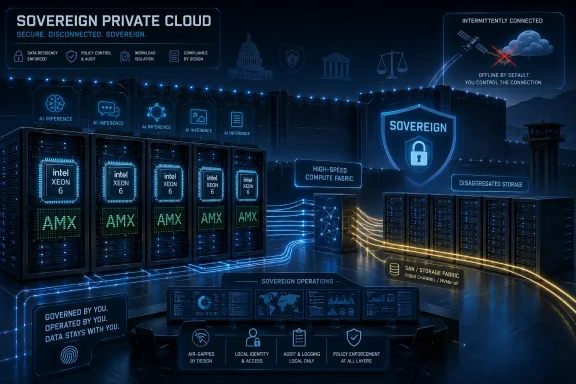
Intel and Microsoft are pushing Azure Local into a much larger class of private cloud deployment, with Intel Xeon 6 processors and Intel AMX positioned as the compute foundation for sovereign environments that can now scale from hundreds to thousands of servers. The move matters because Azure Local is no longer being framed merely as a branch-office, edge, or hyperconverged infrastructure option; Microsoft is presenting it as the backbone of Sovereign Private Cloud for governments, regulated industries, and enterprises that need Azure-consistent operations on hardware they own. For WindowsForum readers, the key shift is architectural: Microsoft is combining local control, disconnected operations, SAN reuse, and built-in AI acceleration into a platform designed to run at datacenter scale without forcing customers into a wholesale redesign.
Azure Local is the successor and expansion path for what many administrators knew as Azure Stack HCI, but the rebranding is more than cosmetic. Microsoft has been steadily moving from a narrowly defined hyperconverged infrastructure story toward an adaptive cloud model where Azure management, Azure Arc, virtual machines, Kubernetes, policy, and lifecycle tooling can extend into customer-controlled infrastructure.
That evolution reflects a broader change in enterprise IT. A few years ago, cloud strategy often meant deciding what could move to hyperscale regions and what had to remain on-premises for latency, legacy, or compliance reasons. In 2026, the conversation is more complicated: governments and regulated businesses increasingly want cloud-style tooling, but they also want hard boundaries around data residency, operational jurisdiction, and external dependencies.
The rise of sovereign cloud has accelerated that shift. Europe’s regulatory posture, defense modernization, critical infrastructure protection, healthcare data governance, and financial-sector resilience planning all point in the same direction: organizations want the elasticity and automation of cloud, but not always the dependency profile of public cloud. Azure Local is Microsoft’s answer to that tension.
Intel’s role is equally strategic. Xeon 6 is not just another server CPU refresh; it is Intel’s attempt to make general-purpose x86 infrastructure more relevant to AI, edge, cloud-native, and high-density workloads. By aligning Xeon 6 with Azure Local’s larger sovereign deployments, Intel is arguing that not every AI-capable private cloud needs to begin with a rack full of discrete accelerators.
The most important technical point is that this scale-up is tied to disaggregated deployment architectures. Rather than treating compute and storage as a tightly coupled hyperconverged unit, Azure Local can now support designs where compute and enterprise storage scale independently. That is critical for large environments, because storage growth and CPU growth rarely happen at the same rate.
Microsoft’s positioning is clear: Azure Local is meant to run everywhere from a single node at the edge to multi-rack environments in sovereign datacenters. Intel’s Xeon 6 processors, with built-in AI acceleration through Intel Advanced Matrix Extensions, provide the silicon foundation for those larger estates.
Key elements of the announcement include:
This does not make Xeon 6 a replacement for high-end GPUs in large model training or heavy multimodal inference. That distinction matters. Instead, it makes the CPU more useful for the growing class of practical enterprise AI workloads: document retrieval, classification, fraud detection, video analysis, local copilots, smaller language models, and application-specific inference.
For Azure Local, that is an important fit. Sovereign environments often need AI close to the data, not because it is trendy, but because moving sensitive data to a public service may be prohibited or operationally unacceptable. A CPU platform with built-in AI acceleration gives architects more options before they commit to GPU-dense infrastructure.
Xeon 6 also gives Intel a way to defend the CPU’s relevance in the AI era. The message is not CPU versus GPU; it is that CPUs remain the orchestration, virtualization, networking, storage, security, and increasingly inference backbone of private cloud environments.
Azure Local benefits from that because:
By allowing integration with enterprise SAN platforms, Azure Local becomes more realistic for brownfield datacenters. Many regulated organizations already have significant investments in Fibre Channel fabrics, storage arrays, backup processes, replication systems, and operational expertise. Asking them to abandon all of that would slow adoption.
The new model lets Azure Local meet customers where they already are. That is especially important for sovereign cloud because these environments are rarely greenfield playgrounds. They are often complex estates with legacy systems, classified workloads, bespoke applications, and strict maintenance windows.
Disaggregation also improves scaling economics. If storage and compute scale independently, infrastructure teams can tune procurement to actual demand rather than buying excess capacity in one domain to satisfy growth in another.
The shift creates several practical advantages:
Microsoft is therefore emphasizing local enforcement of policy, role-based access control, auditing, and compliance configuration. That matters because a sovereign environment cannot be truly autonomous if its control plane depends on a constant link to a public cloud region. Resilience is not only about workload uptime; it is also about governance uptime.
This has direct implications for national infrastructure and defense scenarios. If a network is isolated by policy, geography, conflict, cyber incident, or emergency response conditions, administrators still need to manage identity, apply configuration, audit changes, and keep workloads running. A private cloud that fails its governance model when disconnected is not sovereign in any meaningful operational sense.
The addition of simplified local identity capabilities also matters. Removing or reducing dependencies on traditional directory infrastructure in certain deployment scenarios can make edge and air-gapped deployments easier to stand up. That said, identity design remains one of the hardest parts of any disconnected environment.
Sovereign architecture now has to account for:
A CPU-first path is appealing when AI is embedded into existing applications rather than built as a standalone supercomputing project. If the model size and throughput requirements fit, using AMX on Xeon 6 can simplify deployment and reduce the operational burden associated with GPU scheduling, driver management, firmware compatibility, and power density.
That does not mean GPUs disappear from Azure Local. Microsoft’s broader sovereign AI messaging includes support for larger models and accelerator-based infrastructure where needed. The better reading is that Xeon 6 gives Azure Local a baseline AI capability across the compute estate, while GPUs remain an option for heavier workloads.
This creates a more graduated adoption path. A hospital, ministry, bank, or utility can start with local AI services on CPU-backed Azure Local systems, then add accelerators for workloads that justify the cost and complexity.
A sensible AI deployment ladder might look like this:
Healthcare has a different but equally compelling profile. Hospitals and research institutions handle sensitive patient data, imaging workloads, clinical systems, and increasingly AI-assisted diagnostics. Local processing can reduce latency and help keep regulated data inside controlled environments.
Financial services firms also have strong reasons to care. Banks and insurers must manage operational resilience, regulator expectations, fraud systems, transaction processing, data sovereignty, and disaster recovery. A cloud-consistent local platform can help modernize infrastructure without moving every sensitive workload into a public region.
For large enterprises, the appeal is not simply control. It is control plus standardization. Azure Local gives Microsoft customers a way to use familiar Azure tooling across local and cloud estates, reducing the operational gap between on-premises systems and cloud-native management.
Industry-specific implications include:
For homelab users and IT professionals, the lesson is that hybrid infrastructure skills are becoming more valuable. Knowledge of virtualization alone is no longer enough. Administrators increasingly need to understand policy-as-code, identity, Kubernetes, local AI inference, storage fabrics, lifecycle automation, and cloud-connected management.
There is also a Windows ecosystem angle. Azure Local depends on Microsoft’s ability to keep Windows Server-class infrastructure relevant while competing with Linux-heavy cloud-native stacks, VMware alternatives, Nutanix, OpenShift, and public cloud appliances. The stronger Azure Local becomes, the more Microsoft can offer a coherent path for organizations that are not ready to abandon Windows-centric operations.
For smaller organizations, some capabilities will remain out of reach due to cost and complexity. But the architectural direction matters because it may lead to simplified deployment models, better validated hardware, improved management tooling, and more accessible local AI infrastructure over time.
WindowsForum readers should watch for:
Nutanix remains a formidable competitor because it has spent years refining hyperconverged operations and hybrid cloud messaging. Its advantage is maturity in HCI operations and a clear virtualization alternative story. Microsoft’s advantage is its sheer ecosystem gravity and the ability to connect Azure Local with Azure, Microsoft 365, Defender, Purview, Arc, and developer services.
AWS and Google have their own distributed cloud and edge strategies, but Microsoft has a distinct enterprise on-premises heritage. Windows Server, Active Directory, Hyper-V, System Center, Azure Arc, and Azure Stack all feed into the credibility of Azure Local. That history is not perfect, but it gives Microsoft a long relationship with the administrators who run regulated estates.
Intel also faces competitive pressure. AMD EPYC has been highly successful in core density, performance-per-watt, and cloud adoption. By highlighting Xeon 6 and AMX in sovereign Azure Local deployments, Intel is emphasizing integrated AI acceleration, platform continuity, and enterprise validation rather than simply chasing headline core counts.
The competitive battleground now includes:
Azure Local’s value proposition depends on Microsoft making lifecycle operations predictable. If updates are disruptive, hardware compatibility is confusing, or troubleshooting requires too many vendor handoffs, customers will treat the platform cautiously. That is why validated partner platforms matter as much as Xeon 6 itself.
The disaggregated model also introduces operational trade-offs. SAN integration helps reuse existing infrastructure, but it brings Fibre Channel zoning, multipathing, array firmware, latency behavior, and storage team coordination back into the critical path. For some organizations, that is an advantage; for others, it reintroduces complexity that HCI was meant to hide.
A successful deployment will require careful sequencing. The technology may scale, but the organization must scale with it.
Operational priorities should include:
This is particularly important because Azure Local now spans multiple deployment shapes. A single-node edge system, a two-node branch cluster, a multi-rack datacenter deployment, and a disconnected sovereign environment may all carry the Azure Local name, but they have very different engineering requirements. Partner validation helps prevent that flexibility from becoming chaos.
For OEMs and storage vendors, the opportunity is substantial. Azure Local gives them a way to sell modern infrastructure into Microsoft-centric customers who are considering private cloud modernization. It also gives storage vendors a renewed role in a market that had been drifting toward pure HCI messaging.
Intel benefits because validated Azure Local platforms can standardize on Xeon 6 for specific configurations. That gives Intel design wins not only at the chip level, but across the broader solution stack.
Partner strategy matters because:
Another key area is AI tooling. Intel AMX provides a hardware capability, but customers need optimized runtimes, model guidance, monitoring, and integration with Microsoft’s AI stack. The easier Microsoft makes it to run governed local inference, the stronger the Azure Local value proposition becomes.
Watch these developments closely:
The broader significance is that Azure Local is maturing from a hybrid infrastructure product into a strategic control point for Microsoft’s sovereign cloud ambitions. Intel Xeon 6 gives that strategy a familiar, AI-capable hardware base, while disaggregated architecture and SAN support make the platform more realistic for large enterprise estates. If Microsoft can keep the operational model simple enough, this could become one of the more important private cloud shifts of 2026: not a retreat from public cloud, but a recognition that the future of cloud will also be local, sovereign, and customer-controlled.
Source: Wccftech Intel Xeon 6 With AMX Accelerate Microsoft's Azure Local, Scaling Deployments To 1000s of Servers
 Background
Azure Local is the successor and expansion path for what many administrators knew as Azure Stack HCI, but the rebranding is more than cosmetic. Microsoft has been steadily moving from a narrowly defined hyperconverged infrastructure story toward an adaptive cloud model where Azure management, Azure Arc, virtual machines, Kubernetes, policy, and lifecycle tooling can extend into customer-controlled infrastructure.That evolution reflects a broader change in enterprise IT. A few years ago, cloud strategy often meant deciding what could move to hyperscale regions and what had to remain on-premises for latency, legacy, or compliance reasons. In 2026, the conversation is more complicated: governments and regulated businesses increasingly want cloud-style tooling, but they also want hard boundaries around data residency, operational jurisdiction, and external dependencies.
The rise of sovereign cloud has accelerated that shift. Europe’s regulatory posture, defense modernization, critical infrastructure protection, healthcare data governance, and financial-sector resilience planning all point in the same direction: organizations want the elasticity and automation of cloud, but not always the dependency profile of public cloud. Azure Local is Microsoft’s answer to that tension.
Intel’s role is equally strategic. Xeon 6 is not just another server CPU refresh; it is Intel’s attempt to make general-purpose x86 infrastructure more relevant to AI, edge, cloud-native, and high-density workloads. By aligning Xeon 6 with Azure Local’s larger sovereign deployments, Intel is arguing that not every AI-capable private cloud needs to begin with a rack full of discrete accelerators.
What Microsoft And Intel Actually Announced
Microsoft says Azure Local can now support sovereign deployments that scale to thousands of servers within a single sovereign environment. That is a meaningful jump from the smaller cluster sizes historically associated with Azure Stack HCI-style deployments, and it changes the category in which Azure Local competes.From Cluster Product To Datacenter Platform
The announcement centers on Sovereign Private Cloud, Microsoft’s customer-operated cloud model for organizations that must retain control over infrastructure, data, and operations. Azure Local supplies the infrastructure layer, while related Microsoft components such as Microsoft 365 Local and Foundry Local extend productivity and AI capabilities into the same controlled boundary.The most important technical point is that this scale-up is tied to disaggregated deployment architectures. Rather than treating compute and storage as a tightly coupled hyperconverged unit, Azure Local can now support designs where compute and enterprise storage scale independently. That is critical for large environments, because storage growth and CPU growth rarely happen at the same rate.
Microsoft’s positioning is clear: Azure Local is meant to run everywhere from a single node at the edge to multi-rack environments in sovereign datacenters. Intel’s Xeon 6 processors, with built-in AI acceleration through Intel Advanced Matrix Extensions, provide the silicon foundation for those larger estates.
Key elements of the announcement include:
- Scaling from hundreds to thousands of servers in sovereign environments.
- Disaggregated compute and storage for more flexible architecture.
- Enterprise SAN integration to preserve existing infrastructure investments.
- Validated hardware ecosystems from major server and storage partners.
- Built-in CPU AI acceleration through Intel AMX on Xeon 6.
- Connected, intermittently connected, and disconnected operations for varied sovereignty needs.
Why Xeon 6 Matters To Azure Local
Intel Xeon 6 gives Microsoft a familiar enterprise platform for scaling Azure Local without asking customers to rethink their entire software stack. That familiarity matters because sovereign private cloud buyers are often conservative by design, especially in government, defense, energy, healthcare, and finance.AMX Turns CPUs Into Local AI Engines
The headline feature here is Intel AMX, a matrix acceleration capability built into supported Xeon processors. AMX is designed to speed up matrix-heavy workloads common in AI inference, machine learning, and numerical processing. In practice, that means certain AI workloads can run more efficiently on the CPU itself, without requiring a discrete GPU for every deployment scenario.This does not make Xeon 6 a replacement for high-end GPUs in large model training or heavy multimodal inference. That distinction matters. Instead, it makes the CPU more useful for the growing class of practical enterprise AI workloads: document retrieval, classification, fraud detection, video analysis, local copilots, smaller language models, and application-specific inference.
For Azure Local, that is an important fit. Sovereign environments often need AI close to the data, not because it is trendy, but because moving sensitive data to a public service may be prohibited or operationally unacceptable. A CPU platform with built-in AI acceleration gives architects more options before they commit to GPU-dense infrastructure.
Xeon 6 also gives Intel a way to defend the CPU’s relevance in the AI era. The message is not CPU versus GPU; it is that CPUs remain the orchestration, virtualization, networking, storage, security, and increasingly inference backbone of private cloud environments.
Azure Local benefits from that because:
- x86 compatibility reduces migration friction for existing workloads.
- AMX acceleration can improve AI inference economics for suitable models.
- P-core and E-core options allow different density and performance designs.
- Enterprise platform commonality simplifies procurement and lifecycle planning.
- CPU-based AI can reduce the need for specialized hardware in smaller or distributed sites.
Disaggregated Architecture Changes The Azure Local Model
The most consequential infrastructure change is Microsoft’s support for larger disaggregated Azure Local deployments using enterprise storage. That is a departure from the pure hyperconverged mindset where compute and storage expand together as nodes are added.SAN Reuse Is More Than Nostalgia
For years, hyperconverged infrastructure promised simplicity by collapsing storage and compute into the same cluster. That model works well for many branch, edge, and mid-sized datacenter deployments, but it can become awkward at large scale. Organizations may need more storage without more compute, more compute without more storage, or specialized arrays for performance, resilience, and operational continuity.By allowing integration with enterprise SAN platforms, Azure Local becomes more realistic for brownfield datacenters. Many regulated organizations already have significant investments in Fibre Channel fabrics, storage arrays, backup processes, replication systems, and operational expertise. Asking them to abandon all of that would slow adoption.
The new model lets Azure Local meet customers where they already are. That is especially important for sovereign cloud because these environments are rarely greenfield playgrounds. They are often complex estates with legacy systems, classified workloads, bespoke applications, and strict maintenance windows.
Disaggregation also improves scaling economics. If storage and compute scale independently, infrastructure teams can tune procurement to actual demand rather than buying excess capacity in one domain to satisfy growth in another.
The shift creates several practical advantages:
- Compute nodes can grow independently from storage capacity.
- Existing SAN investments can remain useful in modernized environments.
- Storage-heavy workloads become easier to support without overbuying CPU.
- Large datacenter designs can align with familiar enterprise architecture.
- Operational teams can reuse skills in Fibre Channel and storage management.
Sovereignty Moves From Policy To Architecture
Sovereignty used to be discussed mainly as a compliance label: where data resides, who can access it, and which laws apply. Microsoft’s Azure Local push reflects a more mature interpretation where sovereignty becomes an architecture pattern involving hardware ownership, management boundaries, identity, policy, audit, and operational continuity.Disconnected Operations Raise The Bar
Azure Local’s support for disconnected operations is central to this story. In a connected model, local infrastructure can still use Azure services for management, monitoring, and lifecycle operations. In disconnected or intermittently connected environments, those assumptions break down.Microsoft is therefore emphasizing local enforcement of policy, role-based access control, auditing, and compliance configuration. That matters because a sovereign environment cannot be truly autonomous if its control plane depends on a constant link to a public cloud region. Resilience is not only about workload uptime; it is also about governance uptime.
This has direct implications for national infrastructure and defense scenarios. If a network is isolated by policy, geography, conflict, cyber incident, or emergency response conditions, administrators still need to manage identity, apply configuration, audit changes, and keep workloads running. A private cloud that fails its governance model when disconnected is not sovereign in any meaningful operational sense.
The addition of simplified local identity capabilities also matters. Removing or reducing dependencies on traditional directory infrastructure in certain deployment scenarios can make edge and air-gapped deployments easier to stand up. That said, identity design remains one of the hardest parts of any disconnected environment.
Sovereign architecture now has to account for:
- Jurisdictional control over data and operations.
- Local policy enforcement when cloud connectivity is unavailable.
- Auditable administrative actions inside the sovereign boundary.
- Lifecycle management that does not assume constant internet access.
- Operational autonomy without abandoning cloud-consistent tooling.
AI At The Edge Without A GPU-First Redesign
The AI angle in this announcement is subtle but important. Microsoft and Intel are not claiming that Xeon 6 with AMX eliminates the need for GPUs across all AI workloads. They are saying that many organizations can begin running local inference and generative AI tasks inside their sovereign environment without introducing a separate specialized infrastructure tier.CPU Inference Has A Strategic Niche
For enterprise AI, the most common workload is not always massive training. It is often inference against private data, retrieval-augmented generation, document processing, anomaly detection, translation, summarization, or workflow automation. These workloads may be latency-sensitive, data-sensitive, or both.A CPU-first path is appealing when AI is embedded into existing applications rather than built as a standalone supercomputing project. If the model size and throughput requirements fit, using AMX on Xeon 6 can simplify deployment and reduce the operational burden associated with GPU scheduling, driver management, firmware compatibility, and power density.
That does not mean GPUs disappear from Azure Local. Microsoft’s broader sovereign AI messaging includes support for larger models and accelerator-based infrastructure where needed. The better reading is that Xeon 6 gives Azure Local a baseline AI capability across the compute estate, while GPUs remain an option for heavier workloads.
This creates a more graduated adoption path. A hospital, ministry, bank, or utility can start with local AI services on CPU-backed Azure Local systems, then add accelerators for workloads that justify the cost and complexity.
A sensible AI deployment ladder might look like this:
- Start with CPU inference for small models, classification, retrieval, and automation.
- Optimize software libraries to take advantage of AMX and supported runtimes.
- Measure latency, throughput, and utilization against real business workloads.
- Add GPUs selectively for larger models, multimodal workloads, or high concurrency.
- Standardize governance so both CPU and GPU AI remain within the same sovereign boundary.
Enterprise Impact: Government, Defense, Healthcare, And Finance
The biggest beneficiaries of this announcement are not ordinary small businesses. They are large organizations with strict requirements around data location, autonomy, uptime, auditability, and long-term infrastructure control.Different Industries, Same Pattern
Government agencies need sovereign infrastructure because public trust, national law, and operational independence are central to their mission. Defense organizations add another layer: they may need connected, intermittently connected, and fully disconnected environments depending on classification level and operational theater. Azure Local’s larger scale makes Microsoft’s private cloud pitch more credible in these contexts.Healthcare has a different but equally compelling profile. Hospitals and research institutions handle sensitive patient data, imaging workloads, clinical systems, and increasingly AI-assisted diagnostics. Local processing can reduce latency and help keep regulated data inside controlled environments.
Financial services firms also have strong reasons to care. Banks and insurers must manage operational resilience, regulator expectations, fraud systems, transaction processing, data sovereignty, and disaster recovery. A cloud-consistent local platform can help modernize infrastructure without moving every sensitive workload into a public region.
For large enterprises, the appeal is not simply control. It is control plus standardization. Azure Local gives Microsoft customers a way to use familiar Azure tooling across local and cloud estates, reducing the operational gap between on-premises systems and cloud-native management.
Industry-specific implications include:
- Government gains a path to Azure-style services inside national or agency-controlled boundaries.
- Defense gains more credible disconnected and intermittently connected deployment options.
- Healthcare can keep sensitive clinical data local while modernizing infrastructure.
- Finance can align cloud tooling with resilience and regulatory expectations.
- Manufacturing can run low-latency AI and control systems close to industrial data sources.
- Telecom and utilities can modernize distributed infrastructure with stronger local autonomy.
Consumer And Windows Enthusiast Impact
At first glance, a sovereign private cloud announcement may seem distant from the everyday Windows enthusiast. Most readers are not deploying thousand-node Azure Local environments in a home lab, and Xeon 6 systems are not exactly impulse purchases.Why This Still Matters Outside The Datacenter
The indirect impact is still significant. Technologies that begin in enterprise infrastructure often shape the management, security, virtualization, and AI capabilities that later influence smaller business deployments and even enthusiast workflows. Azure Local’s evolution also tells us where Microsoft believes Windows Server, Hyper-V, Azure Arc, and hybrid management are headed.For homelab users and IT professionals, the lesson is that hybrid infrastructure skills are becoming more valuable. Knowledge of virtualization alone is no longer enough. Administrators increasingly need to understand policy-as-code, identity, Kubernetes, local AI inference, storage fabrics, lifecycle automation, and cloud-connected management.
There is also a Windows ecosystem angle. Azure Local depends on Microsoft’s ability to keep Windows Server-class infrastructure relevant while competing with Linux-heavy cloud-native stacks, VMware alternatives, Nutanix, OpenShift, and public cloud appliances. The stronger Azure Local becomes, the more Microsoft can offer a coherent path for organizations that are not ready to abandon Windows-centric operations.
For smaller organizations, some capabilities will remain out of reach due to cost and complexity. But the architectural direction matters because it may lead to simplified deployment models, better validated hardware, improved management tooling, and more accessible local AI infrastructure over time.
WindowsForum readers should watch for:
- Azure Local features filtering into smaller validated systems.
- Windows Server integration with Azure Arc and hybrid management.
- Local AI tooling that benefits from CPU acceleration.
- Storage and networking changes that influence SMB infrastructure design.
- Licensing and support models that determine whether Azure Local remains enterprise-only or broadens its appeal.
Competitive Landscape
Microsoft’s expanded Azure Local push lands in a market that is already tense. Broadcom’s VMware changes have pushed many enterprises to reassess virtualization strategy, while Nutanix, Red Hat, Dell, HPE, Lenovo, and public cloud providers are all competing for the post-VMware modernization wave.VMware, Nutanix, AWS, And Google All Feel The Pressure
For Microsoft, Azure Local is a way to capture organizations that want a VMware alternative without giving up enterprise support, validated hardware, and integrated cloud management. The pitch is especially strong where Microsoft already owns identity, productivity, endpoint management, security tooling, and developer platforms. Azure Local becomes another layer in the Microsoft estate.Nutanix remains a formidable competitor because it has spent years refining hyperconverged operations and hybrid cloud messaging. Its advantage is maturity in HCI operations and a clear virtualization alternative story. Microsoft’s advantage is its sheer ecosystem gravity and the ability to connect Azure Local with Azure, Microsoft 365, Defender, Purview, Arc, and developer services.
AWS and Google have their own distributed cloud and edge strategies, but Microsoft has a distinct enterprise on-premises heritage. Windows Server, Active Directory, Hyper-V, System Center, Azure Arc, and Azure Stack all feed into the credibility of Azure Local. That history is not perfect, but it gives Microsoft a long relationship with the administrators who run regulated estates.
Intel also faces competitive pressure. AMD EPYC has been highly successful in core density, performance-per-watt, and cloud adoption. By highlighting Xeon 6 and AMX in sovereign Azure Local deployments, Intel is emphasizing integrated AI acceleration, platform continuity, and enterprise validation rather than simply chasing headline core counts.
The competitive battleground now includes:
- Virtualization replacement for customers reconsidering VMware.
- Sovereign cloud platforms for governments and regulated industries.
- Private AI infrastructure for data-sensitive inference workloads.
- Hybrid control planes that unify public cloud and on-premises operations.
- Validated hardware ecosystems that reduce deployment risk.
- CPU versus accelerator economics for mainstream enterprise AI.
Operational Reality: Scaling To Thousands Is Hard
The phrase “thousands of servers” sounds impressive, but experienced administrators know that scale creates its own problems. Hardware count is only one dimension; networking, identity, patching, observability, backup, capacity planning, firmware, security baselines, and incident response all become harder as the estate grows.The Management Plane Becomes The Product
At smaller scale, teams can sometimes compensate for tooling gaps with manual procedures and institutional knowledge. At sovereign-scale private cloud, that breaks down quickly. The control plane, update process, hardware validation, monitoring stack, and support model become as important as the raw performance of the servers.Azure Local’s value proposition depends on Microsoft making lifecycle operations predictable. If updates are disruptive, hardware compatibility is confusing, or troubleshooting requires too many vendor handoffs, customers will treat the platform cautiously. That is why validated partner platforms matter as much as Xeon 6 itself.
The disaggregated model also introduces operational trade-offs. SAN integration helps reuse existing infrastructure, but it brings Fibre Channel zoning, multipathing, array firmware, latency behavior, and storage team coordination back into the critical path. For some organizations, that is an advantage; for others, it reintroduces complexity that HCI was meant to hide.
A successful deployment will require careful sequencing. The technology may scale, but the organization must scale with it.
Operational priorities should include:
- Reference architecture discipline before procurement begins.
- Network and storage validation under realistic failure conditions.
- Identity planning for connected and disconnected modes.
- Patch and firmware governance across server, storage, and fabric layers.
- Capacity modeling for compute, memory, storage, AI, and east-west traffic.
- Clear support ownership across Microsoft, Intel, OEMs, and storage vendors.
Hardware Ecosystem And Partner Strategy
Microsoft’s announcement highlights validated compute and storage platforms from partners including major enterprise infrastructure vendors. That partner list is not just a procurement detail; it is a signal that Azure Local’s sovereign-scale ambitions depend on the traditional server and storage ecosystem.Validation Is The New Battleground
Large customers rarely want unsupported combinations of servers, NICs, HBAs, firmware, storage arrays, and drivers. They want tested configurations with clear responsibility when something fails. In private cloud, especially at sovereign scale, validated hardware becomes a trust mechanism.This is particularly important because Azure Local now spans multiple deployment shapes. A single-node edge system, a two-node branch cluster, a multi-rack datacenter deployment, and a disconnected sovereign environment may all carry the Azure Local name, but they have very different engineering requirements. Partner validation helps prevent that flexibility from becoming chaos.
For OEMs and storage vendors, the opportunity is substantial. Azure Local gives them a way to sell modern infrastructure into Microsoft-centric customers who are considering private cloud modernization. It also gives storage vendors a renewed role in a market that had been drifting toward pure HCI messaging.
Intel benefits because validated Azure Local platforms can standardize on Xeon 6 for specific configurations. That gives Intel design wins not only at the chip level, but across the broader solution stack.
Partner strategy matters because:
- OEM validation reduces deployment uncertainty.
- Storage partnerships make brownfield modernization more realistic.
- Support alignment affects customer confidence.
- Reference designs speed procurement and architecture review.
- Channel partners can turn Azure Local into repeatable offerings.
- Hardware choice helps Microsoft avoid appearing too vertically locked down.
Strengths and Opportunities
The strongest part of Microsoft and Intel’s Azure Local push is that it addresses a real market need: cloud-consistent infrastructure for organizations that cannot, should not, or will not place every workload in a public region. The opportunity is especially large because it combines sovereignty, AI, hybrid management, and infrastructure modernization at a moment when many enterprises are already rethinking virtualization and private cloud strategy.- Azure-consistent operations can reduce the skills gap between public cloud and on-premises teams.
- Xeon 6 with AMX gives customers a CPU-based path for practical local AI inference.
- Disaggregated architecture makes Azure Local more credible for large datacenter deployments.
- SAN integration protects existing investments and lowers migration resistance.
- Disconnected operations address real requirements in defense, government, and critical infrastructure.
- Validated partner systems can reduce risk for buyers who need supported configurations.
- Microsoft’s ecosystem reach gives Azure Local a natural foothold in Windows-heavy enterprises.
Risks and Concerns
The risks are equally real, especially because sovereign private cloud buyers are demanding customers. They want autonomy, but they also want cloud simplicity; they want local control, but they do not want to inherit brittle infrastructure; they want AI, but they may underestimate the operational demands of running models inside regulated environments.- Complexity could rise as Azure Local expands from HCI clusters to disaggregated datacenter platforms.
- Disconnected operations may create update, support, and security challenges if not tightly managed.
- SAN integration can reintroduce legacy operational dependencies and troubleshooting silos.
- AI expectations may exceed what CPU acceleration can reasonably deliver for larger models.
- Licensing and billing clarity will be crucial for customers comparing VMware, Nutanix, and Azure Local.
- Vendor coordination could become difficult across Microsoft, Intel, OEMs, storage vendors, and integrators.
- Sovereignty claims must be matched by transparent controls, auditability, and jurisdiction-specific assurances.
Looking Ahead
The next phase will determine whether Azure Local becomes a mainstream private cloud platform or remains a specialized solution for the most regulated Microsoft customers. The technical pieces are coming together, but adoption will depend on proof: reference customers, repeatable deployment patterns, stable lifecycle operations, and credible cost models.What To Watch Next
The most important signal will be how quickly Microsoft and its hardware partners publish and mature validated configurations for large-scale, disaggregated Azure Local deployments. If customers can buy predictable building blocks, adoption will accelerate. If every deployment feels bespoke, the market will move more slowly.Another key area is AI tooling. Intel AMX provides a hardware capability, but customers need optimized runtimes, model guidance, monitoring, and integration with Microsoft’s AI stack. The easier Microsoft makes it to run governed local inference, the stronger the Azure Local value proposition becomes.
Watch these developments closely:
- Azure Local 2604 adoption among early sovereign and regulated customers.
- Validated Xeon 6 reference architectures from major OEM and storage partners.
- Foundry Local integration for larger models and local inference workflows.
- Real-world performance data for AMX-accelerated AI workloads on Azure Local.
- Competitive responses from Nutanix, VMware ecosystem partners, AWS, Google, and AMD-based platforms.
The broader significance is that Azure Local is maturing from a hybrid infrastructure product into a strategic control point for Microsoft’s sovereign cloud ambitions. Intel Xeon 6 gives that strategy a familiar, AI-capable hardware base, while disaggregated architecture and SAN support make the platform more realistic for large enterprise estates. If Microsoft can keep the operational model simple enough, this could become one of the more important private cloud shifts of 2026: not a retreat from public cloud, but a recognition that the future of cloud will also be local, sovereign, and customer-controlled.
Source: Wccftech Intel Xeon 6 With AMX Accelerate Microsoft's Azure Local, Scaling Deployments To 1000s of Servers
