
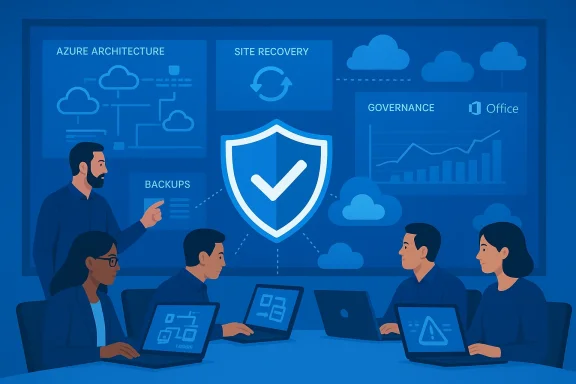
Businesses moving to Microsoft Azure are increasingly doing it with a partner at their side: a new NetEnrich survey shows most organizations are “very likely” to hire a managed services provider to migrate to or manage Azure, and they point to security, backups and disaster recovery as the single biggest reason to outsource cloud operations.
Background
Azure adoption has moved well past experiments and into mainstream IT portfolios for many organizations. The NetEnrich survey highlighted that nearly half of respondents already run at least 50 percent of their infrastructure and workloads in Azure, and a majority operate hybrid or multi-cloud estates that include Azure. Those adoption levels are driving a practical question: who operates, secures and optimizes these cloud estates day-to-day? The survey finds an emphatic answer — managed services providers (MSPs). The pattern makes sense when you consider the capabilities Azure brings. Microsoft offers integrated services for disaster recovery, backups, cost analysis and security posture management — capabilities MSPs package into operational programs and service-level agreements (SLAs). But those platform capabilities are only one half of the equation; organizations still must architect, configure and govern them correctly. That operational burden is where MSPs claim value. The platform-level features are real and documented, and they form the technical basis for many managed services offerings.Why the MSP model matters for Azure migrations
Cloud complexity and the skills gap
Moving to Azure is rarely a single technical act; it’s an organizational transformation that touches architecture, networking, identity, backup, compliance and budgets. Many IT teams — especially in midmarket firms — do not have the full spectrum of cloud skills in-house, and hiring or training for them is expensive and slow. MSPs position themselves to provide those skills on demand, from migration planning to 24×7 operations and security monitoring.The market data supports this: two-thirds of organizations surveyed by NetEnrich said they were “very likely” to use an MSP in the coming year, with top motivations tied to security, backups and disaster recovery. Those are areas that require both platform expertise (Azure Site Recovery, Azure Backup) and operational discipline (runbooks, DR testing, SLAs).
Shared responsibility and the danger of misconfiguration
A core reason organizations outsource cloud operations is risk management. Cloud providers operate a secure platform, but customers are responsible for correctly configuring and operating their workloads — the so-called shared responsibility model. Industry research is clear: misconfigurations and customer-side errors are the leading root cause of cloud exposures and breaches. That reality creates demand for partners who can run continuous posture management and prevent configuration drift. Managed services that include automated posture scanning (CSPM), patching, identity hygiene and logging substantially reduce the risk surface.FinOps and cost control
Azure’s flexibility is powerful — and it can be expensive if left unchecked. Cost management, rightsizing and purchase strategy (Reserved Instances, Savings Plans) are specialized skills that many organizations lack. The NetEnrich survey indicates that organizations plan to buy tools for migration and management, and many intend to invest in cloud analysis and optimization tools next year. MSPs often provide FinOps capabilities as a managed service or run periodic optimization engagements to find immediate cost savings, implement tagging and budget alerts, and set up ongoing governance.What MSPs actually deliver (and how Azure supports it)
MSPs sell outcomes and operational certainty. The most common managed service capabilities bundled around Azure include:- Discovery & inventory: automated asset discovery, dependency mapping and application classification to prepare for migration.
- Migration planning and runbooks: lift-and-shift, re-platform or refactor strategies with pilot waves and rollback safety.
- Security baseline & 24×7 monitoring: identity and access control hardening, continuous posture checks, and managed detection/response (often integrating Microsoft Defender for Cloud and SIEM).
- Backup & disaster recovery: configuration and testing of Azure Backup, Azure Site Recovery (ASR) and zone/region failover plans.
- Cost management & FinOps: tagging, budgets, automated shutdowns, reserved instance planning and monthly cost reviews.
- Integration & managed Microsoft 365 connectivity: ensuring Azure workloads interoperate with Office 365, Entra ID and endpoint management.
- Compliance and audit readiness: mapping Azure controls to regulatory requirements and preparing audit artifacts.
NetEnrich survey: the headline numbers and what they mean
The NetEnrich data summarized in the BetaNews report gives a focused view on why businesses are looking to MSPs for Azure work:- 67% of respondents said they are “very likely” to engage an MSP in the next year to migrate to Azure or to manage cloud/on-prem environments. This is a behavioral signal: most buyers want external operational support rather than purely internal delivery.
- 46% reported running at least half of their IT infrastructure and workloads on Azure, indicating Azure is not just a test bed but a primary platform for many organizations.
- Top perceived benefits of MSP engagement:
- Security, backups and disaster recovery planning/protection — 72%. This aligns with MSPs’ emphasis on posture management and DR runbooks.
- Discovery & inventory of IT resources — 65%. Discovery is a precondition to reliable migrations and cost optimization.
- Assessment of cost and ROI / cloud roadmap — 59%. Organizations want cost predictability and staged roadmaps rather than open-ended cloud spend.
- 62% operate a multi-cloud environment that includes Azure, underscoring the complexity MSPs face when reconciling different public clouds and on-premises estates.
- Top adoption challenges: data security/privacy concerns (30%) and budgetary constraints (28%). These are precisely the friction points MSPs are positioned to mitigate.
- Tool purchasing intentions: 64% plan to buy migration/management tools, 57% cloud analysis/optimization, 56% cloud monitoring tools — a clear market for tooling and managed services.
- 79% said interconnectivity between Azure and Microsoft products (Office 365, Enterprise Mobility Suite, etc. is extremely important — a strong platform lock-in incentive and a win for Microsoft-aligned MSPs.
Verifying platform claims: what Azure actually provides
To assess whether MSPs’ selling points are justified, it’s worth checking the feature set Azure offers and where operational work remains required.- Azure Backup and Azure Site Recovery provide managed backup and orchestrated replication to meet many recovery objectives. Azure Site Recovery supports replication from on-premises VMware/Hyper-V and Azure VMs, with replication frequencies and recovery plan orchestration designed to deliver measurable RTO/RPO capabilities. However, customers must configure and test failover plans to ensure they meet organizational objectives.
- Azure Availability Zones and region-level designs enable higher uptime SLAs for VMs and services when architected across zones, reducing single-point failures. Zone-aware deployments are part of designing for resilience but do not eliminate the need for recovery testing and capacity planning.
- Microsoft Cost Management is a first-party tool for cost visibility, budgeting, alerts and recommendations; it’s free for Azure subscriptions and is frequently used in FinOps cycles. But cost optimization is an ongoing discipline that needs telemetry, governance and periodic human review — a common managed service deliverable.
- Microsoft Defender for Cloud (Defender) is a unified posture and workload protection platform (CNAPP-like capabilities) that covers CSPM, CWPP and DevSecOps integrations and can be a central element of managed security programs. Its capability to surface misconfigurations, prioritized recommendations and integration with XDR/SIEM tooling is why MSPs include it in managed security offerings.
Strengths of the MSP approach (what works)
- Fast ramp to production: MSPs can supply the specialized skills needed to complete migrations faster than many in-house teams can recruit and train. When tight migration windows exist, that speed matters.
- Consolidated accountability: firms that buy managed services get a named vendor and SLAs for availability, recovery, and response times — a commercial remedy that many internal teams cannot replicate.
- FinOps maturity: experienced MSPs run recurring cost reviews, rightsizing activities and reserved-instance planning that frequently reduce waste and put predictable governance in place.
- Security discipline: partners offering managed detection, continuous posture management and automated remediation reduce the human error that drives many cloud incidents.
- Integration experience: MSPs that specialize in Microsoft ecosystems accelerate the integration between Azure workloads and Microsoft 365/Entra ID/Endpoint Management, which the survey respondents rated as highly important.
Risks, caveats and practical limitations
- Shared-responsibility fallacy: organizations often assume the cloud provider is “responsible for security.” In reality, many incidents trace to customer misconfiguration or weak IAM. Outsourcing to an MSP reduces this risk but does not remove the customer’s obligation to define policy, enforce least privilege, and own sensitive data governance. Independent research shows misconfiguration remains the leading cloud security failure mode — a key reason organizations buy posture management and CSPM.
- Vendor and partner lock-in: heavy reliance on Azure PaaS features and deep integration with Microsoft services delivers speed and capability but can make future multi-cloud or repatriation strategies harder. Similarly, long-running managed services contracts that lack clear exit and portability clauses can create dependency on a partner. Procurement teams should insist on documented runbooks, data export paths and automation artifacts to preserve mobility.
- Audit snapshots and operational drift: certifications and partner badges (e.g., Expert MSP designations) are valuable signals, but they are point-in-time validations. Buyers should demand ongoing performance metrics, periodic third-party reviews, and contractual SLAs to guard against operational drift between audits.
- Recurring cost trade-offs: managed services replace capital or staff costs with predictable operational fees. That trade-off suits many organizations but needs financial modelling to see whether the recurring OPEX plus platform spend yields a better total cost of ownership than a self-managed model.
- Partial coverage and tooling gaps: no single MSP covers every capability equally. Security-focused partners may be weak on migration tooling; migration specialists may not deliver best-in-class FinOps. Match the partner’s explicit competencies to the workload and the regulatory profile of the customer.
Practical checklist for IT leaders evaluating an Azure MSP
- Inventory & classify: produce an up-to-date inventory of workloads, data sensitivity, dependencies and network topology before you talk to partners. Discovery is non-negotiable.
- Run a short pilot: migrate a noncritical workload to validate tooling, performance and failover processes. Pilots produce telemetry that helps sizing and cost choices.
- Define RTO & RPO: make availability objectives explicit and include them in any SLA. Use Azure Site Recovery and Azure Backup as the technical foundation but require runbook proof and periodic drills.
- Demand FinOps outcomes: require a partner to set budgets, tagging policy, monthly optimization reports, and a timeline for Reserved Instance savings or Savings Plan recommendations. Use Microsoft Cost Management for baseline telemetry.
- Security baseline: insist on identity-first controls (MFA, conditional access), least privilege (RBAC), Key Vault for secrets management, and integration to Defender for Cloud and a SIEM. Have the MSP provide evidence of continuous posture monitoring and remediation workflows.
- DR & test schedule: require documented recovery plans and proof of periodic failover drills (tabletop and live tests) as an SLA metric. Verify documented RPO/RTO performance during tests.
- Portability & exit rights: insist the contract includes automation exports (ARM templates/Bicep, Terraform state), data extraction timelines, and a knowledge-transfer plan.
- References & domain experience: ask for customer references with similar regulatory and performance requirements and check independent partner badges and audit evidence.
- Pricing transparency: demand line-of-service pricing, predictable OPEX bands and a clear change-control process for scope creep.
- Governance cadence: operationally embed a monthly FinOps and security review with agreed KPIs, and maintain a shared runbook repository with access control.
Tools and products to expect in an MSP engagement
- Azure Site Recovery and Azure Backup for resilience and data protection. MSPs will typically configure, test and automate recovery plans using these services.
- Microsoft Defender for Cloud for posture management, workload protection and DevSecOps integrations. MSPs use Defender as the central posture scanner, often linking it to managed remediation playbooks.
- Microsoft Cost Management (and third-party FinOps tools) to provide budget enforcement, recommendations and reporting. Expect MSPs to integrate cost telemetry into routine reviews.
- Cloud Security Posture Management (CSPM) and Cloud Workload Protection (CWPP) add-ons, whether first-party or third-party, for continuous scanning and automated remediation. These tools address the misconfiguration risks documented by industry analysts.
- Integration tooling for migration: Azure Migrate, Database Migration Service, and migration orchestration engines. MSPs will often bring automation to speed discovery, lift-and-shift or re-platform waves.
Real-world procurement language to include in contracts
- SLAs tied to measurable runbook outcomes: time-to-detect, time-to-restore, RTO/RPO adherence during test windows.
- FinOps KPIs: monthly savings target, cost drift thresholds, tagging compliance percentage.
- Security KPIs: percentage of critical posture items remediated within X days, mean time to contain incidents, and results of quarterly external penetration tests.
- Evidence & audits: quarterly runbook reviews, annual third-party audit summary, and immediate notification of any audit failures.
- Exit terms: automated artifact handover (ARM/Bicep/Terraform), data egress timeframe and fees, and 90-day knowledge transfer with shadowing.
Final analysis and verdict
The NetEnrich survey reflects a clear market dynamic: Azure is now a mainstream enterprise platform, and the majority of organizations prefer to buy operational certainty rather than assemble it from scratch. Security, backups and disaster recovery top the list of motivations for hiring MSPs — precisely the areas where misconfiguration and operational drift create the largest business risk. The platform features Azure provides — Site Recovery, Availability Zones, Azure Backup, Defender for Cloud, and Cost Management — are mature and robust. But they require disciplined operations to deliver their promise. That implementation and ongoing governance is the practical business problem MSPs solve. This combination — powerful platform + operational complexity — explains why the market for Azure-managed services will continue to grow. However, buyers must do their homework: validate partner capabilities with references and audit evidence, demand measurable FinOps and security outcomes, maintain contractual portability, and keep an internal baseline of cloud competence so the organization can govern the outsourced relationship effectively. In short, MSPs are a pragmatic bridge to cloud maturity, not a shortcut that removes the buyer’s responsibilities.The evidence is straightforward: customers want the speed and capabilities of Azure, but they also want the safety net of experienced operators. When those two conditions are satisfied — platform capability plus operational discipline — Azure migrations and cloud operations become a strategic accelerator rather than an ongoing cost and risk center.
Source: BetaNews Businesses rely on managed services providers to move to Azure
