

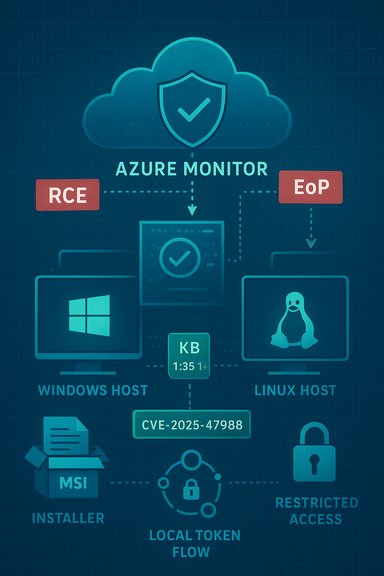
Microsoft’s advisory listings and community trackers show activity around Azure Monitor Agent and related Azure agents, but the numeric label CVE-2025-59504 could not be confidently resolved in vendor or community records during verification — what is verifiable is that multiple high‑impact flaws affecting Azure monitoring and management agents (including remote code execution and local privilege escalation issues) were disclosed across mid‑2025 and October 2025, and defenders must treat any AMA/agent advisory as urgent until their inventory is mapped to vendor KBs and patched versions.
Background / Overview
Azure Monitor Agent (AMA) is Microsoft’s on‑host data collection service used to gather logs and metrics from Windows and Linux machines and forward them into Azure Monitor and Log Analytics. The agent runs with elevated privileges on hosts, processes telemetry, and accepts local inputs and configuration changes that can influence how it executes or parses data. Because of the agent’s privileged context and its exposure on many internet‑connected networks, bugs in AMA can lead to severe outcomes — from remote code execution to local privilege escalation and management‑plane token abuse.Public vendor and third‑party advisories in 2025 documented multiple vulnerabilities in Azure Monitor Agent and adjacent agents. One confirmed RCE disclosed in July 2025 (CVE‑2025‑47988) affected AMA builds prior to 1.35.1 and was tracked by major scanners and advisories; independent vulnerability databases and scanner plugins flagged the required upgrade to 1.35.1 as the remediation. At the same time, community reporting and incident analysis for Azure‑adjacent agents (notably the Azure Connected Machine / Arc agent family) show repeated patterns: improper access control, command‑injection or unsanitized installer inputs, and timing/race conditions that permit local escalation to SYSTEM/root. Those agent families are conceptually separate from AMA, but they share the same operational risk profile: privileged on‑host services that can be abused to pivot into cloud resources or to persist at scale.
What we verified and what we could not
Verifiable facts
- A Remote Code Execution affecting Azure Monitor Agent was publicly disclosed and tracked as CVE‑2025‑47988; multiple scanners and advisories list the affected versions as builds prior to 1.35.1 and recommend upgrading to 1.35.1 or later.
- Multiple other vulnerabilities affecting Azure monitoring/management agents were disclosed in October 2025; these include improper access control (CWE‑284) and deserialization issues that carry local or adjacent‑network attack vectors and high impact scores in some trackers.
- Microsoft’s Security Update Guide (MSRC) is the canonical source for CVE→KB→fixed‑version mappings for Microsoft products; defenders must rely on MSRC entries to map advisories to specific builds and KB article numbers for automated patching and inventory. The MSRC site is authoritative even when its content is client‑side rendered.
Unverified or ambiguous claims
- The specific label CVE‑2025‑59504 could not be located in the vendor’s public advisory index or in leading third‑party aggregators at time of verification. That numeric identifier therefore should be treated as unverified until the Microsoft Security Update Guide entry for CVE‑2025‑59504 is located and inspected directly. If you were provided this CVE string in an operational ticket, it is essential to re‑check the MSRC entry and map the advisory text to the KB number and agent build rather than trusting the numeric alone.
- Public proof‑of‑concept exploit code for many of the AMA/agent vulnerabilities was not present in major exploit repositories at the time of review, although lack of PoC does not imply low risk; historically, EoP and code‑injection classes are weaponized quickly after disclosure.
Why the maturity metric matters for operators
The vulnerability maturity metric — the degree of confidence that a vulnerability exists and the credibility of the technical detail — directly influences urgency and remediation strategy.- When a vulnerability is confirmed by the vendor (high maturity), organizations can immediately act on vendor KBs and package builds with great confidence.
- When a vulnerability is only discussed in community threads or third‑party feeds but lacks vendor confirmation, mapping and remediation become riskier; patch automation keyed only to a CVE string can miss the correct KB/agentVersion mapping.
- When details are partial or speculative (low maturity), defenders should prioritize increased detection and containment while waiting for vendor confirmation; hunting and inventorying are the highest‑leverage actions.
Technical analysis: how Azure Monitor Agent RCEs and agent EoPs typically work
Key attack surfaces in agent architectures
- Local privileged services and daemons that accept configuration or plugin inputs.
- Local metadata endpoints and identity token flows (for Arc/Connected Machine agents these are often referenced as HIMDS). Attackers with elevated local privileges can query these endpoints to obtain machine‑assigned tokens and call cloud APIs.
- Installer/upgrade paths (MSI/agent installers) that run with elevated privileges — unsanitized installer inputs or argument chaining in MSI repair/upgrade flows can lead to command injection in privileged contexts.
Common vulnerability patterns reported across advisories
- Improper input validation leading to code injection (CWE‑94) in components that parse remote configuration or telemetry. The July 2025 AMA RCE (CVE‑2025‑47988) was characterized as a code‑injection defect, exploitable from an adjacent network.
- Improper access control (CWE‑284) where non‑privileged processes can invoke privileged functionality exposed by the agent (local EoP patterns). These typically start as a local foothold and are then escalated.
- Deserialization of untrusted data and other parsing defects that can lead to arbitrary code execution in elevated contexts.
- Race conditions and synchronization defects that require timing but can be automated once understood.
Practical exploit consequences
- Remote Code Execution (RCE) from adjacent network or LAN context (where present) allows an unauthenticated or low‑privileged network attacker to execute arbitrary code on a vulnerable host — full host compromise follows.
- Local Elevation of Privilege (EoP) gives a low‑privileged authenticated local attacker the path to SYSTEM/root. Once SYSTEM/root is achieved on a management host, the attacker can query local metadata endpoints, obtain machine tokens, modify agent extensions, and thereby expand their foothold into Azure resources or other managed hosts.
Confirmed remediation paths and version mappings
When vendor advisories are present, they are the single source of truth. For the July 2025 AMA RCE tracked as CVE‑2025‑47988, the remediation path was an upgrade to Azure Monitor Agent version 1.35.1 or later. Scanner vendors (Nessus/Tenable) and vulnerability databases referenced the same fixed build. Enterprises should not rely solely on CVE strings in workflows; instead, map to the precise package version and KB entry published by Microsoft. If your automation or patching pipeline only matches CVEs, add logic to:- query MSRC for the advisory text and extract KB/article/environment mappings, or
- maintain a trusted internal KB that maps vendor build numbers to your patch definitions.
Immediate operational playbook (first 24–72 hours)
- Inventory: Identify all hosts running Azure Monitor Agent, Azure Connected Machine agent (azcmagent), and any other Azure management/monitoring agents.
- At scale: use Azure Resource Graph to enumerate Arc‑connected machines and extract agentVersion fields; for AMA, use centralized configuration inventory or endpoint management systems.
- On a host: check azcmagent/AMA installed package versions and logs in standard install paths.
- Confirm the vendor advisory: Search the Microsoft Security Update Guide (MSRC) for the exact CVE text and map the KB/agentVersion. Treat MSRC as authoritative. If MSRC cannot be reached due to client‑side rendering or access issues, use trusted mirrors (but still re‑validate on MSRC when possible).
- Patch high‑risk hosts first: bastions, jump boxes, CI/CD runners, build agents, and any host with a machine‑assigned identity. Apply the vendor update and reboot as required. Validate versions post‑patch.
- Contain if you cannot patch immediately:
- Restrict inbound network exposure to management/monitoring agents.
- Limit who can run installers or MSI repair operations locally (enforce UAC, restrict local admin group membership).
- Apply application allow‑listing (Windows Defender Application Control or AppLocker) for critical agent binaries and their update installers.
- Hunt and monitor:
- Alert on unexpected token requests to local metadata endpoints from user processes.
- Alert on unusual child processes spawned by agent binaries or MSI installers.
- Hunt for sudden extension installs/modifications and new service creation in agent folders.
- Forensic precautions:
- If you suspect compromise, preserve agent logs and EDR telemetry, collect memory images if feasible, and treat machine identities/tokens as possibly compromised (rotate credentials or revoke tokens where practical).
Detection examples and EDR rules (conceptual)
- Alert on processes that request managed identity tokens (IMDS/HIMDS) outside of usual service contexts.
- Alert on MSI installer runs that include shell metacharacters or unexpected arguments.
- Watch for process creation where azcmagent/AMA is the parent and the child is an unusual executable or script.
- Monitor for appcrash / unhandled exception events in agent processes — these can indicate attempted exploitation of memory or parsing bugs.
Critical analysis: strengths, gaps and risks
Strengths
- Microsoft published security updates and the MSRC Security Update Guide provides a canonical place to map CVEs to KBs and fixed builds. This is the most reliable method to triage and remediate at scale.
- Multiple independent security vendors and scanners rapidly indexed the significant AMA RCE and agent EoP issues, giving operators corroborating signals and scanner coverage for detection and patching.
Gaps and operational risks
- CVE fragmentation and identifier mismatch. The same underlying agent class of problems has been cataloged under different CVEs across community trackers, causing real-world confusion and patch‑management gaps. Relying solely on a CVE string in automation can leave systems unpatched. Operators must map by vendor KB and agentVersion.
- Vendor advisories are concise. MSRC publishes short descriptions and remediation guidance but not full technical root‑cause details. That helps prevent mass weaponization immediately on disclosure, but slows defenders who need to validate exposure programmatically.
- Potential rapid weaponization. Even when PoCs are not public immediately, EoP and code‑injection bugs are high‑value to attackers and are often chained with other foothold vectors (phishing, container escape, compromised CI jobs). Assume that PoC publication or exploitation can follow quickly.
Recommended medium‑ and long‑term mitigations (1–12 weeks)
- Automate vendor KB mapping: augment CVE‑based patch rules with MSRC KB/agentVersion checks to ensure your automation approves the correct update for AMA and Arc agents.
- Harden agent update and install paths: require signed installers, disallow local non‑admin MSI repairs where feasible, and restrict Installer privileges through Group Policy.
- Minimize management plane exposure: move management traffic to private endpoints, reduce internet exposure of management hosts, and enforce network segmentation between build/CI runners and bastion or management hosts.
- Enforce least privilege for agent service accounts: run agents under constrained service accounts and reduce interactive logon rights on hosts that manage infrastructure.
- Include agent version checks in CI/CD and image build pipelines so that ephemeral images and containers do not introduce outdated or vulnerable agent builds into production.
What to tell executives and risk owners
- Impact: these agent vulnerabilities are not just host‑compromise issues — they are management plane multipliers. A single compromised management host can lead to token theft, extension abuse, and cloud resource access, increasing the blast radius beyond the local host.
- Urgency: treat any confirmed agent vulnerability as a patch‑priority item for bastions, jump boxes, and CI/CD runners.
- Confidence: when you receive a numeric CVE (for example CVE‑2025‑59504), require operations to verify the MSRC advisory and map the KB/agentVersion before marking systems as remediated. If the CVE cannot be found on MSRC, do not assume “no risk” — verify by product text and fixed build on the vendor site.
Final verdict and pragmatic next steps
- If your runbooks or tickets reference CVE‑2025‑59504 specifically, treat that label as provisional until MSRC publishes an authoritative entry mapping that CVE to a KB and fixed agent version. The inability to locate CVE‑2025‑59504 in vendor records during verification means follow‑up is required.
- If your estate runs Azure Monitor Agent versions older than 1.35.1, upgrade to 1.35.1 or later as a confirmed remediation for the July 2025 RCE tracked as CVE‑2025‑47988; cross‑check against your vendor notices before mass deployment.
- For all Azure management/monitoring agents, prioritize inventory, map CVE→KB→agentVersion via MSRC, patch high‑risk hosts immediately, and implement short‑term containment controls (network isolation, stricter installer controls) while you complete remediation.
Source: MSRC Security Update Guide - Microsoft Security Response Center
