

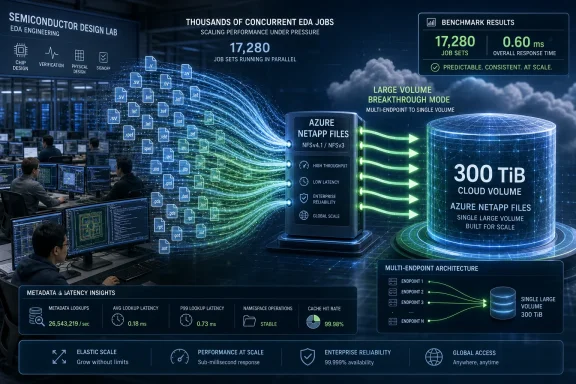
Microsoft and NetApp published new SPECstorage Solution 2020 EDA_BLENDED results on April 24, 2026, showing Azure NetApp Files large volume breakthrough mode scale reaching 17,280 job sets with 0.60 millisecond overall response time in a 300 TiB cloud storage configuration. That is not merely another benchmark trophy for Azure’s slide deck. It is a signal that one of cloud EDA’s most stubborn objections — shared file storage under brutal concurrency — is being attacked at the layer where chip design teams actually feel pain. The claim is no longer that EDA can move to the cloud; it is that storage may no longer be the automatic reason it cannot.
For years, the easiest part of the cloud EDA pitch was compute. If a design team needed more cores for simulation, verification, regression, or synthesis, the cloud could provide them in volumes that most corporate datacenters could not justify keeping idle. The hard part was what happened after those cores arrived: thousands of jobs began hammering shared project trees, tool libraries, scratch areas, and result directories, and suddenly the elegant elasticity story met the unglamorous physics of file systems.
Electronic Design Automation workloads are not just “big data” workloads with semiconductor branding. They are messy, metadata-heavy, latency-sensitive, and relentlessly concurrent. A regression farm may look impressive on a cloud bill, but if a shared file system turns every metadata lookup into a tiny tax on thousands of jobs, the farm becomes less a supercomputer than a very expensive waiting room.
That is why Azure NetApp Files’ latest benchmark matters. Microsoft is not merely saying that ANF can serve a large amount of data. It is arguing that a native Azure file service can sustain the kind of low-latency, shared NFS behavior that historically kept many serious EDA environments anchored to carefully tuned on-premises storage appliances.
The distinction matters for WindowsForum readers because the story is not really about chip designers alone. It is about a broader shift in cloud infrastructure: the move from elastic resources that look good in isolation to managed platforms that behave predictably when every layer is under pressure.
The published result for Azure NetApp Files large volume breakthrough mode scale lists 17,280 job sets, 125,474 MB/s, and an overall response time of 0.60 milliseconds. The underlying test used a 300 TiB configuration and was published alongside other SPECstorage EDA_BLENDED submissions, giving it a useful frame of comparison rather than leaving it as a vendor-owned marketing number.
There is nuance here. The SPEC result’s detailed performance table shows latency increasing at the highest tested load points, which is exactly why the overall response-time number should be read as a benchmark metric rather than a universal guarantee for every production environment. Still, the result is substantial because EDA teams rarely care about peak throughput in isolation; they care about whether performance remains usable as concurrency rises.
That is the point Microsoft and NetApp are trying to make. The old cloud storage fear was not that a file service could never be fast under ideal conditions. It was that it would become unpredictable as the job count grew, and unpredictability is poison in a design flow where tool licenses, engineer time, and tape-out schedules are all expensive.
That architectural detail is more important than the branding. Many enterprise cloud disappointments happen when a service scales in one dimension but not the one the workload needs. A volume can be large without being responsive, a service can publish impressive throughput without tolerating metadata storms, and a cluster can add compute while making shared storage worse.
EDA punishes those gaps. A design environment is not a tidy sequence of read, compute, write. It is a living filesystem under assault from tools that open, stat, create, modify, and delete huge numbers of files while other stages perform heavier data movement. The relevant question is not whether a service can store hundreds of terabytes, but whether it can remain calm when thousands of jobs behave like thousands of impatient engineers.
Breakthrough mode appears to be Microsoft and NetApp’s answer to that very specific anxiety. By expanding the concurrency envelope around large volumes, ANF is trying to let teams preserve the operational simplicity of a shared namespace without accepting the traditional penalty of a single hot bottleneck.
On-premises EDA infrastructure has historically won because it was purpose-built, physically close to users and tools, and controlled by teams who understood every eccentricity of the design flow. The storage systems were often expensive, but they were bought for a reason. When tape-out dates are measured in missed market windows and millions of dollars, nobody wants to discover that cloud elasticity came with a hidden latency tax.
But the on-premises model has its own failure mode: capacity planning. Semiconductor teams do not consume infrastructure evenly. They surge around verification, regressions, signoff, and tape-out milestones, then sit with infrastructure that was sized for peaks. Cloud’s promise is not just more compute; it is the ability to shape infrastructure around the design cycle rather than forcing the design cycle to fit a procurement calendar.
If the storage layer can keep up, that promise becomes much more credible. A team can burst regressions into Azure without treating shared file performance as a science experiment. A company can extend an existing environment into the cloud for peak demand rather than committing to permanent datacenter expansion. A smaller design house can potentially access infrastructure patterns that once belonged mostly to the largest semiconductor firms.
That does not make cloud EDA easy. Data gravity, IP protection, export controls, license servers, tool certification, network design, and cost governance still matter. But it changes the shape of the objection. Storage is moving from “the reason we cannot” to “one of the systems we must architect correctly.”
Those names matter because they are not casual cloud adopters running hobbyist workloads. AMD operates in one of the most competitive processor markets in the world. ASML sits at the center of the semiconductor equipment ecosystem. Applied Materials is a foundational player in chip manufacturing technology. These are organizations for whom infrastructure failure is not an inconvenience; it is a threat to product execution.
The endorsement should still be read as vendor-supplied evidence, not independent ethnography. Microsoft is highlighting customers that support its narrative, and no public cloud announcement volunteers the ugly migration details unless forced. Yet customer validation in EDA carries more weight than it would in a generic SaaS migration because the workload is so unforgiving.
The broader lesson is that cloud adoption in semiconductors is becoming less ideological. The debate is no longer between cloud believers and datacenter traditionalists. It is becoming a portfolio decision: which parts of the design flow belong on premises, which can burst, which can be cloud-native, and which storage architecture lets those choices coexist without turning file movement into a second job.
That is why Microsoft’s claim about reduced bottlenecks has a business dimension beyond storage. In EDA, faster does not simply mean more elegant. It can mean more verification runs before a deadline, more confidence in a design change, fewer late surprises, and a better chance of hitting a tape-out window.
The license angle is particularly sharp. EDA tools are famously expensive, and many customers manage license pools with extreme care. A storage bottleneck that stretches job duration can make a license pool look too small even when the real culprit is infrastructure drag. Improve the file system’s behavior, and the same license footprint can sometimes do more useful work.
That does not mean ANF automatically lowers costs. High-performance managed storage is not cheap, and large volumes tied to demanding service levels can become a serious line item. But the right comparison is not raw dollars per TiB. It is the cost of predictable throughput against the cost of missed schedules, underused compute, license contention, and overbuilt on-premises capacity.
That is important because modern Microsoft infrastructure is not just Windows Server, Active Directory, and SMB shares. It is hybrid identity, Linux VMs, Kubernetes, HPC, SAP, Oracle, AVS, AI training, and specialized industry workloads that expect protocols and performance characteristics Microsoft did not historically own end to end. Azure NetApp Files is one of the clearest examples of Microsoft deciding that the answer is not to reinvent every storage behavior in Redmond, but to integrate a proven specialist platform as a first-party Azure service.
For administrators, that model is both attractive and uncomfortable. Attractive, because it offers managed access to enterprise storage capabilities without building a NetApp estate from scratch. Uncomfortable, because it adds another premium service with its own quotas, regional availability, networking constraints, mount best practices, and performance economics.
That is the modern cloud bargain. You get a managed service that can absorb operational complexity, but you do not get to ignore architecture. The more specialized the workload, the more the customer still needs to understand the shape of its I/O, its metadata behavior, and its failure domains.
A high-performance shared file service also does not remove the need for disciplined data layout. Some teams may prefer a centralized large-volume model to simplify namespace management and maximize throughput. Others may split workloads across multiple volumes to isolate job types, projects, or performance domains. Hybrid organizations may use ANF mainly as burst capacity, extending on-premises environments into Azure during peak regression demand.
Each pattern has tradeoffs. A single namespace can simplify user and tool behavior, but it increases the importance of getting the storage design right. Multiple volumes can distribute load, but they may add operational complexity. Burst models can soften capital planning, but they raise questions about data synchronization, security boundaries, and network path consistency.
There is also the matter of regional reality. Not every Azure feature is equally available everywhere, and high-end storage architectures may depend on specific regional capabilities, quotas, or preview status. Enterprises that treat the benchmark as a purchase order rather than an engineering input will be disappointed. The result proves capability; it does not replace design.
The pattern is deliberate. Microsoft does not need every semiconductor workflow to become cloud-native overnight. It needs enough critical workloads to prove that Azure can be a serious extension of the engineering datacenter. Once the storage and compute foundation is credible, higher-level services — automation, analytics, security tooling, identity, governance, and eventually AI-assisted design workflows — become easier to attach.
NetApp also benefits from this shift. For decades, storage vendors sold into enterprise datacenters by being the trusted layer underneath critical applications. In the cloud era, the risk was that hyperscalers would abstract that role away. Azure NetApp Files shows a different path: make the storage platform native enough to be consumed like Azure, while preserving the performance identity that made customers trust it in the first place.
That hybrid identity is why ANF is strategically interesting. It is neither a generic object store nor a simple file share. It is a specialist storage service embedded inside a hyperscale platform, aimed at workloads where general-purpose cloud primitives are not enough.
On-premises storage still offers control, locality, predictable procurement once installed, and deep integration with established engineering practices. Some organizations will prefer to keep their most sensitive IP and critical workflows inside private facilities. Others may use cloud only for overflow, experimentation, or geographically distributed collaboration.
The benchmark also does not answer every cost question. A cloud environment that performs beautifully can still surprise finance teams if capacity pools, data movement, snapshots, replication, compute bursts, and license usage are not governed carefully. Storage that is no longer the technical bottleneck can still become an economic bottleneck if teams treat elasticity as infinite permission.
What has changed is the burden of proof. The old assumption that cloud shared storage is inherently unsuitable for large-scale EDA is harder to defend. The more precise argument now has to be about a specific workload, region, security model, toolchain, data layout, and cost envelope.
 The Cloud EDA Argument Has Moved From Compute to Contention
For years, the easiest part of the cloud EDA pitch was compute. If a design team needed more cores for simulation, verification, regression, or synthesis, the cloud could provide them in volumes that most corporate datacenters could not justify keeping idle. The hard part was what happened after those cores arrived: thousands of jobs began hammering shared project trees, tool libraries, scratch areas, and result directories, and suddenly the elegant elasticity story met the unglamorous physics of file systems.Electronic Design Automation workloads are not just “big data” workloads with semiconductor branding. They are messy, metadata-heavy, latency-sensitive, and relentlessly concurrent. A regression farm may look impressive on a cloud bill, but if a shared file system turns every metadata lookup into a tiny tax on thousands of jobs, the farm becomes less a supercomputer than a very expensive waiting room.
That is why Azure NetApp Files’ latest benchmark matters. Microsoft is not merely saying that ANF can serve a large amount of data. It is arguing that a native Azure file service can sustain the kind of low-latency, shared NFS behavior that historically kept many serious EDA environments anchored to carefully tuned on-premises storage appliances.
The distinction matters for WindowsForum readers because the story is not really about chip designers alone. It is about a broader shift in cloud infrastructure: the move from elastic resources that look good in isolation to managed platforms that behave predictably when every layer is under pressure.
The Benchmark Is Impressive Because It Tests the Boring Part That Breaks
The SPECstorage Solution 2020 EDA_BLENDED benchmark is valuable because it does not flatter storage systems with a single heroic number. It models a blended EDA workload that includes frontend metadata pressure and backend throughput demand, which is closer to what semiconductor teams face during real design cycles. In practical terms, it asks whether the storage platform can keep responding quickly when many jobs are making many different kinds of requests at once.The published result for Azure NetApp Files large volume breakthrough mode scale lists 17,280 job sets, 125,474 MB/s, and an overall response time of 0.60 milliseconds. The underlying test used a 300 TiB configuration and was published alongside other SPECstorage EDA_BLENDED submissions, giving it a useful frame of comparison rather than leaving it as a vendor-owned marketing number.
There is nuance here. The SPEC result’s detailed performance table shows latency increasing at the highest tested load points, which is exactly why the overall response-time number should be read as a benchmark metric rather than a universal guarantee for every production environment. Still, the result is substantial because EDA teams rarely care about peak throughput in isolation; they care about whether performance remains usable as concurrency rises.
That is the point Microsoft and NetApp are trying to make. The old cloud storage fear was not that a file service could never be fast under ideal conditions. It was that it would become unpredictable as the job count grew, and unpredictability is poison in a design flow where tool licenses, engineer time, and tape-out schedules are all expensive.
Breakthrough Mode Is a Storage Architecture Answer, Not a Magic Button
Azure NetApp Files large volume breakthrough mode is aimed squarely at that concurrency problem. NetApp has described breakthrough mode as using multiple storage endpoints for a single large volume, with dedicated capacity stamps intended to reduce noisy-neighbor effects and support demanding HPC and EDA workloads. Microsoft’s own performance documentation frames the feature around scale-out Linux workloads, large file counts, parallel operations, and EDA-style access patterns.That architectural detail is more important than the branding. Many enterprise cloud disappointments happen when a service scales in one dimension but not the one the workload needs. A volume can be large without being responsive, a service can publish impressive throughput without tolerating metadata storms, and a cluster can add compute while making shared storage worse.
EDA punishes those gaps. A design environment is not a tidy sequence of read, compute, write. It is a living filesystem under assault from tools that open, stat, create, modify, and delete huge numbers of files while other stages perform heavier data movement. The relevant question is not whether a service can store hundreds of terabytes, but whether it can remain calm when thousands of jobs behave like thousands of impatient engineers.
Breakthrough mode appears to be Microsoft and NetApp’s answer to that very specific anxiety. By expanding the concurrency envelope around large volumes, ANF is trying to let teams preserve the operational simplicity of a shared namespace without accepting the traditional penalty of a single hot bottleneck.
The Cloud Is Starting to Look Less Like a Compromise for Chip Design
The most interesting sentence in Microsoft’s announcement is not the benchmark number. It is the implication that cloud-based EDA can now be “in many cases superior” to traditional environments. That is a provocative claim, and one that deserves both attention and skepticism.On-premises EDA infrastructure has historically won because it was purpose-built, physically close to users and tools, and controlled by teams who understood every eccentricity of the design flow. The storage systems were often expensive, but they were bought for a reason. When tape-out dates are measured in missed market windows and millions of dollars, nobody wants to discover that cloud elasticity came with a hidden latency tax.
But the on-premises model has its own failure mode: capacity planning. Semiconductor teams do not consume infrastructure evenly. They surge around verification, regressions, signoff, and tape-out milestones, then sit with infrastructure that was sized for peaks. Cloud’s promise is not just more compute; it is the ability to shape infrastructure around the design cycle rather than forcing the design cycle to fit a procurement calendar.
If the storage layer can keep up, that promise becomes much more credible. A team can burst regressions into Azure without treating shared file performance as a science experiment. A company can extend an existing environment into the cloud for peak demand rather than committing to permanent datacenter expansion. A smaller design house can potentially access infrastructure patterns that once belonged mostly to the largest semiconductor firms.
That does not make cloud EDA easy. Data gravity, IP protection, export controls, license servers, tool certification, network design, and cost governance still matter. But it changes the shape of the objection. Storage is moving from “the reason we cannot” to “one of the systems we must architect correctly.”
AMD, ASML, and Applied Materials Give the Story Production Weight
Benchmarks are useful, but EDA buyers are not easily moved by synthetic confidence. They want to know whether serious engineering organizations are already betting production work on the platform. Microsoft’s announcement names AMD and ASML as organizations using Azure NetApp Files for EDA and high-performance design workloads, and includes an endorsement from Applied Materials’ Srikanth Gubbala praising ANF’s high-throughput NFS performance for shrinking runtimes and accelerating tape-out schedules.Those names matter because they are not casual cloud adopters running hobbyist workloads. AMD operates in one of the most competitive processor markets in the world. ASML sits at the center of the semiconductor equipment ecosystem. Applied Materials is a foundational player in chip manufacturing technology. These are organizations for whom infrastructure failure is not an inconvenience; it is a threat to product execution.
The endorsement should still be read as vendor-supplied evidence, not independent ethnography. Microsoft is highlighting customers that support its narrative, and no public cloud announcement volunteers the ugly migration details unless forced. Yet customer validation in EDA carries more weight than it would in a generic SaaS migration because the workload is so unforgiving.
The broader lesson is that cloud adoption in semiconductors is becoming less ideological. The debate is no longer between cloud believers and datacenter traditionalists. It is becoming a portfolio decision: which parts of the design flow belong on premises, which can burst, which can be cloud-native, and which storage architecture lets those choices coexist without turning file movement into a second job.
The Economics Are About Time, Not Just Terabytes
Storage vendors love to talk about throughput, IOPS, and latency, but EDA executives care about a different unit: schedule. If storage stalls reduce compute utilization, the company pays for idle cores. If regressions take longer, engineers wait longer for feedback. If tool licenses are tied up by jobs making poor progress, software costs rise without corresponding output.That is why Microsoft’s claim about reduced bottlenecks has a business dimension beyond storage. In EDA, faster does not simply mean more elegant. It can mean more verification runs before a deadline, more confidence in a design change, fewer late surprises, and a better chance of hitting a tape-out window.
The license angle is particularly sharp. EDA tools are famously expensive, and many customers manage license pools with extreme care. A storage bottleneck that stretches job duration can make a license pool look too small even when the real culprit is infrastructure drag. Improve the file system’s behavior, and the same license footprint can sometimes do more useful work.
That does not mean ANF automatically lowers costs. High-performance managed storage is not cheap, and large volumes tied to demanding service levels can become a serious line item. But the right comparison is not raw dollars per TiB. It is the cost of predictable throughput against the cost of missed schedules, underused compute, license contention, and overbuilt on-premises capacity.
The NFS Story Still Matters in a Windows-Centric World
At first glance, this may seem like a Linux-and-silicon story sitting at the edge of WindowsForum’s usual orbit. EDA farms are commonly Linux-heavy, and the benchmark configuration details around NFS are far from the world of desktop Windows. But for IT pros, the relevance is broader: Microsoft is continuing to build Azure into a place where deeply Unix-flavored enterprise workloads can run without being treated as second-class citizens.That is important because modern Microsoft infrastructure is not just Windows Server, Active Directory, and SMB shares. It is hybrid identity, Linux VMs, Kubernetes, HPC, SAP, Oracle, AVS, AI training, and specialized industry workloads that expect protocols and performance characteristics Microsoft did not historically own end to end. Azure NetApp Files is one of the clearest examples of Microsoft deciding that the answer is not to reinvent every storage behavior in Redmond, but to integrate a proven specialist platform as a first-party Azure service.
For administrators, that model is both attractive and uncomfortable. Attractive, because it offers managed access to enterprise storage capabilities without building a NetApp estate from scratch. Uncomfortable, because it adds another premium service with its own quotas, regional availability, networking constraints, mount best practices, and performance economics.
That is the modern cloud bargain. You get a managed service that can absorb operational complexity, but you do not get to ignore architecture. The more specialized the workload, the more the customer still needs to understand the shape of its I/O, its metadata behavior, and its failure domains.
The Fine Print Is Where Production Architectures Will Succeed or Fail
The benchmark headline is big, but production EDA deployments will live in details that never fit neatly into a launch blog. Microsoft’s own documentation around large volume breakthrough mode discusses Linux mount options, VM bandwidth limits, service levels, throughput behavior, and workload characteristics. Those are not implementation trivia; they are the difference between reproducing the promise and merely buying the product.A high-performance shared file service also does not remove the need for disciplined data layout. Some teams may prefer a centralized large-volume model to simplify namespace management and maximize throughput. Others may split workloads across multiple volumes to isolate job types, projects, or performance domains. Hybrid organizations may use ANF mainly as burst capacity, extending on-premises environments into Azure during peak regression demand.
Each pattern has tradeoffs. A single namespace can simplify user and tool behavior, but it increases the importance of getting the storage design right. Multiple volumes can distribute load, but they may add operational complexity. Burst models can soften capital planning, but they raise questions about data synchronization, security boundaries, and network path consistency.
There is also the matter of regional reality. Not every Azure feature is equally available everywhere, and high-end storage architectures may depend on specific regional capabilities, quotas, or preview status. Enterprises that treat the benchmark as a purchase order rather than an engineering input will be disappointed. The result proves capability; it does not replace design.
Microsoft Is Turning Industry Workloads Into Cloud Beachheads
This announcement fits a larger Azure strategy: win specialized workloads by solving the bottleneck that keeps them off cloud. For AI, that bottleneck may be GPU supply and data pipeline design. For SAP, it may be certified infrastructure and resilient storage. For EDA, it is shared file performance under concurrency.The pattern is deliberate. Microsoft does not need every semiconductor workflow to become cloud-native overnight. It needs enough critical workloads to prove that Azure can be a serious extension of the engineering datacenter. Once the storage and compute foundation is credible, higher-level services — automation, analytics, security tooling, identity, governance, and eventually AI-assisted design workflows — become easier to attach.
NetApp also benefits from this shift. For decades, storage vendors sold into enterprise datacenters by being the trusted layer underneath critical applications. In the cloud era, the risk was that hyperscalers would abstract that role away. Azure NetApp Files shows a different path: make the storage platform native enough to be consumed like Azure, while preserving the performance identity that made customers trust it in the first place.
That hybrid identity is why ANF is strategically interesting. It is neither a generic object store nor a simple file share. It is a specialist storage service embedded inside a hyperscale platform, aimed at workloads where general-purpose cloud primitives are not enough.
The Benchmark Does Not End the On-Premises Debate
There is a temptation to turn this kind of result into a clean victory lap: cloud beats on-premises, storage bottleneck solved, everyone migrate. That would be too simple. Semiconductor infrastructure is conservative for good reasons, and many EDA environments will remain hybrid for years.On-premises storage still offers control, locality, predictable procurement once installed, and deep integration with established engineering practices. Some organizations will prefer to keep their most sensitive IP and critical workflows inside private facilities. Others may use cloud only for overflow, experimentation, or geographically distributed collaboration.
The benchmark also does not answer every cost question. A cloud environment that performs beautifully can still surprise finance teams if capacity pools, data movement, snapshots, replication, compute bursts, and license usage are not governed carefully. Storage that is no longer the technical bottleneck can still become an economic bottleneck if teams treat elasticity as infinite permission.
What has changed is the burden of proof. The old assumption that cloud shared storage is inherently unsuitable for large-scale EDA is harder to defend. The more precise argument now has to be about a specific workload, region, security model, toolchain, data layout, and cost envelope.
The Real Win Is Predictability Under Pressure
The concrete lesson from Azure NetApp Files’ latest EDA push is not that every chip design team should immediately move wholesale into Azure. It is that cloud storage for the hardest shared-file workloads is becoming more credible, measurable, and production-oriented. That is a meaningful shift for a sector where infrastructure caution is rational.- Azure NetApp Files large volume breakthrough mode scale has a published SPECstorage Solution 2020 EDA_BLENDED result of 17,280 job sets with 0.60 millisecond overall response time.
- The result matters because EDA workloads stress metadata operations, throughput, and latency at the same time rather than in clean separate phases.
- Microsoft is positioning ANF as a way to scale cloud compute without allowing shared storage contention to erase the benefit.
- Production references from AMD, ASML, and Applied Materials give the announcement more weight, while still leaving room for customer-specific validation.
- IT teams should treat the benchmark as evidence of capability, not as a substitute for workload profiling, regional planning, network design, and cost modeling.
- The broader implication is that Azure is becoming more viable for specialized engineering workloads that once seemed permanently tied to purpose-built datacenters.
References
- Primary source: Microsoft Azure
Published: 2026-05-22T15:30:08.672814
Azure NetApp Files for EDA workloads: From revolution to breakthrough at scale | Microsoft Azure Blog
Discover how Azure NetApp Files enables scalable, high-performance storage for EDA workloads, delivering low latency, massive concurrency, and predictable performance in the cloud. azure.microsoft.com
- Related coverage: netapp.com
Preview: Large volume breakthrough mode in Azure NetApp Files | NetApp
Breakthrough mode in Azure NetApp Files is now available in preview, enabling extreme performance and scalability for demanding HPC and EDA workloads.www.netapp.com - Official source: learn.microsoft.com
Azure NetApp Files large volume breakthrough mode performance benchmarks for Linux | Microsoft Learn
Describes the tested performance capabilities of a single Azure NetApp Files large volume breakthrough mode as it pertains to Linux use cases.learn.microsoft.com - Related coverage: docs.netapp.com
Azure NetApp Files documentation
Azure NetApp Files is a Microsoft Azure native, high performance file storage service for your core business applications. This documentation describes how t...docs.netapp.com - Related coverage: azurefeeds.com
