

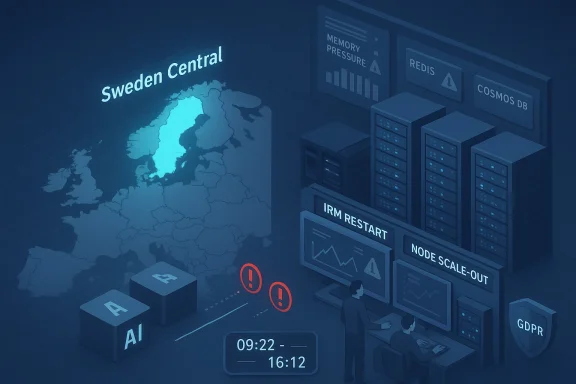
Microsoft's Azure OpenAI Service suffered a prolonged outage in the Sweden Central region on 27 January 2026, leaving customers in the region — including those constrained by EU data‑residency requirements — unable to run inference and realtime workloads for much of the working day. The failure, detected just after 09:00 UTC and fully mitigated by 16:12 UTC, was traced to cascading platform failures driven by an unhealthy internal resource manager (IRM) service, pod out‑of‑memory conditions, and stressed backend dependencies such as Redis and Cosmos DB fallbacks. Microsoft’s incident timeline confirms a sequence of mitigations — an IRM restart, node scale‑out, and an increase in pod memory — before normal service was restored, but the episode highlights persistent resilience gaps for cloud AI services running in single, compliance‑constrained regions.
Background
Azure OpenAI Service is Microsoft’s managed offering that hosts large language models and realtime AI endpoints for enterprise customers. For many European businesses, the Sweden Central region is a critical deployment target because it has been marketed as a GDPR‑compatible, EU‑resident location for AI workloads. That makes the operational health of Sweden Central particularly sensitive: outages there can’t always be mitigated by trivially switching to a non‑EU region without introducing regulatory and contractual complications. Over the past year customers have reported intermittent stability issues in Sweden Central for a range of models and realtime services, and the January 27 incident is the latest high‑visibility example.What happened — a step‑by‑step timeline
The official Azure status history provides a clear, minute‑by‑minute chronology of the incident and the engineering actions taken. Summarized, the critical events were:- Detection: 09:22 UTC — monitoring detected intermittent availability issues and elevated error rates affecting Azure OpenAI Service in Sweden Central.
- Initial mitigation: 12:36 UTC — engineers restarted the internal resource manager (IRM) service on Sweden Central clusters as a first remedial action.
- Pod failures: 12:46 UTC — the cluster experienced pods crashing with out‑of‑memory (OOM) terminations.
- Scale‑out: 13:02 UTC — the team scaled out nodes in the AKS cluster to improve request handling and resilience.
- Memory increase: 15:30–15:53 UTC — memory available to impacted pods was raised to relieve memory pressure.
- Recovery: 16:12 UTC — Azure confirmed service restoration and mitigation of customer impact.
Scope and customer impact
- Models and endpoints: Microsoft’s status messaging and customer reports indicate that major production models — including GPT‑5.x and GPT‑4.1 family variants used by many enterprise deployments — were affected by the incident. Customers reported 500/503 errors and failed inferences during the outage window.
- Realtime/voice services: Users of the Realtime APIs and voice endpoints experienced failed WebSocket connections and invalid response status errors. This mattered for telephony and voice‑bot operators who deploy only to Sweden Central because of EU residency requirements; they had no EU region to fail over to for realtime models at the time.
- Downstream services: The outage touched not only the OpenAI API endpoints but also dependent AI services that rely on Azure’s OpenAI platform, including vector store operations and the AI Studio experience. Community threads in Microsoft’s Q&A forums show user reports of failed uploads, vectorization failures, and portal slowdowns.
- Business continuity: Several production services — voice bots, customer chat assistants, and internal automation pipelines — reported partial or complete unavailability during the outage window. In some cases operators performed emergency manual failover to non‑EU regions, accepting trade‑offs in data residency or functionality.
Technical analysis — what the status page tells us
Microsoft’s summary names multiple technical contributors rather than a single blunt cause. The chief items include:- An unhealthy backend dependent service that caused cascading failures through the platform’s request processing and authorization layers.
- IRM crash‑looping and restarts: the internal resource manager appears to have become unstable, prompting an IRM restart as an initial mitigation. Restarting control plane services is a standard step to clear transient state or unlock stalled orchestration, but it’s a blunt instrument when underlying resource pressure remains unresolved.
- Memory pressure in the AKS cluster: pods were terminated with OOM errors and only recovered after scaling out nodes and increasing pod memory allocations. This indicates that either runtime memory usage spiked (for example, due to large in‑flight request contexts or memory leaks) or planned resource limits were insufficient for peak loads.
- Redis pool exhaustion and Cosmos DB fallback failures: the status narrative and community accounts reference stressed Redis pools and failed DB fallbacks, which can magnify platform instability by making transient spikes become persistent errors when stateful caches and metadata stores fail to keep up. These are classic signs of a dependency‑chain amplification problem: a single strained component causes other components to back up, creating cascading timeouts and 5xx responses.
How Microsoft responded — strengths and weaknesses
Microsoft’s public timeline and the actions logged in the Azure status entries show sensible, sequential remediation steps: detection, restart of the IRM control plane, identification of OOMs, node scale‑out, and memory increases. Those are appropriate actions for the symptoms described. However, the incident also exposed operational shortcomings:- Strength: Microsoft detected the issue via monitoring and provided public status updates through Azure status, advising customers to consider failover where possible and committing to a PIR. Public, timely acknowledgment reduces uncertainty and helps customers react.
- Weakness: The incident took seven hours from detection to full mitigation in a region providing critical EU‑resident AI services. For enterprise customers running production workflows, that duration is long and costly, especially for services with realtime or synchronous user‑facing expectations. Community comments show customers were forced to improvise failover and workarounds.
- Weakness: Single‑region model availability and feature parity remain a systemic risk. Some realtime models and newer versions are not available across multiple EU regions, leaving customers with no regulatory‑compliant failover options. That amplifies business continuity risk for EU‑resident deployments.
- Weakness: The need to restart IRM and then perform hardware‑level mitigations (scale nodes, increase pod memory) suggests that capacity management or autoscaling thresholds did not prevent the cluster from tippling into an unstable regime. Modern cloud services aim to make these transitions seamless; the manual steps imply more brittle automation or insufficient resource headroom.
Customer takeaways and mitigation strategies
For teams running AI services on Azure (or any managed AI cloud offering), this outage is a practical reminder that the cloud is resilient but not infallible. Customers should treat platform availability as a shared responsibility and prepare for regional failures.Key tactics:
- Multi‑region deployment and automatic failover. Where legally possible, deploy critical services across multiple regions and configure automatic DNS failover or traffic managers. This reduces single‑region single‑point‑of‑failure risk. If regulatory constraints prevent cross‑region failover, create tested manual playbooks. Lesson: Don’t wait for production to break to build resilience.
- Graceful degradation. Design applications to fall back to cached responses, simpler models, or queue requests for asynchronous processing when runtime inference isn’t available. This reduces the perceived downtime for end users.
- Robust retry and backoff logic. Implement exponential backoff and circuit breakers when calling managed APIs to avoid thrashing backends during transient failures. Many customers saw 500/503 errors; indiscriminate retries can worsen overload.
- Capacity and cost trade‑offs. Maintain buffer capacity where possible (e.g., standby deployments with minimal cost) for rapid scale‑up in a second region. Consider negotiating for dedicated capacity or SLA commitments if your business depends on predictable AI throughput.
- Observability and runbooks. Instrument health checks for model latencies, inference error rates, Redis/Cosmos latencies, and pod memory usage. Test incident playbooks regularly and keep escalation contacts for platform teams.
Architectural recommendations for Microsoft and other cloud AI providers
This incident is a case study in why AI infrastructure needs specialized operational patterns beyond generic PaaS services.- Broader regional parity for realtime endpoints. Customers needing GDPR‑compliant realtime services require model availability and parity across multiple EU regions. Providers should prioritize cross‑region rollout for realtime and voice models to reduce single‑region exposure. Community reports show that lack of EU alternatives forced risky failovers to non‑EU regions for some customers.
- Hardened dependency isolation. Redis and Cosmos DB pools are common amplification points. AI platform architectures should isolate critical metadata and token‑authorization paths to prevent a single cache exhaustion from degrading request authorization globally. Rate limiting, backpressure, and graceful fallback strategies for caches and metadata stores are essential.
- Better autoscaling and memory management. Pods hosting AI orchestration code should have predictive autoscaling based on inference concurrency and memory footprints. Autoscaling should be conservative enough to prevent OOM surge death spirals and avoid cascading control‑plane restarts as the first reaction.
- Transparent incident telemetry. Customers need faster, more granular status channels (e.g., per‑model, per‑endpoint health flags), and clearer guidance on when regional failover is safe. While Azure did publish a timeline, customers repeatedly asked for updates and expressed frustration at how long mitigation took.
- Proactive resilience features. Offer managed cross‑region replication for critical state such as vector indexes, model deployment metadata, and realtime session handoffs. That would enable more automated failover with fewer regulatory trade‑offs.
Regulatory and compliance friction
One of the harder constraints for EU customers is data residency. When a single EU region hosts a required deployment — for example, realtime speech models tied to local laws — customers can’t simply fail over to a US region without potentially violating GDPR commitments or contractual obligations. The incident shows that providers must balance regional compliance with operational redundancy by ensuring model and feature parity across multiple compliant regions. Some customers explicitly called this out in support threads: they were unable to maintain business continuity because the only region supporting their realtime model was Sweden Central.The economics of reliability: SLAs, credits, and real impact
Outages like this prompt discussions about what customers should expect from a managed AI provider’s SLA. Traditional compute and storage SLAs often fail to capture the operational model for AI inference and realtime APIs, where latency, predictability, and model availability are as important as raw uptime. Customers should:- Review SLA terms specifically for AI services and clarify what constitutes a breach (e.g., model unavailability vs. portal degradation).
- Negotiate custom SLAs or dedicated capacity for high‑value applications.
- Maintain incident cost models to quantify business impact and inform discussions with vendors.
What we still don’t know — and what to watch for in the PIR
Microsoft’s public incident notes identify the mitigation steps and contributing systems, but they stop short of a full root cause explanation. Key unknowns that the forthcoming PIR should address:- Why did the IRM become unhealthy? Was it triggered by a specific rollout, a memory leak, a malformed request pattern, or a control‑plane race condition?
- What caused the memory pressure? Large context sizes, runaway request patterns, or a regression in model hosting runtimes are all plausible.
- Were there automation gaps — missing autoscaling triggers or slow remediation playbooks — that turned a transient spike into a prolonged outage?
- How will Microsoft change capacity planning, testing, and deployment procedures to prevent similar cascading failures?
Practical checklist for WindowsForum readers running AI workloads on Azure
- Confirm whether your deployments are single‑region and whether those regions are critical for regulatory reasons. If so, create a compliance‑aware failover plan.
- Add resilience patterns now: circuit breakers, backoff, and graceful degradation. Test them under simulated fault conditions.
- Instrument the full dependency chain: API success rates, Redis/Cosmos latencies, pod memory/CPU, and IRM/control‑plane health. Automate alerts for early warning.
- Maintain a minimal warm standby in at least one alternate region (even if it carries extra cost). A standby can reduce RTO from hours to minutes.
- Subscribe to Azure Service Health and enable targeted alerts for the specific Azure OpenAI resources and regions you use.
Conclusion
The Sweden Central outage on 27 January 2026 is a reminder that even the newest class of cloud services — managed LLM and realtime AI platforms — inherits classic infrastructure failure modes: dependency overload, memory pressure, control‑plane instability, and cascading failures. Microsoft’s engineering interventions restored service, and the promised PIR should help customers and the broader industry learn from the event. Still, the incident exposes hard trade‑offs for customers who require EU residency and single‑region deployments: without broader regional parity and hardened dependency isolation, businesses remain exposed to potentially long, disruptive outages.For enterprises building on Azure OpenAI Service, the safe path forward combines platform safeguards and application‑level resilience: multi‑region strategies where legal, robust observability, and graceful degradation. Cloud providers must likewise accelerate cross‑region parity for realtime models and harden platform dependencies so that a single stressed component cannot cascade into a region‑wide service outage. The next PIR will be the key test: will Microsoft provide the technical depth and corrective commitments that restore confidence for GDPR‑constrained AI workloads?
Source: theregister.com Microsoft Azure OpenAI Service goes down in Sweden
