

The Microsoft Azure outage that began at 19:46 UTC on February 2, 2026, and stretched into the next morning is not just another bullet point on a vendor status page — it is a textbook example of how small, automated changes inside a hyperscale cloud can cascade into long, painful outages that stop development pipelines, block VM provisioning, and cripple identity-dependent services for hours.
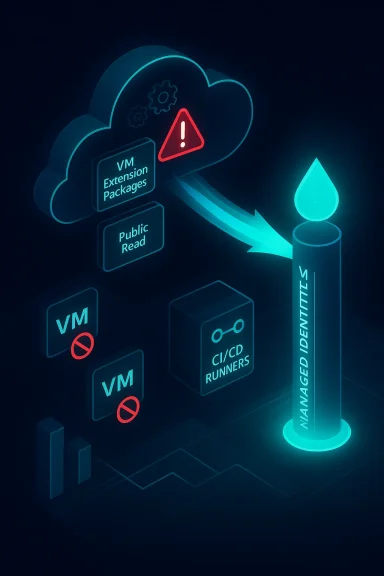
On February 2–3, 2026, Azure customers across multiple regions experienced two related failure windows: a Virtual Machines service management incident (tracking ID FNJ8‑VQZ) that began at 19:46 UTC on February 2 and a Managed Identities platform issue (tracking ID M5B‑9RZ) that unfolded roughly between 00:10 and 06:05 UTC on February 3. The proximate cause, according to Microsoft’s incident disclosures, was an automated policy remediation job that unintentionally disabled public read access for a subset of Microsoft‑managed storage accounts which host VM extension packages. That policy change prevented VM agents and provisioning flows from downloading essential artifacts; subsequent mitigation actions then overloaded the Managed Identities token service and produced a second, identity‑focused outage window.
This sequence — a benign, automated change that blocks essential artifacts, followed by a mitigation that triggers a traffic surge and a second failure — is increasingly familiar. The Azure case highlights three realities of modern cloud operations: shared primitive services (storage for extension packages, token issuance) are high‑value failure points; automated remediation tools can be dangerous when targeting logic has bugs; and mitigation actions themselves can create secondary failures unless staged and throttled.
The lesson is simple and harsh: failures in primitive services have an outsized, nonlinear impact. A single misapplied policy can turn into an hours‑long outage affecting a diversity of services and customers.
Automation raises the bar for safe change: manual mistakes are replaced by systematic mistakes that execute everywhere. When a scripted change has bad targeting, it doesn’t fail fast and locally — it fails broadly and noisily.
Two clarifications are important:
There are no easy shortcuts: achieving operational resilience means investing in engineering time, rehearsed runbooks, and redundancy that costs money. But the alternative — assuming the cloud will always “do the right thing” — now carries measurable risk. The Azure outage on February 2–3, 2026, should be a clarion call to both sides of the partnership: cloud providers must accept the duty to make automated remediations safer, and enterprises must stop outsourcing resilience to a single provider. When both sides act, we reduce not just the frequency of headlines about outages, but the real business harm those outages cause.
Source: InfoWorld Why cloud outages are becoming normal
 Background / Overview
On February 2–3, 2026, Azure customers across multiple regions experienced two related failure windows: a Virtual Machines service management incident (tracking ID FNJ8‑VQZ) that began at 19:46 UTC on February 2 and a Managed Identities platform issue (tracking ID M5B‑9RZ) that unfolded roughly between 00:10 and 06:05 UTC on February 3. The proximate cause, according to Microsoft’s incident disclosures, was an automated policy remediation job that unintentionally disabled public read access for a subset of Microsoft‑managed storage accounts which host VM extension packages. That policy change prevented VM agents and provisioning flows from downloading essential artifacts; subsequent mitigation actions then overloaded the Managed Identities token service and produced a second, identity‑focused outage window.This sequence — a benign, automated change that blocks essential artifacts, followed by a mitigation that triggers a traffic surge and a second failure — is increasingly familiar. The Azure case highlights three realities of modern cloud operations: shared primitive services (storage for extension packages, token issuance) are high‑value failure points; automated remediation tools can be dangerous when targeting logic has bugs; and mitigation actions themselves can create secondary failures unless staged and throttled.
Why this outage matters: the anatomy of cascading failure
Shared primitives, gigantic blast radius
Hyperscale clouds rely on a small set of primitive platform services — object storage endpoints, token/identity issuers, and control‑plane orchestration services — to support hundreds of higher‑level offerings. In Azure’s incident, Microsoft‑managed storage accounts that host VM extension packages acted as one such primitive. When public read access to those storage endpoints was removed, VM provisioning and extension installation failures followed immediately. Because these extension packages are downloaded during provisioning, the inability to fetch them breaks VM lifecycle operations, AKS node provisioning, scale sets, and hosted CI/CD runners.The lesson is simple and harsh: failures in primitive services have an outsized, nonlinear impact. A single misapplied policy can turn into an hours‑long outage affecting a diversity of services and customers.
Automation and policy remediation as double‑edged swords
Cloud operators use automated remediation to reduce toil and correct drift at scale. But automated jobs — especially those that enforce security or access policies — require impeccable targeting logic. In the Azure incident, a periodic remediation job intended to disable anonymous access was misapplied to accounts that required anonymous (public read) access for legitimate operations. A data synchronization bug in the targeting logic caused those Microsoft‑managed accounts to be included and thus blocked.Automation raises the bar for safe change: manual mistakes are replaced by systematic mistakes that execute everywhere. When a scripted change has bad targeting, it doesn’t fail fast and locally — it fails broadly and noisily.
Mitigation storms and retry cascades
After the initial fix was applied in some regions, queued and retried operations sought to complete. Those backlogged operations created a sudden surge against the Managed Identities token issuance platform. Multiple attempts by engineers to scale the identity service and process the backlog failed to absorb the traffic; Microsoft temporarily removed traffic from the service to repair infrastructure without further load. This mitigation‑triggered overload phenomenon — where the comeback effort produces a second outage — is a recurring pattern in modern incidents and one of the main reasons outages last as long as they do.The human and economic dimensions
Staffing, institutional knowledge, and the “B‑team” problem
Several analysts point to industry trends that increase the probability of operational error: headcount reductions, reorganizations, and skill‑gaps in operational teams. When experienced operators leave and processes are entrusted to less seasoned staff or to automated jobs without sufficient guardrails, the chance that an innocuous change goes wrong rises. That is not to say human error is the primary villain in every outage; rather, the interplay of automation, reduced experience, and complex interdependencies makes human‑originated problems more dangerous. This trend is plausible and supported by multiple industry reports, but attributing a single outage to workforce changes requires internal data that is not publicly verifiable; readers should treat such causal claims cautiously.Cost cutting vs. reliability tradeoffs
Hyperscalers operate under strong cost and growth pressures. Engineering and operational staffing are expensive, and companies continuously optimize. When reliability engineering or operational capacity is trimmed as part of cost savings, resilience becomes vulnerable. The Azure outage demonstrates the tension: enforcing access security (disabling anonymous reads) is a cost‑justified control, but doing so via an automated, broadly effective remediation without adequate preflight checks produced catastrophic side effects. Organizations must balance cost efficiency against the catastrophic cost of outages.Real consequences for enterprises and developers
Developer productivity and CI/CD pipelines
Hosted CI/CD runners, GitHub Actions, and Azure DevOps rely on VM provisioning and extension installation to execute jobs. When provisioning is blocked, hosted runner pools cannot scale and queued jobs time out. The Azure incident halted or delayed builds, tests, and deployments for hundreds of organizations. The downstream impact is more than developer frustration: delayed releases, missed SLAs, frozen deployments, and potential financial consequences for businesses dependent on continuous deployment.Kubernetes and cloud native workloads
AKS and other managed Kubernetes services often create nodes dynamically and rely on extensions or agents to bootstrap nodes. If the node provisioning flow fails, clusters cannot scale, self‑healing node replacements cannot be completed, and cluster autoscaler features break. For production systems with autoscaling for traffic spikes, this can produce overloaded pods and cascading failures in customer‑facing services.Identity failures and cross‑service outages
Managed identities are used pervasively across Azure to grant tokens for resource access without secrets. When the Managed Identities token service is overloaded or unavailable, a wide range of dependent services — analytics, managed databases, AI services, and orchestrators — cannot authenticate. That transforms a storage read failure into a cross‑service authentication crisis.What went right — and what went wrong — in Microsoft’s response
Measures that worked
- Microsoft identified the proximate cause and provided progressive incident updates on the status page.
- Engineers rolled out targeted mitigations region by region, validating fixes before wider application.
- When Managed Identities became overloaded, Microsoft isolated or removed traffic to enable controlled repairs and health recovery, avoiding aggressive restores that would re‑trigger failures.
Where the response could be stronger
- Staged throttling on mitigation rollouts could have reduced the retry surge that hit the identity platform.
- Preflight validation and simulation of the remediation job against production‑like targeting logic would likely have detected the targeting bug.
- Faster circuit breakers and token issuance rate‑limits could have prevented the identity token system from going from healthy to overloaded under replay pressure.
Cross‑checking the record: what the public evidence shows
Microsoft’s status history records the incident timeline and identifies the misapplied storage access remediation as the root trigger of the VM provisioning failures. Those public updates also document the subsequent Managed Identities overload and the service IDs FNJ8‑VQZ and M5B‑9RZ used in the incident history. Independent reporting and community telemetry (developer forums, hosted runner errors, and social reporting) corroborate the sequence: VM provisioning failures beginning at 19:46 UTC on February 2 and identity issues persisting until roughly 06:05 UTC on February 3. Community reports also anchor the impact on hosted CI/CD runners and AKS nodes. Where public evidence ends is in the internal mechanics of the targeting logic bug and why safeguards failed; Microsoft’s final PIR will be the authoritative source on those internal details.Practical recommendations for enterprises: what to do now
Cloud users must accept that provider outages happen — but they can reduce blast radius, restore operations faster, and lower business impact with concrete actions.Short‑term (immediate, tactical) steps
- Validate critical provisioning flows by running scheduled synthetic tests that exercise VM provisioning, extension installation, and identity acquisition in each region you rely on.
- Adopt caching and private artifact replication for critical extension packages and bootstrap artifacts, ideally using private endpoints or blob copies in your subscription. This prevents reliance on a vendor’s public read endpoints for core provisioning flows.
- Configure hosted runner fallbacks: enable self‑hosted runner pools or an on‑premises fallback that can execute critical pipelines if hosted runners stall.
- Harden time‑critical deployment windows: avoid scheduled production pushes that rely entirely on transient cloud provisioning during known maintenance windows or when an incident is ongoing.
Mid‑term (architectural) strategies
- Implement defensive bootstrapping: bake required agents and templates into images (golden images) so provisioning does not require dynamic downloads during the critical path.
- Use private endpoints and VNet integration for artifact stores to limit dependency on public access.
- Design services for graceful degradation: ensure core business functions do not require new token issuance in the critical path, or design token refresh retries with exponential backoff and jitter to avoid synchronized retry storms.
- Introduce multiregion redundancy for control‑plane dependent workloads and rehearsed runbooks for partial region failover.
Long‑term (organizational, contractual) moves
- Negotiate transparent post‑incident reporting and measurable timelines for PIR publication in enterprise contracts. Insist on access to metrics and root cause evidence for serious incidents.
- Build a resilience budget: allocate resources for multicloud or hybrid fallbacks for the most critical workloads; accept that multicloud is a reliability hedge, not a cost avoidance measure.
- Include recovery time objectives (RTO) and recovery point objectives (RPO) in contracts for cloud‑native services, and require playbooks and runbook tests to be part of vendor SLAs.
Concrete technical controls and checklist
- Validate provisioning flows with a heartbeat: create an automated test that provisions a throwaway VM, installs the agent/extension, and runs a small health script every region you use.
- Maintain baked images: maintain a pipeline that periodically bakes agent bundles into VM images and rotates them to reduce reliance on runtime downloads.
- Implement private artifact mirrors: replicate key extension packages and artifacts into your subscription or artifact storage under private control.
- Harden identity flows: where possible, prefetch tokens, cache them safely, and design long‑lived intermediate credentials for short windows to avoid synchronous mass token requests.
- Self‑host critical runners: keep a modest fleet of self‑hosted CI/CD runners for emergency use.
- Test failed‑path behavior: run chaos tests that simulate artifact unavailability and measure end‑to‑end recovery for critical workflows.
What cloud providers should do differently
Hyperscalers can and should reduce systemic risk by improving how changes to global policies are validated and rolled out.- Implement multi‑factor preflight checks for policy remediation jobs, including canary targets and negative lists for managed accounts deemed critical.
- Add explicit dependency maps: when a storage account hosts artifacts used by control plane flows, classify that account as “protected” and exclude it from automated remediation unless human approval is provided.
- Build stronger throttles and staged replay controls that limit the rate at which backlogs can replay after a mitigation, preventing downstream platform overload.
- Publish more granular health and capacity metrics during incidents so customers can automate their own mitigation and routing decisions faster.
Regulatory, contractual, and financial considerations
Cloud outages like this one raise practical attention for procurement and risk managers. SLAs for many IaaS components provide credits for downtime, but credits rarely equal the business loss from halted deploys, missed transactions, or brand damage. Enterprises should:- Reassess what SLA credits actually compensate for business impact and negotiate contractual protections for critical workloads.
- Require PIR delivery timelines in vendor agreements and insist on executive engagement for severe incidents.
- Consider insurance or business continuity funds that account for cloud provider systemic failures.
Why outages are becoming more visible — and why that’s not the same as “the cloud failing”
There’s a perceptual shift: cloud outages are more visible and more societally impactful because the cloud is now the backbone of business operations. In earlier eras, an outage might take down a single data center with localized impact. Today, a policy change or a token issuance problem can affect dozens of services across regions, broadcasting the failure across every developer channel and customer experience.Two clarifications are important:
- Visibility does not necessarily mean increased frequency of root causes. Part of what we see is a higher consequence per failure because more critical operations ride on shared primitives.
- Some classes of failure are actually rarer because automation, monitoring, and platform maturity have improved. The paradox is that while many low‑level failures are handled automatically, the remaining failure modes are either systemic (shared primitives) or emergent (complex multi‑service interactions), and they attract attention when they occur.
Caution where public evidence is thin
Analyses that attribute outages to layoffs, underinvestment, or specific staffing practices should be treated as hypotheses unless backed by internal documentation or vendor admissions. The public incident record establishes the technical sequence: a misapplied storage access remediation, followed by a surge that overwhelmed identity issuance. Broader industry dynamics — staffing, cost cutting, organizational priorities — are contextual and plausible drivers, but not direct causal proof for a specific event. Responsible coverage notes these likely contributors while avoiding definitive blame without internal evidence.Final thoughts: resilience as a shared responsibility
The February Azure incident is a sobering reminder that cloud resilience is not purely a vendor problem. Hyperscalers must improve change validation, canarying, and staged rollouts for policy remediations that affect platform artifacts. They must also design mitigations that account for replayed queues and downstream capacity. Equally, enterprises must treat the cloud as an environment where control‑plane dependencies matter; they must design defensive architectures that reduce reliance on vendor public artifacts and token issuance in critical paths.There are no easy shortcuts: achieving operational resilience means investing in engineering time, rehearsed runbooks, and redundancy that costs money. But the alternative — assuming the cloud will always “do the right thing” — now carries measurable risk. The Azure outage on February 2–3, 2026, should be a clarion call to both sides of the partnership: cloud providers must accept the duty to make automated remediations safer, and enterprises must stop outsourcing resilience to a single provider. When both sides act, we reduce not just the frequency of headlines about outages, but the real business harm those outages cause.
Source: InfoWorld Why cloud outages are becoming normal
