

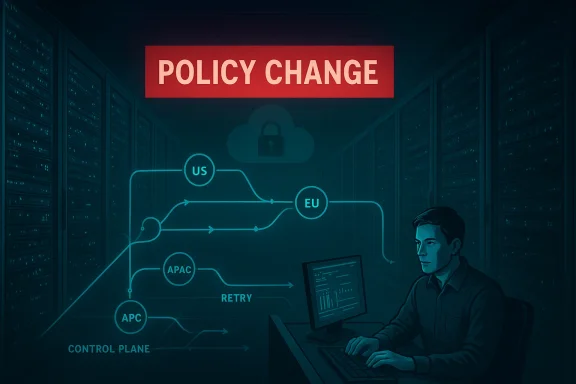
Microsoft’s Azure cloud platform suffered a chain-reaction failure that began with a misapplied storage policy and ballooned into more than ten hours of service disruption, leaving virtual machine (VM) management, managed identities, and developer CI/CD pipelines partially or fully incapacitated across multiple regions. The outage exposed a familiar but dangerous pattern at hyperscale: a narrow control-plane change—intended or accidental—can cascade through dependent services, create retry storms and backlogs, and force operators into stop‑gap mitigations such as removing traffic entirely to repair infrastructure safely.
The incident began when a policy change was accidentally applied to a subset of Microsoft‑managed storage accounts responsible for hosting virtual machine extension packages. That change blocked public read access to those storage accounts, preventing typical VM lifecycle operations—provisioning, scaling, and extension installation—from fetching required packages. Microsoft logged the virtual machines incident under tracking ID FNJ8‑VQZ and later acknowledged a related managed identities incident under tracking ID M5B‑9RZ after an attempted mitigation generated a large spike of identity traffic that overwhelmed the identities platform.
The outage window spanned the evening and overnight hours (UTC) and concluded after a staged recovery during which Microsoft intentionally removed traffic from affected identity infrastructure, repaired nodes while they were not serving load, and then gradually ramped traffic back to drain the backlog safely. Microsoft’s status history lists the VM incident beginning at 19:46 UTC on 2 February and the Managed Identities impact between roughly 00:10 UTC and 06:05 UTC on 3 February, with full mitigation declared after backlogged operations completed.
Two technical failure modes combined to escalate the event:
Two trends matter most going forward:
The immediate takeaway from this incident is straightforward: stabilize quickly, protect core runpaths, and communicate continuously. The strategic takeaway is harder: rebuild architectures and operational practices around the unglamorous discipline of resilience engineering. Until that work is complete across teams and clouds, events like the Azure outage will continue to be expensive, disruptive, and instructive.
Conclusion
The Azure outage that began with a policy change to Microsoft‑managed storage accounts and culminated in a drained identity platform is not merely a technical footnote; it’s a cautionary case study in the interplay between configuration management, control‑plane coupling, and retry amplification at hyperscale. Enterprises must respond by hardening both architecture and operations: diversify critical paths, stage and guard automated changes, rehearse incident playbooks, and accept that resilience requires continuous investment. Only by designing for control‑plane failures will organizations maintain continuity in an era where cloud platforms are both more capable and more interconnected than ever.
Source: Network World Azure outage disrupts VMs and identity services for over 10 hours
 Background
The incident began when a policy change was accidentally applied to a subset of Microsoft‑managed storage accounts responsible for hosting virtual machine extension packages. That change blocked public read access to those storage accounts, preventing typical VM lifecycle operations—provisioning, scaling, and extension installation—from fetching required packages. Microsoft logged the virtual machines incident under tracking ID FNJ8‑VQZ and later acknowledged a related managed identities incident under tracking ID M5B‑9RZ after an attempted mitigation generated a large spike of identity traffic that overwhelmed the identities platform. The outage window spanned the evening and overnight hours (UTC) and concluded after a staged recovery during which Microsoft intentionally removed traffic from affected identity infrastructure, repaired nodes while they were not serving load, and then gradually ramped traffic back to drain the backlog safely. Microsoft’s status history lists the VM incident beginning at 19:46 UTC on 2 February and the Managed Identities impact between roughly 00:10 UTC and 06:05 UTC on 3 February, with full mitigation declared after backlogged operations completed.
Timeline and confirmed facts
What Microsoft recorded (authoritative anchors)
- 19:46 UTC (02 Feb) — Customers began receiving errors for VM service management operations across multiple regions; tracking ID FNJ8‑VQZ.
- ~20:10–22:15 UTC — Partial region-level mitigations restored some functionality, but extension downloads and scale set operations still failed in places as the policy rollback rolled out.
- ~00:10 UTC (03 Feb) — Following the first mitigation, a surge in queued operations and retry traffic overwhelmed the Managed identities for Azure resources platform in East US and West US; tracking ID M5B‑9RZ.
- 04:20–06:05 UTC (03 Feb) — Infrastructure nodes recovered, Microsoft carried out a controlled ramp of traffic to allow backlogged identity operations to complete, and the service was declared restored at 06:05 UTC.
Corroboration from dependent platforms
Third‑party services that rely on Azure reported correlated failures. GitHub Actions hosted runners experienced broad degradation and queueing because runner provisioning depends on Azure VM extension packages and metadata; GitHub’s status updates explicitly linked their runner failures to a backend compute provider’s storage access policy change and cited the same Azure tracking ID. That independent confirmation underlines the cross‑vendor nature of the blast radius.The technical anatomy: how a storage policy change became an identity outage
At first glance, blocking public read access to a set of storage accounts looks like a narrowly-scoped permission fix. In this case, however, those storage accounts were the distribution points for VM extension packages—small but indispensable artifacts used during VM creation and configuration. When VMs, VM scale sets, and AKS node provisioning attempted to download those packages and got HTTP errors instead, orchestrators and provisioning systems generated retries, backoffs, and queued operations at large scale.Two technical failure modes combined to escalate the event:
- Control-plane dependency coupling. Many upstream and downstream services depend on the ability to fetch small, often public, resources during lifecycle operations. A policy change that interferes with those fetches will not merely delay a single VM—it will stall thousands of orchestration operations across multiple regions.
- Retry/backlog amplification. The attempted regional mitigation restored access for some regions while previously‑failing operations continued retrying and queuing. That surge of pending operations concentrated a large number of token requests and identity operations against the Managed Identities platform. The identities nodes in East US and West US were already processing normal traffic; the replay and retry storms pushed them beyond capacity, causing token issuance and identity‑operation failures. Microsoft eventually removed traffic from the affected identity infrastructure to repair nodes without load and then carefully ramped traffic back so backlogs could be drained safely.
Scope and customer impact
The outage touched a wide variety of Azure services and customer workflows:- Azure Virtual Machines: provisioning, scaling, start/stop, and lifecycle operations failed or returned errors in multiple regions.
- Azure Virtual Machine Scale Sets & AKS: node provisioning and extension installation were affected, causing cluster autoscaling and node replacement operations to fail.
- Azure DevOps and GitHub Actions: Hosted runners and pipelines that depend on VM extension packages or on-the-fly VM provisioning queued, timed out, or failed—delaying CI/CD, releases, and developer workflows. GitHub’s status acknowledged the compute provider’s storage policy change as the cause of their hosted runner failures.
- Managed identities: token acquisition and resource operations that use managed identities failed in East US and West US while identity nodes recovered. Services like Azure Synapse, Azure Databricks, Azure Stream Analytics, Microsoft Copilot Studio, Azure Database for PostgreSQL Flexible Servers, and Azure Container Apps were among the dependent services Microsoft listed.
Industry context: this outage is part of a worrying trend
Hyperscale outages have become more visible and more consequential. Over the past year major providers have suffered high-profile disruptions with similar systemic patterns—control-plane bugs, bad configuration propagation, and cascading failures amplified by automation and retry storms.- October’s AWS US‑EAST‑1 disruption began inside DynamoDB’s DNS automation and propagated through EC2, NLB, and numerous global services, producing roughly 15 hours of disruption for many customers and a lengthy post‑mortem outlining race‑condition failures in DNS planners and enactors. The AWS incident highlights how automation and shared control-plane infrastructure can be a single point of failure.
- Cloudflare’s November outage was traced to a bad Bot Management configuration file that doubled in size, exceeded internal limits, and crashed traffic-proxy components—causing intermittent global failures until the bad configuration was rolled back. That real‑world event illustrated that edge and CDN systems are also vulnerable to configuration propagation failures.
- Google Cloud’s June outage stemmed from an invalid automated update to API management and IAM systems; the corruption of policy data led to authorization failures and denied requests across numerous services. The incident underlined the fragility of centralized policy stores and the downstream effects when authorization systems cannot evaluate permissions.
Where organizations went wrong — and what they can fix now
The Azure outage exposes common design and operational blind spots that manifest at hyperscale:- Implicit trust in vendor-managed artifacts. Many orchestration flows assume that vendor‑hosted artifacts (extension packages, metadata endpoints) are always reachable and behave as expected. When that assumption fails, provisioning systems often lack a graceful fallback.
- Lack of explicit throttling and retry controls in large-scale replay scenarios. Systems that rely on synchronous identity or provisioning tokens can generate retry storms when they encounter transient failures. Good client-side backoff and server‑side throttling strategies can limit amplification.
- Insufficient observability across hidden dependencies. Many teams only observe their immediate surface-level failures (pipeline timeout, VM provisioning failure) without visibility into the upstream service responsible for the artifact or authorization token. Mapping third‑party dependencies and monitoring them is no longer optional.
- Change management that underestimates global propagation risk. Automated configuration changes and permission updates must include staged rollouts, canary checks, and automated rollback triggers. When a control-plane change affects global resources, the blast radius can be enormous.
Practical incident playbook for CIOs and SREs
When a hyperscale dependency fails, “wait and pray” is not an option. The event reinforces an operational mantra: stabilize, prioritize, communicate. Those three steps should be codified and rehearsed.- Stabilize
- Declare a formal cloud incident and assign a single incident commander to avoid fragmented decisions.
- Immediately freeze non‑essential changes—stop deployments, infrastructure updates, and automated rollouts.
- Switch CI/CD pipelines to manual or self‑hosted runners for critical releases where possible; queue non‑critical releases. Self‑hosted runners on different infrastructure providers can drastically reduce exposure.
- Prioritize
- Protect customer‑facing runpaths first: authentication, payment flows, and support channels. Identify a minimal set of services required to keep the business operational and divert engineering focus there.
- Implement or increase rate limiting and backpressure on components that are likely to generate retry storms (e.g., identity issuers, token caches, extension downloads). Server‑side throttling can limit amplification while backlogs are drained.
- Communicate
- Issue regular internal updates with clear scope, impact, and next‑update times. External customer-facing communications should be templated ahead of time and adapted to the specific incident. Transparency reduces the cost of customer support and clarifies expectations.
- Maintain an incident runbook that includes vendor escalation paths, contact details for cloud provider SRE teams, and scripts for switching to alternate runners or subsystem paths.
Architecture and procurement recommendations
CIOs and platform architects should treat cloud providers as partners, not monolithic guarantees. Practical steps:- Multi‑cloud or hybrid strategies for critical control‑plane dependencies. Where possible, avoid building an authentication, deployment, or verification workflow that relies exclusively on a single vendor’s control plane. Use federated or cross‑provider fallbacks for key authentication flows.
- Self‑hosted CI runners and mutable artifact caches. Maintain the ability to run CI/CD on alternate infrastructure or on‑premise systems for emergency releases. Cache critical extension packages and artifacts in vendor‑agnostic storage that you control. This reduces blast radius when vendor‑hosted artifact distribution fails.
- Chaos engineering for control planes. Extend chaos tests beyond application workloads to include intermittent unavailability of artifact stores, identity token failures, and forced throttling of provisioning APIs. Exercise the recovery playbooks, not just the failover logic.
- Contractual and SLA clarity. Understand what the provider’s SLA covers, how credits are calculated, and what the escalation and remediation timelines are. Be realistic: SLA credits rarely equal business losses, but contractual clarity matters for negotiations and enterprise risk reporting.
The human cost and compensation reality
When cloud control planes fail, the business impact is measured not only in minutes of downtime but also in diverted engineering hours, missed release windows, revenue leakage, and customer trust erosion. Some customers have reported frustration at the gap between operational impact and the small monetary credits provided under standard cloud SLAs. Microsoft and other providers typically offer credits based on defined downtime metrics rather than a measure of business impact, which can be far smaller than the true operational cost to enterprises. That contractual asymmetry is a hard reality for IT leaders to manage.What Microsoft and hyperscalers can do better
Hyperscalers have public post‑incident review processes and long lists of remediation items after each major outage. For this Azure incident, Microsoft has committed to internal retrospectives and a Post Incident Review (PIR) to be published within its stated window. The PIR should be judged on three attributes:- Technical specificity. Exact sequences, root‑cause traces, and the specific code or config change that triggered the policy application need to be documented. Customers require operational detail to adapt their designs.
- Actionable remediations. Statements like “we will improve telemetry” are necessary but insufficient. Microsoft must specify changes to rollout, canarying, throttling, and identity platform capacity planning.
- Customer remediation pathways. Clear guidance on responsible disclosure, credit calculations, and expedited support for high‑impact customers will materially reduce friction post‑incident.
Risk mitigation checklist (actionable)
- Inventory and classify which vendor‑hosted artifacts your provisioning depends on. Cache critical artifacts locally.
- Implement self‑hosted runners for CI/CD and keep a pared‑down emergency pipeline ready.
- Add server‑side throttles and circuit breakers on identity and provisioning endpoints to avoid overload during replay storms.
- Run chaos experiments that intentionally break artifact fetches and managed identity token issuance.
- Maintain an incident playbook with named incident commander, escalation paths to provider SRE, and templated communications.
- Review contractual SLAs and consider insurance or contractual remedies for high‑impact workloads.
Final analysis: what this outage means for the future of cloud resilience
The Azure outage is the latest reminder that cloud resilience is not just a provider problem—it is an architectural and operational responsibility shared between cloud vendors and their customers. Hyperscalers will continue to push complexity into the control plane to support rapid innovation, but that very complexity increases the cost of mistakes and the potential for cascading failures.Two trends matter most going forward:
- The accelerating demands of AI and real‑time workloads are increasing both the velocity of control‑plane changes and the volume of ephemeral provisioning operations, making careful rollout, canarying, and capacity planning an operational imperative.
- Automation, when unguarded by robust concurrency controls and failure isolation, shifts human toil from routine tasks into emergency response. Organizations must invest in defensive automation—safe rollouts, idempotent updates, and throttled retries—so that automation helps rather than harms during incidents.
The immediate takeaway from this incident is straightforward: stabilize quickly, protect core runpaths, and communicate continuously. The strategic takeaway is harder: rebuild architectures and operational practices around the unglamorous discipline of resilience engineering. Until that work is complete across teams and clouds, events like the Azure outage will continue to be expensive, disruptive, and instructive.
Conclusion
The Azure outage that began with a policy change to Microsoft‑managed storage accounts and culminated in a drained identity platform is not merely a technical footnote; it’s a cautionary case study in the interplay between configuration management, control‑plane coupling, and retry amplification at hyperscale. Enterprises must respond by hardening both architecture and operations: diversify critical paths, stage and guard automated changes, rehearse incident playbooks, and accept that resilience requires continuous investment. Only by designing for control‑plane failures will organizations maintain continuity in an era where cloud platforms are both more capable and more interconnected than ever.
Source: Network World Azure outage disrupts VMs and identity services for over 10 hours
