

Microsoft and the Center for Internet Security (CIS) have delivered a major operational win for cloud security teams: official CIS Linux Benchmarks are now available as a built‑in capability in Microsoft Azure, exposed through Azure Policy’s Machine Configuration and powered by the new azure-osconfig compliance engine, enabling continuous, audit‑grade assessments across cloud and hybrid fleets.
Source: Fox 59 https://fox59.com/business/press-re...-benchmarks-now-available-on-microsoft-azure/
 Background
Why CIS Benchmarks matter
The CIS Benchmarks are widely used, community‑driven configuration standards for hardening operating systems and applications. They provide two levels of guidance—Level 1 (L1) for essential hardening and Level 2 (L2) for more stringent security controls that may impact usability. Organizations use them for regulatory compliance, audit readiness, and to codify secure‑by‑default configurations.Azure’s Machine Configuration and azure‑osconfig
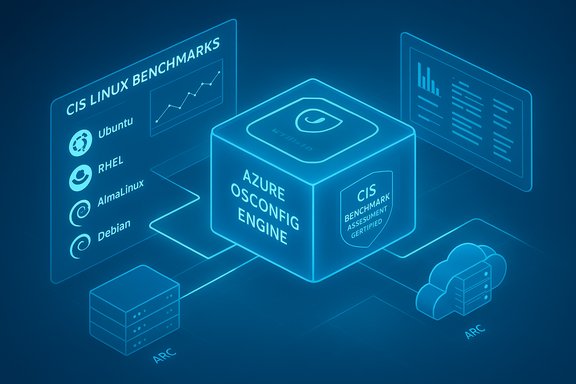
Azure Policy’s Machine Configuration experience has been expanding beyond Windows baselines to include flexible, parameterizable baselines for Linux workloads. The capability announced by Microsoft ingests CIS machine‑readable artifacts (XCCDF/OVAL) and evaluates them with azure‑osconfig, a compliance engine Microsoft says has satisfied the requirements of CIS Certification (CIS Benchmark Assessment Certified) for the supported mappings. At initial release this integration is in preview and operates in audit‑only mode; Microsoft has signaled auto‑remediation is planned for a future update.What Microsoft and CIS announced (the facts)
- The built‑in policy is surfaced inside Azure Policy → Machine Configuration as: [Preview]: Official CIS Security Benchmarks for Linux Workloads. Administrators can assign the built‑in definition, select distributions and profiles, and collect continuous audit reporting.
- The checks are executed by azure‑osconfig, which ingests CIS machine‑readable benchmark content so rule logic aligns with canonical CIS specifications; Microsoft reports that azure‑osconfig is CIS Benchmark Assessment Certified for the benchmark mappings it ships with.
- Initial release is Preview and audit‑only: the service reports noncompliant settings but does not yet perform automatic remediation; remediation is explicitly planned for a later release.
- The preview supports a broad set of Linux distributions and mapped CIS benchmark versions (examples include Ubuntu 22.04/24.04, RHEL 8/9, AlmaLinux, Rocky, Oracle Linux, Debian 12, SUSE SLE 15). Each supported mapping listed in Microsoft’s documentation is marked as CIS‑certified for assessment.
- The capability is designed to work across Azure and in hybrid scenarios through Azure Arc: Arc‑registered machines with the required agents/extensions can be continuously evaluated, enabling a single compliance pipeline for multi‑cloud/hybrid fleets.
Supported distributions and benchmark versions (at preview)
The Azure documentation lists the supported distro/version pairings and their CIS Benchmark versions; examples from the preview include:- Ubuntu 22.04 LTS + Pro — CIS Ubuntu 22.04 Benchmark v2.0.0 — L1 + L2 (audit supported).
- Ubuntu 24.04 LTS + Pro — CIS Ubuntu 24.04 Benchmark v1.0.0 — L1 + L2 (audit supported).
- Red Hat Enterprise Linux 8 / 9 — mapped to the appropriate CIS RHEL benchmark versions — L1 + L2 (audit supported).
- AlmaLinux 8/9, Rocky Linux 8/9, Oracle Linux 8/9 — each mapped and certified for assessment.
- Debian Linux 12 — mapped to CIS Debian benchmark v1.1.0 — L1 + L2 (audit supported).
- SUSE Linux Enterprise 15 — mapped to CIS SLE benchmark v2.0.1 — L1 + L2 (audit supported).
How it works — technical flow and integration points
Ingest, evaluate, report
Azure’s compliance engine ingests the canonical CIS machine‑readable artifacts (XCCDF/OVAL) and evaluates configured machines against those rules. Results are surfaced as policy compliance events in Azure Policy and can be exported to Azure Monitor / Log Analytics or forwarded into existing SIEM and ticketing pipelines for remediation tracking. This reduces reliance on bespoke parsers and manual rule mapping.Hybrid coverage via Azure Arc
For on‑premises or multi‑cloud servers, Azure Arc lifecycle and extension management is the prerequisite: Arc‑registered machines with the azure‑osconfig agent/extensions can be continuously evaluated. Intermittent connectivity or missing agents will limit assessment fidelity; teams should verify Arc health before trusting fleet‑wide compliance numbers.Parameterization and exceptions
The azure‑osconfig engine supports dynamic parameters for rule evaluation so organizations can tailor thresholds or toggle acceptable exceptions without changing the underlying XCCDF logic. That makes it possible to adapt canonical CIS logic where business needs legitimately diverge from vendor recommendations while preserving a common audit trail.Why this matters: practical benefits for security and ops teams
Embedding CIS Benchmarks natively in Azure Policy represents a material operational shift that reduces friction for large fleets:- Centralized compliance visibility: No need to deploy and maintain separate scanners on every host; built‑in policies enable continuous, centralized reporting.
- Closer parity with canonical CIS content: Because the engine consumes the official machine‑readable artifacts, the assessment logic should align more closely with CIS’s canonical text, reducing disputes between internal scans and audit expectations.
- Hybrid reach: With Azure Arc integration, the same baseline can be evaluated across cloud, on‑premises, and multi‑cloud workloads, simplifying governance for hybrid estates.
- Scalability and operational integration: Azure Policy’s scale and integration with telemetry, RBAC, and automation pipelines lets organizations fold CIS findings into SRE, SOC and ticketing workflows without bespoke glue code.
Notable limitations and risks (what to watch for)
Embedding canonical benchmarks in a cloud provider’s managed control plane is powerful — but it carries important caveats:- Preview status and legal terms: The feature is in Preview and governed by Azure Preview supplemental terms; it should not be treated as a production enforcement mechanism until GA and remediation functionality are validated.
- Audit‑only at release: Initial functionality is audit‑only. Built‑in detection does not automatically remediate findings; remediation workflows must be prepared separately until Microsoft ships remediation.
- Assessment variance and false positives: Differences in detection logic compared with tools such as CIS‑CAT Pro or third‑party scanners can produce mismatches. Expect a reconciliation phase to tune exceptions and avoid noisy alerting.
- Operational impact of L2: L2 controls are intentionally strict and can break application functionality if enforced indiscriminately; treat Level 2 as a controlled program with staged rollouts and vendor sign‑offs.
- Arc connectivity dependencies: Hybrid assessment requires healthy Azure Arc registration and agent telemetry; intermittent connectivity will create blind spots.
- False sense of security: Passing CIS configuration checks improves configuration hygiene but does not replace runtime controls such as EDR, vulnerability management, network segmentation, or secure development practices. Benchmarks are a piece of a broader defense‑in‑depth strategy.
A practical adoption roadmap for platform teams
To adopt built‑in CIS Benchmarks on Azure safely and efficiently, follow a staged plan:- Inventory and baseline: Map current scanning tools, the images you run (marketplace vs. custom images), and where CIS checks are already in use. Confirm /etc/os‑release preservation for custom images to enable accurate detection.
- Pilot (audit‑only): Choose a small, representative pilot cohort (stateless front ends, app servers, test DBs) and enable the built‑in policy in audit mode to catalog noise, mismatches and false positives.
- Parallel validation: Run Azure’s built‑in results side‑by‑side with your existing CIS scans (CIS‑CAT Pro or vendor tools) to identify rule mismatches and to produce an apples‑to‑apples reconciliation report.
- Tune exception registry: Use the built‑in custom parameterization to set acceptable exceptions and document business justification, owners, and expiration for each exception.
- Prepare remediation playbooks: Build and test runbooks or CI/CD remediation automations now — remediation will be necessary immediately after auto‑remediation becomes available. Ensure rollback capability and change control.
- Stage enforcement: Move from audit to enforcement incrementally: enforce L1 for low‑risk pools first, keep L2 in staged hardened environments with strong testing and vendor approvals.
- Operationalize KPIs: Track time‑to‑remediate, percent of fleet compliant, exceptions outstanding, and trend metrics to measure program maturity and justify investment.
Remediation, automation and audit defensibility
Even in audit‑only mode, Azure’s built‑in assessments improve audit defensibility because the compliance engine ingests canonical CIS artifacts and outputs traceable assignments and evaluation logs. When auto‑remediation ships, expect a two‑stage model for enterprise adoption:- Stage A: Automation for trivial fixes (ownerless, idempotent changes such as file permission corrections). These are the first candidates for automated remediation once Microsoft enables the feature.
- Stage B: Change‑controlled remediations for settings that could impact service availability, performance, or third‑party compatibility. These must go through normal change advisory processes and vendor validation.
Vendor coordination and the future roadmap
Microsoft has signaled ongoing investments: expanding distro coverage, supporting new benchmark releases automatically, and adding remediation capabilities. CIS continues to publish new, cloud‑oriented benchmarks (AKS‑optimized, Azure Linux variants) and maintains a cadence of updates that the azure‑osconfig engine will need to track. Operational maturity will depend on how quickly Microsoft can keep ingestion mappings current across benchmark releases and how it surfaces migration guidance when major benchmark versions change. Expect the following near‑term milestones to watch for:- GA and supplemental terms clarifications (the legal standing of preview outputs in audit evidence).
- Auto‑remediation feature rollouts and associated RBAC/approval models.
- Expanded image parity work with distro vendors to reduce deviations between cloud hardened images and canonical CIS expectations.
Critical analysis — strengths and potential blind spots
Strengths
- Operational simplification: Embedding CIS assessments into Azure Policy materially lowers the bar to continuous compliance at scale, removing complex packaging and mapping steps.
- Audit credibility: CIS certification of the azure‑osconfig engine strengthens the evidentiary value of results in audit conversations.
- Hybrid consistency: Azure Arc enables a single control plane across cloud and on‑premises assets — a real governance advantage for hybrid estates.
Potential blind spots and operational risks
- Overreliance on a single control plane: Centralized assessment is efficient but may create systemic blind spots if Arc/agent telemetry fails; distributed monitoring and defense‑in‑depth remain essential.
- Mismatch friction with existing tooling: Many organisations have long‑running processes driven by CIS‑CAT Pro, vendors’ attestations, or legacy scanners; reconciling differences will require effort.
- Preview governance complexity: Relying on preview outputs for compliance evidence is risky until GA and legal terms are clear.
What is verified, and what still needs extra caution
- Verified: The built‑in policy name, the involvement of azure‑osconfig, the CIS Benchmark Assessment Certified claim from Microsoft, the supported distributions and audit‑only preview status are documented in Microsoft’s Machine Configuration guidance.
- Cross‑reference: CIS’s own benchmark pages and CIS updates confirm active publication of Azure‑focused Linux benchmarks and continuing benchmark cadence; the Microsoft documentation and CIS pages together satisfy the cross‑reference requirement for the main technical claims.
- Cautionary: Quotes or marketing statements in third‑party press releases (for example the EINPresswire version) reflect CIS and vendor messaging and should be treated as organizational commentary rather than technical guarantees — the technical behaviors and scope should be validated against Microsoft documentation and the CIS benchmark text before being used as audit evidence.
Practical checklist (quick reference for engineers)
- Verify that targeted Linux images present a standard /etc/os‑release so azure‑osconfig can detect the distro.
- Register Arc for on‑premises/multi‑cloud machines and confirm agent telemetry health.
- Enable the built‑in policy in audit mode for a pilot cohort.
- Run parallel scans with existing CIS tooling and document mismatches.
- Build remediation playbooks and test rollback paths.
- Maintain an exception registry with owners and expiration dates.
Conclusion
Making CIS Benchmarks a built‑in, certified capability of Azure Policy is an operational milestone for cloud security: it reduces the friction of continuous CIS assessment, improves parity with canonical benchmark text, and gives hybrid fleets a single compliance pipeline through Azure Arc. The technical claims are verifiable in Microsoft’s documentation and are reinforced by CIS’s ongoing benchmark updates; audit teams gain a clearer, more centralized source of compliance telemetry. That said, the feature ships as Preview and audit‑only; prudent adoption requires staged pilots, parallel validation, remediation readiness, and careful governance around L2 enforcement. The real operational value will arrive when Azure adds robust auto‑remediation with controlled approval workflows and when Microsoft maintains tight synchronization with CIS benchmark releases. Until then, treat the built‑in capability as a high‑value visibility and governance tool — not a one‑click compliance silver bullet.Source: Fox 59 https://fox59.com/business/press-re...-benchmarks-now-available-on-microsoft-azure/
