

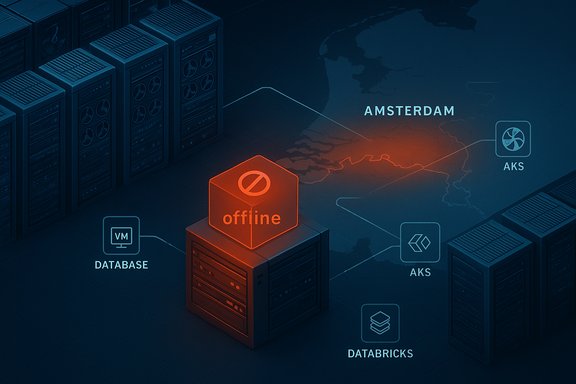
Microsoft Azure suffered a regional disruption on 5 November when a reported datacenter “thermal event” in its West Europe cloud region forced automated cooling and hardware-protection actions that took a subset of storage scale units offline and produced degraded performance across numerous services — an incident that underlines how physical datacenter events can cascade into broad cloud outages and why redundancy choices matter now more than ever.
Microsoft’s West Europe region (the Amsterdam-area cluster in the Netherlands) provides multiple availability zones and hosts a broad set of platform services used by enterprises across Europe. Availability zones are physically separate datacenter sites inside a region that are intended to provide fault isolation for power, cooling and networking. On 5 November, Microsoft posted an advisory that a thermal event — reported as a localized cooling failure or temperature spike inside a single availability zone — had triggered automated safety procedures that withdrew or powered down affected hardware. That action reportedly caused a subset of storage scale units to go offline in one AZ, and Microsoft warned that resources in other AZs that depended on those storage units might also experience service degradation. Early public reporting noted an estimated recovery window of roughly 90 minutes for visible signs of recovery on impacted units. At the same time, or shortly thereafter, outage-tracking services and media reported a brief spike in Amazon/AWS user incidents in the United States; AWS stated its services were operating normally after customer-facing symptoms subsided. The two hyperscalers had both been managing other high-profile incidents in late October, and this latest pair of events revived questions about concentration risk and operational transparency.
For Windows and Azure operators, the immediate priorities are clear: audit storage redundancy and critical-state placement, harden retry and failover logic, keep programmatic admin paths ready, and insist on post‑incident transparency that lets customers validate provider actions and remediation. Hyperscale clouds will continue to automate protection — and those protections will sometimes cost short-term availability to protect long-term data integrity. The right approach for enterprises is not to avoid the cloud, but to design for its real failure modes and to make those designs operationally tested and contractually enforceable.
Source: Data Center Dynamics Microsoft Azure experiences outage in European cloud region due to data center "thermal event"
 Background / Overview
Microsoft’s West Europe region (the Amsterdam-area cluster in the Netherlands) provides multiple availability zones and hosts a broad set of platform services used by enterprises across Europe. Availability zones are physically separate datacenter sites inside a region that are intended to provide fault isolation for power, cooling and networking. On 5 November, Microsoft posted an advisory that a thermal event — reported as a localized cooling failure or temperature spike inside a single availability zone — had triggered automated safety procedures that withdrew or powered down affected hardware. That action reportedly caused a subset of storage scale units to go offline in one AZ, and Microsoft warned that resources in other AZs that depended on those storage units might also experience service degradation. Early public reporting noted an estimated recovery window of roughly 90 minutes for visible signs of recovery on impacted units. At the same time, or shortly thereafter, outage-tracking services and media reported a brief spike in Amazon/AWS user incidents in the United States; AWS stated its services were operating normally after customer-facing symptoms subsided. The two hyperscalers had both been managing other high-profile incidents in late October, and this latest pair of events revived questions about concentration risk and operational transparency. What “thermal event” means operationally
The physical-to-platform chain
A “thermal event” in a datacenter context typically refers to an overheating condition or cooling-system failure that causes hardware temperatures to exceed safe thresholds. Modern datacenters include environmental monitoring that triggers automated mitigation — from throttling and fan-speed increases to structured power‑down of compute or storage units — to prevent permanent damage. In hyperscale operations, those automated responses are intentionally conservative; taking a storage scale unit offline is a protective measure, but it immediately removes capacity and I/O paths that many higher-level services assume remain available. Two operational consequences are notable:- Automated withdrawals of storage or compute capacity create immediate I/O errors and latency spikes for services that synchronously depend on those units. VMs, databases, AKS nodes and other platform services frequently require low-latency access to block or file storage; a removed scale unit produces retries, timeouts and cascading failures.
- The impact can cross availability-zone boundaries when services or tenant resource placements implicitly rely on storage constructs whose physical replicas sit in the affected facility. If customers used lower-cost redundancy (e.g., LRS), all replicas might have been colocated inside the same datacenter or AZ, increasing exposure.
Why a single AZ problem can ripple across a region
Cloud providers design regions and zones to reduce correlated failures, but practical constraints and platform architectures create common-mode couplings:- Some storage constructs or control-plane metadata live in specific physical units; when those units are withdrawn, dependent services across zones can observe degraded behavior.
- Management and orchestration systems (Kubernetes control plane, metadata services, catalogues such as Databricks Unity Catalog) often require synchronous access to storage. If metadata storage loses part of its backing, operations like scale-outs or job launches stall.
- DNS, caching and global-edge effects can amplify symptoms — users and services see timeouts, retries and authentication issues even when the core compute backends remain healthy.
Verified account of the 5 November incident
- Microsoft’s public status updates and subsequent trade reporting described the trigger as an environmental “thermal event” that affected datacenter cooling and led to storage scale units going offline in a single availability zone in West Europe (Netherlands). Recovery actions were underway; Microsoft’s initial visible‑recovery estimate reported to press was approximately 90 minutes.
- Independent status aggregators and community monitoring recorded the incident as causing service disruptions or degraded performance for a range of services in West Europe including Virtual Machines, Azure Database for PostgreSQL/MySQL Flexible Servers, Azure Kubernetes Service (AKS), Storage, Service Bus, Virtual Machine Scale Sets and Databricks workloads. Reports said Databricks users might observe degraded performance when launching or scaling compute workloads.
- The incident was handled with standard containment and recovery practices: isolating the thermal condition, bringing cooling systems back online, recovering or reprovisioning affected storage nodes and validating data integrity before returning units to service. Those steps preserve data but can prolong visible customer impact while migrations and validations complete.
Context: recent hyperscaler incident history
October incidents and why they matter
Late October saw high-profile outages affecting both Azure and AWS:- Azure experienced a broad outage on 29 October that public reporting linked to an issue in Azure Front Door (AFD) — an edge routing/control-plane service — caused by a configuration change that produced widespread portal and authentication failures. That outage highlighted the blast radius of edge and identity control-plane faults.
- AWS also suffered a major outage in October (centered on US‑EAST‑1) that impacted DNS and other core services for many customers, and Amazon publicly acknowledged and remediated the issue after extended recovery. The 5 November AWS spike appears to have been a short-lived US-centric incident; AWS told reporters services were operating normally after the reports subsided.
- Hyperscalers face different classes of risk — physical/environmental failures, orchestration/control-plane configuration mistakes, and underlying network/subsea vulnerabilities — and no single risk model dominates.
- The aggregation of services and shared control planes increases collateral exposure when failures occur. Enterprises must design to assume that any single layered dependency can fail.
Technical anatomy: storage scale units, redundancy and failure modes
What is a storage scale unit?
In hyperscale clouds, storage is implemented as large arrays of storage servers and backend scale units that handle block, file and object storage. A storage scale unit is a physical or logical grouping of nodes and storage media that serves a subset of the storage footprint for a region. When an entire scale unit is withdrawn for thermal protection, all the data and I/O capacity that unit served are either reconstructed from other replicas or temporarily unavailable until recovery or proactive migration completes. Trade press and status updates tied the 5 November outage to precisely this behaviour.Replication options and customer exposure
Microsoft’s documented storage redundancy options are crucial to understanding customer risk:- LRS (Locally Redundant Storage): replicates data within a single datacenter or availability zone and is the lowest-cost option. LRS protects against drive and rack failures but is vulnerable to datacenter-level events such as cooling failures or fire. Microsoft explicitly warns that temporary datacenter events can render LRS replicas temporarily unavailable.
- ZRS (Zone-Redundant Storage): synchronously replicates across three or more AZs in a region and provides stronger protection against a datacenter/AZ outage. ZRS is recommended for high-availability scenarios within a region.
- GRS/GZRS (Geo-, Geo-Zone-Redundant Storage): provide cross-region replication and are the safeguard against regional or multi-zone disasters. GZRS uses ZRS in the primary region and asynchronous replication to a secondary region.
Impact profile: what broke and who saw problems
Reported symptoms from the 5 November event aligned with a storage-led failure mode:- I/O errors, elevated latencies and timeouts for disks and storage accounts hosted on impacted scale units.
- Virtual Machines experiencing degraded performance or failure to boot if they synchronously required access to affected storage replicas.
- Database services (PostgreSQL/MySQL Flexible Servers) showing transaction timeouts and retry storms.
- AKS and Databricks clusters failing to scale or launch when control plane or workspace metadata required access to the impacted storage.
Microsoft’s response and operational strengths
Microsoft’s immediate actions followed established playbooks:- Isolate the thermal condition and restore cooling systems.
- Recover or rebuild affected storage nodes while validating data integrity.
- Use traffic steering and orchestration restarts to move workloads away from impaired hardware where possible.
- Post periodic status updates and advise affected tenants to check their subscription‑scoped Azure Service Health notifications.
- Rapid detection: automated environmental sensors and telemetry spotted temperature anomalies and triggered protective automation before hardware damage occurred.
- Conservative safety-first posture: automated shutdowns preserve long-term data integrity at the expense of short-term availability — a defensible trade for enterprise data protection.
- Clear operational playbook: isolation, staged restoration and data validation are standard and reduce the risk of data corruption from rushed recoveries.
Where the response and design show weakness
Notwithstanding those strengths, the incident revealed structural tensions and work‑in-progress areas:- Visibility and cadence: community reports sometimes saw symptoms before a clear global status entry was posted. This creates a window where customers must rely on subscription-scoped Service Health rather than the global status page. Forum analyses flagged a recurring mismatch between on-the-ground symptoms and early public messaging.
- Common-mode dependencies: storage topology and certain metadata/control-plane services remain single points of failure for particular tenant configurations. When a physical fault triggers automatic withdrawal of units, dependencies that assumed zone-level isolation can still be exposed.
- Architectural mismatch: many organizations default to lower-cost redundancy (LRS) for non-critical workloads and discover the limits of that choice under real datacenter events. That cost/availability tradeoff is not a bug — it’s an architectural decision — but incidents like this make the consequences visible and costly.
Practical mitigations and immediate steps for Windows/IT teams
For teams operating on Azure — and, by extension, for any cloud consumer — there are concrete, tested steps to reduce exposure to zonal and storage-level incidents:- Review storage redundancy choices
- Audit all storage accounts (blobs, managed disks, file shares) and map which use LRS vs ZRS/GZRS. Prioritize migration of critical data and database backends to ZRS or geo‑replication.
- Validate high-availability design
- Ensure compute and stateful services are architected for cross-AZ failover or multi-region failover where appropriate. Test failover procedures under controlled conditions to verify RTO/RPO assumptions.
- Prepare programmatic out-of-band admin paths
- Keep authenticated CLI/PowerShell runbooks and service principals available. Don’t rely exclusively on portal.azure.com for incident remediation. Past incidents show portals can be affected differently from programmatic APIs.
- Harden retry and timeout policies
- Implement exponential backoff, circuit breakers and idempotent operations in application stacks to avoid retry storms during transient storage failures.
- Configure Service Health alerts and telemetry
- Subscribe to Azure Service Health and create actionable alerts for resource failures. Gather tenant-level logs and SLA evidence to support escalations and potential contractual claims.
- Value multi-region and multi-cloud only for critical workloads
- For the smallest possible exposure to provider-specific systemic failures, maintain a tested regional failover strategy or multi-cloud architecture for the most business‑critical paths.
- Demand operational transparency contractually
- When service outages cause material business loss, customers should assert post-incident reporting rights and SLA remedies; gather timestamps and telemetry during incidents to make any claims auditable.
Strategic implications for cloud procurement and risk management
This thermal event is not an isolated curiosity — it is an operational reminder with procurement and governance implications:- Procurement teams should require clarity about physical-path diversity, storage durability options and post-incident reporting in commercial agreements.
- SRE and platform teams must map physical failure domains (datacenter floor, availability zone, region) to redundancy and DR plans rather than assuming “the cloud” abstracts away physical risk.
- Boards and risk committees should treat repeated high-visibility outages across providers as systemic risk and require measurable resilience programs (DR tests, contractual SLAs, evidence trails).
Cross-checking the coverage: independent confirmation
Key public facts about the November 5 event are corroborated across multiple independent outlets:- Trade and technical press coverage explicitly described a datacenter thermal/cooling problem that led to storage units going offline in West Europe; both Data Center Dynamics and The Register reported Microsoft’s advisory and the nature of the fault.
- Aggregators that monitor status pages captured the incident and logged the impacted services and recovery messages, reinforcing the timeline presented in press updates.
- Community and forum analyses collected the practical implications and tenant-level guidance, and they cautioned that precise timing and severity can vary by subscription and redundancy configuration.
Risk outlook and what to watch next
- Microsoft’s expected follow-up is a formal post‑incident report that will detail the chain-of-causation, the environmental and automation thresholds that triggered protective withdrawals, and corrective engineering steps. That post‑incident analysis is the critical document for customers seeking to understand long-term mitigations and whether design or process changes will reduce recurrence risk.
- For security and operational teams, keep an eye on:
- Official Azure post‑incident RCA and remediation plans.
- Any changes Microsoft makes to cooling/fail‑over automation, or to how storage scale units are isolated and recovered.
- Customer-facing guidance on changing storage redundancy types or migrating critical metadata to multi-zone or geo‑replicated architectures.
- For procurement and legal teams, track SLA and contractual follow-up from Microsoft if the outage produced measurable business impact; preserve logs and customer tickets for any remediation conversations.
Conclusion
A datacenter thermal event that trips cooling protections is a reminder that hardware and environmental systems remain first-order risks for cloud operations. Microsoft’s protective automation likely prevented hardware damage and data loss, but the withdrawal of storage components produced visible consequences for dependent services — exactly the kind of scenario redundancy options such as ZRS and geo‑replication are designed to mitigate. The incident also underscores two persistent truths for enterprise cloud consumers: first, that failure domains extend from racks and cooling systems up through storage fabrics and control planes; and second, that architectural decisions about redundancy and failover determine whether a cloud event is an annoyance or a major outage.For Windows and Azure operators, the immediate priorities are clear: audit storage redundancy and critical-state placement, harden retry and failover logic, keep programmatic admin paths ready, and insist on post‑incident transparency that lets customers validate provider actions and remediation. Hyperscale clouds will continue to automate protection — and those protections will sometimes cost short-term availability to protect long-term data integrity. The right approach for enterprises is not to avoid the cloud, but to design for its real failure modes and to make those designs operationally tested and contractually enforceable.
Source: Data Center Dynamics Microsoft Azure experiences outage in European cloud region due to data center "thermal event"
