

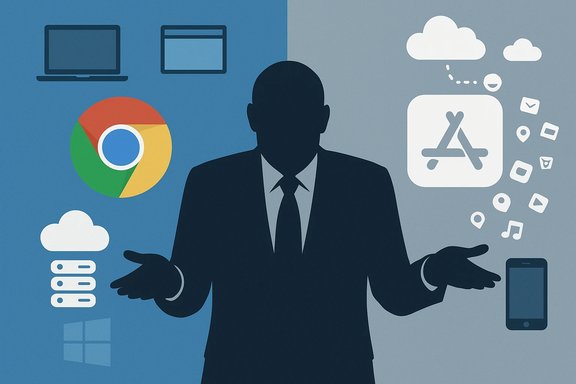
Steve Ballmer’s public shrug at a browser-based future captured a defining tension in 2009: a veteran platform company defending a proven stack while a new generation of devices and distribution models rewired how software is created, delivered, and monetized. The question then — whether a web-centric operating model was “an idea whose time had come” — is no longer academic. It shaped how mobile platforms, browsers, cloud services, and even Windows evolved in the decade that followed. This feature revisits the debate sparked by a Betanews column, verifies the key claims around App Store growth and Ballmer’s remarks, and offers a technical and strategic reading of what that moment meant for Microsoft, for rivals such as Google and Apple, and for the enterprise customers who historically anchored Windows' dominance.
July 2009 was a crossroads. Google publicly unveiled its vision of a browser-based operating environment and called it Chrome OS; Apple celebrated the App Store’s first birthday with a headline metric — 1.5 billion app downloads in the first year — underscoring a new distribution model that favored lightweight, rapidly deployed apps; and Microsoft’s CEO framed the company’s response around evolving Windows and its existing application stack rather than creating a new client OS. Those moves crystallized two competing narratives: a cloud-and-browser-first future versus a locally rich, tightly integrated operating-system-first future.
A balanced response requires three commitments: protect existing customers with care, rapidly invest in the emergent platform models that matter to users, and design Windows and services to enable web-first, cloud-connected experiences rather than treat them as adversaries. That approach turns the tension between legacy and innovation into a source of competitive advantage — by making the operating system a bridge rather than a barricade.
Verified facts referenced in this article include Apple’s press release confirming 1.5 billion App Store downloads on July 14, 2009, and multiple contemporary transcripts and reports capturing Steve Ballmer’s Worldwide Partner Conference remarks and the industry reaction.
Source: BetaNews Steve Ballmer's denial can't stop change from coming
 Background: the summer of 2009 in one paragraph
July 2009 was a crossroads. Google publicly unveiled its vision of a browser-based operating environment and called it Chrome OS; Apple celebrated the App Store’s first birthday with a headline metric — 1.5 billion app downloads in the first year — underscoring a new distribution model that favored lightweight, rapidly deployed apps; and Microsoft’s CEO framed the company’s response around evolving Windows and its existing application stack rather than creating a new client OS. Those moves crystallized two competing narratives: a cloud-and-browser-first future versus a locally rich, tightly integrated operating-system-first future. Overview: what Betanews argued and what it claimed
The Betanews commentary argued that a web-based operating system/platform was inevitable, driven primarily by mobile devices and app stores. The column transcribed portions of Steve Ballmer’s remarks from Microsoft’s Worldwide Partner Conference and used those quotes as the focal point for criticism: Ballmer insisted Microsoft didn’t need a new OS and that Windows should evolve to combine local richness with Internet-connected capabilities. Betanews countered that mobile app ecosystems (Apple, BlackBerry, Android, Nokia at the time) were lightweight, web-connected, and proving the viability of a different application stack — one that reduced dependence on heavyweight Windows-style clients. Key factual claims in the column that merit verification:- Apple’s App Store had reached 1.5 billion downloads on its one-year anniversary.
- Ballmer publicly downplayed Chrome OS and said Microsoft didn’t need a new operating system; he stated that roughly half of PC use wasn’t in the web browser and argued Windows should be the platform to combine local richness and Internet capabilities.
The moment: App Store scale and the new distribution model
Apple’s announcement — “More than 1.5 billion applications downloaded in just one year” — was more than a marketing statistic. It signaled:- A centralized distribution channel where discovery, payment processing, updates, and developer reach were integrated.
- A new economics of scale for developers: small teams could reach tens of millions of devices overnight.
- Reinforced momentum for mobile-first and cloud-connected software design: apps were purpose-built for constrained devices and intermittent connectivity, yet they were often tightly integrated with online services.
- The model rewarded small, iterative updates and rapid deployment. Developers could fix bugs and ship features without the long cycles of traditional desktop software.
- App marketplaces reduced friction for users to discover and install software, changing expectations about how software should be obtained and maintained.
- Cloud-backed services and web APIs meant that even thin clients could deliver powerful, stateful experiences.
Ballmer’s position: transcript, claims, and immediate reaction
At the Worldwide Partner Conference, Steve Ballmer made three defensible points and one strategic stand:- Defensible point: the future would mix the best of rich client Windows-style applications and web deployment models (users like click-to-deploy, global reach, but also expect richness and offline support).
- Defensible point: customers — especially enterprise customers — value backward compatibility, integration, and predictable support models.
- Strategic stand: “We don’t need a new operating system. What we need to do is to continue to evolve Windows...and how we build applications like Office.” That was Ballmer’s public posture: enhance the existing stack rather than start a fresh client OS play.
Historical context: why Netscape mattered (and still matters as precedent)
The browser wars of the mid–late 1990s were not just history lessons; they were the template for how platform dominance could be defended and extended. Microsoft’s bundling of Internet Explorer into Windows and the resulting antitrust actions (United States v. Microsoft) demonstrated how control of an operating system could be leveraged to tilt new platform battles. The DOJ’s antitrust complaint in 1998 laid out that Microsoft sought to “eliminate” the competitive threat posed by browsers like Netscape Navigator by leveraging Windows distribution. That history made Microsoft particularly wary of platforms that could erode the OS’s centrality. Why this matters now:- The strategic lesson from Netscape was not purely legal; it was organizational. Microsoft’s engineering, sales channels, and partner economics were engineered around an OS-centric model.
- Any credible web- or cloud-first challenger threatened those economics by shifting value away from Windows licenses and toward services, browsers, and platform-agnostic cloud stacks.
Why web-based platforms looked different in 2009 — and why mobile accelerated the shift
The argument that “this time is different” compared to the late-1990s browser push rests on several concrete technical and market changes that converged by 2009:- Ubiquitous, faster connectivity. Mobile networks and Wi‑Fi proliferation made always-on or commonly connected scenarios feasible for more users.
- Richer web standards and runtimes. Browsers and engines increasingly supported HTML5-era APIs, local storage, and richer JavaScript engines that blurred the line between native and web apps.
- Mobile-first UI/UX expectations. Apps for phones and netbooks emphasized minimalism, rapid updates, and direct integration with cloud services; many of these patterns were portable to larger screens.
- Marketplace economics. App stores created a reliable revenue channel for developers, lowering barrier-to-entry and incentivizing platform-specific innovation.
Critical analysis: strengths in Ballmer’s argument
Ballmer’s stance carried real merit when evaluated against Microsoft’s responsibilities and customer base:- Enterprise continuity: Microsoft’s customers — and corporate IT departments in particular — prized stability, security, and backward compatibility. These are not trivial to deliver with radical platform pivots. Promising to evolve Windows signaled a commitment to enterprise risk management and long-term support.
- Product leverage: Windows + Office + Windows Server represented an integrated revenue engine. Sudden abandonment or radical fragmentation would have alienated partners and customers and would have been costly.
- Technical realism: At the time, many web standards were still immature; browser runtime performance and real cross-device consistency were ongoing challenges. A gradual, evolutionary approach was defensible from an engineering standpoint.
Critical analysis: limits and risks of the defensive posture
Despite those strengths, the defensive posture carried material risks that Betanews and later observers identified:- Opportunity cost: Focusing on incremental evolution of Windows risked ceding leadership in new user experiences built around mobility, instant distribution, and service-driven monetization.
- Developer mindshare: App stores and web platforms rewired developer incentives. If developers invested heavily in web-first or mobile ecosystems, they might deprioritize Windows-native development over time.
- Commoditization pressure: Low-cost, web-centric devices (e.g., netbooks running Chrome OS or web-heavy netbooks) could erode Windows’ low-end share, and market share erosion at the margin can compound.
- Agility mismatch: Microsoft’s long release cycles and enterprise-focused processes were ill-suited to the rapid cadence of app marketplaces and cloud services.
How the industry actually evolved (brief retrospective)
Looking back from later vantage points, several observable patterns validate both the criticisms and the prudence in Ballmer’s stance:- Web and mobile ecosystems did become central to computing. App stores matured into multi-billion-dollar marketplaces, and web technologies improved dramatically.
- Microsoft adapted over time, but not always smoothly: it pursued cloud services, built Azure, invested in Office 365, and eventually shifted Edge to a Chromium foundation — a tacit recognition of web engine and developer realities.
- Competition and consolidation shaped outcomes: Google’s Chrome browser and Android ecosystem became major vectors for web-app distribution; Apple’s App Store remained a dominant ecosystem on its own terms.
Practical implications for Microsoft at the time — a prioritized playbook
If the objective in 2009 was to protect Windows’ core value while not conceding the future, an executable, prioritized approach would have included the following steps:- Modernize Windows for web-native workflows
- Embed robust web platform primitives (service workers, local caches, standardized APIs) to support Progressive Web Apps (PWAs).
- Embrace cross-platform engines and standards
- Invest in compatibility and interoperability (e.g., better HTML5 support, web debugging, tooling that attracts developers).
- Convert Office to a cloud-first service
- Accelerate hosted, collaborative Office offerings that mirror mobile-first UX and lower friction for adoption (Office Web Apps / Office 365 trajectories).
- Open distribution and monetization paths
- Offer a curated store model that lowers friction for developers but preserves enterprise controls for IT.
- Partner with OEMs on low-cost devices
- Provide a lightweight Windows configuration for netbooks and subnotebooks to retain OEM shelf space without sacrificing premium Windows SKU economics.
The user and enterprise perspective: what to watch for
For enterprise IT and power users, the transition implied two practical facts:- Expect mixed architectures for years. Enterprises should plan for hybrid deployments — local rich clients for mission-critical apps, and web/cloud apps for new greenfield scenarios.
- Focus on data and identity portability. As apps move to cloud and web UIs, identity, data governance, and integration become the durable sources of platform lock-in — not the client OS alone.
Risks that were underappreciated in 2009 and remain relevant
Several long-term risks were under-emphasized in the 2009 debate and deserve attention even now:- Fragmentation fatigue: Multiple stores, multiple web runtimes, and divergent APIs increase developer and operations complexity.
- Privacy and control: Centralized app stores and cloud services shift data control to platform operators; governance and vendor lock-in must be managed.
- UX inconsistency: Web technologies matured but still yield inconsistent UX across devices unless there’s strong engineering discipline and cross-platform testing.
Final assessment: who was right — Ballmer, Apple, or the web advocates?
The short answer: all parties were partially right. The App Store model reshaped software distribution and developer economics in ways that were impossible to ignore; web-centric models gained credibility and performance; and yet the enterprise and the installed base retained immense inertia that a single pivot could not instantly overcome.- Apple won the mobile-first developer mindshare and created a profitable app marketplace that rewarded platform investment.
- Google’s web-first experiments and Android’s open device ecosystem pulled significant market share and pushed web-runtime improvements.
- Microsoft preserved revenue and enterprise relationships by evolving Windows and investing in cloud services, but it also had to adapt more aggressively than the company initially signaled.
Conclusion: the invasion of ideas won’t be stopped by denial
The BetaNews column accurately captured a spirit of technological momentum in mid‑2009: app stores and mobile devices were already changing user expectations and developer economics. Ballmer’s message was strategically coherent for Microsoft’s priorities — protect the installed base, reassure partners, and avoid needless fragmentation — but exclusively defensive positions carry long-term costs in fast-moving platform battles.A balanced response requires three commitments: protect existing customers with care, rapidly invest in the emergent platform models that matter to users, and design Windows and services to enable web-first, cloud-connected experiences rather than treat them as adversaries. That approach turns the tension between legacy and innovation into a source of competitive advantage — by making the operating system a bridge rather than a barricade.
Verified facts referenced in this article include Apple’s press release confirming 1.5 billion App Store downloads on July 14, 2009, and multiple contemporary transcripts and reports capturing Steve Ballmer’s Worldwide Partner Conference remarks and the industry reaction.
Source: BetaNews Steve Ballmer's denial can't stop change from coming
