
In September 2009, Microsoft CEO Steve Ballmer dismissed Google Chrome and Apple Safari as “rounding errors” while Internet Explorer still dominated the browser market and Firefox looked like the only meaningful challenger. Seventeen years later, the line reads less like a bad prediction than a snapshot of Microsoft’s deepest strategic blind spot: it understood distribution, but underestimated iteration. Chrome did not win because it was preinstalled on Windows. It won because the browser stopped being a Windows accessory and became the operating layer for everything else.
Ballmer’s remark was not absurd when he made it. Chrome had launched only a year earlier, Internet Explorer still had overwhelming global share, and Firefox was the insurgent browser with real cultural momentum. If you were looking at the market through a spreadsheet in 2009, Chrome really was small enough to wave away.
That is what makes the quote useful. The mistake was not that Ballmer failed to read the numbers; the mistake was that he read them too literally. Microsoft’s browser lead was a monument to the PC era, but Chrome was being built for the web-app era that was already arriving.
Internet Explorer’s share came from Windows, corporate inertia, and years of default placement. Chrome’s growth came from a different kind of gravity: speed, release cadence, web standards, developer goodwill, and Google’s ability to turn the browser into the front door for its search, ads, Gmail, Docs, YouTube, Android, and cloud ecosystem.
In other words, Microsoft was judging a flywheel as if it were a feature.
For years, that was enough. Consumers bought PCs, enterprises deployed Windows images, and the browser arrived as part of the furniture. Competing browsers could be downloaded, but they had to ask users to make an active choice. Internet Explorer only had to be there.
That advantage was enormous, but it came with a cost. A product protected by distribution tends to optimize for compatibility, not urgency. It serves installed bases, line-of-business apps, intranets, ActiveX controls, corporate policies, and the long tail of old assumptions that make IT departments nervous.
Chrome arrived with fewer obligations. It could break with the past faster because it had less past to preserve. It treated the browser as a fast-moving application platform, not a component of the Windows estate.
That difference mattered more with every passing year. As web apps became richer and JavaScript-heavy sites became normal, users and developers began to notice browser performance in a way they had not during the static-page era. Chrome made speed feel like a product feature. Internet Explorer made compatibility feel like a burden.
The old browser market moved at the pace of packaged software. Big releases came with ceremony. Features, security changes, and standards support arrived in waves. Chrome helped normalize a world where the browser updated constantly, almost invisibly, and users learned to expect improvement without thinking about version numbers.
That cadence changed the politics of the web. Developers could target modern capabilities sooner. Security fixes could move faster. Performance work became continuous rather than episodic. The browser became less like Microsoft Office and more like a living service.
Microsoft eventually learned the lesson, but late. Edge today is a competent, fast, Chromium-based browser with strong enterprise controls and deep Windows integration. But the very fact that Microsoft rebuilt Edge on Chromium in 2020 is the quietest possible admission that the browser engine war ended with Google setting the terms.
That is the irony hiding under Ballmer’s quote. Chrome did not merely beat Internet Explorer. It helped define the technical foundation on which Microsoft’s replacement browser now depends.
Market-share numbers always deserve caution. They vary by region, device type, methodology, and whether you are looking at desktop, mobile, or all platforms combined. But the shape of the market is not in doubt: Chrome became the default browser for the open web, even when it was not the default browser on Windows.
That victory was powered partly by quality and partly by ecosystem. Chrome benefited from Google Search prompts, Android, Gmail, YouTube, Docs, and a web increasingly optimized around Chromium’s behavior. Developers test where users are, users go where sites work best, and the cycle reinforces itself.
This is where the story becomes uncomfortable for anyone who cares about competition. Chrome’s rise was a triumph over Microsoft’s old bundling advantage, but it also produced a new concentration of power. The web escaped one browser monoculture only to flirt with another.
Firefox, the browser Ballmer identified as the real threat in 2009, is now the smaller ideological counterweight: independent engine, privacy branding, nonprofit steward, shrinking share. Safari remains powerful because Apple controls the iPhone and mandates WebKit for iOS browsers in many practical respects. Edge survives through Windows integration, enterprise tooling, and Microsoft’s willingness to promote it heavily.
But Chrome sets the pace. When one browser family becomes the assumed target for developers, the open web becomes less open in practice, even if the standards process remains formally open.
The problem is not that Edge is bad. The problem is that Edge arrived after the browser had already become an ecosystem choice.
For consumers, Chrome means passwords, bookmarks, extensions, Google account sync, Android continuity, and years of habit. For developers, Chromium means the compatibility baseline. For enterprises, Chrome has become familiar, policy-manageable, and already integrated into workflows that no longer map neatly onto Windows alone.
Microsoft can preinstall Edge. It can recommend Edge. It can make Edge the handler for certain Windows surfaces. It can place banners in Bing and Windows Search. But those tactics solve yesterday’s problem: getting in front of the user. They do not solve today’s problem: convincing users to move their digital identity, muscle memory, and trust.
That is why Mozilla’s complaints about Microsoft’s Edge promotion and alleged dark patterns resonate beyond the browser wars. The accusation is not simply that Microsoft wants users to choose its browser. Every browser maker wants that. The accusation is that Microsoft still reaches for operating-system leverage when it struggles to win browser loyalty on its own.
That is the same playbook that made Internet Explorer dominant. The difference is that it now looks defensive rather than inevitable.
The names have changed, but the leverage points are familiar. Defaults matter. Preinstallation matters. Search placement matters. Account sync matters. Prompts and warnings matter. The company that controls the first-run experience has enormous influence over what users later describe as preference.
Microsoft knows this because it pioneered the model. Google knows it because it mastered the service-era version. Apple knows it because Safari and WebKit sit inside a tightly controlled mobile ecosystem. Mozilla knows it because Firefox has to fight uphill against all of them.
That is why Ballmer’s old line lands differently now. It is not just a laugh-at-the-executive moment. It is a reminder that dominant platforms usually underestimate threats until those threats discover a stronger distribution channel, a faster development loop, or a new layer of user dependency.
Chrome had all three. It rode Google’s web properties, updated at cloud speed, and became the identity layer for users who lived across devices. Internet Explorer had Windows. For a while, that was enough. Then it was not.
That competition improved the web. Sites became more capable, browser security improved, and the developer experience became less haunted by old IE-specific workarounds. Anyone who built for the web in the IE6 era understands how much pain was buried under the phrase “browser compatibility.”
But the current market has its own problems. A Chromium-heavy web can drift toward a single implementation reality, even when multiple brands sit on top of it. Edge, Brave, Vivaldi, Opera, and Chrome are not the same product, but they share a common engine lineage that gives Google unusual influence over the direction of the web platform.
For sysadmins, this creates a practical bargain. Chromium-based browsers reduce compatibility headaches and simplify support, but they also narrow the diversity of engines in real-world use. Enterprises may prefer the manageability of Edge or Chrome, yet the broader web benefits when Firefox and Safari remain strong enough to keep standards honest.
The result is a strange inversion of 2009. Back then, the danger was Microsoft’s browser dominance tied to Windows. Today, the danger is a web ecosystem where Google’s browser dominance is so complete that even Microsoft’s best browser strategy depends on Google’s engine.
The deeper lesson is that market share is a lagging indicator when the basis of competition is changing. In 2009, Microsoft was still looking at browsers through the lens of installed operating systems. Google was looking at browsers through the lens of web services, developer velocity, and cross-device identity.
The numbers favored Microsoft. The direction favored Google.
That distinction is especially relevant now as Microsoft pushes Copilot across Windows, Office, Edge, and cloud services. The company is again trying to turn a platform position into habitual use of a new interface layer. This time the interface is not the browser; it is AI. The question is whether users experience that integration as helpful gravity or as another round of coercive defaults.
History suggests the answer will not be decided by placement alone. If Copilot becomes genuinely useful, users will forgive a lot of promotion. If it feels imposed, the backlash will echo the browser wars: not because people reject integration, but because they resent being cornered.
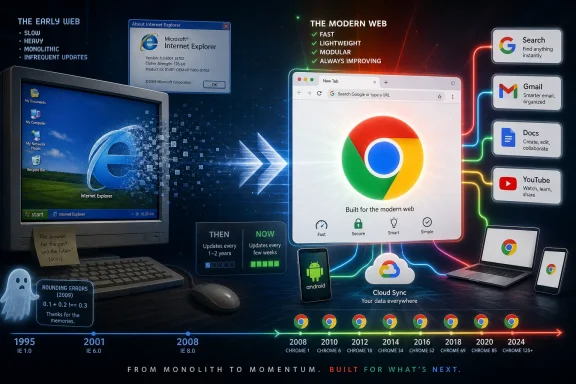 Ballmer Was Right About the Present and Wrong About the Future
Ballmer’s remark was not absurd when he made it. Chrome had launched only a year earlier, Internet Explorer still had overwhelming global share, and Firefox was the insurgent browser with real cultural momentum. If you were looking at the market through a spreadsheet in 2009, Chrome really was small enough to wave away.That is what makes the quote useful. The mistake was not that Ballmer failed to read the numbers; the mistake was that he read them too literally. Microsoft’s browser lead was a monument to the PC era, but Chrome was being built for the web-app era that was already arriving.
Internet Explorer’s share came from Windows, corporate inertia, and years of default placement. Chrome’s growth came from a different kind of gravity: speed, release cadence, web standards, developer goodwill, and Google’s ability to turn the browser into the front door for its search, ads, Gmail, Docs, YouTube, Android, and cloud ecosystem.
In other words, Microsoft was judging a flywheel as if it were a feature.
Internet Explorer’s Empire Was Built for a Slower Web
To understand why Microsoft misread Chrome, you have to remember what Internet Explorer represented in 2009. IE was not merely a browser. It was the browser most people encountered because it came with Windows, and Windows was still the gravitational center of personal computing.For years, that was enough. Consumers bought PCs, enterprises deployed Windows images, and the browser arrived as part of the furniture. Competing browsers could be downloaded, but they had to ask users to make an active choice. Internet Explorer only had to be there.
That advantage was enormous, but it came with a cost. A product protected by distribution tends to optimize for compatibility, not urgency. It serves installed bases, line-of-business apps, intranets, ActiveX controls, corporate policies, and the long tail of old assumptions that make IT departments nervous.
Chrome arrived with fewer obligations. It could break with the past faster because it had less past to preserve. It treated the browser as a fast-moving application platform, not a component of the Windows estate.
That difference mattered more with every passing year. As web apps became richer and JavaScript-heavy sites became normal, users and developers began to notice browser performance in a way they had not during the static-page era. Chrome made speed feel like a product feature. Internet Explorer made compatibility feel like a burden.
Google Turned the Browser Into a Product That Shipped Like the Web
Sundar Pichai’s later telling of Chrome’s early years is revealing because it focuses less on market share than tempo. Google pushed aggressive goals, iterated rapidly, and treated a six-week release cycle as a competitive weapon. That was not just engineering culture; it was strategy.The old browser market moved at the pace of packaged software. Big releases came with ceremony. Features, security changes, and standards support arrived in waves. Chrome helped normalize a world where the browser updated constantly, almost invisibly, and users learned to expect improvement without thinking about version numbers.
That cadence changed the politics of the web. Developers could target modern capabilities sooner. Security fixes could move faster. Performance work became continuous rather than episodic. The browser became less like Microsoft Office and more like a living service.
Microsoft eventually learned the lesson, but late. Edge today is a competent, fast, Chromium-based browser with strong enterprise controls and deep Windows integration. But the very fact that Microsoft rebuilt Edge on Chromium in 2020 is the quietest possible admission that the browser engine war ended with Google setting the terms.
That is the irony hiding under Ballmer’s quote. Chrome did not merely beat Internet Explorer. It helped define the technical foundation on which Microsoft’s replacement browser now depends.
The Rounding Error Became the Standard
By 2026, Chrome’s position is no longer just dominant; it is structural. StatCounter’s May 2026 global browser numbers put Chrome at 70.25 percent and Edge at 5.14 percent, a gap so large that Microsoft’s browser business now lives in the shadow of the company Ballmer once waved off. Internet Explorer, meanwhile, has been retired since June 15, 2022, with Microsoft steering remaining legacy needs into IE mode inside Edge.Market-share numbers always deserve caution. They vary by region, device type, methodology, and whether you are looking at desktop, mobile, or all platforms combined. But the shape of the market is not in doubt: Chrome became the default browser for the open web, even when it was not the default browser on Windows.
That victory was powered partly by quality and partly by ecosystem. Chrome benefited from Google Search prompts, Android, Gmail, YouTube, Docs, and a web increasingly optimized around Chromium’s behavior. Developers test where users are, users go where sites work best, and the cycle reinforces itself.
This is where the story becomes uncomfortable for anyone who cares about competition. Chrome’s rise was a triumph over Microsoft’s old bundling advantage, but it also produced a new concentration of power. The web escaped one browser monoculture only to flirt with another.
Firefox, the browser Ballmer identified as the real threat in 2009, is now the smaller ideological counterweight: independent engine, privacy branding, nonprofit steward, shrinking share. Safari remains powerful because Apple controls the iPhone and mandates WebKit for iOS browsers in many practical respects. Edge survives through Windows integration, enterprise tooling, and Microsoft’s willingness to promote it heavily.
But Chrome sets the pace. When one browser family becomes the assumed target for developers, the open web becomes less open in practice, even if the standards process remains formally open.
Microsoft’s Edge Problem Is Not Engineering
It is tempting to frame Microsoft’s browser decline as a simple product failure. That would be too easy and not entirely fair. Modern Edge is good software. It is fast, secure, compatible, manageable, and in many enterprise environments it is a rational default.The problem is not that Edge is bad. The problem is that Edge arrived after the browser had already become an ecosystem choice.
For consumers, Chrome means passwords, bookmarks, extensions, Google account sync, Android continuity, and years of habit. For developers, Chromium means the compatibility baseline. For enterprises, Chrome has become familiar, policy-manageable, and already integrated into workflows that no longer map neatly onto Windows alone.
Microsoft can preinstall Edge. It can recommend Edge. It can make Edge the handler for certain Windows surfaces. It can place banners in Bing and Windows Search. But those tactics solve yesterday’s problem: getting in front of the user. They do not solve today’s problem: convincing users to move their digital identity, muscle memory, and trust.
That is why Mozilla’s complaints about Microsoft’s Edge promotion and alleged dark patterns resonate beyond the browser wars. The accusation is not simply that Microsoft wants users to choose its browser. Every browser maker wants that. The accusation is that Microsoft still reaches for operating-system leverage when it struggles to win browser loyalty on its own.
That is the same playbook that made Internet Explorer dominant. The difference is that it now looks defensive rather than inevitable.
The Antitrust Ghost Never Really Left the Browser
The browser has always been more than an app because it mediates access to everything else. In the late 1990s and early 2000s, that made Internet Explorer central to Microsoft’s antitrust battles. In the 2020s, the same logic applies to Chrome, mobile browsers, app stores, search defaults, and AI assistants.The names have changed, but the leverage points are familiar. Defaults matter. Preinstallation matters. Search placement matters. Account sync matters. Prompts and warnings matter. The company that controls the first-run experience has enormous influence over what users later describe as preference.
Microsoft knows this because it pioneered the model. Google knows it because it mastered the service-era version. Apple knows it because Safari and WebKit sit inside a tightly controlled mobile ecosystem. Mozilla knows it because Firefox has to fight uphill against all of them.
That is why Ballmer’s old line lands differently now. It is not just a laugh-at-the-executive moment. It is a reminder that dominant platforms usually underestimate threats until those threats discover a stronger distribution channel, a faster development loop, or a new layer of user dependency.
Chrome had all three. It rode Google’s web properties, updated at cloud speed, and became the identity layer for users who lived across devices. Internet Explorer had Windows. For a while, that was enough. Then it was not.
Windows Users Won the First War and Inherited the Second
For ordinary Windows users, Chrome’s rise brought real benefits. It broke the sense that the browser was whatever Microsoft shipped. It made speed, standards support, sandboxing, and frequent updates competitive necessities. It forced Microsoft to modernize, first with EdgeHTML and later by joining Chromium.That competition improved the web. Sites became more capable, browser security improved, and the developer experience became less haunted by old IE-specific workarounds. Anyone who built for the web in the IE6 era understands how much pain was buried under the phrase “browser compatibility.”
But the current market has its own problems. A Chromium-heavy web can drift toward a single implementation reality, even when multiple brands sit on top of it. Edge, Brave, Vivaldi, Opera, and Chrome are not the same product, but they share a common engine lineage that gives Google unusual influence over the direction of the web platform.
For sysadmins, this creates a practical bargain. Chromium-based browsers reduce compatibility headaches and simplify support, but they also narrow the diversity of engines in real-world use. Enterprises may prefer the manageability of Edge or Chrome, yet the broader web benefits when Firefox and Safari remain strong enough to keep standards honest.
The result is a strange inversion of 2009. Back then, the danger was Microsoft’s browser dominance tied to Windows. Today, the danger is a web ecosystem where Google’s browser dominance is so complete that even Microsoft’s best browser strategy depends on Google’s engine.
The Lesson Is Not That Executives Should Stop Mocking Rivals
Tech history is full of executives dismissing products that later mattered. That genre is entertaining, but it can be misleading. The real lesson is not that leaders should never make confident predictions. Their job is to make bets with incomplete information.The deeper lesson is that market share is a lagging indicator when the basis of competition is changing. In 2009, Microsoft was still looking at browsers through the lens of installed operating systems. Google was looking at browsers through the lens of web services, developer velocity, and cross-device identity.
The numbers favored Microsoft. The direction favored Google.
That distinction is especially relevant now as Microsoft pushes Copilot across Windows, Office, Edge, and cloud services. The company is again trying to turn a platform position into habitual use of a new interface layer. This time the interface is not the browser; it is AI. The question is whether users experience that integration as helpful gravity or as another round of coercive defaults.
History suggests the answer will not be decided by placement alone. If Copilot becomes genuinely useful, users will forgive a lot of promotion. If it feels imposed, the backlash will echo the browser wars: not because people reject integration, but because they resent being cornered.
The Browser War’s Most Concrete Lessons Are Still Sitting on the Desktop
The Ballmer quote survives because it compresses an entire industry shift into one mistaken phrase. It also gives Windows users and IT pros a useful way to think about platform power in 2026: the default is powerful, but the product that compounds faster can still win.- Chrome was genuinely small when Ballmer dismissed it in 2009, but its release cadence and ecosystem leverage mattered more than its initial share.
- Internet Explorer’s dominance depended on Windows distribution, while Chrome’s dominance grew from performance, web-service integration, and developer adoption.
- Microsoft’s 2020 move to Chromium-based Edge showed that the browser engine contest had already shifted toward Google’s technical center of gravity.
- Internet Explorer’s 2022 retirement closed the old Windows browser era, but it did not end Microsoft’s instinct to use Windows surfaces to promote Edge.
- The modern web is healthier than the IE6-era web in many ways, yet Chrome’s scale creates a new concentration risk for standards, competition, and user choice.
- For administrators, the practical answer is not browser tribalism but policy clarity: support what users need, manage defaults transparently, and preserve alternatives where they reduce lock-in.
References
- Primary source: Windows Central
Published: 2026-06-18T14:50:08.433247
Loading…
www.windowscentral.com - Related coverage: techcrunch.com
Loading…
techcrunch.com - Related coverage: gs.statcounter.com
Loading…
gs.statcounter.com - Related coverage: faq-mac.com
Loading…
www.faq-mac.com - Related coverage: techcrunchjapan.com
Loading…
techcrunchjapan.com - Related coverage: maclife.de
Loading…
www.maclife.de
- Related coverage: appleinsider.com
Loading…
appleinsider.com - Related coverage: techradar.com
Loading…
www.techradar.com - Related coverage: macmagazine.com.br
Loading…
macmagazine.com.br - Related coverage: ashgabattimes.com
Loading…
ashgabattimes.com - Related coverage: statcounter.com
Loading…
statcounter.com - Related coverage: macrumors.com
Microsoft's Chromium Edge Browser for Mac Officially Launches
Microsoft today announced the first stable launch of its Edge browser built on the Google Chromium open source project. Microsoft Edge can be downloaded on both Windows machines and Macs. A beta version of the Microsoft Edge browser has been available for several months ahead of the official...www.macrumors.com - Official source: microsoft.com
Loading…
www.microsoft.com - Official source: news.microsoft.com
Loading…
news.microsoft.com - Official source: blogs.windows.com
Loading…
blogs.windows.com - Official source: support.microsoft.com
Loading…
support.microsoft.com - Official source: learn.microsoft.com
Loading…
learn.microsoft.com - Related coverage: idownloadblog.com
Loading…
www.idownloadblog.com - Related coverage: axios.com
Loading…
www.axios.com - Related coverage: mypayrollreports.com
Loading…
www.mypayrollreports.com - Related coverage: pcgamer.com
Loading…
www.pcgamer.com - Related coverage: radioeng.com
Loading…
www.radioeng.com - Official source: info.microsoft.com
Loading…
info.microsoft.com - Related coverage: forums.intercede.com
Loading…
forums.intercede.com