

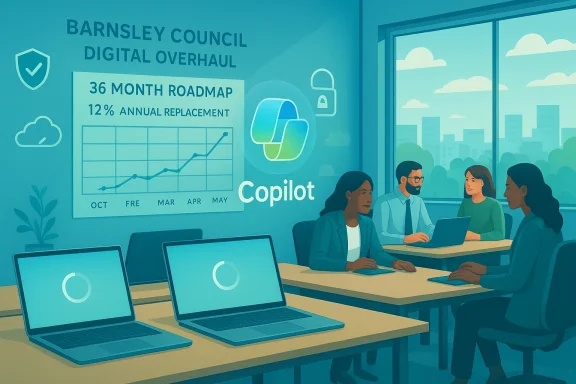
Barnsley Council’s announcement that it will spend £1.1 million on a “major overhaul” of its digital services is the latest example of local authorities betting on device refreshes and AI to stabilise day‑to‑day operations and ease staff workloads — but the numbers in the brief notice raise as many questions as they attempt to answer. The package, as reported by the BBC, includes a recurring device‑refresh stream of about £285,000 a year (the council says this equates to replacing roughly 12% of its machines annually), and a continuing annual bill of about £300,000 to maintain Microsoft Copilot licences — an explicit decision to double down on AI assistance for staff. Those headline figures are small enough to be achievable within a council budget, yet large enough to warrant detailed scrutiny of procurement strategy, security controls and long‑term value for money.
Barnsley’s move sits inside a wider pattern across UK councils: local authorities are increasingly procuring AI tools such as Microsoft 365 Copilot to reduce routine admin work and switching to scheduled refresh programmes to avoid a growing backlog of ageing, insecure devices. Microsoft case studies and industry writeups show many councils are reporting measurable productivity gains after pilots of Copilot and similar tools, and procurement frameworks for the public sector now list Copilot SKUs with published per‑user pricing that makes the Barnsley numbers plausible.
At the same time, careful analysis of similar public‑sector refresh programmes exposes three persistent pitfalls: vendor lifecycle misalignment (buying hardware or OS versions that will shortly reach end‑of‑support), under‑budgeting for the day‑two costs of imaging, testing and helpdesk support, and weak or incomplete AI governance that allows models to leak sensitive prompts or encourage over‑reliance on machine‑generated outputs. These issues recur across multiple council and departmental programmes and should be central to how Barnsley executes the £1.1m plan.
But turning those time savings into recurring cash savings is tricky:
Practical actions for Barnsley and peers:
Barnsley’s £1.1m package is directionally correct: invest to reduce endpoint risk and experiment with productivity‑boosting AI. The council’s approach could produce measurable staff benefits, support recruitment and modernise workflows. However, turning that headline commitment into durable value requires two things done well: disciplined financial planning that accounts for recurring licence and operational costs, and a robust set of governance, reporting and sustainability commitments that prevent the programme becoming a short‑term feel‑good exercise. The devil is in the implementation and the transparency of outcomes.
Key immediate actions for Barnsley: publish the licence count and per‑user cost for Copilot, publish the device inventory and upgradeability assessment that underpins the 12% replacement rate, and commit to quarterly public reporting against clear KPIs (device replacement progress, Copilot uptake/training completion and measurable productivity outcomes). Those steps will turn a promising headline into an accountable programme of digital modernisation that residents — and auditors — can understand and judge.
Source: BBC Barnsley Council to spend £1.1m on 'digital overhaul'
 Background / Overview
Barnsley’s move sits inside a wider pattern across UK councils: local authorities are increasingly procuring AI tools such as Microsoft 365 Copilot to reduce routine admin work and switching to scheduled refresh programmes to avoid a growing backlog of ageing, insecure devices. Microsoft case studies and industry writeups show many councils are reporting measurable productivity gains after pilots of Copilot and similar tools, and procurement frameworks for the public sector now list Copilot SKUs with published per‑user pricing that makes the Barnsley numbers plausible. At the same time, careful analysis of similar public‑sector refresh programmes exposes three persistent pitfalls: vendor lifecycle misalignment (buying hardware or OS versions that will shortly reach end‑of‑support), under‑budgeting for the day‑two costs of imaging, testing and helpdesk support, and weak or incomplete AI governance that allows models to leak sensitive prompts or encourage over‑reliance on machine‑generated outputs. These issues recur across multiple council and departmental programmes and should be central to how Barnsley executes the £1.1m plan.
What the package actually says (and what we can verify)
- The BBC reported that Barnsley Council plans a £1.1m digital overhaul that includes a device refresh stream and continuing Microsoft Copilot licences. The council reportedly expects to spend about £285,000 a year replacing laptops and will replace ~12% of machines each year to maintain service levels. The same report states the council will continue funding Microsoft Copilot licences at about £300,000 a year. (User-provided BBC excerpt.)
— I could not access the BBC page directly via an automated crawl here, so I rely on the excerpt you supplied as the primary text of the BBC item. That should be treated as the authoritative framing of the council’s announcement for the purpose of this article. - Microsoft’s published UK pricing for Microsoft 365 Copilot is publicly available and sits in the same ballpark as the sums Barnsley reports committing. Microsoft’s official pricing shows Copilot licenses are priced per user per month (with annual purchase options) and, depending on plan and billing cadence, translate into several hundred pounds per user per year. That pricing makes a £300,000 annual Copilot bill plausible for a mid‑sized user base.
- Independent public‑sector case studies and vendor pages confirm that UK councils have been adopting Copilot and reporting time savings and recruitment/retention benefits — Barnsley itself is featured in vendor materials describing Copilot use cases. Those case studies are useful for understanding likely benefits, but they are typically vendor‑hosted and should be treated as promotional unless corroborated by independent audits.
Breaking down the numbers: Copilot at ~£300k/year — what that implies
Microsoft lists Copilot pricing in its UK catalogue at around £23.10 per user per month when billed annually (the enterprise Copilot offering). At that rate, annual per‑user cost is about £277.20 (before VAT). Using that published figure:- £300,000 per year for Copilot ÷ £277.20 ≈ 1,082 licences.
- Microsoft pricing varies with volume discounts, public‑sector purchasing agreements and which Copilot tier (Chat, full Microsoft 365 Copilot, agent/Studio capacity) is purchased. The per‑user bill could be lower or higher than the simple calculation above depending on those variables.
- The published unit price does not include the non‑licensing costs of successful Copilot adoption: training, supervision, policy rollout, logging/audit tooling (e.g., Microsoft Purview), integration into internal knowledge sources, and extra helpdesk support. Those operational costs are recurring and should be budgeted alongside licence spend.
- Vendor case studies (including Barnsley’s appearance in Microsoft materials) often describe time savings in minutes or hours per user per week. These convert into capacity but are frequently self‑reported metrics measured during pilots — helpful signals but not definitive financial savings until a council demonstrates reduced agency spend, paused recruitments, or other cashable offsets. Treat the claimed productivity gains as promising but provisional until Barnsley can show concrete HR or budgetary impacts.
The device refresh math: £285k/year and 12% replacement — feasible or underfunded?
The council says it will spend £285,000 a year and believes about 12% of machines will need replacing annually to maintain service levels. Interpreting those numbers requires assumptions about average replacement cost per laptop.- Public‑sector and enterprise procurement briefs show broad per‑device replacement costs generally in the range of a few hundred to around one thousand pounds per device, depending on spec, procurement scale and service levels (imaging, accessories, warranty, disposal/refurbish). A reasonable mid‑range assumption for an office laptop replacement in current procurement cycles is roughly £600–£900 per device when imaging and disposal costs are included.
- Using a midpoint assumption of £750 per device:
- £285,000 / £750 ≈ 380 devices replaced per year.
- If 380 devices represent 12% of the estate, Barnsley’s device estate would be ~3,167 devices.
- Using a more conservative second assumption (per‑device cost £1,000), the same £285,000 would replace ~285 devices/year, implying an estate of ~2,375 devices.
- Replacement cost is not the whole story. Total Cost of Ownership includes imaging, enrolment in device management (e.g., Autopilot/Intune), staff time to reconfigure, license entitlements for Windows 11 or Copilot+ features, accessory replacement (docking stations, monitors), secure data erasure and certified recycling. Councils often under‑budget these recurring operational items.
- Hardware compatibility for modern Windows 11 or Copilot+ experiences can shrink the population of upgradeable devices. Minimum hardware baselines (TPM, supported CPU families, RAM and storage thresholds and, in some Copilot+ cases, NPU/TOPS specifications) mean some machines are non‑upgradeable in place and therefore cost more to replace. That can create spikes in capital need when cohorts that were once serviceable become obsolete overnight.
- If the council intends to roll out on‑device AI features (Copilot+ PCs with Neural Processing Units), the average replacement cost rises materially. Not every role needs an AI‑accelerated device; a persona‑driven approach (prioritise caseworkers, content authors, and roles that directly benefit from on‑device inference) keeps costs in check.
Productivity claims vs. procurement reality: weighing the benefits
Many councils (Kent, Somerset, Aberdeen and others) have documented time savings after introducing Copilot: meeting minutes automated, faster drafting of documents, triage of casework and improved accessibility supports for staff. These are real operational wins — they change the daily work experience and, in some cases, free capacity.But turning those time savings into recurring cash savings is tricky:
- To call licence spend "paid for" by productivity, a council must demonstrate cashable outcomes: either reduced agency/temp spend, paused recruitment, measurable reduction in overtime or fewer backlogs that would otherwise require extra spending. Vendor case studies sometimes report paused recruitment as a direct offset, but those are specific to local circumstances and may not generalise. Treat such claims as plausible outcomes rather than guaranteed returns.
- There is also the risk of demand rebound: making staff more productive can increase throughput and raise constituent expectations, producing a growth in service demand that absorbs the saved time rather than translating into headcount reductions. A robust business case anticipates where saved capacity will be redeployed.
Security, data governance and AI oversight — the non‑negotiables
Buying Copilot licences is not just a productivity decision; it’s a governance decision. Responsible deployments in the public sector require:- Clear prompt and data‑use policies: what staff are allowed to include in prompts (personal data, case notes, health or social care details), and when human review is mandatory. Councils should prohibit sending sensitive PII or caseworker notes into public model prompts unless processed within an enterprise tenant with explicit controls.
- Auditability and logging: Copilot and related Microsoft offerings integrate with Microsoft Purview and other governance tooling; councils should enable and test detailed logging to support audits and Freedom of Information / data subject access requests. Purview’s lineage features can be a central control for compliance if properly configured.
- Training and change management: mandatory training (even brief 60–90 minute courses) on Copilot's strengths and limitations should be a precondition for licence enablement. Human‑in‑the‑loop review, escalation paths for hallucinations or suspect outputs, and periodic model performance reviews are essential operational controls.
- Contractual protections and data residency: councils must examine their Microsoft contracts and procurement paperwork to confirm where model inference happens, how prompts and telemetry are retained, and whether vendor commitments match the council’s legal and regulatory needs (GDPR, public‑sector data residency expectations). Vendor materials assert enterprise protections, but the operational detail is what matters.
Procurement timing and lifecycle risk — the trap councils fall into
A perennial problem that public bodies encounter is misalignment between procurement windows and vendor lifecycles. Defra’s experience with OS lifecycle timing serves as a cautionary tale: capital refreshes that standardise on a platform near the end of mainstream support can create a second tranche of urgent spending when that platform reaches end‑of‑support. Councils must anchor refresh schedules to vendor lifecycle calendars, not to the immediate urgency of broken devices.Practical actions for Barnsley and peers:
- Publish a time‑boxed device strategy: identify cohorts upgradeable in place to Windows 11, cohorts needing firmware enablement (TPM, Secure Boot), and non‑upgradeable devices requiring replacement. This turns a 12% aspirational figure into a measurable migration plan.
- Use ESU/bridge options strategically: Extended security updates (ESU) exist to buy time for genuinely legacy machines that cannot be migrated in the next 12 months; they are rarely a long‑term cost‑effective plan. ESU pricing compounds year on year and should be used narrowly.
- Pilot, measure, and report: if Barnsley claims recruitment/retention benefits driven by Copilot, the council should publish the metrics that demonstrate these outcomes (vacancy fill rates, agency spend, vacancy freezes, helpdesk metrics) and tie them to the annual licence cost to prove value for money. Vendor case studies alone are not sufficient evidence.
Environmental and sustainability considerations
Large‑scale device replacement produces e‑waste and can be politically sensitive. Best practice in public procurement now demands circular procurement clauses: trade‑in and refurbishment options, certified secure data erasure, and partnerships with accredited refurbishers to reduce the environmental footprint and lower gross capital cost through reuse pipelines. Including these elements in vendor contracts mitigates criticism and reduces net spend over time.Practical checklist: what Barnsley should do next (operationally realistic)
- Publish a 36‑month device and Copilot roadmap with explicit KPIs:
- Device cohorts (upgradeable / upgradeable with firmware work / replace).
- Annual replacement targets and cost lines (capex and day‑two opex).
- Expected Copilot users, training plan, and measurable productivity targets (time saved, cashable offsets).
- Validate licensing math transparently:
- Publish number of Copilot licences purchased and per‑user cost (net of public‑sector discounts).
- Show the assumed conversion from time saved to cashable savings (e.g., paused recruitments, reduced agency costs).
- Strengthen AI governance:
- Mandate prompt hygiene training before licences are granted.
- Turn on tenant‑level protections and Purview logging; publish a short data‑use policy for staff and residents.
- Adopt circular procurement:
- Publish trade‑in/reuse commitments and certified data erasure processes.
- Seek refurbishment partners to offset hardware spend and reduce e‑waste.
- Report quarterly:
- Vulnerability counts, device replacement progress, Copilot uptake and training completion rates, and any service or data incidents attributable to Copilot or device changes.
Strengths, weaknesses and the balanced verdict
Strengths- The council is addressing a real problem: ageing devices create security risk and hamper staff productivity. Investment in refresh and AI tools can materially improve staff experience and service responsiveness if implemented well. Vendor and public‑sector case studies document time‑savings and measurable operational wins.
- The modest scale of the commitment (£1.1m headline) makes it a manageable programme for a council: it’s not an attempt to replatform everything at once, but rather a staged combination of refresh and software investment — a model other councils are following.
- Licensing is a recurring cost: £300,000 a year for Copilot is ongoing and must be sustained even if immediate cashable savings fail to materialise. The council should show how it will fund this long term, or what service changes will offset licence spend.
- Device refresh figures risk understating hidden operational costs: imaging, testing, broken workflows, legacy application compatibility and helpdesk overheads are real and often underestimated. If hardware base isn’t matched to Windows 11/Copilot+ requirements, the council may face higher replacement costs than modelled.
- AI governance is essential but resource‑intensive. Without mandatory training, strong DLP and audit trails, the council risks privacy incidents, misapplied AI outputs and reputational damage. Vendor case studies emphasise benefits — but the operational and legal responsibility for safe use sits firmly with the council.
Barnsley’s £1.1m package is directionally correct: invest to reduce endpoint risk and experiment with productivity‑boosting AI. The council’s approach could produce measurable staff benefits, support recruitment and modernise workflows. However, turning that headline commitment into durable value requires two things done well: disciplined financial planning that accounts for recurring licence and operational costs, and a robust set of governance, reporting and sustainability commitments that prevent the programme becoming a short‑term feel‑good exercise. The devil is in the implementation and the transparency of outcomes.
Conclusion
Barnsley Council’s plan to spend £1.1m on a device refresh and continued Microsoft Copilot licences captures both the promise and the complexity of municipal digital transformation. The sums involved are realistic when compared to published Copilot pricing and typical device replacement economics, but they are only the opening moves in a longer game. To secure real value for residents and taxpayers, the council must convert claimed productivity gains into measurable, cashable outcomes, anchor device refreshes to vendor lifecycles, and publish clear governance and sustainability commitments. Done properly, this investment can reduce risk, improve staff productivity and help the council keep services running more efficiently; done poorly, it will be a recurring cost with limited public benefit.Key immediate actions for Barnsley: publish the licence count and per‑user cost for Copilot, publish the device inventory and upgradeability assessment that underpins the 12% replacement rate, and commit to quarterly public reporting against clear KPIs (device replacement progress, Copilot uptake/training completion and measurable productivity outcomes). Those steps will turn a promising headline into an accountable programme of digital modernisation that residents — and auditors — can understand and judge.
Source: BBC Barnsley Council to spend £1.1m on 'digital overhaul'
