

Microsoft’s plan to turn Windows into an AI-first platform has collided with the stubborn reality of users who value stability, control and predictable upgrades — and the resulting standoff is exposing a massive gap between marketing ambition and user willingness to follow. A cluster of vendor statements, news reports and advocacy research now paints a stark picture: as many as one billion PCs remain on Windows 10 even after Microsoft’s formal end of support, roughly half of those devices are technically eligible to move to Windows 11 and are simply not being upgraded, and the fallout touches security, sustainability and the future roadmap for Windows itself.
This dynamic explains both the vendor optimism about a refresh cycle and the political/PR tension in user communities and regulatory conversations.
Yet several risks loom:
Source: Futurism Vast Number of Windows Users Refusing to Upgrade After Microsoft's Embrace of AI Slop
 Background
The timeline, in one line
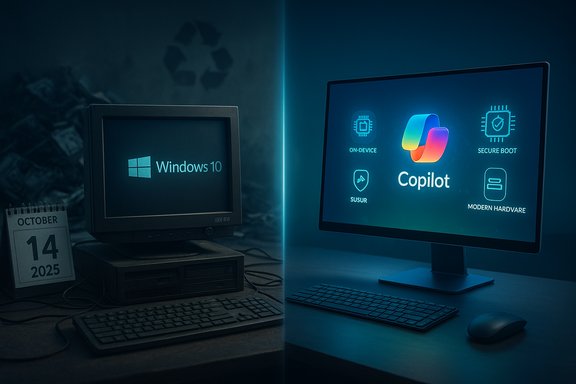
Microsoft formally set the end-of-support date for Windows 10 as October 14, 2025; after that date Home and Pro editions no longer receive security updates under the standard lifecycle, though limited Extended Security Update (ESU) options have been announced for users and organizations that need a bridge. That deadline framed much of the industry’s activity in 2024–2025: marketing drives to push users to Windows 11, OEM refresh cycles pitched around so-called “AI PCs,” and public debate about whether Microsoft’s stricter hardware bar (TPM 2.0, Secure Boot and newer CPU generations) is genuinely about security or effectively forces hardware turnover.The new axis: AI-first Windows
Over the past year Microsoft has publicly repositioned Windows as the platform on which a new class of on-device and hybrid AI features will live. Executives describe a vision of an “agentic OS” — a system able to surface, plan and complete multi-step tasks with user permission — and have tied product messaging to Copilot, on-device models and hardware acceleration (NPUs). That shift is explicit and rapid, and it underpins the company’s argument for modern hardware that can handle AI workloads. But that narrative has not gone unchallenged. Announcements about Windows becoming “agentic” met immediate and vocal user resistance on social channels; key Microsoft leaders publicly acknowledged the feedback and pledged to collect and act on it, but the optics of pushing AI-first experiences at the same time Windows 10 support ended has hardened user skepticism.The scale of the holdouts: what Dell told investors — and what it means
On a recent Dell earnings call the company’s COO, Jeff Clarke, framed the installed Windows base and migration challenge with blunt numbers that reverberated through the industry: Dell estimated the global installed Windows base at roughly 1.5 billion PCs, and said around 500 million of those devices are capable of running Windows 11 but haven’t upgraded, while another 500 million are too old or incompatible with Windows 11’s hardware baseline. Taken together, that produced the headline claim — repeated across the press — that about one billion PCs remain on Windows 10 in some form. Multiple outlets reproduced Dell’s remarks and used them to quantify the upgrade gap; Forbes and other major outlets highlighted the scale and the risk: if Dell’s figures are taken at face value they imply a structural market where a third of the global PC fleet is “refusing” to move, whether by choice or because the hardware doesn’t qualify. Important nuance: these are vendor-level estimates and rounded figures. Dell’s statements reflect its view of the installed base and its commercial lens (opportunity for trade-ins and refresh cycles), not a telemetry release from Microsoft. That distinction matters for analysis: Dell’s numbers are credible and newsworthy, but they are not an audited global registry of operating system installs. Several market trackers (StatCounter, Steam hardware reports) show regional variation and somewhat different share snapshots, reinforcing that precision varies by method.Why so many users aren’t upgrading
Multiple forces explain the high number of Windows 10 holdouts. These factors overlap and reinforce one another.- Hardware incompatibility: Windows 11’s baseline (TPM 2.0, UEFI Secure Boot, CPU generation checks and other constraints) disqualifies many older-but-serviceable machines. For some users the only pragmatic option is to keep Windows 10 or buy a new device.
- Cost sensitivity and inertia: Replacing a still-functional laptop or desktop is expensive. For many users — especially in price-sensitive markets and small businesses — the immediate benefits of Windows 11 do not justify the cost. The option to pay for short-term extended security support (ESU) also reduces the immediacy of upgrading.
- Software and workflow compatibility: Certain legacy apps, drivers, or industry-specific tools run only on older environments; organizations with complex software stacks test and delay migration to avoid disruption.
- UI and UX friction: Windows 11 introduced interface changes and removal of some longstanding behaviors; power users have documented regressions and missing features that reduce the perceived value of an upgrade. Recurring user complaints — from taskbar limitations to telemetry defaults — feed resistance.
- AI fatigue and privacy concerns: Microsoft’s visible pivot toward agentic AI features and Copilot integration is not universally popular. Many users view baked-in, proactive AI as intrusive or a threat to control, especially when early AI-driven features (like Recall in testing) showed bugs or raised privacy questions. The social-media backlash to the “agentic OS” phrasing is one measurable indicator of this trend.
- Perceived quality issues: Some users say recent builds and AI-first features introduced regressions and instability in core experiences; that perception — whether fully justified — dampens enthusiasm for adoption. Community discussions and forum threads repeatedly call for Microsoft to prioritize reliability over feature novelty.
Security, operational risk and the e-waste problem
The consequences of a large Windows 10 tail are tangible and twofold.Security exposure
When mainstream support stops, routine security patches and bug fixes stop arriving for most editions. That produces a rising risk surface: attackers have a broad, stable target (unpatched software patterns) and organizations with exposed endpoints must increase monitoring, compensate with compensating controls, or pay for ESU coverage. Microsoft’s lifecycle documentation makes clear what “end of support” means in practical terms for Home and Pro users.E-waste and sustainability
Advocacy groups warned early that strict upgrade gates would produce a sustainability problem. The United States Public Interest Research Group (US PIRG) and affiliated Environment America research estimate that the Windows 10 retirement could result in 1.6 billion pounds of electronic waste from devices that cannot upgrade to Windows 11. That calculation comes from modeling the number of incompatible machines and reasonable pathways for disposal or replacement, and several media outlets and local news reports flagged the estimate. The figure is large and should be treated as an estimate with assumptions, but it underscores a plausible environmental externality of an aggressive hardware baseline. Caveat: e-waste projections are model-based and sensitive to assumptions about reuse, resale and recycling behavior. The headline number is useful as a risk indicator, not as a precise scientifically measured weight.Microsoft’s argument and executive messaging
Microsoft’s product leaders have been explicit about the strategy: bring more intelligence into the OS, extend Copilot and on-device models, and incent hardware refresh to deliver consistent security and new capabilities.- Yusuf Mehdi, Microsoft’s executive vice president and chief marketing officer for consumer, described the company’s ambition in blunt terms: to “rewrite the entire operating system around AI” and build what he called an “AI PC” where voice, vision and agentic features play a central role in daily workflows. This quote and related interviews were widely reported by leading publications.
- Pavan Davuluri, Microsoft’s Windows president, used the phrase “agentic OS” in social posts promoting Ignite and subsequent briefings; the phrase drew visceral online pushback and forced a rapid public response acknowledging user feedback. Davuluri told developers and the public that Microsoft is “taking a ton of feedback” and that the team is working on usability and power‑user pain points. Those interactions are notable because they reflect both the strategic intent and the PR challenge.
OEM and market dynamics: a refresh opportunity — and a tension
Dell’s framing of the market as having roughly 1.5 billion installed PCs with a 500/500 split between upgrade-capable holdouts and incompatible machines has commercial logic: the OEM sees a serviceable upgrade funnel for trade-ins and new sales. On the call, Dell tied that opportunity to the broader trend of manufacturers building “AI PCs” that include NPUs and marketing Copilot-forward features. For OEMs, the math is straightforward: if a substantial fraction of the installed base delays upgrades, the industry can monetize that latency through promotions, financing and bundled experiences. For Microsoft, the calculus is more complex: pushing an AI-first Windows that works best on newer hardware can accelerate platform modernization, but it risks alienating users who feel coerced.This dynamic explains both the vendor optimism about a refresh cycle and the political/PR tension in user communities and regulatory conversations.
Quality control and the “AI-code” problem
A separate but related concern involves Microsoft’s internal use of AI in software development. Company leaders acknowledged that a non-trivial portion of the company’s codebase is now generated or assisted by AI: figures reported in public conversations place the number in a 20–30% range for some projects. That rapid adoption raises legitimate questions about code quality practices, test coverage, security review and the potential for subtle regressions when AI‑generated code slips into deep system components. Industry reporting emphasizes that the metric is imprecise — it varies by language, project and definition of “written by AI” — but the trend is material and merits scrutiny. Implication: if Windows features, or their interactions, are increasingly assembled with AI assistance, then Microsoft must demonstrate rigorous engineering governance (automated testing, fuzzing, red-team reviews and independent audits) to sustain confidence. Many in the community worry that a fast pivot to new features without commensurate investment in foundational reliability will erode trust.What’s verifiable and what should be treated cautiously
- Verifiable, high-confidence facts:
- Windows 10 end-of-support date: October 14, 2025, per Microsoft lifecycle documentation.
- Dell’s earnings call remarks: Jeff Clarke’s estimate of a 1.5 billion installed base and the 500M/500M split were made on a public investor call and are quoted in multiple transcripts and reports. These are vendor-provided, rounded figures that illuminate OEM thinking.
- US PIRG e-waste estimate: the 1.6 billion pounds figure appears in published PIRG materials and related reporting as an advocacy estimate. It is model-based and valid as a policy-warning statistic.
- Microsoft executive statements about AI-first direction: public interviews and briefings contain Mehdi’s and Davuluri’s remarks about embedding AI deeply into Windows. Those quotations are on the record.
- Claims to treat with caution:
- The exact one-billion number for Windows 10 devices in the wild is a rounded, vendor-framed figure. It is consistent with Dell’s framing (500M eligible but unupgraded + 500M ineligible), and it maps to some market-snapshot trackers, but global device counts vary by measurement method. Treat the “one billion” headline as a credible vendor-backed estimate rather than precise telemetry from every endpoint.
- Some community statements attributing all user resistance to “AI hatred” simplify a complex set of technical, economic and workflow reasons. Social-media backlash matters, but it is only one of several drivers. See the earlier sections for the layered causes.
Practical guidance for users and IT teams
- Check compatibility now. Use Microsoft’s PC Health Check or equivalent vendor tools to determine whether a device is eligible for Windows 11. For incompatible machines, plan replacement or long-term mitigation strategies.
- Consider ESU only as a bridge. Extended Security Updates can buy time but are not a substitute for modernizing endpoints. ESU strategy should be paired with an upgrade or device-replacement plan.
- Harden and segment. For organizations with Windows 10 endpoints post-EOL, prioritize network segmentation, endpoint detection/response, strict access controls and rapid patching of other software layers to reduce risk exposure.
- Back up before any migration. Whether upgrading in place or replacing hardware, maintain verified backups and test restores. Legacy applications may require compatibility testing with Windows 11.
- Evaluate alternatives where appropriate. For some classes of devices — particularly older machines used for single-purpose tasks — Linux or lightweight operating systems may provide a secure and sustainable path, reducing e-waste risk and preserving functionality without forced hardware churn.
Critical analysis: strengths, risks and what Microsoft must prove
Microsoft’s strengths are clear: deep cloud integration, a massive installed base, a substantial partner and OEM network, and the scale to train and deploy hybrid AI models. The “AI PC” vision is plausible: voice, vision, on-device agents and Copilot integrations could genuinely change workflows if they are reliable, private-by-design and demonstrably useful.Yet several risks loom:
- Trust erosion: pushing agentic behaviors into the OS without ironclad controls, clear memory policies and easy opt-outs will fuel distrust among power users and wary enterprises. Visible design choices (persistent prompts, telemetry defaults) that feel coercive amplify that risk.
- Engineering stability: rapid feature addition — particularly when AI tools are used in development — must be matched by rigorous testing, security audits and a stronger incident-response posture. Public confidence will hinge on Microsoft’s ability to show that new features don’t regress foundational capabilities.
- Sustainability and fairness: hardware gates that force replacement raise legitimate equity and environmental questions. Advocacy groups’ e-waste estimates are a policy warning; the company must address reuse, trade-in programs and responsible recycling at scale.
- Market reaction: OEMs see opportunity in device replacement; consumers see cost. If the value proposition for Windows 11 and AI PCs remains marginal for average users, adoption will lag and Microsoft will face a prolonged multi-year transition that complicates product planning.
- That AI features materially improve day-to-day outcomes for a broad set of users (not only early adopters).
- That agentic behaviors are safe, auditable and clearly controllable by users and admins.
- That modern security protections enabled by Windows 11 are sufficiently compelling in real-world risk reduction to justify migration costs for organizations.
- That the company will mitigate environmental effects through major trade-in, refurbishment and recycling commitments.
Conclusion
The controversy around the Windows 10 tail is more than a numbers story: it’s a lens on product strategy, user trust and the limits of platform persuasion. Dell’s investor remarks crystallized a blunt reality — large segments of the installed base are not upgrading — and that fact amplifies several pressing challenges for Microsoft: how to deliver AI features that users want, how to manage security and compatibility in a mixed fleet, and how to avoid turning a software transition into a sustainability and trust crisis. The path forward requires more than marketing: it requires demonstrable engineering discipline, transparent governance of agentic features, tangible trade-in and recycling programs, and an approach that restores agency to users. The outcome will determine not only Windows’ product trajectory but also how mainstream computing reconciles convenience-driven AI with the long-standing user demands for control, predictability and privacy.Source: Futurism Vast Number of Windows Users Refusing to Upgrade After Microsoft's Embrace of AI Slop
