

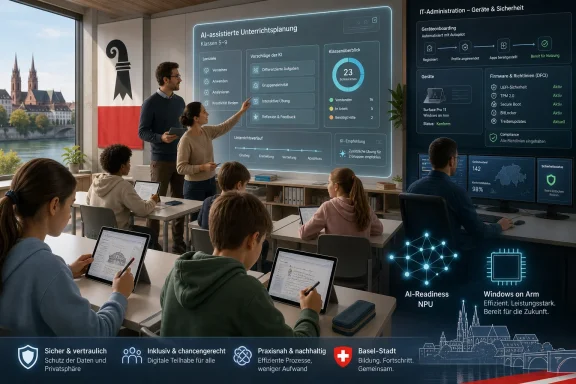
Basel-Stadt’s Department of Education said on June 10, 2026, that it is expanding its school digitalization program by issuing 11,000 Surface Pro 11 devices to pupils in grades 5 through 9, with rollout having begun in August 2025. The Swiss canton is not merely refreshing classroom hardware; it is betting that Windows on Arm, Microsoft 365, Intune, Autopilot, and on-device AI hardware can become the default operating model for public education. That makes Basel-Stadt a useful case study for every school system now trying to decide whether “AI readiness” is a curriculum goal, a procurement slogan, or a new form of platform lock-in.
The headline number is easy to remember: 18,000 schoolchildren and 2,800 teachers have already been equipped with Surface devices and accessories as part of a program that began with a 2020 strategy group and moved to Surface Pro 7+ in 2021. The more important number may be five: after five years, pupils can buy their devices for a symbolic amount, turning what looks like a managed fleet into a personal bridge between school and early working life.
The Basel-Stadt project reads at first like a familiar Microsoft customer story: a public-sector customer standardizes on Surface, Microsoft 365 A5, Windows 11, Intune, and Autopilot, while Microsoft highlights manageability, durability, and the path to AI. But the education context changes the stakes. A device issued to a 10- or 11-year-old is not just an endpoint; it is a policy statement about what digital literacy means.
The canton’s Department of Education says the work began in 2020, when educators and IT specialists were asked to define suitable digital learning environments and school technology. In 2021, that led to Surface Pro 7+ deployments. Four years later, the program has moved to Surface Pro 11 with Qualcomm Snapdragon processors and Windows on Arm.
That chronology matters because this is not an emergency pandemic laptop scheme. Many school systems bought devices under pressure and then spent the next several years discovering what they had actually bought. Basel-Stadt’s story is different: it describes a planned standardization program that survived its first hardware generation and is now being renewed around AI-capable client devices.
The argument Microsoft wants readers to take away is that Surface has become a durable, manageable, school-friendly platform. The argument IT leaders should actually test is sharper: if education is now a full-stack computing environment, then the winners are not simply the vendors with the best screens or keyboards, but the vendors that can make identity, deployment, firmware policy, classroom software, and lifecycle management feel like one system.
Basel-Stadt officials make that explicit. Christian Kern, Head of Digitalization and Projects at the Department of Education, frames the new devices as a way to get the next generation “fit for AI” and ready for digital work. Microsoft’s example is Project Spark, an AI app intended to help teachers produce personalized and interactive teaching content and lesson plans.
That is a revealing choice of example. The first visible classroom impact is not necessarily students running large models locally or writing code against NPUs. It is teachers using AI-assisted tooling to create materials, adapt lessons, and change the preparation workflow around instruction.
This is where the rhetoric of “AI PCs” collides with the institutional reality of schools. The educational value of the NPU will not be determined by TOPS numbers alone. It will depend on whether teachers are trained, whether AI outputs are reviewed, whether data governance is credible, and whether the software ecosystem gives schools reasons to prefer local acceleration over cloud-only services.
Still, Basel-Stadt’s procurement shows how quickly AI has moved from optional experiment to buying criterion. A few years ago, a school tablet decision might have revolved around weight, battery life, pen input, and repairability. Those still matter. But the presence of an NPU is now being folded into the language of future readiness, and that will influence every large education tender over the next several years.
Schools are unusually good candidates for managed Arm PCs because they can standardize the software stack. If the core workload is Microsoft 365, Teams, Edge, web apps, classroom portals, pen input, PDF annotation, and a controlled set of approved applications, the compatibility problem becomes narrower. The device is not expected to run every obscure Win32 utility a sysadmin has accumulated since 2009.
That does not mean the issue disappears. Any school system choosing Windows on Arm needs a sober application audit. Exam software, accessibility tools, specialist subject apps, printer utilities, VPN clients, classroom monitoring systems, and legacy teaching resources can all become edge cases. In a managed education fleet, one unsupported component can generate a disproportionate amount of help-desk pain.
Basel-Stadt’s choice suggests confidence that its workloads are compatible or controllable. It also indicates that the advantages of the new platform — battery life, thermals, portability, and AI hardware — outweighed the lingering risk. For Microsoft and Qualcomm, that is exactly the kind of deployment they need: not a gamer’s benchmark win, but a public institution treating Arm-based Windows as normal.
The long-term effect could be subtle but important. If pupils spend years using Windows on Arm without thinking about the processor architecture, Microsoft wins a perception battle it has been fighting for a decade. The architecture stops being a caveat and becomes just another school-issued PC.
Anyone who has managed school hardware knows why this matters. A one-to-one device program can collapse under the weight of first-boot chaos. If pupils are waiting for apps to install, policies to apply, firmware to update, and identity flows to settle, the first day becomes a support incident rather than a milestone.
Autopilot’s pre-provisioning model shifts much of that work away from the end user. IT staff, a partner, or a vendor can prepare devices so that the pupil’s experience is closer to receiving a ready school computer than building one from scratch. In Basel-Stadt’s case, pre-provisioning is being handled with help from itec solutions, a partner the department says it has worked with for more than 20 years.
That detail is easy to overlook, but it is central. Modern management is often sold as “zero touch,” but real deployments are rarely zero effort. They require procurement coordination, tenant hygiene, identity design, app packaging, network readiness, enrollment profiles, support procedures, and a partner or internal team that knows where Autopilot is smooth and where it is brittle.
The same applies to Surface’s Device Firmware Configuration Interface. Basel-Stadt highlights the ability for administrators to access hardware configuration without physically touching devices. In plain English, this means firmware policy becomes part of the cloud management story. For a school system with thousands of devices, that is not a luxury; it is the difference between scalable governance and a technician tour of every classroom.
Basel-Stadt’s stated criteria reflect that reality. The department cites lightweight design, durability, central manageability, manufacturer support, and pupil approval of the design. The Surface form factor — tablet, type cover, touch, and pen — is presented as versatile enough for different classroom uses.
There is a practical argument here that should not be dismissed as marketing. A pen-enabled detachable can be a writing surface, a reading device, a laptop, a presentation tool, and an accessibility aid. For younger pupils especially, touch and pen can reduce the friction of digital work compared with a traditional clamshell laptop.
But detachables also carry their own operational questions. Type covers wear. Pens disappear. Hinges, kickstands, and screens face daily abuse. If the device is going home every night, the school is also managing a fleet that lives partly outside school buildings, with all the risk that implies.
That is why Basel-Stadt’s five-year lifecycle and symbolic buyout matter. The program appears to treat the device as something pupils should care for over time, not as an anonymous cart laptop. If that cultural piece works, it can reduce damage and increase ownership. If it fails, the service desk inherits the consequences.
That distinction is sensible. A shared classroom device for younger children has different requirements from a personal take-home machine for grades 5 through 9. It needs to be robust, intuitive, inexpensive enough to scale, and comfortable for short learning activities rather than long personal workflows.
Microsoft says the Go 4 devices have longer battery life, generate less heat, and cost less than the predecessor model. Those are the kinds of incremental improvements that matter far more in classrooms than thinness bragging rights. A cool, quiet, shared tablet that survives the school day is a better education device than a more glamorous machine that needs constant charging and supervision.
The split fleet also reflects a more mature view of digitalization. Not every educational problem requires a personal AI PC. Sometimes the right answer is a managed shared device that supports touch, pen, and simple access to learning materials. The danger in AI-era procurement is that every age group gets pulled toward the most expensive endpoint because the strategy deck says “future skills.”
Basel-Stadt seems to be avoiding that trap, at least in hardware segmentation. The older pupils get personal Surface Pro devices; younger pupils get shared Surface Go devices. That is a more defensible model than pretending one form factor can cover every developmental stage.
For school IT, this is attractive because fragmentation is expensive. Every separate vendor relationship, management console, identity exception, and unsupported app creates drag. A standardized Microsoft stack promises fewer moving parts and a familiar workplace environment for pupils.
Thomas Wenk, Head of Digitalization and Informatics at the Department of Education, makes that workplace argument directly: the operating system is the same one found in the world of work, making the later transition easier. That is a classic Windows-in-education argument, and it remains potent. Schools do not only teach abstract digital literacy; they also socialize students into the tools they are likely to encounter in offices, universities, and public institutions.
The risk is that familiarity can become dependency. If every layer of the school computing environment comes from one vendor, switching costs rise. Curriculum materials, teacher workflows, identity structures, device policies, support scripts, and user expectations all start to assume the Microsoft stack.
That does not make Basel-Stadt’s choice wrong. It does mean that the governance question is larger than device procurement. A public education system standardizing on a vendor’s hardware, cloud services, AI tools, and management platform should be able to explain not only why it chose that stack, but how it will preserve student agency, data protection, interoperability, and future bargaining power.
In European education, data protection is not a feature checkbox. It is a continuing obligation. Schools handle minors’ data, learning records, communications, behavioral signals, accessibility needs, and sometimes sensitive family information. AI tools add another layer of concern because prompts, generated materials, user telemetry, and content-processing boundaries must be understood, not waved away.
Microsoft 365 A5 brings serious security and compliance capabilities, and Intune gives administrators strong policy control. But no vendor can outsource accountability away from the public authority that chooses and configures the system. The school system still has to decide which features are enabled, what data is processed, where it is stored, how access is audited, and how teachers are trained not to turn convenience into exposure.
The same applies to AI-assisted lesson planning. A tool that helps teachers generate personalized materials may be genuinely useful. It may also encourage overconfidence in automated output or introduce opaque assumptions into classroom content. The governance burden shifts from “may teachers use AI?” to “under what rules, with what review, and with what protection for pupils?”
Basel-Stadt’s emphasis on parent communication is therefore not a soft community-relations detail. It is operational risk management. Letters, videos, and parent boards may sound mundane, but they are part of the social license for a one-to-one computing program. A technically elegant deployment can still fail if parents believe it is being imposed without transparency.
The department prepared online courses, instructions, and teaching materials to introduce the Surface Pro and Go devices. That is the right instinct, but the deeper challenge is not teaching staff where the buttons are. It is helping them decide when digital tools improve learning and when they merely decorate it.
AI intensifies that challenge. Teachers are now being asked to evaluate generated content, personalize lessons, manage digital classrooms, and model responsible tool use for pupils who may already be experimenting with consumer AI outside school. The Surface Pro 11 may enable that future, but it does not automatically create the pedagogical confidence required to use it well.
This is where education technology projects often disappoint. They define success as deployment completion rather than changed practice. A thousand devices can be enrolled perfectly and still produce mediocre learning if the classroom model remains unchanged or if teachers treat the devices as a compliance burden.
Basel-Stadt’s stated goal is more ambitious: interactive, individualized forms of learning and preparation for future work. That goal requires more than device uptime. It requires time for teachers to redesign lessons, share working practices, identify failure modes, and push back when technology does not serve the curriculum.
The lesson is not that every organization should buy Surface Pro 11. It is that the procurement conversation is shifting from device specs to lifecycle architecture. A cheaper laptop that costs more to deploy, manage, repair, secure, and retire may not actually be cheaper. A premium device that plugs cleanly into existing management may justify itself if the operational savings are real.
That said, Microsoft’s stack works best when the organization is ready to live by Microsoft’s assumptions. Cloud identity, Intune policy, Autopilot registration, supported Windows editions, TPM requirements, firmware-management eligibility, and application compatibility all matter. If any of those pieces are missing or politically contested, the advertised simplicity can become a troubleshooting maze.
Basel-Stadt appears to have done much of the unglamorous work first. It modernized power and WLAN infrastructure across school buildings. It involved parents. It leaned on a long-term partner. It built teacher training materials. Those details are not side notes; they are the foundation.
The mistake for imitators would be to copy the device choice without copying the institutional preparation. Surface is not magic. Autopilot is not a substitute for planning. AI readiness is not a license to skip governance. The Basel-Stadt deployment is compelling precisely because it is presented as a system, not a shopping cart.
The headline number is easy to remember: 18,000 schoolchildren and 2,800 teachers have already been equipped with Surface devices and accessories as part of a program that began with a 2020 strategy group and moved to Surface Pro 7+ in 2021. The more important number may be five: after five years, pupils can buy their devices for a symbolic amount, turning what looks like a managed fleet into a personal bridge between school and early working life.
 Basel-Stadt Turns the School Laptop Into Public Infrastructure
The Basel-Stadt project reads at first like a familiar Microsoft customer story: a public-sector customer standardizes on Surface, Microsoft 365 A5, Windows 11, Intune, and Autopilot, while Microsoft highlights manageability, durability, and the path to AI. But the education context changes the stakes. A device issued to a 10- or 11-year-old is not just an endpoint; it is a policy statement about what digital literacy means.The canton’s Department of Education says the work began in 2020, when educators and IT specialists were asked to define suitable digital learning environments and school technology. In 2021, that led to Surface Pro 7+ deployments. Four years later, the program has moved to Surface Pro 11 with Qualcomm Snapdragon processors and Windows on Arm.
That chronology matters because this is not an emergency pandemic laptop scheme. Many school systems bought devices under pressure and then spent the next several years discovering what they had actually bought. Basel-Stadt’s story is different: it describes a planned standardization program that survived its first hardware generation and is now being renewed around AI-capable client devices.
The argument Microsoft wants readers to take away is that Surface has become a durable, manageable, school-friendly platform. The argument IT leaders should actually test is sharper: if education is now a full-stack computing environment, then the winners are not simply the vendors with the best screens or keyboards, but the vendors that can make identity, deployment, firmware policy, classroom software, and lifecycle management feel like one system.
The Surface Pro 11 Refresh Is Really an AI Procurement Decision
The move from Surface Pro 7+ to Surface Pro 11 is not just a normal replacement cycle. The Surface Pro 11 belongs to Microsoft’s Copilot+ PC generation, powered by Snapdragon X Plus or X Elite processors and including a Qualcomm Hexagon NPU rated at 45 TOPS. In normal consumer marketing, that NPU is pitched as the local engine for AI experiences. In schools, it becomes something more politically charged: a promise that pupils are being prepared for a world where AI tools are ambient.Basel-Stadt officials make that explicit. Christian Kern, Head of Digitalization and Projects at the Department of Education, frames the new devices as a way to get the next generation “fit for AI” and ready for digital work. Microsoft’s example is Project Spark, an AI app intended to help teachers produce personalized and interactive teaching content and lesson plans.
That is a revealing choice of example. The first visible classroom impact is not necessarily students running large models locally or writing code against NPUs. It is teachers using AI-assisted tooling to create materials, adapt lessons, and change the preparation workflow around instruction.
This is where the rhetoric of “AI PCs” collides with the institutional reality of schools. The educational value of the NPU will not be determined by TOPS numbers alone. It will depend on whether teachers are trained, whether AI outputs are reviewed, whether data governance is credible, and whether the software ecosystem gives schools reasons to prefer local acceleration over cloud-only services.
Still, Basel-Stadt’s procurement shows how quickly AI has moved from optional experiment to buying criterion. A few years ago, a school tablet decision might have revolved around weight, battery life, pen input, and repairability. Those still matter. But the presence of an NPU is now being folded into the language of future readiness, and that will influence every large education tender over the next several years.
Windows on Arm Enters the Classroom by the Side Door
For Windows enthusiasts, the most interesting technical detail may be Basel-Stadt’s adoption of Qualcomm Snapdragon-based Surface Pro 11 devices. Windows on Arm has spent years trying to escape a reputation built from compatibility anxiety, uneven performance, and a software ecosystem that lagged behind x86. Education may be one of the places where the trade-off finally makes sense.Schools are unusually good candidates for managed Arm PCs because they can standardize the software stack. If the core workload is Microsoft 365, Teams, Edge, web apps, classroom portals, pen input, PDF annotation, and a controlled set of approved applications, the compatibility problem becomes narrower. The device is not expected to run every obscure Win32 utility a sysadmin has accumulated since 2009.
That does not mean the issue disappears. Any school system choosing Windows on Arm needs a sober application audit. Exam software, accessibility tools, specialist subject apps, printer utilities, VPN clients, classroom monitoring systems, and legacy teaching resources can all become edge cases. In a managed education fleet, one unsupported component can generate a disproportionate amount of help-desk pain.
Basel-Stadt’s choice suggests confidence that its workloads are compatible or controllable. It also indicates that the advantages of the new platform — battery life, thermals, portability, and AI hardware — outweighed the lingering risk. For Microsoft and Qualcomm, that is exactly the kind of deployment they need: not a gamer’s benchmark win, but a public institution treating Arm-based Windows as normal.
The long-term effect could be subtle but important. If pupils spend years using Windows on Arm without thinking about the processor architecture, Microsoft wins a perception battle it has been fighting for a decade. The architecture stops being a caveat and becomes just another school-issued PC.
Autopilot Is the Unsung Hero of the Whole Project
The most persuasive part of Basel-Stadt’s story is not the glossy hardware. It is the deployment model. Microsoft says Windows Autopilot pre-provisioning was implemented before rollout so that IT could configure apps, settings, and policies before devices reached classrooms.Anyone who has managed school hardware knows why this matters. A one-to-one device program can collapse under the weight of first-boot chaos. If pupils are waiting for apps to install, policies to apply, firmware to update, and identity flows to settle, the first day becomes a support incident rather than a milestone.
Autopilot’s pre-provisioning model shifts much of that work away from the end user. IT staff, a partner, or a vendor can prepare devices so that the pupil’s experience is closer to receiving a ready school computer than building one from scratch. In Basel-Stadt’s case, pre-provisioning is being handled with help from itec solutions, a partner the department says it has worked with for more than 20 years.
That detail is easy to overlook, but it is central. Modern management is often sold as “zero touch,” but real deployments are rarely zero effort. They require procurement coordination, tenant hygiene, identity design, app packaging, network readiness, enrollment profiles, support procedures, and a partner or internal team that knows where Autopilot is smooth and where it is brittle.
The same applies to Surface’s Device Firmware Configuration Interface. Basel-Stadt highlights the ability for administrators to access hardware configuration without physically touching devices. In plain English, this means firmware policy becomes part of the cloud management story. For a school system with thousands of devices, that is not a luxury; it is the difference between scalable governance and a technician tour of every classroom.
The Most Important Classroom Feature May Be Battery Life
Schools are harsh environments for computers in ways consumer reviews rarely capture. Devices travel in bags, get dropped, lose chargers, endure crowded desks, and live on schedules that do not pause for firmware updates. A machine that looks merely adequate in a spec sheet can be excellent in a classroom if it is light, durable, cool, and alive at the end of the day.Basel-Stadt’s stated criteria reflect that reality. The department cites lightweight design, durability, central manageability, manufacturer support, and pupil approval of the design. The Surface form factor — tablet, type cover, touch, and pen — is presented as versatile enough for different classroom uses.
There is a practical argument here that should not be dismissed as marketing. A pen-enabled detachable can be a writing surface, a reading device, a laptop, a presentation tool, and an accessibility aid. For younger pupils especially, touch and pen can reduce the friction of digital work compared with a traditional clamshell laptop.
But detachables also carry their own operational questions. Type covers wear. Pens disappear. Hinges, kickstands, and screens face daily abuse. If the device is going home every night, the school is also managing a fleet that lives partly outside school buildings, with all the risk that implies.
That is why Basel-Stadt’s five-year lifecycle and symbolic buyout matter. The program appears to treat the device as something pupils should care for over time, not as an anonymous cart laptop. If that cultural piece works, it can reduce damage and increase ownership. If it fails, the service desk inherits the consequences.
The Go 4 Deployment Shows Basel-Stadt Knows One Size Does Not Fit All
The Surface Pro 11 rollout gets the attention, but the 2,000 Surface Go 4 devices for younger elementary pupils may say just as much about the canton’s approach. Basel-Stadt is not handing the same personal device to every child at every age. Younger pupils receive shared, latest-generation Surface Go 4 devices with touchscreens and pens.That distinction is sensible. A shared classroom device for younger children has different requirements from a personal take-home machine for grades 5 through 9. It needs to be robust, intuitive, inexpensive enough to scale, and comfortable for short learning activities rather than long personal workflows.
Microsoft says the Go 4 devices have longer battery life, generate less heat, and cost less than the predecessor model. Those are the kinds of incremental improvements that matter far more in classrooms than thinness bragging rights. A cool, quiet, shared tablet that survives the school day is a better education device than a more glamorous machine that needs constant charging and supervision.
The split fleet also reflects a more mature view of digitalization. Not every educational problem requires a personal AI PC. Sometimes the right answer is a managed shared device that supports touch, pen, and simple access to learning materials. The danger in AI-era procurement is that every age group gets pulled toward the most expensive endpoint because the strategy deck says “future skills.”
Basel-Stadt seems to be avoiding that trap, at least in hardware segmentation. The older pupils get personal Surface Pro devices; younger pupils get shared Surface Go devices. That is a more defensible model than pretending one form factor can cover every developmental stage.
Microsoft’s Full-Stack Pitch Is Powerful Because It Solves Real Problems
The Basel-Stadt story is a near-perfect example of Microsoft’s education pitch in 2026. Surface is the hardware. Windows 11 is the operating system. Microsoft 365 A5 is the productivity and security layer. Intune is the management plane. Autopilot is the deployment path. DFCI brings firmware into scope. AI tooling is the future-facing justification.For school IT, this is attractive because fragmentation is expensive. Every separate vendor relationship, management console, identity exception, and unsupported app creates drag. A standardized Microsoft stack promises fewer moving parts and a familiar workplace environment for pupils.
Thomas Wenk, Head of Digitalization and Informatics at the Department of Education, makes that workplace argument directly: the operating system is the same one found in the world of work, making the later transition easier. That is a classic Windows-in-education argument, and it remains potent. Schools do not only teach abstract digital literacy; they also socialize students into the tools they are likely to encounter in offices, universities, and public institutions.
The risk is that familiarity can become dependency. If every layer of the school computing environment comes from one vendor, switching costs rise. Curriculum materials, teacher workflows, identity structures, device policies, support scripts, and user expectations all start to assume the Microsoft stack.
That does not make Basel-Stadt’s choice wrong. It does mean that the governance question is larger than device procurement. A public education system standardizing on a vendor’s hardware, cloud services, AI tools, and management platform should be able to explain not only why it chose that stack, but how it will preserve student agency, data protection, interoperability, and future bargaining power.
Data Protection Is the Trust Layer Microsoft Cannot Merely Assert
Basel-Stadt says school infrastructure was modernized for the Surface devices and that data protection was factored in. Microsoft’s customer story quotes the department as saying data protection is “fully covered by Microsoft.” That phrase will reassure some readers and irritate others.In European education, data protection is not a feature checkbox. It is a continuing obligation. Schools handle minors’ data, learning records, communications, behavioral signals, accessibility needs, and sometimes sensitive family information. AI tools add another layer of concern because prompts, generated materials, user telemetry, and content-processing boundaries must be understood, not waved away.
Microsoft 365 A5 brings serious security and compliance capabilities, and Intune gives administrators strong policy control. But no vendor can outsource accountability away from the public authority that chooses and configures the system. The school system still has to decide which features are enabled, what data is processed, where it is stored, how access is audited, and how teachers are trained not to turn convenience into exposure.
The same applies to AI-assisted lesson planning. A tool that helps teachers generate personalized materials may be genuinely useful. It may also encourage overconfidence in automated output or introduce opaque assumptions into classroom content. The governance burden shifts from “may teachers use AI?” to “under what rules, with what review, and with what protection for pupils?”
Basel-Stadt’s emphasis on parent communication is therefore not a soft community-relations detail. It is operational risk management. Letters, videos, and parent boards may sound mundane, but they are part of the social license for a one-to-one computing program. A technically elegant deployment can still fail if parents believe it is being imposed without transparency.
Teacher Training Is Where the Strategy Either Becomes Education or Stays IT
Basel-Stadt says the overall project was divided into a technical subproject and a teacher training effort. That separation is telling. Hardware distribution is visible, measurable, and easy to photograph. Training is slower, more human, and harder to reduce to a procurement milestone.The department prepared online courses, instructions, and teaching materials to introduce the Surface Pro and Go devices. That is the right instinct, but the deeper challenge is not teaching staff where the buttons are. It is helping them decide when digital tools improve learning and when they merely decorate it.
AI intensifies that challenge. Teachers are now being asked to evaluate generated content, personalize lessons, manage digital classrooms, and model responsible tool use for pupils who may already be experimenting with consumer AI outside school. The Surface Pro 11 may enable that future, but it does not automatically create the pedagogical confidence required to use it well.
This is where education technology projects often disappoint. They define success as deployment completion rather than changed practice. A thousand devices can be enrolled perfectly and still produce mediocre learning if the classroom model remains unchanged or if teachers treat the devices as a compliance burden.
Basel-Stadt’s stated goal is more ambitious: interactive, individualized forms of learning and preparation for future work. That goal requires more than device uptime. It requires time for teachers to redesign lessons, share working practices, identify failure modes, and push back when technology does not serve the curriculum.
The Swiss Case Carries a Message for Windows Admins Everywhere
For Windows admins, the Basel-Stadt deployment is less a school story than a preview of endpoint management’s next normal. The endpoint is now expected to be cloud-enrolled, firmware-governed, identity-bound, security-managed, AI-capable, and ready for handoff with minimal local intervention. That model is spreading from enterprises into classrooms, municipalities, healthcare, and small organizations that once treated PC setup as a manual craft.The lesson is not that every organization should buy Surface Pro 11. It is that the procurement conversation is shifting from device specs to lifecycle architecture. A cheaper laptop that costs more to deploy, manage, repair, secure, and retire may not actually be cheaper. A premium device that plugs cleanly into existing management may justify itself if the operational savings are real.
That said, Microsoft’s stack works best when the organization is ready to live by Microsoft’s assumptions. Cloud identity, Intune policy, Autopilot registration, supported Windows editions, TPM requirements, firmware-management eligibility, and application compatibility all matter. If any of those pieces are missing or politically contested, the advertised simplicity can become a troubleshooting maze.
Basel-Stadt appears to have done much of the unglamorous work first. It modernized power and WLAN infrastructure across school buildings. It involved parents. It leaned on a long-term partner. It built teacher training materials. Those details are not side notes; they are the foundation.
The mistake for imitators would be to copy the device choice without copying the institutional preparation. Surface is not magic. Autopilot is not a substitute for planning. AI readiness is not a license to skip governance. The Basel-Stadt deployment is compelling precisely because it is presented as a system, not a shopping cart.
Basel-Stadt’s Bet Is Bigger Than a Surface Refresh
The practical lesson from Basel-Stadt is that school digitalization has moved beyond the “laptop or tablet” debate. The device now sits inside a stack of identity, management, security, pedagogy, AI, and public trust.- Basel-Stadt began its school digital transformation planning in 2020, chose Surface Pro 7+ in 2021, and began rolling out Surface Pro 11 devices in August 2025.
- The current rollout gives 11,000 pupils in grades 5 through 9 Surface Pro 11 devices, while 2,000 Surface Go 4 devices support younger elementary pupils.
- The program has already equipped about 18,000 schoolchildren and 2,800 teachers with Surface devices and associated accessories.
- The Surface Pro 11 refresh brings Windows on Arm, Snapdragon processors, stronger battery-life claims, and an NPU intended to support modern AI workloads.
- The most operationally important pieces may be Intune, Autopilot pre-provisioning, and DFCI, because they allow Basel-Stadt to manage thousands of devices as a governed fleet rather than as individual machines.
- The hardest test will not be whether the devices enroll successfully, but whether teachers, parents, pupils, and administrators can turn a Microsoft-centered platform strategy into better learning without surrendering too much control to the platform.
References
- Primary source: Microsoft
Published: 2026-06-10T11:52:07.903222
Rethinking education in Basel-Stadt: Digitalization with Microsoft Surface | Microsoft Customer Stories
The Department of Education at the canton of Basel-Stadt uses Microsoft Surface devices to prepare young people for their future careers.www.microsoft.com
- Official source: learn.microsoft.com
Windows Autopilot for pre-provisioned deployment | Microsoft Learn
Windows Autopilot for pre-provisioned deployment.learn.microsoft.com - Official source: support.microsoft.com
Surface Pro (11th Edition) features | Microsoft Support
Learn what features are included with Surface Pro (11th Edition).support.microsoft.com - Official source: techcommunity.microsoft.com
How to use Device Firmware Configuration Interface (DFCI) for Surface Devices with Intune | Microsoft Community Hub
Explore how to use Device Firmware Configuration Interface (DFCI) for Surface Devices with Microsoft Endpoint Manager! techcommunity.microsoft.com
- Official source: cdn-dynmedia-1.microsoft.com
- Official source: info.microsoft.com
