

Battlefield 6 has shipped a meaningful progression tweak that eases the early grind for attachments and base XP gains — but the core problem that prompted the outcry remains: brittle, poorly‑matched Challenges and unreliable tracking that gate critical weapons and gadgets.
Battlefield’s latest entry opened to enormous attention: high concurrent player numbers, strong early sales, and a broadly positive reaction to large‑scale combat and Portal’s creative tools. That momentum, however, arrived alongside a wave of launch‑era friction — entitlement bugs, matchmaking oddities, and, crucially, a progression architecture that many players called needlessly punitive.
Progression in Battlefield 6 blends rank gating, XP, and discrete Challenges (assignments) that must be completed to unlock specific weapons, attachments, or class gadgets. The problem is twofold: numeric grind rates that made early unlocks feel slow, and Challenge objectives whose design or telemetry often misalign with weapon roles and map geometry. Players not only found these tasks frustrating — they frequently found them impossible or bugged, blocking access to core tools.
For now, the patch is a welcome, pragmatic step — one that improves the experience for many players — but the biggest problem still remains the one that sparked the outcry in the first place: mismatched, opaque, and sometimes broken Challenges that gate access to weapons and class gadgets. The pathway to durable goodwill is straightforward, if operationally demanding: fix the tracking, make the objectives fair and transparent, and demonstrate responsiveness through concrete, generous measures when the system fails.
Source: Windows Central I'm happy Battlefield 6 just made these huge improvements to its slow progression system — but the biggest problem still remains
 Background
Battlefield’s latest entry opened to enormous attention: high concurrent player numbers, strong early sales, and a broadly positive reaction to large‑scale combat and Portal’s creative tools. That momentum, however, arrived alongside a wave of launch‑era friction — entitlement bugs, matchmaking oddities, and, crucially, a progression architecture that many players called needlessly punitive.Progression in Battlefield 6 blends rank gating, XP, and discrete Challenges (assignments) that must be completed to unlock specific weapons, attachments, or class gadgets. The problem is twofold: numeric grind rates that made early unlocks feel slow, and Challenge objectives whose design or telemetry often misalign with weapon roles and map geometry. Players not only found these tasks frustrating — they frequently found them impossible or bugged, blocking access to core tools.
What changed: the progression patch, spelled out
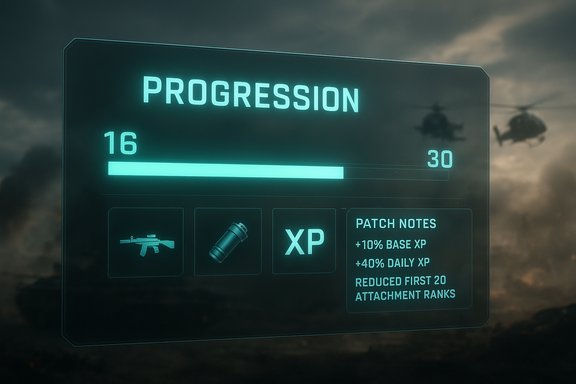
As part of a rapid response to community feedback, the developers implemented several targeted adjustments intended to reduce the tedium of early progression. The main, confirmed changes are:- Base XP increases: XP from match completion was raised by 10%, and the daily bonus XP was increased by 40%, improving passive progression for every match played.
- Attachment rank compression: The XP required to unlock the first 20 ranks of weapon attachments was reduced substantially, so players start earning useful attachments almost twice as fast. UI oddities may briefly show abnormal progress for weapons currently being leveled, but progression should normalize after playing a match with the weapon.
- Assignment rank requirements lowered: Assignments previously gated behind career ranks 20, 23, and 26 were retuned to require ranks 10, 15, and 20, respectively — allowing players to start some assignments much earlier.
Why the patch matters — and why it’s not enough
Faster attachments and XP: immediate wins
The adjustment to attachments and base XP directly targets the most visible complaints from new players: long waits to reach the first meaningful weapon upgrades. By halving the early attachment rank cost curve and lifting daily XP, the update both:- Shortens the time to hit meaningful power/utility thresholds.
- Reduces the desperation to chase higher‑level gadgets via repetitive or exploitative sessions.
But Challenges remain the gating choke point
The fundamental remaining problem is what the game asks players to do to earn certain unlocks. Many Challenges have objectives that are:- Misaligned with weapon identity (for example, forcing hip‑fire damage on weapons designed for deployment and bipod use).
- Dependent on map geometry or playlist population (long‑range kill quotas on maps without reliable 200m sightlines).
- Sometimes aberrantly hard because they require large single‑match quotas rather than cumulative progress across multiple games.
The tracking problem: a technical blocker with real consequences
Alongside design missteps, many players report that progress simply doesn’t get counted. Symptoms include:- Repairs, revives, and gadget interactions that yield zero challenge credit.
- Rank‑up rewards that fail to appear until a client restart.
- Assignments that appear to be stuck or not cumulative even when the play should qualify.
How players are coping today: safe, legitimate workarounds
The community rapidly identified methods to bypass or soften the grind, relying on features already present in the game:- Server Browser / Private matches: Hosting passworded, low‑population matches (often with many bots) to create predictable environments where long‑range kills, objective counts, or vehicle destroys can be accumulated reliably. This method uses only in‑game tools and is a repeated recommendation from coverage and player guides.
- Portal and verified community modes: Using Portal’s persistent, bot‑enabled experiences to craft scenarios that directly match the Challenge requirements, often the fastest route to complete edge‑case objectives.
- XP multipliers and short rounds: Pairing the above tactics with in‑game boosters and short, objective‑dense modes (e.g., Rush) to increase XP per minute yields.
The larger product risk: optics, trust, and monetization suspicion
There’s a reputational hazard when a high‑profile live service launches with grindy or opaque progression. Players often infer monetization intent when unlocking feels intentionally onerous, even if that isn’t the design objective. That perception has a real cost:- Short‑term churn from frustrated players.
- Erosion of goodwill toward future monetization or season pass systems.
- Amplified social media backlash that can deter potential buyers.
What Battlefield Studios can and should do next
The team has already applied a set of surgical fixes to XP and early attachment ranks — a good start. Here are practical, prioritized steps that would materially improve perception and play experience:- Ship hotfixes for obvious telemetry failures and apply retroactive credit to affected players where possible. Tracking bugs are the most direct source of community outrage.
- Make high‑pain single‑match objectives cumulative across matches (e.g., turn “30 objective kills in one round” into “30 objective kills cumulative”). This preserves the Challenge’s intent while removing the lottery.
- Reevaluate and retune specific objectives that contradict weapon identities (hip‑fire LMG damage, ADS‑only SMG quotas, unrealistic long‑range tallies). Replace or tier them with incremental micro‑rewards to maintain motivation.
- Publish clear, in‑client documentation of where each Challenge counts (which playlists, whether Portal or private matches contribute) to remove guesswork.
- Offer an official, low‑pop “Practice Challenges” playlist (bot‑enabled) as a sanctioned grind route; this reduces reliance on community workarounds and makes dev intent clear.
Practical advice for players right now
- If a Challenge is bugged, document progress (screenshots/video) and file a ticket; evidence increases the chance of retroactive credit.
- Use the Server Browser or Portal to create repeatable, low‑noise environments for problematic objectives; it’s legitimate and often much faster.
- Keep the client updated and restart after rank‑up issues — many UI sync problems clear after a full client restart.
- Pair runs with XP boosters or edition perks if available to maximize progression rate while the studio iterates.
Technical note: anti‑cheat and PC prerequisites
The title enforces a firm PC security posture: kernel‑level anti‑cheat (EA’s Javelin) and platform trust prerequisites such as TPM 2.0 and UEFI Secure Boot. Those requirements are developer‑published and affect who can play on PC without troubleshooting (MBR→GPT conversions, BIOS changes, etc.. While this posture improves cheat resistance, it also raises support friction for older or custom systems — a tradeoff the studio must manage through clear documentation and tooling guidance.Balanced verdict
The recent progression patch is the right sort of quick fix: it eases early friction and makes the early gameplay loop feel more rewarding. Those are measurable, meaningful improvements for retention and immediate satisfaction. But this is a partial victory. The structural issue — challenge design and telemetry reliability — still poses the most serious threat to player trust and long‑term engagement. Until Challenges are made sensible and tracking is demonstrably reliable, complaints will persist and the community will continue to lean on workarounds.Final analysis — what success will look like
Battlefield 6 can recover and settle into its strengths if the studio executes a rapid triage plan: hotfix tracking bugs, retune or rephrase the worst Challenges, add transparency to where progress counts, and offer sanctioned low‑pop routes to complete strenuous objectives. If those steps arrive quickly and with clear comms, the early outrage will likely cool and the community will refocus on the game’s real merits: large‑scale battles, satisfying vehicle play, and Portal creativity. If the studio stalls or offers only cosmetic concessions, the backlash will linger and risk long‑term churn.For now, the patch is a welcome, pragmatic step — one that improves the experience for many players — but the biggest problem still remains the one that sparked the outcry in the first place: mismatched, opaque, and sometimes broken Challenges that gate access to weapons and class gadgets. The pathway to durable goodwill is straightforward, if operationally demanding: fix the tracking, make the objectives fair and transparent, and demonstrate responsiveness through concrete, generous measures when the system fails.
Source: Windows Central I'm happy Battlefield 6 just made these huge improvements to its slow progression system — but the biggest problem still remains
