

Bazzite’s usage numbers have spiked in recent weeks, and for the first time in years a mainstream narrative about gaming on Linux has moved from “theoretical possibility” to practical choice for a meaningful slice of players — driven by Proton’s compatibility progress, Valve’s SteamOS momentum, and the real-world prompt of Windows 10 reaching end of support. What started as an independent, community-led Fedora spin with a SteamOS‑style shell is now pulling measurable attention: Bazzite’s team reported a roughly 1.25x week‑over‑week user growth trend and figures on the order of tens of thousands of weekly users and petabytes of installation traffic — numbers that matter for an unaffiliated distro with zero corporate backing.
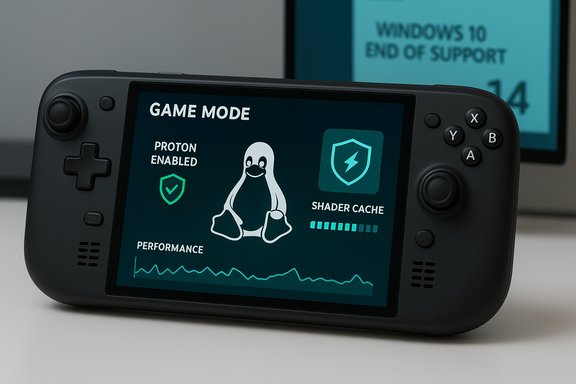
Bazzite is a Fedora‑based, SteamOS‑style Linux distribution built explicitly for gaming-first workflows. Its design intent is straightforward: offer a console‑like, controller‑friendly experience out of the box while still allowing users access to a traditional desktop when needed. The project bundles Steam, Proton helpers, tuned Mesa and kernel builds, Waydroid for Android compatibility, and an immutable atomic update model that aims to reduce the usual Linux upgrade fragility. The distro’s official documentation and product pages describe a gaming-first posture that targets handheld PCs and Steam Deck‑style usage models. This surge in attention didn’t occur in a vacuum. Two converging external forces have changed the calculus for many PC users:
This is not a mass exodus from Windows; Microsoft still owns the vast majority of the PC gaming market and delivers unmatched compatibility for certain classes of software. But Bazzite — and the ecosystem it represents — is shrinking the circumstances where Windows is the only practical choice. For gamers who focus on single‑player AAA and handheld sessions, for those who dislike Windows’ increasing OS‑level integrations, and for tinkerers who value control over telemetry and updates, the tradeoffs increasingly favor trying Linux.
Practical readers should treat the headline numbers as an invitation to test, not a call to immediate conversion: back up, test on disposable media, keep Windows available for multiplayer and proprietary workflows, and watch the anti‑cheat and publisher signals closely. If Bazzite’s trials convert into lasting installs at scale, the industry’s response — in QA, anti‑cheat tooling, and vendor support — will determine whether this is an inflection or an interesting footnote in PC gaming history.
Source: Windows Central https://www.windowscentral.com/gami...ing-bazzite-instead-of-sticking-with-windows/
 Background / Overview
Bazzite is a Fedora‑based, SteamOS‑style Linux distribution built explicitly for gaming-first workflows. Its design intent is straightforward: offer a console‑like, controller‑friendly experience out of the box while still allowing users access to a traditional desktop when needed. The project bundles Steam, Proton helpers, tuned Mesa and kernel builds, Waydroid for Android compatibility, and an immutable atomic update model that aims to reduce the usual Linux upgrade fragility. The distro’s official documentation and product pages describe a gaming-first posture that targets handheld PCs and Steam Deck‑style usage models. This surge in attention didn’t occur in a vacuum. Two converging external forces have changed the calculus for many PC users:- Microsoft formally ended mainstream support for Windows 10 on October 14, 2025, creating a clear migration event and leaving millions of compatible machines with a choice: upgrade to Windows 11, enroll in paid Extended Security Updates, buy new hardware, or consider alternatives.
- Valve’s Steam ecosystem, Proton compatibility layers, and the Steam Deck’s user base have shifted the technical baseline for Linux gaming — raising the practical compatibility of modern Windows titles on Linux to near‑mainstream levels for the titles most players actually buy and play. The Steam Hardware & Software Survey shows Linux usage on Steam hitting new highs (3.2% in November 2025), evidence that the Valve‑led stack matters.
Why Bazzite is suddenly attractive to gamers
A gaming-first, lean software surface
Bazzite’s central advantage is that it dramatically reduces the software and service surface that normally runs on a generic Windows installation. By booting directly into a Steam‑style “Game Mode” and shipping with Proton, tuned Mesa stacks, and curated kernels, the distro presents a much lighter background environment.- Less background scheduler and I/O noise can translate into fewer micro‑stutters and more predictable frame pacing on thermally constrained handheld hardware.
- Atomic updates and an immutable base reduce the risk of breakage from a single package upgrade, which appeals to gamers who want “set it and play” reliability.
- Tools for fine power/TDP control and shader cache handling are exposed by default on many builds, allowing handheld users to squeeze steadier performance from the same hardware.
Proton, Mesa and a practical compatibility layer
Valve’s Proton, the vkD3D/DirectX→Vulkan layers, and community efforts like ProtonDB have compressed years of compatibility work into a reliable path for many titles.- Recent community summaries and compatibility-tracking projects show that the most played and visibility‑weighted portion of the Steam catalog is now largely playable on Linux via Proton and related tools — the “near‑90%” headline usually referenced relates to the top‑played games and Platinum/Gold compatibility bands tracked by community databases. That matters because these are the games publishers watch when deciding whether Linux deserves testing and support.
Handhelds and constrained thermal envelopes
Handheld PCs (ROG Ally family, Lenovo Legion Go S, Steam Deck, etc. are a specific audience where OS‑level tuning matters most. Bazzite’s lean compositor, scheduler tweaks, and explicit TDP controls make it easier to extract consistent frame pacing in the power bands these devices operate in.- For many users, the benefit is not a massive FPS leap but the difference between a juddery 45–55 FPS with noticeable spikes and a steadier, more playable session in the same power envelope. Community testers and outlets have replicated these directional results on multiple hardware platforms.
The numbers: reading Bazzite’s growth claims
Bazzite’s social account recently posted weekly growth metrics showing about a 1.25x week‑over‑week increase over a 30‑day window; more concretely, community reporting placed Bazzite at roughly 50,000 weekly users and reported around 2 petabytes of install traffic to date. For an independent distro with no corporate backing, those raw figures are significant: they demonstrate trial at scale and non‑trivial bandwidth/installation reach. However, those figures should be read with context and caution.- A 1.25x weekly growth rate sustained over many weeks quickly compounds, but short‑window spikes (driven by press coverage, a new hardware image, or Windows calendar events like EOL) can also artificially inflate trial numbers.
- Downloads and installs are interesting leading indicators, but long‑term active device retention (daily active users, average session length, and churn) are the metrics that determine whether a distro affects market behavior for developers and vendors.
What works today—and what still breaks
Where Linux (and Bazzite) shine
- Single‑player and offline AAA titles: most of the heavy hitters are playable under Proton with high compatibility ratings. This is facilitated by Valve’s continued Proton work and community validation tools.
- Handheld and mid‑power optimization: Bazzite’s scheduler and TDP exposure frequently yield smoother frame‑time profiles on constrained devices.
- Reduced telemetry footprint and a savings‑first lifecycle for older hardware: for users who don’t need Windows‑specific apps, Bazzite prolongs hardware usefulness while keeping systems patched by virtue of a maintained Fedora base.
Where the hard limits remain
- Kernel‑level anti‑cheat systems: many competitive multiplayer experiences are effectively blocked by kernel‑mode anti‑cheat drivers that are Windows‑native (examples publicly referenced include Ricochet/Ricochet2 in Call of Duty, Riot’s Vanguard architecture for Valorant, and EA’s Javelin for Battlefield titles). Those systems require publisher/anti‑cheat vendor cooperation to provide Linux‑compatible alternatives; until that happens, many high‑profile multiplayer titles remain inaccessible. Valve has made it clearer that developers must declare kernel‑level anti‑cheat on Steam, highlighting the scale of the issue.
- Some vendor utilities and device‑specific firmware features: things like Armoury Crate, proprietary capture stacks, or GPU vendor control panels remain Windows‑centric and may not function under Linux without workarounds.
- Professional creative and productivity suites: Adobe Creative Cloud, Microsoft Office full desktop feature parity, and many proprietary modeling/CAD tools are not natively supported; while alternatives and browser/cloud options exist, they are not drop‑in replacements for many professionals.
Cross‑checks and verification of key claims
- Windows 10 end of support: Microsoft’s lifecycle pages and support notices confirm that Windows 10 reached end of support on October 14, 2025. The company’s guidance encourages migration to Windows 11, ESU enrollment, or hardware replacement for continued security coverage. This calendar event is a verifiable migration catalyst.
- Steam survey momentum: independent reporting of Valve’s monthly Steam Hardware & Software Survey confirms Linux’s share climbed to about 3.2% in November 2025 — the highest recorded monthly share in recent history — with SteamOS Holo occupying the largest Linux distribution slice. That trend supports the contention that Valve’s ecosystem is materially increasing Linux presence on Steam.
- Proton compatibility: community‑sourced databases and third‑party analyses place the playable share of top‑played games on Linux in the high‑80s to low‑90s percentile range (counting Platinum+Gold categories across Steam’s visibility‑weighted titles). These metrics reflect the state of play for popular titles, but they do not imply every single Steam game in the catalog is universally playable without caveats. Readers should interpret the “~90%” claim as being about the most‑played sets of titles rather than the whole long‑tail catalog.
- Bazzite’s usage claims: the specific weekly growth multiplier (1.25x), the 50,000 weekly user figure, and the 2‑petabyte install total are drawn from the project’s public reach metrics and press coverage; those numbers are credible as self‑reported growth signals but do not yet appear to be independently tracked by a third‑party analytics service in the public domain. Treat them as important leading indicators — meaningful because of scale — but note that long‑term retention and daily active user numbers are not publicly detailed.
Practical guidance for WindowsForum readers
If you’re considering trying Bazzite, follow a conservative, methodical plan. These are the practical steps many community experts recommend:- Create a complete backup of your Windows system and make recovery media. Never overwrite your only working Windows installation without a fallback.
- Test with a Live USB or external SSD first to verify Wi‑Fi, GPU acceleration, audio, controllers, docks, and other peripherals.
- Validate your must‑have titles: check ProtonDB and the community reports for each game you care about; test one game at a time and document working Proton versions and runtime tweaks.
- Prefer dual‑boot for a transitional period instead of a clean, primary‑drive conversion. Keep Windows for titles gated by anti‑cheat or Game Pass dependencies.
- If you buy or repurpose a handheld device as a Linux gaming machine, favor AMD GPUs/APUs when possible; current open‑source Mesa drivers typically provide a smoother out‑of‑the‑box experience than the alternative on Linux, though vendor specifics matter.
Strengths, risks and the longer‑term market implications
Strengths that could change vendor behavior
- Concentrated Linux usage tied to Valve’s SteamOS baseline reduces fragmentation for developers: a more uniform Linux target (SteamOS Holo + Proton) makes testing and support investments more attractive.
- If Linux usage grows from pilot trials to sustained installs, publishers may be more likely to opt into user‑space anti‑cheat alternatives or certify anti‑cheat stacks for Proton, widening the multiplayer pool.
- Hardware vendors and OEMs watching refurb, repair, and secondary markets may consider Linux images for older devices or low‑cost handhelds, particularly for kiosks and dedicated gaming boxes.
Real risks and reasons Windows won’t vanish
- Anti‑cheat constraints remain the single largest barrier for many players. Kernel‑mode anti‑cheat drivers are both a technical and contractual blocker that often sits outside the control of end users or distro maintainers. Until major publishers adopt Linux‑friendly anti‑cheat options, Windows remains the practical default for competitive and many multiplayer titles.
- Enterprise and professional app ecosystems (Adobe, certain Microsoft enterprise suites, many creative workflows) still tilt loyalty to Windows, particularly in mixed workflow households where the PC is used for both gaming and professional work.
- Vendor and OEM support, warranty considerations, and firmware update flows are designed around Windows; installing a community distro can void support or complicate formal service interactions.
What Microsoft and the industry should watch
The practical effect of the shift will be felt first where the marginal economics favor it:- Devs and publishers will watch Steam survey slices to see whether Linux users consistently spend and engage at parity. If they do, publishing pipelines and QA budgets will follow.
- Anti‑cheat vendors and studios will face a commercial calculus: continue to rely on invasive kernel drivers that block alternative platforms, or invest in cross‑platform, user‑space solutions that preserve compatibility — the latter costs money and rework but opens new markets.
- OEMs that service refurbished electronics and the used device market may find value in shipping Linux images — particularly to price‑sensitive buyers who only need a browser, streaming apps, or a dedicated gaming box.
Conclusion
Bazzite’s recent usage spike is important because it is a high‑visibility instance of several broader dynamics colliding: the scheduled end of Windows 10 support, Valve’s long game on Proton and SteamOS, and the maturing ecosystem of gaming‑first Linux distributions that make a console‑like, low‑maintenance gaming experience viable for a substantial set of players.This is not a mass exodus from Windows; Microsoft still owns the vast majority of the PC gaming market and delivers unmatched compatibility for certain classes of software. But Bazzite — and the ecosystem it represents — is shrinking the circumstances where Windows is the only practical choice. For gamers who focus on single‑player AAA and handheld sessions, for those who dislike Windows’ increasing OS‑level integrations, and for tinkerers who value control over telemetry and updates, the tradeoffs increasingly favor trying Linux.
Practical readers should treat the headline numbers as an invitation to test, not a call to immediate conversion: back up, test on disposable media, keep Windows available for multiplayer and proprietary workflows, and watch the anti‑cheat and publisher signals closely. If Bazzite’s trials convert into lasting installs at scale, the industry’s response — in QA, anti‑cheat tooling, and vendor support — will determine whether this is an inflection or an interesting footnote in PC gaming history.
Source: Windows Central https://www.windowscentral.com/gami...ing-bazzite-instead-of-sticking-with-windows/
