

An inventor represented by InventHelp has filed a new patent-pending concept aimed at making student-driver cars more visible: the Beginning Driver Sign (BKC-730), an overhead display the inventor says is designed to be seen from greater distances and more angles than conventional rear-window stickers. The idea, promoted through a PR distribution earlier this week, is simple on its face — increase situational awareness among surrounding drivers — but it raises a surprisingly broad set of technical, regulatory, human-factors and commercial questions that deserve scrutiny before anyone considers mass deployment or adoption by driving schools and fleets.
The announcement surfaced via a syndicated press release distributed through major wire services on February 16, 2026 and republished by multiple outlets. The filing identifies the product as BKC-730 and credits an inventor from West Valley City, Utah, who framed the device as a visibility-first solution for student-driver vehicles. According to the inventor’s claims, the device is mounted to the top of a vehicle and displays a clear visual marker that can be observed by drivers approaching from behind and from oblique angles — addressing a common complaint about rear-window placards that are sometimes obscured or not seen until a following driver is already close.
InventHelp — the invention-promotion firm that facilitated the press release — is a familiar industry intermediary that provides invention-development services, prototype referrals and marketing support. The company’s model and track record are well known to prospective inventors: InventHelp distributes promotional materials and can help file documentation, but its role is not equivalent to manufacturer validation, regulatory approval, or independent safety certification.
A strong go-to-market play could be partnerships with recognized driving-school associations, safety NGOs, or insurance firms; such partners could provide credibility and help fund robust pilot trials that produce evidence for safety benefits (or otherwise).
Transforming an idea into a reliable safety product requires rigorous, independent validation. That means optical testing to meet established visibility standards, human-factors trials to demonstrate behavior change, and regulatory reviews to ensure the device is lawful and non-distracting. InventHelp’s press-release distribution has put the concept in front of a broad audience; the next steps should be engineering validation, peer-reviewed or third-party testing, and pilot deployments with driving schools and insurers.
If those tests show measurable reductions in risky behavior or near-miss incidents, the overhead sign could become a low-cost complement to existing novice-driver safety programs. Until then, consumers and fleet buyers should approach the announcement as the beginning of a product-development journey — promising in concept, but incomplete without the data that separates marketing claims from verified safety improvements.
Source: The Malaysian Reserve https://themalaysianreserve.com/202...r-develops-beginning-driver-sign-bkc-730/amp/
 Background
The announcement surfaced via a syndicated press release distributed through major wire services on February 16, 2026 and republished by multiple outlets. The filing identifies the product as BKC-730 and credits an inventor from West Valley City, Utah, who framed the device as a visibility-first solution for student-driver vehicles. According to the inventor’s claims, the device is mounted to the top of a vehicle and displays a clear visual marker that can be observed by drivers approaching from behind and from oblique angles — addressing a common complaint about rear-window placards that are sometimes obscured or not seen until a following driver is already close.InventHelp — the invention-promotion firm that facilitated the press release — is a familiar industry intermediary that provides invention-development services, prototype referrals and marketing support. The company’s model and track record are well known to prospective inventors: InventHelp distributes promotional materials and can help file documentation, but its role is not equivalent to manufacturer validation, regulatory approval, or independent safety certification.
Overview: what is being proposed and why it matters
At its core the BKC-730 is a visibility enhancement for vehicles driven by inexperienced motorists. The inventor’s stated rationale is straightforward:- Conventional novice-driver signs (stickers or rear-window placards) can be missed because they are low and sometimes blocked by cargo, headrests, window tinting, or glare.
- An overhead display, visible from a larger angular range and from further distances, would give following drivers more time to notice the novice-driver status and adjust their behavior accordingly.
- That extra reaction time could reduce risky overtaking maneuvers, reduce tailgating, and lower the chance of conflict in heavy traffic.
Product anatomy and how it might work
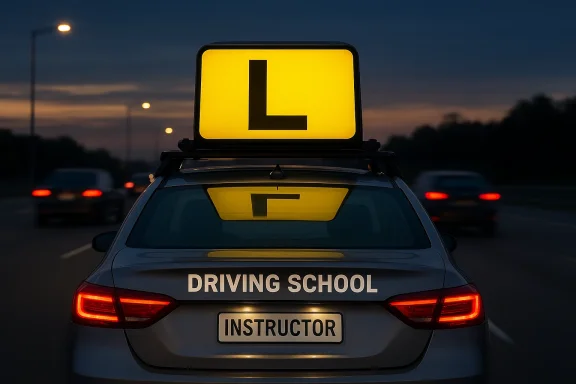
The press material describes the product as an overhead display engineered to be visible "from above a car" and "from more angles." While the distributed text does not include detailed drawings in most republished summaries, a reasonable technical read of the concept suggests these core components:- A low-profile roof-mounted unit designed to be affixed to the vehicle's roof or roof rack.
- A high-contrast visual panel (likely yellow with a black symbol or text) sized and shaped to balance visibility with legal/installation constraints.
- Optional illumination or retroreflective sheeting to improve night visibility.
- A fastening system intended to avoid damage to the roof and to allow removal when the vehicle is no longer used for instruction.
- Weather-resistant housing and sealed electronics if the sign contains lighting.
- Adhesive or clamp mounts that avoid puncturing the vehicle’s weather seals.
- A design optimized for low aerodynamic penalty and low wind noise.
- Compatibility with different vehicle roof geometries via universal adapters.
Human-factors and visibility: the real tests that matter
Visibility claims must stand up to measurable engineering and human-factors scrutiny. The concept is plausible: elevating a conspicuous marker can increase the detection range and the angular field from which other drivers can spot the sign. But the devil is in the details.- Retroreflectivity and illumination: Road signs are regulated to ensure they can be seen at night. Transportation authorities specify materials and retroreflective performance; any aftermarket sign intended to function as a safety marker should use materials that meet recognized luminance and contrast thresholds so it is visible both in daylight and at night. Without retroreflective sheeting or built-in illumination, an overhead sign might offer no advantage at dusk or under poor lighting.
- Contrast and standardization: Traffic signage conventions (color, symbol, shape) are standardized for a reason: drivers learn to decode them quickly. A new symbol or color can be effective, but only if it’s intuitive and sufficiently contrasted with its background. If the BKC-730 uses a familiar symbol (for example, the exclamation mark or a “novice” legend), designers should follow established contrast and sizing guidance so the marker is legible at speed and at distance.
- Mounting height and angle: Elevated markers can reduce occlusion by other objects in the vehicle, but roof-mounted devices change the line-of-sight geometry. Their effectiveness depends on typical following-driver eyepoint heights and the sightlines on multi-lane roads or hilly terrain. Careful field-of-view testing is required.
- Human behavior response: Will drivers actually change behavior when they see the sign? There’s evidence that identification marks can nudge following drivers toward more cautious behavior in some contexts, but the effect size varies with culture, local driving norms, and the prevalence of prank or novelty signage. Behavioral trials with a control group would be essential to validate any safety claims.
Regulatory and legal landscape
A device that modifies vehicle appearance or adds an overhead fixture triggers a cascade of legal and regulatory questions that vary widely by jurisdiction.- Signage standards and traffic guidance: Many countries standardize road symbols and signage for public roads. If a device looks like an official traffic sign, it could create confusion or even violate traffic control device rules. Conversely, if it’s clearly a private accessory, it may avoid that specific pitfall but still be subject to visibility and obstruction laws.
- Licensing and requirements for novice-driver identification: Laws about identifying novice drivers differ around the world. Several countries mandate a specific beginner driver sign for newly licensed motorists (for example, certain European and former-Soviet jurisdictions require a standardized exclamation-mark or similar identifier for drivers within their first two years). By contrast, the United States uses Graduated Driver Licensing (GDL) programs that rely on age and restrictions rather than mandatory exterior signage. That dichotomy means a product designed to address a universal need will face inconsistent legal environments across countries.
- Vehicle modification and safety standards: Any roof-mounted accessory must not compromise structural integrity, interfere with airbags, create additional hazards in a crash, block emergency egress, or violate roof-load limitations specified by vehicle manufacturers. In the U.S., vehicle safety standards (and insurance considerations) can be implicated by aftermarket attachments. Manufacturers seeking to sell a permanent rooftop safety marker would need to account for these constraints and emphasize non-invasive mounting systems and crash-safe design.
- Distracted-driving considerations: Regulators may scrutinize any rooftop device that contains flashing lights or dynamic displays. Flashing or animated signage could be considered a distraction under local statutes and would be disfavored or prohibited.
Comparative context: where similar markings already exist
Identification of novice drivers is not a new idea. Different jurisdictions use distinct approaches:- Some countries require standardized novice-driver placards (often a yellow square with a black exclamation mark) for a fixed period following licensure.
- Driving schools often use removable rooftop “student driver” signs that are clearly labeled and recognized by local road users.
- Several nations regulate the size, color and placement of such markings to ensure consistent recognition.
InventHelp and commercialization realities
InventHelp’s role in this announcement is as a facilitator: helping the inventor prepare promotional materials and distribute a press release. That route is common for individual inventors seeking to attract licensing partners or manufacturers, but it’s important to be clear about limits.- Press release distribution is not validation. Wire-service distribution amplifies awareness but does not equate to third-party testing, certification, or commercial availability.
- InventHelp is not a manufacturer. Licensing or manufacturing deals still require engineering development, compliance testing, and production-capable designs.
- Consumer caution is warranted. Inventors and consumers should understand that invention-promotion services are often an early step in a long commercialization path; many concepts publicized in press releases never reach production.
Technical risks and testing checklist
Converting a promising visibility concept into a safe, mass-market product requires stopping to run a set of technical and human-factors validations. Key tests and certifications that responsible developers should pursue include:- Materials and optics
- Measure retroreflectivity and luminous intensity at night across common approach angles.
- Use retroreflective sheeting or integrated illumination to meet recognized visibility thresholds.
- Mounting and vehicle compatibility
- Demonstrate non-invasive mounting on typical rooflines without compromising water ingress seals.
- Verify roof-load safety and ensure the mount does not interfere with roof-airbags or other OEM features.
- Aerodynamic and durability testing
- Perform wind-tunnel or field testing to quantify aerodynamic drag and crosswind stability.
- Verify performance under vibration, road salt, and extreme weather.
- Human-factors and field trials
- Conduct controlled studies to determine if the overhead marker measurably changes following-driver behavior and reaction times.
- Run pilot deployments with driving schools and collect near-miss and comfort metrics.
- Regulatory compliance
- Review local statutes in target markets for lighting, signage, and vehicle modification restrictions.
- If illumination is used, ensure it does not produce distracting flashes or colors that conflict with traffic signals.
- Insurance and manufacturer guidance
- Consult insurers about liability implications for instructor and student-driver vehicles using rooftop signage.
- Obtain statements of non-objection (or guidance) from vehicle OEMs where possible.
Market prospects: who would buy it, and why?
Potential early adopters include:- Driving schools that want an easily seen identifier for dual-control or learner vehicles.
- Parents of new drivers looking for any edge that might reduce risk.
- Fleet operators and employer-run driver training programs that include new-driver training as part of onboarding.
- Insurance pilot programs exploring behavioral nudges to reduce risk and claims.
A strong go-to-market play could be partnerships with recognized driving-school associations, safety NGOs, or insurance firms; such partners could provide credibility and help fund robust pilot trials that produce evidence for safety benefits (or otherwise).
Strengths of the concept
- Simplicity: A visible identifier that is easy to understand is easier to adopt than complex driver-assist systems.
- Potentially broad utility: If it works as intended, it could benefit any novice driver regardless of age.
- Low-tech resilience: A passive, well-reflective sign would not rely on complex electronics, reducing failure modes.
- Clear commercial path: Driving schools and families present an obvious initial market.
Potential weaknesses and risks
- Unproven safety claims: The press release frames the device as improving safety, but controlled evidence is not presented.
- Regulatory ambiguity: Roof-mounted items and flashing devices may violate statutes or be rejected by regulators.
- Human behavior variability: In some driving cultures, identification can lead to negative behaviors (e.g., harassment, tailgating), reducing or reversing any intended benefit.
- Inventor-promotion dynamics: Announcement via an invention-promotion channel can generate publicity but does not substitute for certification, manufacturing capability, or independent validation.
- Liability considerations: If a rooftop sign fails (becomes detached) or blocks sightlines, legal and insurance implications arise.
Recommendations for stakeholders
For inventors and product developers:- Prioritize independent field trials with driving-school partners before scaling production.
- Publish test results openly: retroreflectivity numbers, detection distances, behavioral metrics.
- Design for non-invasive installation and minimal aerodynamic penalty.
- Treat announcements as signals to evaluate, not as endorsements. Insist on seeing engineering reports and trial data prior to adoption.
- Consider controlled pilot programs and track objective safety metrics (near-miss rates, instructor observations).
- Consider whether a standardized novice identifier could be useful, and if so, adopt an evidence-based requirement that includes specification for size, color, reflectivity and placement.
- If rooftop identification proves effective, provide regulatory guidance to ensure consistent, non-distracting designs.
- Ask for proof: detection-distance tests at night and day, mounting instructions and warranty terms.
- Weigh cost against evidence: inexpensive stickers and driver education remain high-value investments.
Closing analysis: cautious potential, but evidence required
The Beginning Driver Sign (BKC-730) is an intuitively appealing concept: elevate a novice-driver identifier so it is visible earlier and from more angles, giving other drivers more time to react. That potential is real — but it is a potential, not a proven outcome.Transforming an idea into a reliable safety product requires rigorous, independent validation. That means optical testing to meet established visibility standards, human-factors trials to demonstrate behavior change, and regulatory reviews to ensure the device is lawful and non-distracting. InventHelp’s press-release distribution has put the concept in front of a broad audience; the next steps should be engineering validation, peer-reviewed or third-party testing, and pilot deployments with driving schools and insurers.
If those tests show measurable reductions in risky behavior or near-miss incidents, the overhead sign could become a low-cost complement to existing novice-driver safety programs. Until then, consumers and fleet buyers should approach the announcement as the beginning of a product-development journey — promising in concept, but incomplete without the data that separates marketing claims from verified safety improvements.
Source: The Malaysian Reserve https://themalaysianreserve.com/202...r-develops-beginning-driver-sign-bkc-730/amp/
