

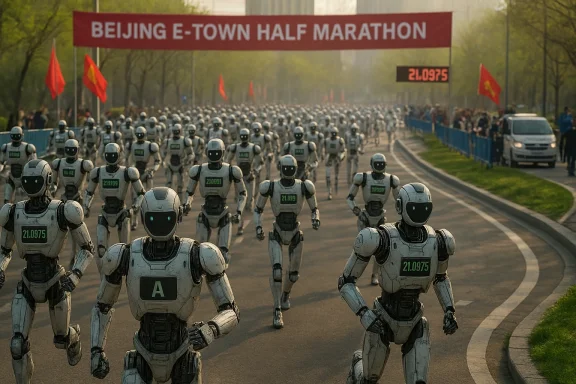
The significance goes well beyond the spectacle. Organizers say the 2026 event will feature autonomous navigation and remote-control categories, with stricter rules that penalize human intervention and reward robots that can finish under their own control. That matters because the race is becoming a public benchmark for whether China’s humanoid robotics sector can move from impressive movement demonstrations to dependable real-world performance. (english.beijing.gov.cn)
Overview
The Beijing humanoid robot half-marathon is an unusual hybrid of sports event, industrial exhibition, and research benchmark. Unlike the earlier “robot exhibition” model that often kept machines in controlled spaces, this race places robots on a 21.0975-kilometer course shared with human runners, then judges them by endurance, stability, and the ability to navigate unpredictable environments. That combination makes it a valuable public proving ground for the entire robotics stack. (english.beijing.gov.cn)
The 2026 edition is especially notable because of its scale. Official Beijing sources said the event drew over 100 teams and more than 300 humanoid robots, with 26 robot brands represented and autonomous-navigation teams accounting for 38 percent of the field. CGTN reported that the full-scale test alone involved more than 70 teams, including four international participants, which suggests the event has become attractive enough to pull in global attention, not just domestic participation. (english.beijing.gov.cn)
That scale reflects a broader push in China to standardize humanoid robotics and convert technical progress into visible industrial momentum. Beijing E-Town has become a dense robotics cluster, and the race fits neatly into a policy environment that wants to accelerate commercialization, not just research. In other words, this is not merely about who can make the flashiest robot walk; it is about whether those robots can be manufactured, certified, fielded, and improved at speed. (globaltimes.cn)
The 2025 inaugural event matters here too. It established the basic template, with the Tiangong robot and other systems showing that humanoid platforms could complete a half-marathon at all, even if under heavy supervision. The 2026 race builds on that first proof and raises the bar in exactly the areas that separate laboratory demos from deployable systems: autonomy, energy efficiency, gait control, and safe operation around people. (globaltimes.cn)
Why this race is different
The race’s value is not in who crosses first, but in what fails first. Every stumble, detour, battery swap, and lost step becomes data about a robot’s real-world maturity. That makes the event feel closer to a field trial than a sporting contest. (news.cgtn.com)
The course itself is designed to expose weaknesses. Organizers said the rehearsal covered urban streets, ecological park terrain, scheduling coordination, equipment support, and emergency response. That means robots must deal with changing surfaces, visual clutter, and the kinds of interruptions that lab benches never produce. (news.cgtn.com)
- Autonomy is becoming the headline metric.
- Endurance is now as important as speed.
- Safety protocols are being treated as a core technical feature.
- Standardization is starting to matter as much as raw motion skill.
Background
The world’s first humanoid robot half-marathon in Beijing, held in April 2025, created the blueprint for this year’s event. That inaugural race demonstrated that a humanoid robot could indeed make it through a half-marathon course, with Tiangong finishing first among the machines. Even then, the event functioned as a bridge between lab performance and public visibility. (globaltimes.cn)
But the 2025 race still looked, in many ways, like a demonstration of what still needed to be solved. Teams relied heavily on human oversight, and the event showcased hardware and software progress more than full autonomy. The 2026 version is different because it is explicitly trying to reduce the role of operators and reward systems that can think and balance for themselves. (english.beijing.gov.cn)
That shift reflects a broader industry trend around embodied AI. The “brain versus body” discussion has become central to humanoid robotics, and the Beijing race gives that debate a measurable form. A robot that can stand, walk, and even sprint in a lab is one thing; a robot that can adapt to a race course over 21 kilometers, in the presence of other runners and changing conditions, is another. (news.cgtn.com)
The event also fits Beijing E-Town’s identity as a robotics hub. Officials have emphasized the area’s industrial chain, its concentration of robotics firms, and the role of competition in pushing downstream commercial use. In practical terms, a robot half-marathon is being used as both a marketing platform and a systems integration test. (globaltimes.cn)
From novelty to benchmark
The early narrative around humanoid robots often centered on their wow factor. They danced, waved, and performed short scripted tasks. The marathon format changes the conversation because it demands reliability over time, which is the exact metric that real deployments care about. (news.cgtn.com)
That matters for buyers, too. Enterprise customers generally do not pay for a robot that looks impressive for 20 seconds; they pay for uptime, consistency, and supportability. A marathon is a crude but surprisingly effective proxy for those qualities. (news.cgtn.com)
- 2025 established the concept.
- 2026 is trying to establish the standard.
- The public race format creates pressure for repeatable engineering.
- The industry gains a shared benchmark, even if an imperfect one.
How the 2026 Race Works
The 2026 event is being staged as a “human-robot co-running” format, with humans and robots starting at the same time and sharing the same course, separated by barriers or landscaped green belts. That arrangement is clever because it creates a real urban setting without making the event purely adversarial. It also gives the race more credibility: robots are not competing in an artificial obstacle lane, but on the kind of route a deployment might actually encounter. (english.beijing.gov.cn)
The rules are also being adjusted to favor autonomy. Beijing officials said remote-controlled teams will face a coefficient adjustment, effectively disadvantaging systems that need more human help. That nudges the competition toward systems that can self-navigate, self-balance, and self-correct under stress. (english.beijing.gov.cn)
There are also explicit hardware requirements. Robots must be independent integrated units, comply with battery standards, and meet form-factor requirements including a complete torso and bipedal structure. These rules matter because they reduce the chance that teams can win by leaning too heavily on offboard support or nonstandard hardware hacks. (english.beijing.gov.cn)
What the rules are really testing
The event is not just asking whether a robot can move forward. It is testing whether the platform can do so while perceiving the environment, planning around obstacles, managing heat and power, and maintaining stable gait over long distance. That combination is why the race is such a strong proxy for real-world robotics maturity. (news.cgtn.com)
It also forces a degree of reproducibility. Once the rules reward autonomous completion, teams can no longer depend on ad hoc operator rescue to mask weaknesses. That creates pressure for better perception stacks, better motion planners, and stronger battery management systems. (english.beijing.gov.cn)
- Hybrid timing keeps the event fair across different control modes.
- Coefficients penalize remote assistance.
- Hardware inspections reduce loopholes.
- Unified ranking makes the event easier to interpret publicly.
The Autonomy Shift
The biggest story in this year’s race is the rise of autonomous navigation. Official Beijing materials say autonomous teams account for 38 percent of participants, and CGTN described the event as a major deployment of autonomous navigation technology. That is a meaningful change because it shows the industry is treating autonomy as a core competitive advantage, not a bonus feature. (english.beijing.gov.cn)
This shift changes the engineering target. A robot that is guided by an operator can be tuned differently from one that must interpret a course on its own. Once autonomy becomes central, perception quality, real-time decision-making, and fail-safe behavior become just as important as mechanics. (news.cgtn.com)
The phrase used by one Chinese expert about the robot “brain” catching up with the “body” is more than a sound bite. It reflects a real industry inflection point: the hardware is getting competent enough that the limiting factor is increasingly the intelligence layer. That is a classic sign that a field is moving from prototype novelty toward productization. (news.cgtn.com)
Autonomy versus teleoperation
Teleoperation remains useful, especially for safety and debugging. But the more the race rewards autonomy, the less teleoperation can serve as a crutch. This is important because many robotics products look impressive when controlled by skilled humans yet struggle when asked to operate independently. (english.beijing.gov.cn)
The practical implication is simple: the race will expose which teams have genuine embodied intelligence and which teams have polished remote-control systems. That distinction matters not only to judges, but also to investors and industrial buyers looking for the next commercial platform. (english.beijing.gov.cn)
- Autonomy creates a more useful benchmark.
- Remote control still has a place, but less strategic value.
- Better autonomy usually implies stronger commercial potential.
- The event is effectively grading the robots on independence.
Hardware, Gait, and Battery Limits
A half-marathon is brutal for humanoid robots because every weakness compounds over time. Short-distance speed is one thing; holding a stable gait for more than 21 kilometers is another. CGTN noted that the race will test battery life, energy management, dynamic balance, and millisecond-level posture control, which is a concise way of saying that small hardware flaws can become race-ending failures. (news.cgtn.com)
Battery handling is especially critical. Official rules only allow certified compliant power batteries, and that is not a bureaucratic footnote. In a long-duration event, power density, thermal behavior, and safe discharge characteristics can determine whether a robot finishes or collapses halfway through. (globaltimes.cn)
Gait control is equally unforgiving. Bipedal locomotion is inherently unstable compared with wheeled motion, and the race forces robots to keep their balance while traversing different surfaces and interacting with a busy urban race environment. That means the competition doubles as a mechanical reliability test. (news.cgtn.com)
Why endurance beats spectacle
A robot that can perform a cartwheel is impressive. A robot that can still stand and move correctly after 15 kilometers is useful. The marathon format rewards the second capability far more than the first, which is why engineers and policymakers alike seem to view the race as a meaningful filter. (news.cgtn.com)
That does not make the event a perfect benchmark, of course. But it does force teams to confront the accumulated reality of endurance robotics, where friction, heat, sensor drift, and battery depletion matter more than showroom choreography. That’s the point, and it is what makes the event interesting to industry watchers. (news.cgtn.com)
- Endurance reveals system-level weaknesses.
- Gait quality must hold under fatigue.
- Power and thermal management become mission-critical.
- Mechanical elegance matters less than operational resilience.
The Industrial Stakes in China
China’s humanoid robotics sector has grown quickly, and the Beijing race is being used to showcase that momentum. Global Times reported that more than 140 humanoid robot manufacturers were active in the country by 2025 and that more than 330 models had been released, a sign that the field is no longer a handful of experimental labs. Whether every claim in that industrial tally survives scrutiny is less important than the direction of travel: the market is expanding, and fast.
The race also has a commercialization function. Beijing officials and state media have framed the event as a way to accelerate the transition from lab prototypes to applications. That makes sense, because public competitions can serve as informal procurement signals, helping government and enterprise buyers identify which platforms are ready for scale. (news.cgtn.com)
The industrial chain around E-Town adds another layer. A dense local ecosystem means teams can iterate faster, find parts more easily, and share testing infrastructure. In robotics, geography still matters, because proximity between model makers, component suppliers, testing venues, and customers can shorten development cycles dramatically. (globaltimes.cn)
China’s broader robotics push
Beijing is not treating this race as an isolated stunt. The event sits alongside a larger strategy that includes standardization, industry coordination, and public-facing technology showcases. The goal appears to be a more mature ecosystem where robots are judged not only on ingenuity, but also on conformity, safety, and production readiness. (globaltimes.cn)
That gives the race a policy dimension that readers outside China should not miss. In Western markets, robotics progress is often filtered through venture funding, enterprise pilots, and consumer hype. In Beijing, the same story is being wrapped in municipal planning, industrial policy, and public competition. That difference matters. (globaltimes.cn)
- The race helps signal industrial maturity.
- It supports local supplier ecosystems.
- It offers a quasi-procurement showcase.
- It advances the standardization agenda.
International Competition and Market Signaling
The presence of four international teams in the rehearsal gives the event extra credibility. It suggests that the race is not only a domestic showcase but also a platform with enough visibility to attract foreign participation. Even if the competition remains heavily China-centered, international entrants make the benchmark more relevant to the wider humanoid robotics market. (news.cgtn.com)
That matters because robotics is still a global race. U.S., European, Japanese, and Korean firms are all working on humanoid platforms, but many of the same engineering bottlenecks remain universal: battery density, actuator efficiency, balance control, and autonomous navigation. A public race in Beijing creates a visible comparison point, whether rivals like it or not. (news.cgtn.com)
It also creates a narrative advantage. A city can only host so many “firsts” before the market starts assuming it has become a serious testbed. Beijing is clearly trying to establish that reputation, and the robot half-marathon is now part of the city’s robotics brand. (english.beijing.gov.cn)
Why global observers care
For investors, the race is an imperfect but useful signal. Teams that can survive a public endurance event may have better systems integration than those that only show polished demos. For enterprises, the event offers a rough proxy for reliability under stress, which is often more valuable than a spec sheet. (news.cgtn.com)
For rivals, the pressure is reputational. If a competitor’s robot cannot keep up in Beijing, that may not mean the company lacks talent, but it can still influence public perception. In emerging categories, perception often moves faster than product cycles. (news.cgtn.com)
- International teams increase legitimacy.
- The event creates a global comparison point.
- Public benchmarks can shape investor sentiment.
- Competitive pressure may accelerate R&D elsewhere.
What the Race Means for Enterprise Buyers
Enterprise buyers should read this event as a maturity signal, not a consumer entertainment story. A robot that can handle a race route for hours demonstrates progress in reliability, routing, energy management, and fault tolerance. Those are the same traits that matter in factories, logistics hubs, inspection jobs, and assisted mobility scenarios. (news.cgtn.com)
That does not mean marathon robots are ready for warehouse deployment tomorrow. It does mean the industry is inching toward platforms that can sustain movement in open environments without constant babysitting. For enterprise use, that is often the difference between a pilot and a purchase order. (news.cgtn.com)
The event also surfaces an important procurement question: do buyers want robots optimized for agility, or robots optimized for uptime? The marathon suggests that the market is starting to value the latter, which is healthy. A flashy robot is interesting; a durable robot is profitable. (globaltimes.cn)
Consumer implications will lag
Consumer adoption of humanoid robots will trail enterprise use for a simple reason: household environments are messy, unstructured, and unforgiving. If robots struggle with a managed race course, they are still far from safe, affordable domestic deployment at scale. That gap is why these events matter as milestones rather than endpoints. (news.cgtn.com)
For consumers, the more immediate effect may be psychological. Public competitions help normalize the idea that humanoid robots are not sci-fi props but real machines with practical limitations. That perception shift can be important, because trust often determines adoption as much as capability does. (globaltimes.cn)
- Enterprise buyers get a better reliability signal.
- Consumer deployment remains a longer-term proposition.
- Public events help build trust and familiarity.
- Robot capability should be judged by sustained usefulness, not stage presence.
Strengths and Opportunities
The Beijing humanoid robot half-marathon is strong precisely because it blends showmanship with measurable engineering constraints. It creates a public stage, but it also forces teams to solve real problems that matter to industry, academia, and policymakers. The result is a rare event that can generate headlines while still pushing technical progress in a meaningful way. That combination is powerful. (english.beijing.gov.cn)
The opportunity lies in standard-setting. If the event continues to mature, it could become a de facto benchmark for humanoid robotics, much like other public competitions have done in other fields. That would help buyers, regulators, and developers compare systems more consistently across years. (english.beijing.gov.cn)
- Autonomy is now being rewarded instead of merely demonstrated.
- Endurance creates a meaningful stress test for full-stack robotics.
- Standardization can improve comparability between teams.
- Public visibility helps attract talent, capital, and partners.
- Industrial clustering around Beijing E-Town can speed iteration.
- International participation increases credibility.
- Commercial signaling may help promising teams land deployments.
Risks and Concerns
For all the excitement, the event is not without risk. A race can become a spectacle that overshadows the limitations of the technology if the media focuses only on the fact that robots are running, not how well they are running or how much human support they still require. That would be the wrong lesson. (news.cgtn.com)
There is also the danger that competition rules could favor showy performance over practical utility. A robot optimized for a 21-kilometer public race is not necessarily optimized for work in warehouses, hospitals, or homes. The challenge for organizers is to keep the benchmark realistic without turning it into a narrow sports contest. (english.beijing.gov.cn)
- The event may overstate readiness if coverage becomes too celebratory.
- Race optimization may not translate cleanly to real-world deployment.
- Heavy reliance on support crews can muddy autonomy claims.
- Battery and safety failures could damage confidence in the category.
- Benchmark design may incentivize gaming the rules.
- Public safety must remain the top priority on a shared course.
- Excessive hype can distort investment and procurement decisions.
Looking Ahead
The most important thing to watch on April 19 is not just who wins, but how the winning systems get there. Did the successful robots navigate independently? Did they need frequent operator intervention? Did the best performers finish with enough stability and battery margin to suggest genuine operational utility? Those are the questions that will tell us whether this race is moving the field forward or simply creating a new kind of robotics theater. (english.beijing.gov.cn)
The second thing to watch is whether the 2026 race becomes a repeatable annual benchmark. If Beijing can maintain consistency in course design, rules, and scoring while allowing the technology to evolve, the event could become a valuable longitudinal measure of humanoid progress. Over time, that would be more important than any single robot’s finish time. (english.beijing.gov.cn)
Key things to monitor
- Whether autonomous teams outperform remote-controlled entrants in meaningful numbers.
- Whether the battery and thermal constraints become the real race-deciding factor.
- Whether new commercial partnerships emerge after the event.
- Whether international participation expands beyond a symbolic presence.
- Whether the rules become a model for other robotics competitions.
In the end, Beijing’s humanoid robot half-marathon is important because it asks a question the robotics industry still cannot avoid: can a humanoid machine do useful work in the real world, for a sustained period, without constant human rescue? The answer on April 19 will not settle the future of embodied AI, but it will provide one of the clearest public signals yet about how far the field has come, and how far it still has to go.