

Bentley Systems’ new partnership with Japan’s EARTHBRAIN marks a pivotal moment for the construction industry’s move from isolated digital tools to a truly connected, AI-enabled digital twin ecosystem — one that promises to bind design, pre-construction planning, earthworks and asset operations into a single, actionable digital thread that can improve safety, productivity and sustainability on real job sites.
Bentley Systems, a global leader in infrastructure engineering software, and EARTHBRAIN, the joint-venture vehicle spun out of Komatsu, NTT DOCOMO, Sony Semiconductor Solutions and Nomura Research Institute, announced a strategic partnership to integrate Bentley’s open, AI-powered iTwin digital twin platform into EARTHBRAIN’s Smart Construction offering. The announcement frames the effort as an upgrade to Smart Construction’s geospatial and site‑execution capabilities, initially in Japan with potential global expansion. This move builds on two pre-existing pillars. First, Bentley’s September 2024 acquisition of Cesium — the widely used 3D geospatial platform and steward of the 3D Tiles standard — folded Cesium’s high-performance visualization stack into Bentley’s iTwin platform, enabling richer, large-scale geospatial experiences. Second, Komatsu’s Smart Construction program (already powered in part by Cesium technologies) has been evolving since announcements and deployments in 2019–2021 and has been operationalized through EARTHBRAIN since the joint venture’s creation in 2021. Together, these strands tell a clear story: geospatial visualization (Cesium), engineering-grade digital twins (iTwin), and operational, machine-level site telemetry (Komatsu / EARTHBRAIN) are being stitched into a single workflow. That pipeline promises to convert on-site sensor feeds, drone surveys, CAD/BIM and machine telemetry into planning inputs, automated construction tasks, and operational analytics — an integrated loop from the cyber world back into the physical job site.
Two trends are worth watching:
That said, the real test will be measured in on-site outcomes: whether integrated twins reduce rework, lower carbon through optimized earthworks, and deliver measurable safety improvements without introducing new cyber or legal risks. Early adopters should insist on pilot metrics, insist on exportable data and governance controls, and budget for the non-trivial work of data hygiene and change management. When those pieces are in place, the partnership could be another important step in moving construction from line-level craft to data-driven engineering at scale.
Source: Construction & Property News Bentley Partners with Japan’s EARTHBRAIN to Advance Smart Construction - Construction & Property News
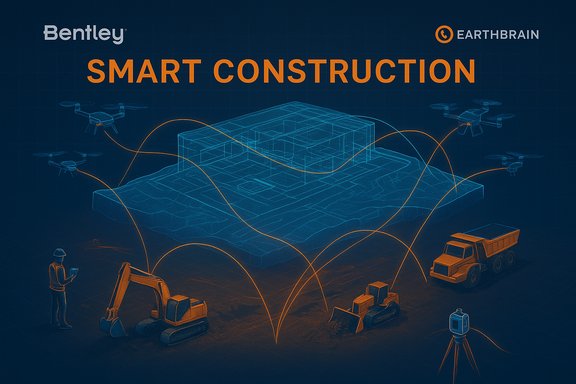 Background / Overview
Bentley Systems, a global leader in infrastructure engineering software, and EARTHBRAIN, the joint-venture vehicle spun out of Komatsu, NTT DOCOMO, Sony Semiconductor Solutions and Nomura Research Institute, announced a strategic partnership to integrate Bentley’s open, AI-powered iTwin digital twin platform into EARTHBRAIN’s Smart Construction offering. The announcement frames the effort as an upgrade to Smart Construction’s geospatial and site‑execution capabilities, initially in Japan with potential global expansion. This move builds on two pre-existing pillars. First, Bentley’s September 2024 acquisition of Cesium — the widely used 3D geospatial platform and steward of the 3D Tiles standard — folded Cesium’s high-performance visualization stack into Bentley’s iTwin platform, enabling richer, large-scale geospatial experiences. Second, Komatsu’s Smart Construction program (already powered in part by Cesium technologies) has been evolving since announcements and deployments in 2019–2021 and has been operationalized through EARTHBRAIN since the joint venture’s creation in 2021. Together, these strands tell a clear story: geospatial visualization (Cesium), engineering-grade digital twins (iTwin), and operational, machine-level site telemetry (Komatsu / EARTHBRAIN) are being stitched into a single workflow. That pipeline promises to convert on-site sensor feeds, drone surveys, CAD/BIM and machine telemetry into planning inputs, automated construction tasks, and operational analytics — an integrated loop from the cyber world back into the physical job site. Why this partnership matters
The missing link in construction tech
Construction has long suffered from fragmented data: separate CAD/BIM files, survey outputs, as-built records, machine telemetry and safety logs live in silos. Integrating those datasets into a format engineers and site teams can use in real time is the crux of digital transformation in construction. Bentley’s iTwin provides an engineering-focused, open digital twin platform while Cesium supplies the web-scale 3D streaming and visualization layer; EARTHBRAIN brings the field deployment, machine integration and local market presence in Japan. The combination creates a credible path toward continuous, actionable digital twins that can be consumed by planners, contractors and operators.Real outcomes: safety, productivity, sustainability
The partnership explicitly aims to improve three high-impact outcomes:- Safety: richer situational awareness and remote monitoring reduce exposure to hazardous tasks and improve incident response.
- Productivity: real-time cut/fill analysis, automated progress tracking, and better alignment between plan and reality shorten decision loops and reduce rework.
- Sustainability: optimized earthworks and material movement can lower fuel use and emissions, and better planning reduces waste.
The technology stack — what’s being integrated
Cesium: high-performance 3D geospatial layer
Cesium’s 3D Tiles and streaming engine make it possible to fuse and stream very large geospatial datasets — drone-derived point clouds, photogrammetric meshes, CAD models, and time-series snapshots — into web clients and mobile devices with GPU acceleration. Cesium’s technology powered Komatsu’s Smart Construction dashboards for years and was folded into Bentley through the 2024 acquisition, ensuring continuity of large-scale geospatial visualization within the iTwin ecosystem.Bentley iTwin: engineering-grade digital twins and analytics
The iTwin platform is Bentley’s open, cloud-native environment for creating engineering-accurate digital twins. It ingests engineering data from diverse CAD/BIM tools, aligns them with reality data and IoT telemetry, and provides APIs and apps for visualization, simulation and analytics. Bentley has emphasized AI and analytics as integral to iTwin use cases — from predictive asset monitoring to generative design assistance in site planning — and has extended iTwin capabilities into IoT monitoring, simulation and real‑time collaboration.EARTHBRAIN / Smart Construction: operational loop and field integration
EARTHBRAIN is the operational conduit for Smart Construction: sensor stacks, connectivity (including 5G), in-field imaging/sensing hardware and Komatsu’s fleet telemetry feed into the Smart Construction platform. EARTHBRAIN’s founding partners deliberately combined machine knowledge (Komatsu), connectivity (NTT DOCOMO), sensing (Sony Semiconductor Solutions) and systems integration & business design (NRI), creating a stack designed for broad field deployment. EARTHBRAIN’s Smart Construction solutions have been reported as deployed on thousands of job sites in Japan, giving the partnership a tangible field footprint to validate integrated twin use cases.How the integration will work in practice
From design to earthworks: a simplified workflow
- Design models and schedules are published by the engineering team into the iTwin environment.
- Drone surveys, machine telemetry and IoT sensors feed reality data into EARTHBRAIN’s Smart Construction platform, processed and streamed by Cesium’s geospatial tech.
- iTwin aligns engineering models with reality feeds, running automated cut/fill computations, clash checks, and risk simulations.
- Validated, optimized tasks (digital tasks) are pushed back into Smart Construction for execution by machine operators or automation tools.
- Progress and telemetry close the loop, enabling iterative planning and performance analytics.
Where AI fits
AI will be used in several places:- Data conditioning and classification (point cloud processing, photogrammetry cleaning).
- Analytics and prediction (progress forecasting, schedule risk analysis, anomaly detection).
- Design assistance and generative site planning (tools like OpenSite+ demonstrate Bentley’s move to embed generative AI into civil site design workflows).
- Operator assistance (recommendation engines and role-based copilots to translate twin-derived decisions into field actions).
Strengths: why this could work
- Complementary assets: The partnership marries Bentley’s engineering and digital twin capabilities with EARTHBRAIN’s field deployments and Cesium’s visualization — this is not a hypothetical toolchain but a composition of proven technologies.
- Open and standards-friendly approach: Bentley and Cesium promote openness (iTwin + 3D Tiles), which helps interoperability and reduces single-vendor lock-in risk for owners and contractors.
- Operational scale in Japan: EARTHBRAIN’s Smart Construction solutions are already in use across a large number of Japanese job sites, providing a testbed and early adopter base to refine workflows and measure ROI. Reported deployment counts are substantial and give the initiative practical momentum.
- End-to-end value chain: The combined stack stretches from high-fidelity engineering models down to machine-level execution, enabling mission‑critical use cases (safety-critical decision support, automated progress validation) that deliver tangible operational value.
Risks, limitations and what to watch closely
Data quality and sensor coverage
A digital twin is only as reliable as its input data. Sparse drone coverage, intermittent telemetry, or misaligned CAD models will undermine model fidelity and reduce the usefulness of automation. Successful pilots must budget for rigorous survey discipline, sensor calibration, and ongoing data governance. Projects that underinvest in these areas risk producing inaccurate recommendations that erode trust.Governance, provenance and liability
When AI suggests changes to site plans or scheduling, clear lines of responsibility and auditable provenance are essential. Engineering teams must retain final authority for critical design changes; agreements about data ownership, liability and regulatory compliance must be explicit in contracts. Digital twins introduce new legal and operational questions — who signs off when an AI-generated plan is executed on a $1M earthwork day? — and these must be addressed up front.Cybersecurity and operational resilience
A consolidated twin that holds design intent, live telemetry and control outputs is an attractive target. Defense-in-depth, strict identity and access controls, network segmentation for OT/IT boundaries, tamper detection for sensor inputs, and robust incident response plans are non-negotiable. Organizations must treat twin deployments like critical infrastructure systems, not only as collaboration tools.Vendor-lock and portability concerns
While openness is emphasized, deep integration with a platform — including cloud services, AI runtimes and proprietary analytics — can create migration friction. Owners and contractors should insist on exportable data formats, open APIs and contractual exit clauses to preserve future options. Standards and interoperability roadmaps should be part of procurement criteria.Overpromising and human factors
Technology will not fix poor procurement, unclear change control processes, or entrenched operational culture. Real gains come from combining tech with process redesign, workforce training and incremental pilots that measure real KPIs. Otherwise, pilots risk generating impressive visualizations but little operational uplift.Commercial and market implications
For contractors and owners
Companies that move early can convert digital twin investments into measurable reductions in rework, fewer change orders and faster handovers. But the upfront commitments are non-trivial: data contracts, surveying cadence, and integration with existing project controls must be budgeted and enforced. Owners should demand demonstration pilots tied to KPIs such as hours saved on quantity takeoffs, reduction in rework, or carbon savings from optimized earthworks.For vendors and integrators
Platform consolidation continues: large vendors like Bentley are buying geospatial capability (Cesium) and adding AI-focused analytics, creating richer ecosystems but also raising the bar for specialized vendors. System integrators and niche ISVs can still thrive by building “powered by iTwin” apps or converting legacy data into twin-ready formats. Interoperability remains a route to differentiation.For regulators and procurement teams
Authorities buying infrastructure projects should update procurement templates to require data portability, provenance logs, and cyber-security audits for any twin-driven project. Public bids that lock data into a single SaaS without export options risk long-term vendor lock-in and higher lifecycle costs. The industry is already moving toward standard information models and data contracts — procurement teams that insist on these will protect future flexibility.Practical recommendations for early adopters
- Start with a focused, measurable pilot: choose a stretch of earthworks, a bridge rehabilitation or an airport ramp where cut/fill and progress can be measured objectively.
- Define KPIs clearly before deployment: e.g., percent reduction in survey time, accuracy of volume calculations, schedule variance improvements, or CO2 saved.
- Invest in data hygiene: establish naming conventions, survey cadence, sensor calibration and a canonical data ingestion pipeline.
- Require exportability: ensure models, point clouds and metadata can be exported in open formats and that APIs are documented.
- Create governance and sign-off workflows: AI outputs should be accompanied by confidence metrics and provenance; humans must retain sign-off for any safety-critical changes.
- Budget for cybersecurity: segmented networks, DLP, encryption at rest and in transit, and monitoring/response capability are essential from day one.
Verifying the key claims — what’s confirmed and what needs caution
- Bentley acquired Cesium on September 6, 2024 — confirmed via Bentley’s acquisition announcement. This acquisition explicitly linked Cesium’s 3D capabilities to Bentley’s iTwin roadmap.
- EARTHBRAIN was formed in 2021 as a joint venture of Komatsu, NTT DOCOMO, Sony Semiconductor Solutions and Nomura Research Institute; the founding press releases confirm the composition and objectives.
- Komatsu and Cesium have a longstanding collaboration powering Komatsu’s Smart Construction dashboard and workflows, with public materials and Cesium blog posts documenting their collaborative product since around 2019–2021.
- EARTHBRAIN’s claim of Smart Construction being deployed across “over 35,000 job sites” appears in recent reporting and company statements; this is a significant operational footprint but should be treated with caution until independent auditing or customer lists are available to verify the specific scope and depth of deployments. Early public statements reference a large installed base in Japan, but procurement teams should request deployment details and success metrics during evaluation.
The bigger picture — what this means for the future of construction
This partnership is emblematic of a broader industry transition from point solutions to integrated platforms that close the loop between engineering intent and field execution. If executed well, the integration of iTwin’s engineering fidelity with Cesium’s geospatial scale and EARTHBRAIN’s field footprint could accelerate the maturity of digital twins from pilot curiosities into operational, risk-bearing systems used daily by engineers and site teams.Two trends are worth watching:
- Convergence of standards and governance: as twin projects scale, demands for open models, data contracts and auditability will drive procurement and standards activity.
- Hybrid architectures and edge/cloud balance: low-latency requirements for field operations and data residency concerns will push vendors to offer flexible deployment models that mix edge processing with cloud analytics.
Conclusion
Bentley’s strategic partnership with EARTHBRAIN connects three critical pieces of modern construction technology — geospatial visualization (Cesium), engineering-grade digital twins (iTwin), and field-scale operational platforms (Smart Construction via EARTHBRAIN) — to propose a practical route toward intelligent, safer, and more efficient construction workflows. The announcement reflects a realistic industry trajectory: pilots tied to clear KPIs, stepwise integration, and an emphasis on openness and engineering fidelity.That said, the real test will be measured in on-site outcomes: whether integrated twins reduce rework, lower carbon through optimized earthworks, and deliver measurable safety improvements without introducing new cyber or legal risks. Early adopters should insist on pilot metrics, insist on exportable data and governance controls, and budget for the non-trivial work of data hygiene and change management. When those pieces are in place, the partnership could be another important step in moving construction from line-level craft to data-driven engineering at scale.
Source: Construction & Property News Bentley Partners with Japan’s EARTHBRAIN to Advance Smart Construction - Construction & Property News
