

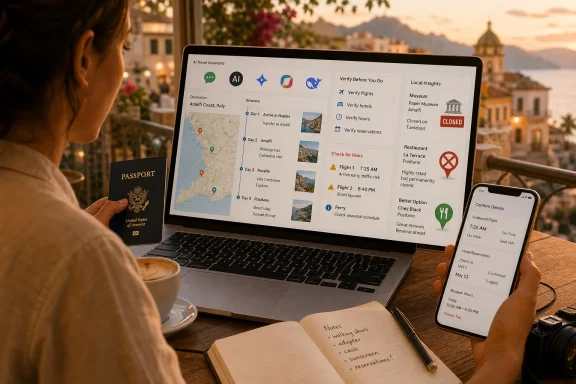
The Travel Bot Is Selling Confidence Before It Has Earned Trust
The pitch for AI vacation planning is irresistible because it attacks one of the least glamorous parts of leisure: the research grind. Nobody dreams of spending a Saturday comparing museum hours, transit routes, hotel cancellation policies, restaurant reservation windows, and whether a “short walk” on a travel blog means five minutes or forty. A chatbot that can turn “five days in Kyoto with two kids and a moderate budget” into a polished itinerary feels like a small liberation.
That is why the latest wave of travel-AI coverage lands with such force. Testers are no longer asking whether a chatbot can name famous attractions. They are asking whether it can build a trip that a person could actually take, with realistic timing, sane geography, useful budgeting, and enough sensitivity to the traveler’s age, stamina, appetite, mobility, and tolerance for chaos.
The answer, so far, is: sometimes, if supervised. General chatbots can synthesize ideas quickly and make unfamiliar destinations feel approachable. Purpose-built tools like Mindtrip can go further by tying the chat interface to maps, visuals, booking paths, and proprietary travel data. But even the better systems remain vulnerable to the same core weakness: they generate a trip-shaped plan before they truly know whether the plan survives contact with the ground.
That is not a small defect. A vacation itinerary is not just text. It is a chain of dependencies: flight times, hotel locations, opening hours, weather, ticket availability, reservation policies, local holidays, transportation bottlenecks, personal preferences, and the physical reality of tired humans. AI is good at drafting the chain. It is still uneven at stress-testing it.
The Prompt Has Become the New Packing List
The first serious lesson from recent AI travel tests is that the user’s prompt now matters almost as much as the destination. Travelers are being told to specify dates, budget, companions, pace, interests, dietary needs, mobility limits, and the kind of trip they actually want. That advice is correct, but it is also revealing. The supposedly magical travel agent still needs the traveler to do a fair amount of travel-agent work up front.
Gunnar Olson at Thrifty Traveler reportedly included a critical detail in his prompt: he would be traveling with an infant. That is precisely the kind of information a competent human planner would treat as a structural constraint, not a decorative note. It should change the rhythm of each day, the number of activities, the distance between stops, the choice of restaurants, and even the ideal hotel neighborhood.
Yet testers keep finding that AI systems can acknowledge a constraint in one sentence and quietly violate it in the next. A bot may say it understands that a family wants a relaxed pace, then produce a schedule that only a caffeinated solo traveler with no luggage could love. It may mention accessibility, then route someone through a hilly neighborhood or a transit transfer that collapses under real-world conditions. It may claim to be optimizing for budget while choosing restaurants, tours, or neighborhoods that tell a different story.
This is the paradox of prompt engineering for vacations. The more specific the user becomes, the more useful the output can be. But the more specific the trip becomes, the more dangerous it is when the model drops one of those constraints halfway through the answer. AI does not forget like a human does; it drifts, which is often harder to detect because the prose remains confident.
A human planner might say, “I cannot fit that in without making Tuesday miserable.” A chatbot is more likely to make Tuesday miserable and format it beautifully.
Claude, ChatGPT, Gemini, Copilot, and DeepSeek Are Not Interchangeable Travel Agents
The most interesting pattern in recent testing is not that one model wins forever. It is that different systems fail and succeed in different ways. That should make travelers cautious about any universal claim that “ChatGPT is best” or “Claude is best” or “Gemini is best.” Trip planning is not one task; it is a bundle of tasks pretending to be one.
Claude has drawn praise for detailed, humane planning and for producing practical extras such as packing lists, budgeting help, taxi suggestions, apps to download, and weather resources. That kind of answer feels less like a search result and more like a competent friend who has thought through the trip. For families and cautious travelers, that is valuable.
Gemini’s advantage is different. Because Google’s ecosystem reaches into Search, Maps, Flights, and Travel, Gemini can be particularly useful when geography and routing matter. A chatbot that understands where things are, not merely what they are called, starts closer to the real problem of travel. But integrations do not automatically create judgment. A route can be mapped and still be a bad day.
ChatGPT remains the default for many users because it is familiar, flexible, and broadly capable. It can brainstorm destinations, compare vibes, build packing lists, rewrite itineraries, and simulate trade-offs. But that generality cuts both ways. Unless it is connected to current, reliable data through browsing, plug-ins, travel partners, or user-provided sources, it can blur the line between timeless advice and outdated specifics.
Copilot benefits from Microsoft’s broader web and productivity context, especially for users already living in the Microsoft stack. DeepSeek, meanwhile, has been praised in some hands-on tests for steering the overall structure of a trip in a sensible direction, even when other tools produced flashier prose. That is a reminder that the prettiest itinerary is not always the best itinerary.
The better question is not which chatbot is the travel agent. It is which part of the job each tool should be trusted to attempt.
Mindtrip Understands That Travel Is Not Just Conversation
Purpose-built AI travel platforms are trying to solve the obvious weakness of general chatbots: travel planning needs more than fluent text. Mindtrip, one of the tools that has impressed recent testers, is built around the idea that itinerary generation should be connected to places, visuals, maps, booking options, and destination-specific data. That is a more serious architecture than asking a general chatbot to invent a vacation in a blank text box.
This matters because travel is inherently spatial. A recommendation is not useful unless it exists, is open, fits the day’s route, matches the traveler’s budget, and does not create an absurd detour. A restaurant ten minutes from the hotel is a convenience. A restaurant forty-five minutes across town after a museum day with children is a trap.
Mindtrip’s strength, according to travel testers, is that it feels closer to a plan-and-book environment than a mere brainstorming tool. That makes it more sophisticated, especially for users who want to move from inspiration to action. The same is true of other travel-specific tools such as Gondola or Kayak on ChatGPT, which narrow the problem by connecting AI to travel inventory, loyalty considerations, or booking flows.
But specialization does not eliminate the verification problem. A platform can improve grounding, reduce hallucinations, and make the itinerary more actionable while still missing the traveler’s private context. It does not know whether your family lingers over breakfast, whether your partner hates long transfers, whether your teenager is done with museums after ninety minutes, or whether “moderate hike” means different things to different knees.
The travel industry’s AI challenge is therefore not merely technical. It is experiential. The machine must model not only places but people, and people are notoriously poor at stating their own constraints until a bad itinerary exposes them.
The Nightmare Scenario Is Not Science Fiction
The nightmare version of AI travel planning is easy to caricature: a bot invents a hotel, recommends a closed attraction, or sends someone to the wrong airport. Those failures happen, and they are serious. But the more common danger is subtler. The itinerary may be mostly correct and still bad.
A plan can include real restaurants, real museums, real neighborhoods, and real train lines while asking too much of the traveler. It can underestimate transfer times, ignore ticket queues, miss seasonal closures, assume luggage can be stored anywhere, or schedule the day as though meals and rest are optional. It can choose a hotel that looks central on a map but is inconvenient for the specific trip being taken.
This is where AI’s fluency becomes a liability. A classic search result looks unfinished; it invites skepticism. A chatbot itinerary looks finished; it invites compliance. The more polished the answer, the more likely a user is to mistake presentation for verification.
Travel professionals have long understood that vacations fail at the seams. The flight is late, the museum is closed on Tuesdays, the beach is wonderful but impossible to reach without a car, the hotel check-in window matters, the “quick lunch nearby” is booked out, and the scenic detour consumes the afternoon. These are not edge cases. They are travel.
AI systems are improving at handling such constraints when connected to live tools, but the burden still falls on the traveler to check the parts of the plan that can ruin the day. That means hours, prices, routes, reservations, neighborhood safety, accessibility, cancellation terms, and any claim that sounds suspiciously convenient.
The Best AI Itinerary Is a Draft, Not a Booking Order
The practical lesson is not to avoid AI. That would be throwing away a genuinely useful planning assistant. The lesson is to demote AI from decision-maker to drafting partner.
Used well, these tools can shorten the blank-page phase. They can suggest neighborhoods, group attractions by theme, translate a traveler’s vague preferences into possible days, generate packing lists, estimate categories of cost, compare destination styles, and identify questions the traveler forgot to ask. For people who find trip planning overwhelming, that is a real gain.
But the moment the plan touches money or time, AI output should become evidence to verify, not instructions to follow. Flights should be checked with airlines or reputable booking platforms. Hotels should be checked on maps and recent reviews. Restaurants should be checked for hours and reservation availability. Attractions should be checked against official websites, local calendars, and ticket systems.
This is especially true for complicated trips: multi-city itineraries, family vacations, accessibility-sensitive travel, road trips, national parks, peak-season travel, international holidays, visa-sensitive travel, and anything involving tight transfers. Those are exactly the trips where AI feels most helpful and where its mistakes are most expensive.
The right workflow is almost embarrassingly traditional. Ask the AI for ideas. Ask it to explain its assumptions. Ask it to reduce the pace. Ask it to flag uncertainties. Then verify every operational detail yourself. The bot can be the intern. You are still the editor.
Travel Planning Exposes the Limits of “Good Enough” AI
AI’s defenders often argue that the tools do not need to be perfect to be useful. That is true. But travel is a harsh domain for “good enough” because the cost of a small error can be emotionally disproportionate. A wrong dinner recommendation is not catastrophic; a wrong transfer on the one day you can visit a landmark may define the trip.
This is why travel planning is such a useful test of consumer AI maturity. It combines recommendation, personalization, logistics, live data, budgeting, geography, language, and risk management. It also requires taste, restraint, and a sense of human fatigue. Those are not fringe requirements. They are the product.
The tools are clearly better than they were in the first ChatGPT travel boom. They ask better follow-up questions, produce more coherent day-by-day plans, and in some cases integrate with maps or booking data. They can also be delightfully creative, suggesting themes for each day or surfacing options a traveler might never have found through ordinary search.
But the gap between impressive and dependable remains. A model can be strong at prose and weak at truth. It can be strong at options and weak at trade-offs. It can be strong at summarizing a destination and weak at knowing whether Tuesday’s plan is physically reasonable after a red-eye flight.
That is the unresolved problem beneath the hype. AI travel planning is not waiting for better adjectives. It is waiting for better accountability.
The Travel Industry Wants the Assistant to Become the Storefront
There is a business reason so many companies are racing into AI travel planning. The itinerary is not just a convenience; it is the point where inspiration turns into spending. Whoever owns the planning interface can influence hotels, flights, tours, restaurants, insurance, loyalty redemption, and advertising. The chatbot is not merely helping you decide. It may become the storefront through which the trip is monetized.
That creates a new layer of concern for travelers. When an AI recommends a hotel or activity, is it optimizing for the user, for availability, for commission, for a partner relationship, for loyalty value, or for what its data can see? Traditional travel search already had this problem, but generative AI makes the ranking feel more personal and less commercial, even when commercial incentives may still be present.
Mindtrip’s creator and referral programs, Kayak’s integration with ChatGPT, Google’s travel ecosystem, and the broader push by booking platforms all point in the same direction. AI travel planning is becoming an interface war. The winner will not simply answer travel questions; it will shape demand.
That does not make these tools nefarious. It makes transparency essential. Travelers should know when recommendations are sponsored, when inventory is incomplete, when prices are estimates, and when the system cannot verify availability. The more conversational the interface becomes, the more important it is that commercial boundaries do not disappear into friendly prose.
For now, users should assume that no AI travel planner sees the whole market and no AI itinerary is neutral in the abstract. Every tool has a field of vision. The safest traveler is the one who understands where that vision ends.
The Human Planner Still Owns the Most Important Data
The enduring advantage of the human traveler is not access to information. AI has plenty of that. The human advantage is self-knowledge, and it remains stubbornly difficult to automate.
Only you know whether your family actually leaves the hotel on time. Only you know whether a packed day feels energizing or oppressive. Only you know whether you would rather eat brilliantly once or casually three times. Only you know whether you want to see the famous attraction or avoid the crowd around it. The bot can infer preferences, but it cannot feel the consequences.
This is why the best AI-assisted trips are likely to be collaborative. The user supplies the values; the machine supplies the structure. The user says, “We do not want to change hotels more than once,” or “We need downtime after lunch,” or “We care more about food than museums,” and the AI turns those constraints into a draft. Then the user pushes back.
The most useful prompt may not be “Plan my dream vacation.” It may be “Plan a vacation, then tell me why this plan might fail.” That second instruction forces the system toward critique rather than performance. It changes the tone from brochure to risk assessment.
Good human planners do this instinctively. They do not just ask what you want to do. They ask what you will regret doing, what you will regret missing, and what kind of inconvenience you tolerate poorly. Until AI systems become better at that kind of interrogation, they will continue to produce trips that look more personalized than they are.
The Smart Traveler Lets the Bot Carry the Clipboard, Not the Passport
The emerging rule for AI travel is simple: use it early, use it often, and do not let it be the final authority. A chatbot is excellent at lowering the activation energy of planning. It is not yet a substitute for judgment, current data, or the traveler’s own sense of pace.
The safest workflow is also the most productive one. Start broad, then narrow. Ask one tool for inspiration, another for route sanity, and a travel-specific platform for booking-adjacent details. Then verify everything that touches money, time, or physical movement.
- AI planners are useful for brainstorming destinations, grouping attractions, creating first-draft itineraries, and identifying planning gaps before a traveler opens a dozen browser tabs.
- General chatbots such as ChatGPT, Claude, Gemini, Copilot, and DeepSeek behave differently enough that no single model should be treated as the universal winner for every trip.
- Travel-specific tools such as Mindtrip, Gondola, and Kayak on ChatGPT are more actionable because they connect planning to maps, booking paths, or travel data, but they still require verification.
- The most dangerous AI travel mistakes are not always fake places; they are overstuffed days, unrealistic transfers, stale hours, bad assumptions, and hidden commercial incentives.
- Travelers should independently confirm flights, hotels, attraction hours, restaurant availability, transit routes, cancellation policies, and any recommendation that would be costly if wrong.
- The best prompt is not merely detailed; it asks the AI to explain assumptions, identify risks, reduce pace, and flag anything it cannot verify.
AI has already changed vacation planning, but it has not conquered it. The next generation of tools will become more grounded, more transactional, and more deeply embedded in booking systems, which means they will be more useful and more influential at the same time. The winners will not be the bots that produce the longest itinerary or the most confident prose; they will be the ones that know when to slow down, admit uncertainty, and leave the final call to the traveler who has to live the trip.
References
- From ChatGPT to Mindtrip: Why AI tools still fall short at planning the perfect vacations Diario AS · 2026-06-06T11:51:06.284745