
Business-travel booking is moving into Microsoft Teams, but the decisive change for IT departments is that these tools are beginning to act on travel policy, corporate content and employee preferences rather than merely display search results. PhocusWire’s examination of AI-driven online booking tools, or OBTs, shows Amadeus, FCM, Serko and startup Otto pursuing the same destination from different angles: make travel booking available inside the work applications employees already use, then let an AI agent narrow choices and eventually complete parts of the transaction.
That is a meaningful shift for organizations built around Microsoft 365. A traditional OBT was a separate web destination: employees left Outlook or Teams, entered dates and destinations, chose from approved inventory, and made the booking under a fixed policy engine. The emerging model places travel inside Teams or an internal Copilot experience, with an agent drawing on calendar data, traveler profiles, approved suppliers, expense rules and possibly CRM data.
The opportunity is real, but the framing needs discipline. Microsoft’s 2025 Work Trend Index did find the average worker receiving 117 emails and 153 Teams messages each weekday. Those figures demonstrate where work communication happens; they do not establish that workers want another workflow competing for attention inside Teams. For travel managers and Microsoft 365 administrators, an OBT embedded in Teams should be judged on whether it removes a handoff and preserves policy controls, not on the mere fact that it has a chat interface.
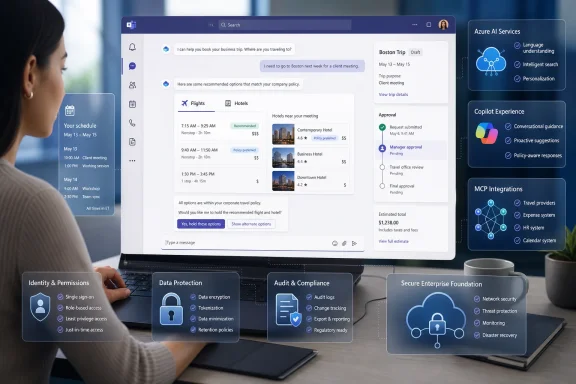
Amadeus has been building toward this model for several years with Cytric Easy, its corporate travel and expense product for Microsoft Teams. The Microsoft AppSource listing confirms that Amadeus offers trip booking, changes, cancellations, approvals, expenses and event-management functions through Teams, while positioning Cytric Easy as the travel-booking option for companies that use a separate expense platform.
PhocusWire reports that Amadeus enterprise growth lead Simone Buckley sees this as especially suited to corporations already standardized on Microsoft. The company’s sales argument is familiar to enterprise IT: an Azure-based service and a Teams-native experience should reduce security-review friction for customers already using Microsoft’s cloud stack.
That claim should not be read as a security shortcut. An application being hosted on Azure, or appearing as a Teams app, does not decide which employee data it can retrieve, what itinerary and policy records it stores, who can approve purchases, or how long traveler data remains available. Those are implementation decisions controlled by identity configuration, consent scopes, vendor contracts, retention rules and data-loss-prevention policies.
Amadeus, Microsoft and Accenture announced an AI assistant for Cytric Easy in 2023, designed to use natural-language interaction in Teams and align traveler preferences with employer policy. More recent Amadeus material says the assistant can provide contextual trip-planning and booking recommendations. The direction is clear: replace a sequence of filters and search-result pages with a conversational request such as booking a London trip around meetings, preferred airline status and company rules.
The practical test is whether the conversational layer remains a front end to deterministic controls. Airfare caps, cabin restrictions, required approval routes, preferred hotel programs and regional duty-of-care requirements cannot become suggestions that an agent can interpret differently from one booking to the next. A policy engine is auditable because its rules and exceptions can be inspected. A chat response that says a booking is “within policy” needs to show the applicable rule, its data source and the exception path before an employee spends company money.
PhocusWire reports that Otto founder Michael Gulmann, formerly an Expedia executive, compares the product to an executive assistant: it learns preferences, watches a calendar and proposes a familiar airline or hotel when a relevant meeting approaches. Otto’s own public material says it can plan, book and adjust business travel while taking corporate policy into account.
There is a significant distinction between learning a traveler’s habits and safely executing a booking. A recommendation engine can recognize that a traveler has previously selected one airline. A corporate travel system must also know whether that carrier is covered by a negotiated agreement, whether a lower logical fare applies, whether the selected flight meets policy, whether the trip needs pre-approval and what happens when a disruption requires rebooking.
The vendors with an advantage will be the ones that combine conversational UX with current, bookable inventory and dependable servicing after a ticket is issued. That is why the partnerships beneath Otto matter. Spotnana supplies the platform and travel-content connectivity; a TMC such as Direct Travel brings the operational service layer that is still necessary when airline waivers, hotel disputes, visa issues or stranded travelers turn a simple reservation into an exception case.
Gulmann’s view that OpenAI, Anthropic and other major AI providers are unlikely to take on travel fulfillment directly is plausible, but it is still a prediction rather than a settled market fact. Consumer AI assistants can increasingly surface travel options, yet taking payment, issuing tickets, handling exchanges, supporting travelers and assuming responsibility for failed transactions are a different business. OBT providers are betting that this transaction and servicing layer remains valuable even if the user starts from ChatGPT, Claude, Copilot or Teams.
One correction is necessary here. MCP does not mean “translation protocol,” as it is described in the supplied reporting. It is the Model Context Protocol, an open protocol originally introduced by Anthropic to let AI applications discover and use external tools, data and resources. In this context, an MCP server could expose approved travel search, policy lookup, traveler-profile or booking actions to an internal agent.
That makes MCP potentially useful for companies that are building their own Copilot Studio agents. Microsoft’s current Copilot Studio documentation supports governance through the Microsoft 365 admin center and Power Platform admin center, including data-loss-prevention controls, geographic processing controls and the ability to restrict publishing of generative AI agents. An organization could theoretically let an internal agent answer, “What flights meet policy for the customer meeting in Chicago?” without making the employee open an external OBT.
But an MCP connection is also an authority boundary, not a harmless plug-in. The OWASP Foundation’s MCP risk guidance highlights prompt injection, exposed credentials and excessive permissions as specific problems. NIST’s generative-AI risk work likewise warns that agent systems calling external tools can be vulnerable when untrusted data is brought into model context.
For a travel deployment, the cleanest initial design is read-only: permit an agent to retrieve policy-compliant options and explain the rule behind each one, but require explicit confirmation in the booking system for ticketing, cancellations, profile changes and payment-related actions. Service accounts should receive narrow permissions; policy logic should remain in the travel platform; and logs should preserve the request, retrieved data, recommendation and human approval.
The risky alternative is an agent with a broad, persistent credential that can read a calendar, inspect CRM records, access a traveler profile and issue tickets based on natural-language instructions. That is not merely an automation project. It is a purchasing and identity-management system with an AI interface.
If that arrives, the conventional division of labor will change. Historically, a company bought a travel program largely bundled around the operating model of its TMC and OBT: a specific booking tool, configuration process, agent-service model and reporting layer. An organization with mature Microsoft 365 governance may instead want its own agent to orchestrate multiple services while retaining the TMC for emergency support, negotiated content, fulfillment and complex international travel.
That does not eliminate the TMC. It raises the premium on clean APIs, reliable policy data, real-time content and service-level accountability. A vendor whose value begins and ends with a branded booking interface is exposed; a vendor that can provide auditable booking and support capabilities to a customer-controlled agent is better positioned.
AI also makes corporate travel’s internal data problem harder to ignore. PhocusWire quotes 1-CP’s Eric-Jan Krausch imagining an agent that notices a concentration of CRM leads in a region, calculates the return on a visit and proposes the trip. The scenario recasts travel from a controlled expense into a commercial action, but it requires integrating sales forecasts, customer data, budgets, travel policy and potentially sensitive employee calendar information.
That is a much larger permission set than “book me a flight.” Before linking CRM data to travel agents, organizations need to decide which users can see pipeline information, whether an agent may infer a trip’s business value, and whether it may recommend—or ever initiate—spend. The more authoritative the agent becomes, the less acceptable an opaque recommendation becomes.
For Windows and Microsoft 365 administrators, the immediate work is governance rather than agent-building. Inventory which travel apps are allowed in Teams, review Entra ID permissions and admin-consent requirements, separate read-only search from transactional tools, apply data policies to Copilot Studio connectors, and insist on a log that answers why each recommendation was made.
The next generation of OBTs will not be defined by whether they can chat. It will be defined by whether an enterprise can let an AI agent access travel data and take limited action without surrendering policy enforcement, auditability or control of the purchase.
The opportunity is real, but the framing needs discipline. Microsoft’s 2025 Work Trend Index did find the average worker receiving 117 emails and 153 Teams messages each weekday. Those figures demonstrate where work communication happens; they do not establish that workers want another workflow competing for attention inside Teams. For travel managers and Microsoft 365 administrators, an OBT embedded in Teams should be judged on whether it removes a handoff and preserves policy controls, not on the mere fact that it has a chat interface.
Cytric Easy turns Teams into the booking front end
Amadeus has been building toward this model for several years with Cytric Easy, its corporate travel and expense product for Microsoft Teams. The Microsoft AppSource listing confirms that Amadeus offers trip booking, changes, cancellations, approvals, expenses and event-management functions through Teams, while positioning Cytric Easy as the travel-booking option for companies that use a separate expense platform.PhocusWire reports that Amadeus enterprise growth lead Simone Buckley sees this as especially suited to corporations already standardized on Microsoft. The company’s sales argument is familiar to enterprise IT: an Azure-based service and a Teams-native experience should reduce security-review friction for customers already using Microsoft’s cloud stack.
That claim should not be read as a security shortcut. An application being hosted on Azure, or appearing as a Teams app, does not decide which employee data it can retrieve, what itinerary and policy records it stores, who can approve purchases, or how long traveler data remains available. Those are implementation decisions controlled by identity configuration, consent scopes, vendor contracts, retention rules and data-loss-prevention policies.
Amadeus, Microsoft and Accenture announced an AI assistant for Cytric Easy in 2023, designed to use natural-language interaction in Teams and align traveler preferences with employer policy. More recent Amadeus material says the assistant can provide contextual trip-planning and booking recommendations. The direction is clear: replace a sequence of filters and search-result pages with a conversational request such as booking a London trip around meetings, preferred airline status and company rules.
The practical test is whether the conversational layer remains a front end to deterministic controls. Airfare caps, cabin restrictions, required approval routes, preferred hotel programs and regional duty-of-care requirements cannot become suggestions that an agent can interpret differently from one booking to the next. A policy engine is auditable because its rules and exceptions can be inspected. A chat response that says a booking is “within policy” needs to show the applicable rule, its data source and the exception path before an employee spends company money.
The chatbot is the easy part; travel content is the product
Otto The Agent illustrates why the underlying transaction infrastructure matters more than an impressive prompt box. Spotnana announced Otto’s broader public availability in December 2025 after a closed beta, describing it as an AI travel assistant built on Spotnana’s platform. Business Travel News separately reported that Otto had begun pilots in managed-travel programs and was using Spotnana and Booking.com integrations.PhocusWire reports that Otto founder Michael Gulmann, formerly an Expedia executive, compares the product to an executive assistant: it learns preferences, watches a calendar and proposes a familiar airline or hotel when a relevant meeting approaches. Otto’s own public material says it can plan, book and adjust business travel while taking corporate policy into account.
There is a significant distinction between learning a traveler’s habits and safely executing a booking. A recommendation engine can recognize that a traveler has previously selected one airline. A corporate travel system must also know whether that carrier is covered by a negotiated agreement, whether a lower logical fare applies, whether the selected flight meets policy, whether the trip needs pre-approval and what happens when a disruption requires rebooking.
The vendors with an advantage will be the ones that combine conversational UX with current, bookable inventory and dependable servicing after a ticket is issued. That is why the partnerships beneath Otto matter. Spotnana supplies the platform and travel-content connectivity; a TMC such as Direct Travel brings the operational service layer that is still necessary when airline waivers, hotel disputes, visa issues or stranded travelers turn a simple reservation into an exception case.
Gulmann’s view that OpenAI, Anthropic and other major AI providers are unlikely to take on travel fulfillment directly is plausible, but it is still a prediction rather than a settled market fact. Consumer AI assistants can increasingly surface travel options, yet taking payment, issuing tickets, handling exchanges, supporting travelers and assuming responsibility for failed transactions are a different business. OBT providers are betting that this transaction and servicing layer remains valuable even if the user starts from ChatGPT, Claude, Copilot or Teams.
FCM’s MCP plan exposes the governance problem
FCM chief experience officer John Morhous told PhocusWire that customers increasingly want travel services inside enterprise tools, including Teams and Slack. FCM has since publicly described deploying Model Context Protocol, or MCP, to make its services accessible from a customer’s own environment and to reduce the friction that can drive travelers outside the managed program.One correction is necessary here. MCP does not mean “translation protocol,” as it is described in the supplied reporting. It is the Model Context Protocol, an open protocol originally introduced by Anthropic to let AI applications discover and use external tools, data and resources. In this context, an MCP server could expose approved travel search, policy lookup, traveler-profile or booking actions to an internal agent.
That makes MCP potentially useful for companies that are building their own Copilot Studio agents. Microsoft’s current Copilot Studio documentation supports governance through the Microsoft 365 admin center and Power Platform admin center, including data-loss-prevention controls, geographic processing controls and the ability to restrict publishing of generative AI agents. An organization could theoretically let an internal agent answer, “What flights meet policy for the customer meeting in Chicago?” without making the employee open an external OBT.
But an MCP connection is also an authority boundary, not a harmless plug-in. The OWASP Foundation’s MCP risk guidance highlights prompt injection, exposed credentials and excessive permissions as specific problems. NIST’s generative-AI risk work likewise warns that agent systems calling external tools can be vulnerable when untrusted data is brought into model context.
For a travel deployment, the cleanest initial design is read-only: permit an agent to retrieve policy-compliant options and explain the rule behind each one, but require explicit confirmation in the booking system for ticketing, cancellations, profile changes and payment-related actions. Service accounts should receive narrow permissions; policy logic should remain in the travel platform; and logs should preserve the request, retrieved data, recommendation and human approval.
The risky alternative is an agent with a broad, persistent credential that can read a calendar, inspect CRM records, access a traveler profile and issue tickets based on natural-language instructions. That is not merely an automation project. It is a purchasing and identity-management system with an AI interface.
AI will challenge the old OBT operating model
Serko chief product officer David Holyoke’s argument, reported by PhocusWire, is more consequential than the usual promise of faster booking. He says AI could let companies move from administering travel programs to intelligently governing them: automating compliance, identifying risk and reducing manual work. Serko’s March 2026 strategy update separately said it planned a multi-agent travel-management solution during 2026.If that arrives, the conventional division of labor will change. Historically, a company bought a travel program largely bundled around the operating model of its TMC and OBT: a specific booking tool, configuration process, agent-service model and reporting layer. An organization with mature Microsoft 365 governance may instead want its own agent to orchestrate multiple services while retaining the TMC for emergency support, negotiated content, fulfillment and complex international travel.
That does not eliminate the TMC. It raises the premium on clean APIs, reliable policy data, real-time content and service-level accountability. A vendor whose value begins and ends with a branded booking interface is exposed; a vendor that can provide auditable booking and support capabilities to a customer-controlled agent is better positioned.
AI also makes corporate travel’s internal data problem harder to ignore. PhocusWire quotes 1-CP’s Eric-Jan Krausch imagining an agent that notices a concentration of CRM leads in a region, calculates the return on a visit and proposes the trip. The scenario recasts travel from a controlled expense into a commercial action, but it requires integrating sales forecasts, customer data, budgets, travel policy and potentially sensitive employee calendar information.
That is a much larger permission set than “book me a flight.” Before linking CRM data to travel agents, organizations need to decide which users can see pipeline information, whether an agent may infer a trip’s business value, and whether it may recommend—or ever initiate—spend. The more authoritative the agent becomes, the less acceptable an opaque recommendation becomes.
Teams integration needs a purchase-control design
The short-term deployment path is therefore less dramatic than the vendor rhetoric suggests. Teams-based travel access can deliver a real benefit today when it consolidates trip collaboration, approval requests, itinerary access and policy-aware search in the application employees already use. It can also reduce booking leakage if the sanctioned path is genuinely easier than searching consumer travel sites.For Windows and Microsoft 365 administrators, the immediate work is governance rather than agent-building. Inventory which travel apps are allowed in Teams, review Entra ID permissions and admin-consent requirements, separate read-only search from transactional tools, apply data policies to Copilot Studio connectors, and insist on a log that answers why each recommendation was made.
The next generation of OBTs will not be defined by whether they can chat. It will be defined by whether an enterprise can let an AI agent access travel data and take limited action without surrendering policy enforcement, auditability or control of the purchase.
References
- Primary source: phocuswire.com
Published: 2026-08-04T04:00:00+00:00
Navigating the future of OBTs in an AI-driven travel industry
Business travel has reached an "inflexion point" on the use of AI, with companies determining how to best incorporate the technology.
www.phocuswire.com
- Related coverage: spotnana.com
Otto The Agent announces AI travel assistant built on Spotnana | Spotnana
The industry has long needed an intelligent agent that understands the traveler, not just the itinerary. After nine months in a closed beta, Otto is now available to everyone, delivering personalized travel experiences for all.www.spotnana.com
- Related coverage: campaign.amadeus.com
- Related coverage: amadeus.com
- Related coverage: newsroom.accenture.com
Amadeus to Work with Microsoft and Accenture to Develop New Generative AI-Powered Integrations to Support Corporate Travel Management
MADRID; Sept. 25, 2023 - As part of its ongoing partnerships strategy, Amadeus announced today it is working with Microsoft and Accenture (NYSE: ACN) to develop newnewsroom.accenture.com - Related coverage: businesstravelnews.com
Otto Opens Up to Wide Use, Starts Corporate Travel Pilots
After nine months of closed beta testing, Otto The Agent—the AI-powered travel assistant backed by Steve Singh's Madrona Venture Group—is opening its availability to the wider public, including its first pilots in managed travel programs, the company announced.www.businesstravelnews.com
- Related coverage: amadeus.com
- Related coverage: fcmtravel.com
FCM Travel shows what’s next for enterprise travel
FCM Travel today demonstrated the latest in its next-generation AI-powered technology ecosystem at Business Travel Show Europe (BTS), as the company continues to redefine what enterprise travel management can deliver as the demands on travel professionals grow. FCM's technology ecosystem is...www.fcmtravel.com - Related coverage: cdn.asp.events
- Related coverage: fcmtravel.com
- Related coverage: learn.microsoft.com
Security and governance - Microsoft Copilot Studio | Microsoft Learn
Use the security and governance controls in Power Platform and Microsoft 365 to manage the security of your data when creating, publishing, and using agents built with Microsoft Copilot Studio.learn.microsoft.com - Related coverage: learn.microsoft.com
Configure data policies for agents - Microsoft Copilot Studio | Microsoft Learn
Prevent accidental data exfiltration or data loss by configuring data policies for Microsoft Copilot Studio agents.learn.microsoft.com - Related coverage: owasp.org
- Related coverage: owasp.org
- Related coverage: devblogs.microsoft.com
Copilot Studio Security | Power Platform Developer Blog
Learn about Microsoft Copilot Studio Security, including deploying, and monitoring, with tools such as Application Insights, and Purview.devblogs.microsoft.com - Related coverage: nvlpubs.nist.gov
Adversarial Machine Learning: A Taxonomy and Terminology of Attacks and Mitigations
This NIST Trustworthy and Responsible AI report provides a taxonomy of concepts and defines terminology in the field of adversarial machine learning (AML). The taxonomy is arranged in a conceptual hierarchy that includes key types of ML methods, life cycle stages of attack, and attacker goals...nvlpubs.nist.gov
- Related coverage: owaspla.owasp.org