

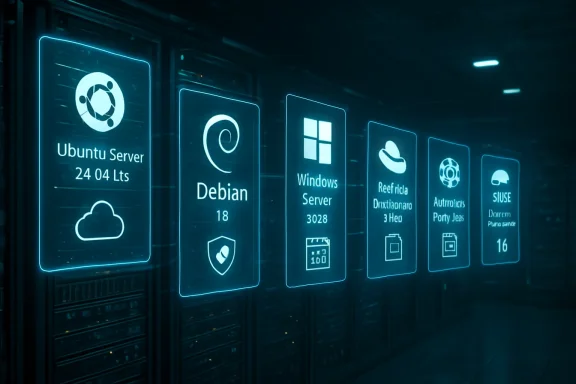
The best server operating system in 2026 is not a single product but a short list: Ubuntu Server 24.04 LTS, Debian 13, Windows Server 2025, Red Hat Enterprise Linux 10, AlmaLinux, Rocky Linux, and SUSE Linux Enterprise Server 16, depending on workload, support model, and budget. That is the answer marketing copy rarely gives, because “best” is easier to sell than “fit.” The real server OS decision is now less about kernel tribalism and more about who carries the operational risk when updates, licensing, compliance, hardware support, and cloud integration collide.
For years, the server operating system debate was staged as Linux versus Windows, with each side pretending the other was an edge case. That framing is obsolete. Linux won the broad infrastructure layer, Windows Server remains deeply entrenched in Microsoft-centric enterprise networks, and neither outcome tells a sysadmin what to install on a new database node next Tuesday.
The more honest question in 2026 is: which failure mode can your organization tolerate? Ubuntu may give developers the package freshness they expect, but it also pulls teams toward Canonical’s support model when long-term maintenance matters. Debian gives you conservatism and community discipline, but expects more from the operator. Windows Server 2025 brings Active Directory, Hyper-V, SMB improvements, and Microsoft integration, but also keeps you inside Microsoft’s licensing and hybrid-cloud orbit.
That is why thin comparison articles that rank “top server OS” choices as if they were gaming laptops miss the point. A web host, a regulated bank, a SaaS startup, a university lab, and a two-person MSP may all need stable servers. They do not need the same operating system.
Its strength is not that it is the purest Linux distribution. Its strength is that almost everything supports it. Cloud providers publish first-class images, software vendors test against it, container tutorials assume it, and developers coming from desktop Linux or WSL are rarely surprised by its package management and layout.
That convenience has real operational value. The OS that your team can patch, automate, troubleshoot, and rebuild quickly is often better than the theoretically superior OS that only one senior engineer understands. Ubuntu’s combination of
The catch is that Ubuntu’s popularity does not make it neutral. Canonical has steadily turned Ubuntu into a product family with Ubuntu Pro, expanded security maintenance, livepatching, compliance modules, and enterprise support layered on top. For some organizations, that is exactly the point. For others, it is a reminder that “free Linux” often becomes a paid risk-management decision once servers become important enough.
Ubuntu Server is the right default for cloud-native teams, SaaS shops, general web hosting, CI infrastructure, Kubernetes nodes, and organizations that want a modern Linux base without building their own platform engineering culture from scratch. It is less compelling where the organization wants maximal minimalism, strict conservatism, or a RHEL-compatible estate.
Debian’s virtue is that it makes fewer assumptions about the business around it. It is not trying to sell you a management portal, a subscription tier, or a migration path into a vendor cloud. It is trying to be Debian. For many sysadmins, that remains a profound advantage.
The trade-off is that Debian asks you to know what you are doing. Its defaults are sensible, but its commercial support story is not as centralized as Canonical’s, Red Hat’s, Microsoft’s, or SUSE’s. If your auditors need a single throat to choke, Debian can be harder to justify unless you already have a support partner or a capable internal Linux team.
Debian is especially strong for infrastructure that prizes stability and transparency over vendor alignment: web servers, DNS, mail, lightweight virtualization hosts, appliances, storage-adjacent services, and internal platforms where the team controls the stack. It is also a strong base for people who simply dislike surprise.
What Debian is not is a magic answer for every enterprise. If you need certified vendor stacks, formal indemnification, or a platform your ERP provider explicitly blesses, Debian may become a philosophical victory and a procurement defeat. In production, both matter.
That distinction matters. RHEL’s value is not merely package selection or kernel version. It is lifecycle policy, backporting discipline, security response, hardware and software certification, management tooling, documentation, and the ability to escalate when an outage becomes a board-level event.
The CentOS collapse changed how many admins talk about Red Hat. The old bargain — use CentOS broadly, pay Red Hat where necessary — was disrupted, and the aftershocks are still visible in 2026. Rocky Linux and AlmaLinux exist because the market still wants RHEL-like behavior without always paying RHEL-like prices.
But dismissing RHEL because of CentOS anger is too easy. For enterprises that need Oracle, SAP, major database vendors, commercial security tools, and formal platform matrices to line up, RHEL often remains the least risky option. It is expensive in the way insurance is expensive: annoying until the day you need it.
RHEL is the strongest choice for regulated industries, certified application stacks, hybrid cloud managed through enterprise tooling, and organizations that treat Linux as a platform contract rather than just an install image. It is overkill for many small web workloads, hobby labs, and cost-sensitive VPS deployments.
Rocky Linux leans heavily into the promise of downstream compatibility with RHEL, appealing to teams that want the old CentOS mental model back as closely as possible. That positioning resonates with conservative shops, hosting providers, and administrators who built years of automation around the Enterprise Linux ecosystem.
AlmaLinux has been somewhat more explicit about application binary compatibility rather than a simplistic “bug-for-bug” clone identity. That may sound like a subtle distinction, but it reflects the new reality after Red Hat changed access to RHEL source packaging. Rebuilding RHEL is no longer the same social and technical exercise it was in the CentOS 7 era.
For many users, the practical difference will be small. If you need a stable Enterprise Linux-compatible platform for web hosting, control panels, VPS nodes, and general-purpose server workloads, both AlmaLinux and Rocky Linux deserve consideration. The bigger decision is whether your organization is comfortable relying on a community rebuild for systems that may eventually demand formal vendor accountability.
These distributions are strongest where RHEL compatibility matters but RHEL subscriptions do not pencil out: hosting fleets, cPanel-style environments, internal Linux services, lab-to-production pipelines, and cost-sensitive enterprises with strong Linux skills. They are weaker where the phrase “supported by Red Hat” is a compliance requirement rather than a preference.
The obvious case remains Active Directory. If your identity model, group policy, file services, certificate services, management workflows, and application stack are built around Microsoft technologies, Windows Server is not merely convenient. It is the native habitat. Running those workloads elsewhere can turn purity into punishment.
Windows Server 2025 also reflects Microsoft’s broader hybrid strategy. Features such as improved SMB capabilities, security hardening, Azure Arc integration, hotpatching in supported scenarios, and Hyper-V improvements are not side notes. They show Microsoft treating Windows Server as a bridge between on-premises infrastructure and Azure-managed operations.
That bridge comes with a toll. Licensing remains complex, especially once virtualization rights, Datacenter versus Standard editions, CALs, SQL Server, Remote Desktop Services, and hybrid entitlements enter the picture. Windows Server can be technically excellent and financially irritating at the same time.
The best case for Windows Server is not “Windows is easier.” It is that the business already runs on Microsoft identity, Microsoft management, Microsoft databases, Microsoft development frameworks, or Microsoft compliance tooling. In that world, choosing Linux for the sake of ideological neatness can increase operational complexity rather than reduce it.
SUSE Linux Enterprise Server 16 gives SUSE a refreshed platform story for the current generation of enterprise computing. Like Red Hat, SUSE sells more than packages. It sells lifecycle, support, certification, tooling, and a vendor relationship that matters when the workload is expensive enough that downtime becomes a financial event.
Its challenge is mindshare. Developers casually reach for Ubuntu. Enterprise Linux conversations default to RHEL and its rebuilds. Windows shops remain Windows shops. SUSE often enters the conversation when a specific workload, region, integrator, or vendor certification pulls it in.
That does not make SUSE weak. It makes it specialized. For SAP-heavy environments, high-availability clusters, mixed Linux estates, and enterprises looking for a credible alternative to Red Hat, SUSE can be the right answer. For small teams seeking maximum online community volume and tutorial availability, it may feel less approachable than Ubuntu or Debian.
The mistake is treating popularity as a proxy for suitability. In server infrastructure, the best-supported niche can beat the most popular default.
That has made Proxmox VE, Hyper-V, Nutanix, KVM-based platforms, OpenShift Virtualization, and cloud-native alternatives more interesting. Proxmox VE 9, built on Debian 13, is especially visible among labs, SMBs, hosting providers, and cost-sensitive virtualization users who want an integrated open-source stack with clustering, storage, and container support.
This matters because the “best server OS” may be the wrong unit of analysis. If most of your servers are virtual machines, the host platform controls much of the operational experience. Backup integration, live migration, storage replication, monitoring, network overlays, and license portability can matter more than whether a guest VM runs Debian or AlmaLinux.
Windows Server with Hyper-V remains attractive for Microsoft-heavy organizations, particularly when licensing already includes virtualization rights. Proxmox is attractive where teams want KVM, ZFS, Ceph, LXC containers, and a lower-cost control plane. VMware still has deep enterprise maturity, but the business context around it has changed enough that many buyers now treat renewal as a strategic review rather than a routine purchase order.
The OS choice has therefore become inseparable from the platform choice. A Linux guest running on a fragile virtualization stack is not a stable server. A perfectly licensed Windows Server estate with poor backup architecture is not a resilient one. The operating system is only one layer of the promise.
Linux distributions differ sharply in how they handle security maintenance. Debian prizes stability and transparent community process. Ubuntu offers broader paid maintenance options and livepatching. RHEL and SUSE wrap security response in enterprise subscription models. AlmaLinux and Rocky Linux depend on community and ecosystem velocity to track the Enterprise Linux world.
Windows Server has its own security arc. Credential protection, secured-core concepts, SMB hardening, Defender integration, and hotpatching scenarios all fit into Microsoft’s pitch: manage Windows Server as part of a broader security and cloud-control plane. That is compelling if the organization already uses Microsoft’s ecosystem. It is less compelling if Azure Arc is viewed as another management dependency.
The uncomfortable truth is that the least secure server OS is usually the one your team neglects. An unpatched Ubuntu VPS with password SSH is not safer than a well-managed Windows Server. A forgotten CentOS 7 box in a closet is not made respectable by nostalgia. A RHEL subscription does not compensate for bad firewall rules, exposed management interfaces, or untested backups.
Security should push buyers toward maintainability. Choose the OS that your team can patch automatically, audit consistently, monitor properly, and rebuild under pressure. Anything else is branding.
That has favored distributions with strong cloud image pipelines. Ubuntu benefits enormously from being a default choice across public clouds. Debian is widely available and trusted. RHEL, SUSE, Rocky, AlmaLinux, and Windows Server all have cloud marketplace presences shaped by support, licensing, and vendor relationships.
The cloud also changed how teams think about lifecycle. If servers are immutable, rebuilt often, and managed through infrastructure-as-code, the OS becomes a standardized base image rather than a pet machine. If servers are long-lived, manually modified, and hard to replace, the OS lifecycle becomes a looming liability.
That divide explains many arguments that otherwise sound ideological. Cloud-native teams often prefer fresher packages, automation-friendly images, and rebuild speed. Traditional enterprise teams may prefer slower change, longer support, certified stacks, and vendor escalation paths. Both are rational because they are solving different problems.
The best server OS for a disposable Kubernetes worker node is not necessarily the best OS for a ten-year records-management application. Treating those as one category is how bad infrastructure standards get written.
Small teams often underestimate this. They choose the OS that looks cheapest on day one and discover later that the real cost is paid in troubleshooting hours. Large enterprises make the opposite mistake, buying support contracts so broad that they obscure whether the internal team still understands the systems it operates.
There is no shame in paying for RHEL, SUSE, Ubuntu Pro, or Windows Server support if the business depends on the workload. There is also no shame in running Debian or AlmaLinux if the team has the skill and discipline to own the stack. The bad decision is pretending that a community forum, a vendor SLA, and one overworked sysadmin are interchangeable.
For web hosting, AlmaLinux and Rocky Linux remain natural fits because the control-panel and Enterprise Linux ecosystem still matters. For developer-facing cloud infrastructure, Ubuntu Server is hard to beat. For conservative open infrastructure, Debian is superb. For Microsoft estates, Windows Server 2025 is the practical answer. For certified enterprise applications, RHEL and SUSE remain heavyweights.
That is not a neat ranking. It is a map.
The goal is not to pick one OS for everything. The goal is to avoid picking seven because every team had a favorite. A sensible 2026 estate might standardize on Ubuntu for cloud-native workloads, Windows Server for Microsoft infrastructure, and RHEL or AlmaLinux for Enterprise Linux applications. Another might use Debian almost everywhere and Windows Server only where Active Directory requires it.
The important part is writing down the rule. If exceptions are allowed, they should be justified by workload requirements, vendor certification, lifecycle needs, or measurable operational benefit. “The developer liked it” is not a server OS policy.
This is where many “best OS” guides fail. They compare features without discussing governance. But in real infrastructure, governance is the feature that keeps the lights on.
Source: openPR.com https://www.openpr.com/news/4499789...ating-system-in-2026-a-full-guide-on-picking/
 The Server OS War Is Over, and the Workload Won
For years, the server operating system debate was staged as Linux versus Windows, with each side pretending the other was an edge case. That framing is obsolete. Linux won the broad infrastructure layer, Windows Server remains deeply entrenched in Microsoft-centric enterprise networks, and neither outcome tells a sysadmin what to install on a new database node next Tuesday.The more honest question in 2026 is: which failure mode can your organization tolerate? Ubuntu may give developers the package freshness they expect, but it also pulls teams toward Canonical’s support model when long-term maintenance matters. Debian gives you conservatism and community discipline, but expects more from the operator. Windows Server 2025 brings Active Directory, Hyper-V, SMB improvements, and Microsoft integration, but also keeps you inside Microsoft’s licensing and hybrid-cloud orbit.
That is why thin comparison articles that rank “top server OS” choices as if they were gaming laptops miss the point. A web host, a regulated bank, a SaaS startup, a university lab, and a two-person MSP may all need stable servers. They do not need the same operating system.
Ubuntu Server Is the Default Until It Isn’t
Ubuntu Server remains the easiest recommendation for a large slice of modern infrastructure because it sits at the intersection of developer familiarity, cloud image availability, hardware enablement, and a predictable LTS cadence. Ubuntu 24.04 LTS is the anchor release most organizations should be considering in 2026 if they want a mainstream Linux server with a long support runway and broad vendor recognition.Its strength is not that it is the purest Linux distribution. Its strength is that almost everything supports it. Cloud providers publish first-class images, software vendors test against it, container tutorials assume it, and developers coming from desktop Linux or WSL are rarely surprised by its package management and layout.
That convenience has real operational value. The OS that your team can patch, automate, troubleshoot, and rebuild quickly is often better than the theoretically superior OS that only one senior engineer understands. Ubuntu’s combination of
apt, systemd, AppArmor, cloud-init, Netplan, and Snap may provoke strong opinions, but in production the ecosystem matters.The catch is that Ubuntu’s popularity does not make it neutral. Canonical has steadily turned Ubuntu into a product family with Ubuntu Pro, expanded security maintenance, livepatching, compliance modules, and enterprise support layered on top. For some organizations, that is exactly the point. For others, it is a reminder that “free Linux” often becomes a paid risk-management decision once servers become important enough.
Ubuntu Server is the right default for cloud-native teams, SaaS shops, general web hosting, CI infrastructure, Kubernetes nodes, and organizations that want a modern Linux base without building their own platform engineering culture from scratch. It is less compelling where the organization wants maximal minimalism, strict conservatism, or a RHEL-compatible estate.
Debian Is Still the Quiet Adult in the Room
Debian 13 “trixie” gives 2026 something the server market always needs: a boring, principled, community-governed operating system that does not chase every enterprise fashion cycle. That sounds like faint praise only to people who have never had to keep production systems alive across years of staff turnover, hardware refreshes, and dependency churn.Debian’s virtue is that it makes fewer assumptions about the business around it. It is not trying to sell you a management portal, a subscription tier, or a migration path into a vendor cloud. It is trying to be Debian. For many sysadmins, that remains a profound advantage.
The trade-off is that Debian asks you to know what you are doing. Its defaults are sensible, but its commercial support story is not as centralized as Canonical’s, Red Hat’s, Microsoft’s, or SUSE’s. If your auditors need a single throat to choke, Debian can be harder to justify unless you already have a support partner or a capable internal Linux team.
Debian is especially strong for infrastructure that prizes stability and transparency over vendor alignment: web servers, DNS, mail, lightweight virtualization hosts, appliances, storage-adjacent services, and internal platforms where the team controls the stack. It is also a strong base for people who simply dislike surprise.
What Debian is not is a magic answer for every enterprise. If you need certified vendor stacks, formal indemnification, or a platform your ERP provider explicitly blesses, Debian may become a philosophical victory and a procurement defeat. In production, both matter.
RHEL 10 Is the Enterprise Linux Answer You Pay For
Red Hat Enterprise Linux 10 arrived into a market that is more skeptical of vendor control than it was a decade ago, but RHEL remains the reference platform for a large class of serious enterprise workloads. If you run certified applications, regulated environments, large fleets, or hybrid-cloud estates where support contracts are part of the architecture, RHEL is not just another Linux distribution. It is the contract wrapped around the distribution.That distinction matters. RHEL’s value is not merely package selection or kernel version. It is lifecycle policy, backporting discipline, security response, hardware and software certification, management tooling, documentation, and the ability to escalate when an outage becomes a board-level event.
The CentOS collapse changed how many admins talk about Red Hat. The old bargain — use CentOS broadly, pay Red Hat where necessary — was disrupted, and the aftershocks are still visible in 2026. Rocky Linux and AlmaLinux exist because the market still wants RHEL-like behavior without always paying RHEL-like prices.
But dismissing RHEL because of CentOS anger is too easy. For enterprises that need Oracle, SAP, major database vendors, commercial security tools, and formal platform matrices to line up, RHEL often remains the least risky option. It is expensive in the way insurance is expensive: annoying until the day you need it.
RHEL is the strongest choice for regulated industries, certified application stacks, hybrid cloud managed through enterprise tooling, and organizations that treat Linux as a platform contract rather than just an install image. It is overkill for many small web workloads, hobby labs, and cost-sensitive VPS deployments.
AlmaLinux and Rocky Linux Carry the CentOS Inheritance Differently
AlmaLinux and Rocky Linux are often mentioned in the same breath, but the difference between them has become more than branding. Both emerged as answers to the end of traditional CentOS Linux. Both are meant to serve administrators who want an enterprise Linux experience without a Red Hat subscription on every node. Both are credible in 2026.Rocky Linux leans heavily into the promise of downstream compatibility with RHEL, appealing to teams that want the old CentOS mental model back as closely as possible. That positioning resonates with conservative shops, hosting providers, and administrators who built years of automation around the Enterprise Linux ecosystem.
AlmaLinux has been somewhat more explicit about application binary compatibility rather than a simplistic “bug-for-bug” clone identity. That may sound like a subtle distinction, but it reflects the new reality after Red Hat changed access to RHEL source packaging. Rebuilding RHEL is no longer the same social and technical exercise it was in the CentOS 7 era.
For many users, the practical difference will be small. If you need a stable Enterprise Linux-compatible platform for web hosting, control panels, VPS nodes, and general-purpose server workloads, both AlmaLinux and Rocky Linux deserve consideration. The bigger decision is whether your organization is comfortable relying on a community rebuild for systems that may eventually demand formal vendor accountability.
These distributions are strongest where RHEL compatibility matters but RHEL subscriptions do not pencil out: hosting fleets, cPanel-style environments, internal Linux services, lab-to-production pipelines, and cost-sensitive enterprises with strong Linux skills. They are weaker where the phrase “supported by Red Hat” is a compliance requirement rather than a preference.
Windows Server 2025 Is Not a Legacy Choice
It is fashionable in some infrastructure circles to talk about Windows Server as if it were a historical artifact kept alive by Active Directory and old line-of-business applications. That is a mistake. Windows Server 2025 is a modern enterprise server platform, and for Microsoft-centered organizations it is often the cleanest operational choice.The obvious case remains Active Directory. If your identity model, group policy, file services, certificate services, management workflows, and application stack are built around Microsoft technologies, Windows Server is not merely convenient. It is the native habitat. Running those workloads elsewhere can turn purity into punishment.
Windows Server 2025 also reflects Microsoft’s broader hybrid strategy. Features such as improved SMB capabilities, security hardening, Azure Arc integration, hotpatching in supported scenarios, and Hyper-V improvements are not side notes. They show Microsoft treating Windows Server as a bridge between on-premises infrastructure and Azure-managed operations.
That bridge comes with a toll. Licensing remains complex, especially once virtualization rights, Datacenter versus Standard editions, CALs, SQL Server, Remote Desktop Services, and hybrid entitlements enter the picture. Windows Server can be technically excellent and financially irritating at the same time.
The best case for Windows Server is not “Windows is easier.” It is that the business already runs on Microsoft identity, Microsoft management, Microsoft databases, Microsoft development frameworks, or Microsoft compliance tooling. In that world, choosing Linux for the sake of ideological neatness can increase operational complexity rather than reduce it.
SUSE Remains the Enterprise Linux Choice People Forget Until SAP Appears
SUSE Linux Enterprise Server rarely dominates casual server OS rankings, but serious infrastructure buyers should not ignore it. SUSE has long held a strong position in SAP environments, European enterprises, high-availability deployments, and organizations that want an enterprise Linux vendor without buying into the Red Hat ecosystem.SUSE Linux Enterprise Server 16 gives SUSE a refreshed platform story for the current generation of enterprise computing. Like Red Hat, SUSE sells more than packages. It sells lifecycle, support, certification, tooling, and a vendor relationship that matters when the workload is expensive enough that downtime becomes a financial event.
Its challenge is mindshare. Developers casually reach for Ubuntu. Enterprise Linux conversations default to RHEL and its rebuilds. Windows shops remain Windows shops. SUSE often enters the conversation when a specific workload, region, integrator, or vendor certification pulls it in.
That does not make SUSE weak. It makes it specialized. For SAP-heavy environments, high-availability clusters, mixed Linux estates, and enterprises looking for a credible alternative to Red Hat, SUSE can be the right answer. For small teams seeking maximum online community volume and tutorial availability, it may feel less approachable than Ubuntu or Debian.
The mistake is treating popularity as a proxy for suitability. In server infrastructure, the best-supported niche can beat the most popular default.
Virtualization Has Turned the OS Choice Into a Platform Choice
The server OS decision in 2026 rarely stops at the guest operating system. Many organizations are also rethinking the layer beneath it. VMware’s licensing upheaval after Broadcom’s acquisition pushed a generation of customers to reconsider assumptions they had not revisited in years.That has made Proxmox VE, Hyper-V, Nutanix, KVM-based platforms, OpenShift Virtualization, and cloud-native alternatives more interesting. Proxmox VE 9, built on Debian 13, is especially visible among labs, SMBs, hosting providers, and cost-sensitive virtualization users who want an integrated open-source stack with clustering, storage, and container support.
This matters because the “best server OS” may be the wrong unit of analysis. If most of your servers are virtual machines, the host platform controls much of the operational experience. Backup integration, live migration, storage replication, monitoring, network overlays, and license portability can matter more than whether a guest VM runs Debian or AlmaLinux.
Windows Server with Hyper-V remains attractive for Microsoft-heavy organizations, particularly when licensing already includes virtualization rights. Proxmox is attractive where teams want KVM, ZFS, Ceph, LXC containers, and a lower-cost control plane. VMware still has deep enterprise maturity, but the business context around it has changed enough that many buyers now treat renewal as a strategic review rather than a routine purchase order.
The OS choice has therefore become inseparable from the platform choice. A Linux guest running on a fragile virtualization stack is not a stable server. A perfectly licensed Windows Server estate with poor backup architecture is not a resilient one. The operating system is only one layer of the promise.
Security Is No Longer a Patch Tuesday Checkbox
Server security in 2026 is less about which OS is “secure” and more about which security model your team can actually operate. Every serious server OS now claims hardening, secure boot support, cryptographic improvements, vulnerability response, and compliance features. Those claims matter, but they do not patch systems by themselves.Linux distributions differ sharply in how they handle security maintenance. Debian prizes stability and transparent community process. Ubuntu offers broader paid maintenance options and livepatching. RHEL and SUSE wrap security response in enterprise subscription models. AlmaLinux and Rocky Linux depend on community and ecosystem velocity to track the Enterprise Linux world.
Windows Server has its own security arc. Credential protection, secured-core concepts, SMB hardening, Defender integration, and hotpatching scenarios all fit into Microsoft’s pitch: manage Windows Server as part of a broader security and cloud-control plane. That is compelling if the organization already uses Microsoft’s ecosystem. It is less compelling if Azure Arc is viewed as another management dependency.
The uncomfortable truth is that the least secure server OS is usually the one your team neglects. An unpatched Ubuntu VPS with password SSH is not safer than a well-managed Windows Server. A forgotten CentOS 7 box in a closet is not made respectable by nostalgia. A RHEL subscription does not compensate for bad firewall rules, exposed management interfaces, or untested backups.
Security should push buyers toward maintainability. Choose the OS that your team can patch automatically, audit consistently, monitor properly, and rebuild under pressure. Anything else is branding.
Cloud Images Made the Installer Less Important
A generation ago, picking a server OS involved ISO images, hardware compatibility lists, RAID drivers, and installer rituals. Those things still exist, especially on bare metal, but cloud computing changed the center of gravity. Today, many server OS decisions happen in a dropdown menu.That has favored distributions with strong cloud image pipelines. Ubuntu benefits enormously from being a default choice across public clouds. Debian is widely available and trusted. RHEL, SUSE, Rocky, AlmaLinux, and Windows Server all have cloud marketplace presences shaped by support, licensing, and vendor relationships.
The cloud also changed how teams think about lifecycle. If servers are immutable, rebuilt often, and managed through infrastructure-as-code, the OS becomes a standardized base image rather than a pet machine. If servers are long-lived, manually modified, and hard to replace, the OS lifecycle becomes a looming liability.
That divide explains many arguments that otherwise sound ideological. Cloud-native teams often prefer fresher packages, automation-friendly images, and rebuild speed. Traditional enterprise teams may prefer slower change, longer support, certified stacks, and vendor escalation paths. Both are rational because they are solving different problems.
The best server OS for a disposable Kubernetes worker node is not necessarily the best OS for a ten-year records-management application. Treating those as one category is how bad infrastructure standards get written.
The Right Choice Depends on Who Owns the 3 A.M. Failure
Every server OS decision eventually becomes an accountability decision. When the database crashes, the kernel panics, the update breaks authentication, or the auditor asks for evidence, who is responsible? The answer should shape the operating system more than any benchmark chart.Small teams often underestimate this. They choose the OS that looks cheapest on day one and discover later that the real cost is paid in troubleshooting hours. Large enterprises make the opposite mistake, buying support contracts so broad that they obscure whether the internal team still understands the systems it operates.
There is no shame in paying for RHEL, SUSE, Ubuntu Pro, or Windows Server support if the business depends on the workload. There is also no shame in running Debian or AlmaLinux if the team has the skill and discipline to own the stack. The bad decision is pretending that a community forum, a vendor SLA, and one overworked sysadmin are interchangeable.
For web hosting, AlmaLinux and Rocky Linux remain natural fits because the control-panel and Enterprise Linux ecosystem still matters. For developer-facing cloud infrastructure, Ubuntu Server is hard to beat. For conservative open infrastructure, Debian is superb. For Microsoft estates, Windows Server 2025 is the practical answer. For certified enterprise applications, RHEL and SUSE remain heavyweights.
That is not a neat ranking. It is a map.
The 2026 Shortlist Should Be Smaller Than the Internet Says
A good server OS strategy narrows choices instead of collecting them. Standardization is one of the few free wins in infrastructure. Every additional operating system adds patching paths, monitoring assumptions, documentation branches, security baselines, and recovery procedures.The goal is not to pick one OS for everything. The goal is to avoid picking seven because every team had a favorite. A sensible 2026 estate might standardize on Ubuntu for cloud-native workloads, Windows Server for Microsoft infrastructure, and RHEL or AlmaLinux for Enterprise Linux applications. Another might use Debian almost everywhere and Windows Server only where Active Directory requires it.
The important part is writing down the rule. If exceptions are allowed, they should be justified by workload requirements, vendor certification, lifecycle needs, or measurable operational benefit. “The developer liked it” is not a server OS policy.
This is where many “best OS” guides fail. They compare features without discussing governance. But in real infrastructure, governance is the feature that keeps the lights on.
The Practical Verdict for Real Server Rooms
The 2026 server OS market rewards clarity more than loyalty. Before choosing, decide whether your priority is developer velocity, enterprise certification, Microsoft integration, low-cost hosting, conservative stability, or vendor-backed compliance.- Ubuntu Server 24.04 LTS is the best general-purpose Linux default for cloud, developer, SaaS, and modern web workloads.
- Debian 13 is the best choice for teams that value stability, transparency, and independence over centralized commercial support.
- Windows Server 2025 is the best choice for Active Directory, Microsoft application stacks, Hyper-V-centric shops, and hybrid Microsoft estates.
- Red Hat Enterprise Linux 10 is the safest enterprise Linux choice when certification, support contracts, and regulated operations matter.
- AlmaLinux and Rocky Linux are the strongest choices for cost-sensitive Enterprise Linux compatibility, especially in hosting and CentOS-migration environments.
- SUSE Linux Enterprise Server 16 deserves a place on the shortlist for SAP, high-availability, and enterprises that want a supported alternative to the Red Hat track.
Source: openPR.com https://www.openpr.com/news/4499789...ating-system-in-2026-a-full-guide-on-picking/
