

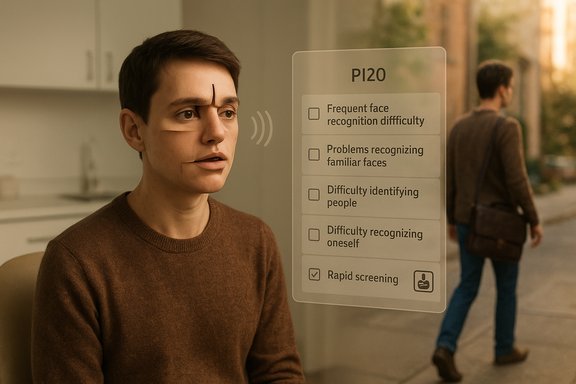
A new PhD project out of the University of Copenhagen reframes how researchers and clinicians should think about developmental prosopagnosia — commonly known as face blindness — by foregrounding lived experience, highlighting diagnostic inconsistency, and proposing streamlined screening tools that could change how the condition is detected and supported. The work combines a phenomenological deep dive into how people with developmental prosopagnosia perceive faces with psychometric work on the widely used PI20 self‑report instrument, and it calls for clearer diagnostic criteria and practical screening in both research and clinical settings.
Background / Overview
Developmental prosopagnosia (DP) is a lifelong difficulty in recognising people from their faces despite normal vision and intellectual functioning. Estimates of how many people are affected have varied in the literature, with earlier figures commonly cited at around 2–2.5% of the population and more recent, large‑scale work arguing that a broader definition that includes milder forms could place prevalence closer to 3% (roughly 1 in 33 people). These differences are not trivial: they reflect how the condition is defined and measured, and they have direct bearing on policy, clinical awareness, and research sampling. The University of Copenhagen PhD project, presented publicly in November 2025 and titled Beyond Face Value: The Phenomenology and Assessment of Developmental Prosopagnosia, is notable for combining two often‑separate strands of prosopagnosia work: (1) rigorous psychometric assessment and measurement development, and (2) qualitative, phenomenological accounts of everyday experience. The thesis author argues that bridging these perspectives is essential to defining meaningful diagnostic criteria and designing screening instruments that reflect real‑world difficulties.Why this matters now
- Public health and social impact: If DP affects on the order of 1–3% of adults, the social and occupational consequences are widespread enough to justify routine screening in some settings (schools, neuropsychology clinics, certain occupational assessments). Clarifying prevalence matters for resource planning and stigma reduction.
- Research integrity: Heterogeneous diagnostic approaches fragment the evidence base — studies using different cutoffs or different combinations of tests may not be studying the same phenomenon. A shared taxonomy and agreed screening tools would make findings more comparable.
- Clinical utility: Self‑report remains a central part of DP assessment. Improving the precision and brevity of questionnaires can make screening more feasible in primary care and allied health settings.
What the thesis claims — headline findings
- People with developmental prosopagnosia often do not experience faces as instantaneous, holistic cues to identity; rather, facial perception may fragment into variable focus on individual features (for example, eyes or mouth) and only intermittently cohere into a transient whole. Recognition often depends on contextual cues — voice, hair, gait, clothing, or explicit social signals — and is described by participants as a slow, effortful, problem‑solving process rather than an automatic glance.
- There is substantial variation across the literature in how DP is defined and operationalised, which complicates cross‑study comparisons and may hide important differences in phenomenology and mechanism. The thesis maps this methodological heterogeneity and argues for clearer taxonomies.
- The project includes psychometric work on the PI20 (the 20‑item Prosopagnosia Index), testing shorter and refined versions and recommending an ultra‑short five‑question screener for rapid screening — a practical instrument intended for quick research and clinical triage. The recommendation to develop and consider ultra‑short screening reflects a trade‑off: faster, more scalable screening versus the detail and nuance of longer inventories. Note: the five‑item proposal appears in the thesis summary and should be considered preliminary until the thesis papers are published and peer‑reviewed.
The phenomenology: faces as fragmented experience
What participants report
Interviews with people who self‑identify as having DP (or who meet diagnostic criteria in the study) describe a striking experience: the face, which most people use as a near‑instantaneous identity marker, does not present as a single, stable gestalt. Instead, interviewees report perception that:- Flickers between attention to particular parts — eyes, mouth, nose — rather than a stable whole.
- Occasional fleeting overall impressions that may be unreliable and quickly dissolve.
- Heavy reliance on contextual anchors (voice, clothing, location, gait) to reconstruct identity; sometimes the social cue of a greeting or smile is what triggers recognition.
Why this matters for testing and support
If recognition commonly involves assembling contextual pieces, then tests that measure only static face memory or isolated perception (single images, short delays) may miss crucial day‑to‑day compensatory strategies and subjective burden. A comprehensive assessment strategy should therefore:- Include ecologically realistic stimuli (videos, conversation snippets).
- Assess reliance on non‑facial cues and the cost (time, effort, anxiety) of recognition in real interactions.
- Ask about social consequences — missed acquaintances, workplace misunderstandings, or reluctance to engage socially.
The PI20 and the case for shorter screeners
What the PI20 is and why it matters
The 20‑item Prosopagnosia Index (PI20) is a validated self‑report instrument created to standardise subjective reporting of face recognition difficulties. It was designed to complement objective face memory tests (like the Cambridge Face Memory Test, CFMT) and has demonstrated meaningful correlations with performance on such tests. Because self‑report captures lived difficulty (which tests alone may not), the PI20 has become a standard tool in DP research.Proposal for an ultra‑short screener
The Copenhagen thesis argues that a well‑validated ultra‑short PI20 (five items) would make rapid screening feasible in busy research labs, primary care, and large population surveys. The practical argument is straightforward:- A 5‑item screener is quick to administer and can flag individuals for more detailed assessment.
- It reduces respondent fatigue and increases the likelihood of use in settings where time is limited.
- It could harmonise recruitment across multisite studies if universally adopted.
Prevalence, diagnostic controversy and what the numbers mean
One of the clearest takeaways from recent literature is that prevalence estimates for DP are sensitive to diagnostic criteria.- Earlier literature frequently cited a prevalence of ~2–2.5%, a figure that arose from particular test cutoffs and screening protocols.
- A large, recent empirical re‑assessment applied multiple historical cutoffs to a large unselected sample and showed prevalence estimates ranging widely depending on method — from well under 1% up to around 3% when looser or DSM‑aligned mild neurocognitive cutoffs are used. The authors concluded that face recognition ability sits on a continuum and that discrete cutoffs are, in many ways, arbitrary.
- Estimates of "how common" DP is should always state the diagnostic criteria behind the number.
- For public communication, saying "up to 3%" (or "around 1 in 33") is defensible if mild forms are included, but researchers must note the definitional boundary.
- For clinical purposes, distinguishing mild from major forms (analogous to DSM‑5 distinctions) may be the most useful path forward.
Strengths of the Copenhagen project
- Cross‑method triangulation: Combining phenomenology with psychometric validation is methodologically robust. It avoids the trap of measuring only what is easy to quantify and instead incorporates lived experience into instrument design.
- Practical focus: The attention to brief screening tools responds directly to a translational gap — how to identify people in non‑specialist settings. Practical tools increase the likelihood that research findings will translate into identification and support.
- Problematisation of diagnostic heterogeneity: Mapping how different studies define DP is valuable; by making this heterogeneity explicit, the work helps the field move toward harmonised diagnostic frameworks.
Risks, limitations and open questions
- Pre‑publication caution: The five‑item PI20 proposal, and certain phenomenological generalisations, appear in the thesis summary and press reporting. These should be validated by published papers (peer‑reviewed journal articles) and independent replication before they are widely adopted. The thesis defence is an important milestone, but journal publication and broader scrutiny are the next steps. Treat recommendations as provisional until the underlying data and analyses are public.
- Measurement trade‑offs: Ultra‑short screeners are efficient but can sacrifice sensitivity to subtypes of DP (for example, perceptual vs memory‑dominant forms). Any short form must be evaluated for false positives and false negatives in diverse populations before being used clinically.
- Generalisation across cultures and languages: Instruments like the PI20 have been translated and validated in several languages, but cultural differences in reporting, stigma, and everyday social dynamics can shape self‑report. Short forms amplify the risk of cultural bias unless validated cross‑culturally.
- Continuum vs category: The evidence that face recognition ability lies on a continuum undermines categorical diagnoses but complicates service provision: who gets supports and under what criteria? Policy and clinical frameworks will need to reconcile continuous variation with practical thresholds for intervention.
What clinicians, researchers and policy makers should do now
- Accept measurement uncertainty and specify diagnostic rules in publications and clinical notes. When reporting prevalence or recruitment criteria, always list which tests and cutoffs were used.
- Treat the PI20 (and its validated translations) as a useful screening adjunct, not a standalone diagnostic instrument; follow up high scores with objective tests like the CFMT and ecological assessments.
- Prioritise replication of short‑form proposals: if a 5‑item PI20 is to be deployed widely, fund and publish rigorous validation studies across age groups, languages and cultural contexts.
- Incorporate ecological and functional outcome measures into research: time‑to‑recognition in real interactions, social impact metrics (isolation, workplace outcomes), and compensatory strategies should be standard secondary outcomes.
- Build clinician and educator awareness campaigns that explain the phenomenology — how recognition can be slow and context‑dependent — because many people with DP are undiagnosed and may be mislabelled as inattentive, rude, or socially awkward.
Practical supports for people with DP (evidence‑informed, pragmatic)
- Environmental and contextual compensations: Encourage use of voice‑based introductions, name badges in professional settings when social mixing is routine, or visual cues in classrooms and workplaces.
- Technology aids: Wearable or phone‑based memory aids, annotated contact photos, or scheduled social cue reminders can reduce social friction.
- Psychoeducation and therapy: Cognitive‑behavioural approaches can help address anxiety that accompanies missed recognitions; social skills training can include explicit scripts for managing recognition failures gracefully.
- Workplace accommodations: Simple measures — explicit introductions in meetings, seating patterns that allow visibility, and inclusive onboarding practices — can reduce the social cost of DP.
How the field should measure success
- Adoption of harmonised diagnostic guidelines that distinguish major and mild DP using clear psychometric thresholds (for example, DSM‑aligned cutoffs plus corroborating self‑report).
- Peer‑reviewed publication and independent validation of any new short form of the PI20, including sensitivity/specificity estimates across populations.
- Increased routine screening uptake in neurology and clinical psychology outpatient settings where face recognition problems are suspected.
- Measurable reduction in social and occupational harms for people with DP through targeted accommodations, assessed in longitudinal follow‑ups.
Final assessment: promise and caution in equal measure
The Copenhagen thesis offers an important corrective to a field that has sometimes privileged laboratory metrics over lived reality. By documenting how people with developmental prosopagnosia experience faces — as fragmented, fleeting, and often reconstructed using non‑facial context — the work makes a persuasive case for rethinking assessment and support. It also offers practical steps: clearer taxonomies and the potential for faster screening instruments that could increase identification in both research and clinical contexts. At the same time, the thrust toward very brief screeners and the media reports of a broad 3% prevalence require caution. Measurement choices matter: who is counted as having DP depends on the tests and cutoffs used. Until the thesis components (especially the proposed five‑item PI20) are published in peer‑reviewed journals and validated across samples and languages, the recommendations should be treated as promising but preliminary. Researchers and clinicians should welcome the thesis for setting a research agenda — but insist on replication, transparent methods, and careful validation before wholesale adoption.Every step forward in understanding developmental prosopagnosia should narrow the gap between laboratory constructs and daily life. This thesis points the field in that direction: centring lived experience, questioning inconsistent diagnostics, and proposing practical measurement tools. The next phase will test whether those tools stand up to independent scrutiny and whether the field can converge on definitions that both reflect the continuum of face recognition ability and provide clear, compassionate pathways to support those who struggle.
Source: Mirage News Research Unveils New Insights on Face Blindness
