

Phenomenex’s move from Dynamics AX to a cloud-first Microsoft stack is a concise blueprint for how a science-focused manufacturer can combine regulatory discipline, ecommerce integration, and modern ERP capabilities to speed operations and free capacity for innovation. The company — a Danaher operating company that designs and manufactures chromatography consumables used across drug discovery, COVID-19 testing, food safety and forensic labs — migrated from an aging on‑premises Dynamics AX environment to Microsoft Dynamics 365 Finance and Dynamics 365 Supply Chain Management on Azure to reduce technology debt, meet Sarbanes‑Oxley requirements, and accelerate order-to-cash and month‑end processes. The migration is presented by the customer as dramatically faster order processing, a near‑real‑time ecommerce integration, and a material reduction in month‑end close time, while setting up a Danaher-wide Center of Excellence for Dynamics 365 to scale best practices across subsidiaries.
Phenomenex is a global leader in chromatography consumables — HPLC and UHPLC columns, GC capillary columns, SPE devices and specialized Biozen biologics LC columns — serving pharmaceutical, clinical, environmental and food-safety labs worldwide. The business is headquartered in Torrance, California and operates manufacturing and distribution sites in North America, Europe, India and China as part of the Danaher Life Sciences family. Phenomenex’s product portfolio and market role are consistent with the kinds of high‑precision, regulated workflows that place a premium on traceability, product lifecycle controls, and reliable supply chains. For many global manufacturing and lab‑consumables firms, ERP is the foundation for governance — managing finance, procurement, inventory, production and regulatory reporting. Phenomenex had been running Microsoft Dynamics AX 2012 R2 as its ERP. That product reached the end of its extended support window in 2022 under Microsoft’s lifecycle policy, prompting many organizations to choose between continuing on unsupported software, buying custom extended support, or migrating to the cloud‑native Dynamics 365 family. The lifecycle and support timelines for Dynamics AX 2012 R2 make migration to a supported cloud platform a practical risk‑mitigation step for firms that must maintain auditable financial controls.
Key takeaways for technical decision‑makers:
Phenomenex’s migration demonstrates that IT modernization in regulated, product‑centric companies is not just about technology — it’s a curated program of compliance, automation and operational redesign. The company’s reported gains — faster order processing, dramatically shorter close cycles and scaled invoice automation — are achievable when IT and finance align on measurable goals, master data is disciplined, and governance for automation is established. The next phase — planning optimization, advanced warehousing and AI agents — will determine whether the initial wins translate into sustained efficiency and strategic capacity for innovation.
Source: Microsoft Phenomenex moves to Dynamics 365 to support biotech innovation and gain operational efficiency | Microsoft Customer Stories
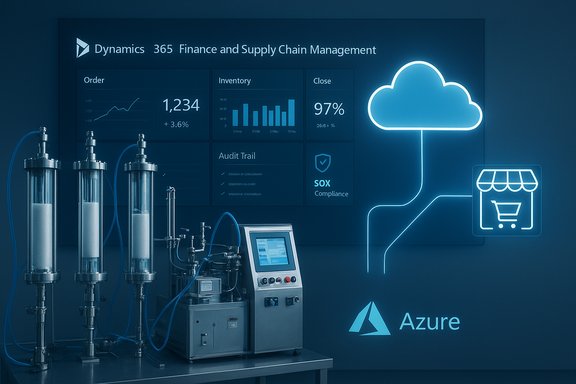 Background / Overview
Phenomenex is a global leader in chromatography consumables — HPLC and UHPLC columns, GC capillary columns, SPE devices and specialized Biozen biologics LC columns — serving pharmaceutical, clinical, environmental and food-safety labs worldwide. The business is headquartered in Torrance, California and operates manufacturing and distribution sites in North America, Europe, India and China as part of the Danaher Life Sciences family. Phenomenex’s product portfolio and market role are consistent with the kinds of high‑precision, regulated workflows that place a premium on traceability, product lifecycle controls, and reliable supply chains. For many global manufacturing and lab‑consumables firms, ERP is the foundation for governance — managing finance, procurement, inventory, production and regulatory reporting. Phenomenex had been running Microsoft Dynamics AX 2012 R2 as its ERP. That product reached the end of its extended support window in 2022 under Microsoft’s lifecycle policy, prompting many organizations to choose between continuing on unsupported software, buying custom extended support, or migrating to the cloud‑native Dynamics 365 family. The lifecycle and support timelines for Dynamics AX 2012 R2 make migration to a supported cloud platform a practical risk‑mitigation step for firms that must maintain auditable financial controls. Why Phenomenex moved: drivers and strategic goals
Risk mitigation and compliance first
Phenomenex’s public narrative frames the migration primarily as a risk‑mitigation exercise: leaving an aging, soon‑to‑be‑unsupported on‑premises ERP and moving to a cloud platform that receives continuous security and compliance updates. In highly regulated industries — and for companies within a publicly accountable corporate structure like Danaher —meeting Sarbanes‑Oxley (SOX) requirements, preserving audit trails and reducing surface area for security vulnerabilities are compelling reasons to modernize. The company explicitly cites SOX and growing regulatory demands as central to the decision to move to Dynamics 365.Operational efficiency and automation
Beyond compliance, Phenomenex wanted to accelerate routine business processes: shorten order processing times, reduce the manual burden of month‑end and foreign exchange adjustments, and speed vendor payment reporting and invoice handling. The combination of Dynamics 365 Finance and Supply Chain Management, plus an AP Invoice Automation capability using AI, gave Phenomenex a path to automate information capture, minimize manual reconciliations and push transactional work into near‑real time. These are common digital‑transformation objectives for manufacturing and distribution businesses seeking to convert operational capacity into innovation time.Future‑proofing and integration
Phenomenex’s migration was also positioned as a foundational step: an architecture to support ecommerce integration, advanced warehousing, planning optimization and eventual AI agents for process exception handling. Danaher’s stated plan to build a Dynamics 365 Center of Excellence (CoE) is a signal that this is not an isolated project but part of a broader enterprise streamlining effort. A CoE increases reuse of design patterns, templates, security models and upgrade discipline across multiple business units — an important consideration for conglomerates seeking predictable operations and lower integration overhead.What changed technically: product choices and architecture
Phenomenex moved to a cloud stack built on Microsoft Azure and the Dynamics 365 product family:- Dynamics 365 Finance — system of record for financials, close automation, FX adjustments and AP automation.
- Dynamics 365 Supply Chain Management — centralized master data, order orchestration, discrete and process manufacturing capabilities, and advanced warehousing features.
- Azure-hosted infrastructure — to reduce on‑premises infrastructure, improve security patching cadence, and provide a platform for analytics and future AI workloads.
- Ecommerce integration — near real‑time order flows between web storefront and Dynamics 365.
- AP Invoice Automation — an AI‑assisted capture and classification engine that automates invoice extraction and matching.
Architecture notes IT teams should watch
- Anchor master data (items, customers, vendors, pricing) in Dynamics 365 and enforce one source of truth for identifiers to minimize reconciliation work.
- Use APIs and eventing for ecommerce integration (rather than batch exports) to realize minutes‑level order processing.
- Put identity, entitlements and role‑based access controls in place from day one to preserve SOX controls across finance roles and segregation‑of‑duties.
- Design an observability plan (audit logs, process telemetry) so you can measure the thin improvements (order-to-ship latency, exceptions per week) and the thick ones (close cycle time).
Reported business outcomes (what Phenomenex is claiming)
Phenomenex presents significant operational gains after the migration. These are customer‑reported metrics from the migration narrative:- Order processing: from days to minutes after ecommerce integration and SCM automation.
- Month‑end close: a reported reduction from roughly 3 hours to 10 minutes for specific close activities.
- AP processing: historical invoice processing that previously took up to a week is expected to drop to a couple of days with AP Invoice Automation; about 2,000 invoices had been trained in the AI engine at the time of the case story. The company anticipates thousands of hours saved annually.
- Faster financial reporting and reduced reliance on manual spreadsheets for foreign exchange adjustments and vendor payment reporting.
Critical analysis — strengths and where Phenomenex did well
1) Strong alignment of compliance and IT strategy
Phenomenex tied the migration to SOX and cybersecurity objectives, which helps prioritize controls and funding. Framing modernisation around compliance reduces the risk of scope creep and increases board‑level sponsorship — a pattern that leads to cleaner, auditable implementations.2) Targeted business cases with visible wins
The focus on order processing, month‑end close, FX adjustments and AP automation gave the program tangible KPIs that are easy for finance and supply chain teams to measure. Reporting major wins on these fronts helps sustain momentum for follow‑on investments like planning optimization and advanced warehousing.3) Hybrid manufacturing support and ecommerce integration
Choosing a platform (Dynamics 365 Supply Chain Management) capable of handling both process and discrete manufacturing avoids architectural fragmentation for consumables manufacturers that mix batch chemistry and part‑based assemblies. Near‑real‑time ecommerce integration is an immediate customer experience win and reduces manual order entry errors.4) Centralized platform for scale
The stated plan to form a Danaher Dynamics 365 Center of Excellence is a positive governance move. A CoE can deliver reusable assets, enforce upgrade discipline, and drive consistent security and integration patterns across subsidiaries — a meaningful multiplier for shared services.5) Brand and product continuity verified by corporate sources
The company’s role in chromatography and the specific product lines (Biozen, Kinetex, Strata SPE, etc. are well documented on Phenomenex/Danaher pages, which supports the business context for the ERP transformation — a manufacturer of high‑value consumables operating in regulated markets. Using the vendor’s product and corporate pages adds confidence to the narrative about why reliability and traceability are business imperatives here.Risks, caveats and what the case study does not prove
While the reported outcomes are attractive, the migration case raises several practical caveats that other IT leaders should weigh carefully.- Customer‑reported metrics vs. audited ROI. The major time‑savings numbers come from the company’s narrative and Microsoft’s case story. Independent verification (audit, CFO commentary in financial filings, or partner performance reports) is not supplied in the public story, so treat the numeric gains as customer‑reported and directional.
- Master data and migration complexity. Large savings from automation depend heavily on accurate master data. If item masters, vendor records, pricing rules or GL mappings are inconsistent, automation will produce exceptions, not savings. The case summary implies Phenomenex invested in stabilization and cleaning, but most projects under‑budget this work. Plan for it explicitly.
- Integration and ISV surface area. Phenomenex integrated ecommerce and AP automation; such point integrations multiply upgrade risk. Every third‑party connector or custom integration adds a coordination point for platform updates and testing. A CoE helps here, but governance discipline is required.
- Vendor lock‑in and consumption costs. Moving deep into Microsoft’s cloud and Dynamics ecosystem accelerates innovation, but can also increase dependence on a single vendor for roadmaps, licensing terms and consumption pricing (for AI or agentic services). Procurement should negotiate exit clauses and data extraction guarantees.
- AI and automation governance. Phenomenex is piloting AP Invoice Automation and planning AI agents for optimization. These tools require strong governance — model validation, audit trails, human‑in‑the‑loop approvals for writebacks — to avoid financial control gaps and regulatory exposures. The case story acknowledges future agent pilots but does not yet supply governance detail.
- Support lifecycle reality for Dynamics AX. The urgency to migrate was driven in part by Dynamics AX 2012 R2 support lifecycle. Microsoft’s lifecycle pages confirm that support for AX 2012 R2 moved through mainstream and extended windows and that the extended support period ended in 2022 — a technical fact that justifies the timing of migrations for many organizations still on AX. This timeline is non‑negotiable when auditors ask about supported software.
Practical checklist for WindowsForum readers considering a similar migration
- Start with a governance and compliance audit.
- Map SOX‑critical processes, segregation of duties, and required audit trails.
- Inventory any custom reports or reconciliations that are control‑relevant.
- Run a short master‑data remediation sprint.
- Fix core item, vendor, GL and price records.
- Use that sprint to size migration complexity and exception rates.
- Build a prioritized business case.
- Quantify order processing latency, month‑end close steps, AP headcount, and expected savings from automation.
- Identify hard vs. soft savings and set measurement gates.
- Choose an integration pattern for ecommerce.
- Prefer event or API‑driven near real‑time order flows.
- Add observability for order lag, exceptions, and routing.
- Lock down security, identity and segregation of duties early.
- Map security roles to SOX control requirements.
- Enable audit logging, immutable trails and retention policies.
- Pilot AP Invoice Automation on a representative vendor sample.
- Use a controlled pilot (e.g., 1,000–2,000 invoices) to measure accuracy and exception rates before broad rollout.
- Validate SLA for human review on high‑value suppliers.
- Establish a Center of Excellence or shared services model.
- Standardize templates, integrations and upgrade testing.
- Document RACI for partner responsibilities and support SLAs.
- Prepare a migration runway for upgrades.
- Avoid heavy, ungoverned customizations.
- Schedule end‑to‑end regression tests for each platform patch and ISV update.
- Plan AI governance from day one.
- Define responsibility for model training, acceptance criteria, and escalation paths for anomalous recommendations.
- Contract for exit and data portability.
- Ensure your contract includes data export formats and retention rules for long‑term auditability.
The vendor, product and market context
Phenomenex’s product portfolio (Kinetex, Biozen, Strata SPE and related consumables) positions the company inside demanding laboratory supply chains where data integrity, traceability and uptime matter. Danaher has continued to invest in Phenomenex product development and global distribution, which complements IT modernization because product and business growth demand more integrated and auditable systems for supply, fulfillment and finance. These commercial facts and product claims are corroborated by Danaher / Phenomenex product and corporate pages that detail the product lines and the company’s role inside Danaher Life Sciences. On the ERP side, Microsoft Dynamics 365 Finance and Supply Chain Management are now the recommended upgrade paths for customers previously on Dynamics AX. Microsoft documentation and lifecycle guidance make it clear that AX 2012 R2 entered extended support and that moving to Dynamics 365 is the supported migration path — a technical reality that has driven strategic upgrades across many sectors including life sciences.What next: roadmap items and what to watch
- Advanced warehousing and planning optimization: Phenomenex plans to adopt advanced warehousing and planning optimization features inside Supply Chain Management to drive better forecast accuracy and fulfillment efficiency. Track progress by measuring forecast vs. actual and fill‑rate improvements.
- AI agents for exception management: Phenomenex intends to pilot AI agents for process optimization. Monitor these pilots for governance maturity — especially approvals, audit trails and cost control of agent consumption.
- Danaher CoE scaling: Watch how Danaher’s Center of Excellence operationalizes templates, security baselines and ISV control patterns. A successful CoE reduces integration drift and upgrade toil across business units.
- Measured ROI reporting: Most customer stories describe operational gains, but independent, audited ROI statements are rarer. When possible, ask partners and prospective vendors to include pre/post KPI baselines as part of any commercial agreement. Expect the CoE to help standardize these success metrics across subsidiaries.
Verdict for IT leaders and WindowsForum readers
Phenomenex’s migration is a pragmatic example of how regulated manufacturers can rationalize risk, reduce technology debt and apply automation to free capacity for product and research investments. The story should be read as an illustrative playbook rather than a turnkey guarantee: the success depends on master‑data discipline, integration quality, clearly measured KPIs and strong governance for automation and AI.Key takeaways for technical decision‑makers:
- Treat end‑of‑support dates for legacy ERP as a non‑negotiable trigger for planning; Dynamics AX timelines justify migration.
- Anchor the migration in compliance outcomes (SOX, auditability) to secure executive sponsorship.
- Pilot automation (AP capture, order flows) with clear exception‑handling and human oversight to avoid control gaps.
- Create a Center of Excellence early if you are a multi‑entity business to capture repeatability and reduce long‑term maintenance cost.
Phenomenex’s migration demonstrates that IT modernization in regulated, product‑centric companies is not just about technology — it’s a curated program of compliance, automation and operational redesign. The company’s reported gains — faster order processing, dramatically shorter close cycles and scaled invoice automation — are achievable when IT and finance align on measurable goals, master data is disciplined, and governance for automation is established. The next phase — planning optimization, advanced warehousing and AI agents — will determine whether the initial wins translate into sustained efficiency and strategic capacity for innovation.
Source: Microsoft Phenomenex moves to Dynamics 365 to support biotech innovation and gain operational efficiency | Microsoft Customer Stories
