

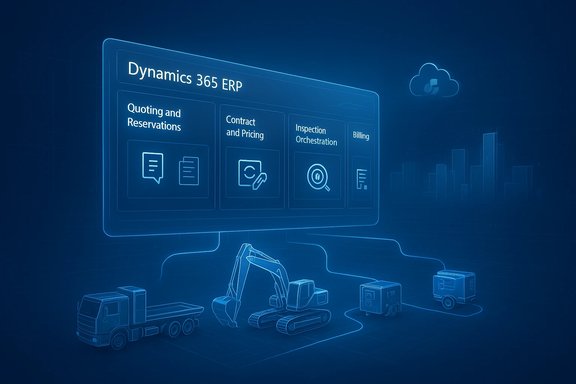
Microsoft is moving rental operations from peripheral add‑ons into the core of Dynamics 365 ERP, outlining a roadmap of native rental capabilities — quoting and reservations, contract and pricing management, inspection orchestration, and billing — that the company says will debut as a connected, cloud‑native set of features in Q4 2026.
Microsoft’s recent briefings and partner activity make clear the strategy: treat asset‑as‑a‑service and rental models as a first‑class ERP scenario, not a bespoke vertical solved only by third‑party point tools. The vendor frames the work as part of a broader shift to agentic business applications — ERP that does more than record transactions, instead actively orchestrating reservations, maintenance, billing, and telemetry-driven decisions with the help of Copilot agents and a partner ecosystem. This repositioning follows growing demand from heavy equipment dealers, fleet operators, and rental houses for tighter integration between quoting, availability, maintenance, and finance — a gap Microsoft and partners now say Dynamics 365 must address natively. Partners and ISVs are already integrating rental solutions with Dynamics 365 and several vendors have announced collaborations or IP agreements with Microsoft to accelerate that roadmap.
By bringing rental lifecycle management into Dynamics 365, Microsoft aims to reduce integration friction and create a single data model that ties utilization, uptime and revenue to the general ledger, forecasting, and capital planning. That is the practical justification Microsoft offers for embedding rental into the ERP core.
Source: ERP Today Microsoft Sharpens Dynamics 365 ERP for Asset-as-a-Service Rental Models
 Background
Microsoft’s recent briefings and partner activity make clear the strategy: treat asset‑as‑a‑service and rental models as a first‑class ERP scenario, not a bespoke vertical solved only by third‑party point tools. The vendor frames the work as part of a broader shift to agentic business applications — ERP that does more than record transactions, instead actively orchestrating reservations, maintenance, billing, and telemetry-driven decisions with the help of Copilot agents and a partner ecosystem. This repositioning follows growing demand from heavy equipment dealers, fleet operators, and rental houses for tighter integration between quoting, availability, maintenance, and finance — a gap Microsoft and partners now say Dynamics 365 must address natively. Partners and ISVs are already integrating rental solutions with Dynamics 365 and several vendors have announced collaborations or IP agreements with Microsoft to accelerate that roadmap. What Microsoft is building: features and timelines
New rental primitives: what to expect
Microsoft’s public product briefing lists four core rental capabilities planned for the Dynamics 365 ERP baseline:- Quoting and reservations to confirm asset availability and convert opportunities into rental contracts.
- Contract and pricing management supporting short‑term, long‑term, rent‑to‑own, seasonal pricing, and flexible terms.
- Inspection orchestration to bind inspections to deliveries, returns, transfers and support condition‑based handoffs.
- Billing and invoicing integrated directly with rental activity to avoid reconciliation gaps between operational and financial systems.
Roadmap and release timing
Microsoft’s statements indicate the capabilities are in development with a planned release in Q4 2026. That timing has been reiterated in partner briefs and vendor posts that reference Microsoft’s product roadmap. As with any complex cross‑module ERP feature, the timeline should be treated as a target subject to change as engineering, partner integration work, and enterprise validation progress.Why this matters: business context and market signals
Asset‑as‑a‑service is reshaping industries
Rental, lease, and subscription models are expanding rapidly across equipment, automotive, healthcare devices, and even B2B technology deployments. Market estimates vary with scope, but trade sources and market research show a large and accelerating addressable market for rental and leasing services — North American equipment rental revenues alone are measured in the tens of billions annually, and broader global “rental & leasing” market estimates commonly run into the hundreds of billions. Microsoft explicitly cited industry forecasts as part of the rationale for the investment. Note: market sizing is notoriously dependent on definitions (equipment rental vs. vehicle rental vs. all leasing). Independent reports produce different totals; readers should treat any single headline figure as directional and consult vertical‑specific research when sizing opportunities.Why ERP vendors are competing on rental
Rental businesses depend on synchronized operational and financial data: reservations must reflect real‑time availability, maintenance events reduce usable fleet, inspections govern acceptance and return conditions, and invoicing must align to meter or usage. Historically, organizations stitched these processes together with spreadsheets, specialist rental packages, or custom integrations to ERP, creating latency, disputes, and idle assets.By bringing rental lifecycle management into Dynamics 365, Microsoft aims to reduce integration friction and create a single data model that ties utilization, uptime and revenue to the general ledger, forecasting, and capital planning. That is the practical justification Microsoft offers for embedding rental into the ERP core.
Ecosystem signal: partners, IP deals, and third‑party solutions
Microsoft’s approach is clearly partner‑centric. The company has both announced collaborative integrations with established rental software vendors and accepted industry IP that fast‑tracks core features.- Integrated Rental announced a strategic collaboration to bring its rental products to Dynamics 365 customers; the PR highlights joint go‑to‑market intent for heavy equipment dealers.
- XAPT publicly announced an IP agreement with Microsoft where rental management technology from XAPT will be used to inform new Dynamics 365 rental capabilities. That post (December 9, 2025) confirms Microsoft is acquiring or licensing domain IP as a fast path to productizing use cases proven in heavy equipment dealerships.
- ISVs like Annata and Sycor, which already offer fleet and rental modules built on Dynamics, demonstrate a healthy ecosystem of vertical specialists that are likely to complement or extend Microsoft’s foundational functionality.
Critical analysis: strengths and practical gains
1) Reduced integration complexity and faster time to value
Bringing quoting, reservations, inspections and billing inside Dynamics 365 reduces the classic M×N integrations problem (one rental engine per partner × multiple back‑office systems). A single data model and shared business logic cut the number of touchpoints that can break during upgrades, shortening implementation cycles for customers that are already Microsoft‑centric.2) Better financial visibility and lifecycle economics
When operational telemetry (utilization, maintenance, inspection outcomes) flows natively into Finance, accounting close and profitability analysis become more accurate and auditable. That enhances decision making for repair vs. replace, capex allocation, and dynamic pricing strategies tied to utilization.3) Platform leverage: Copilot, telemetry, and AI agents
Microsoft’s narrative ties rental to Copilot and agentic applications: agents can automate common reconciliation, propose price adjustments based on demand signals, or surface utilization anomalies to fleet managers. Where implemented responsibly, these AI assistants can reduce manual exception handling and accelerate billing cycle time.4) Partner acceleration and vertical focus
IP agreements and partner collaborations mean Microsoft need not reinvent deep, industry‑specific edges (e.g., heavy equipment dealer workflows or telematics integration). Harvesting proven IP from specialists like XAPT and integrating ISV solutions provides customers with more options and shorter pilots.Real risks and caveats every buyer should weigh
Data quality and master‑data hygiene remain the leading dependency
ERP‑native rental only delivers value if the asset register, serial tracking, meter counts, and transaction timestamps are accurate. Organizations that treat the new features as a silver bullet but fail to invest in master‑data cleanup will find AI assistants and automation amplifying errors rather than removing them. This remains the most consistent implementation risk across modern ERP projects.Integration surface to telematics, IoT and mobile inspection tools
Many rental firms rely on third‑party telematics, IoT sensors, and mobile inspection apps. Microsoft’s core rental primitives need robust, low‑latency integration points. Where partners supply field mobile apps (some ISVs already do), buyers should confirm on‑device offline capability, robust reconciliation, and audit trails to avoid service‑delivery gaps in low‑connectivity environments.Governance for AI agents and auditability
Agentic workflows (Copilot‑driven automations) must be auditable, traceable, and bounded by least privilege. Financial and safety processes such as contract changes, write‑offs, and inspection overrides require human‑in‑the‑loop checks and clear audit trails. Without explicit governance, automation can create regulatory and financial exposure.ISV consolidation and vendor lock‑in risks
Microsoft’s acquisition or licensing of ISV IP reduces time‑to‑market but also changes the partner landscape. Vendors who previously differentiated on core rental features may need to pivot to deeper vertical capabilities, which can be good for customers but may reduce choice in foundational functions. Organizations should evaluate both Microsoft’s core roadmap and partner offerings, factoring in long‑term portability and upgrade paths.Timeline and scope uncertainty
Planned Q4 2026 delivery is a public target, but complex cross‑module features often slip or arrive with staged capabilities and feature flags. Implementers should budget for phased delivery and validate that critical features — those that materially affect revenue recognition and billing — are available and certified for their regulatory and tax jurisdictions.Practical guidance: a checklist for IT leaders and ERP teams
- Start with a focused pilot: migrate a single site or fleet category (e.g., light equipment or a specific region) to validate reservations‑to‑invoice flows before broad rollout.
- Treat master data as a project: asset register, serial numbers, meter counters, warranty and geographic ownership must be correct before automation.
- Map integrations: list telematics, inspection apps, POS, and finance connectors. Define SLAs and offline reconciliation strategies.
- Design governance for Copilot agents: require human approval for financial changes above thresholds, log agent actions, and run red‑team tests on automation logic.
- Evaluate partner solutions early: identify ISVs with deep vertical workflows and check their roadmap against Microsoft’s core feature plan.
- Run a compliance review: ensure billing models (usage, time, subscription, rent‑to‑own) map to your revenue recognition policies and tax computations.
- Plan licensing and change management: Microsoft’s licensing model and seat requirements evolve; align license assignment and admin controls to avoid access gaps.
How vendors and partners fit in
Microsoft’s posture is explicitly hybrid: build the horizontal plumbing, let partners fill vertical needs. That model has sensible economies — horizontal primitives standardize processes and reduce integration cost, while partners deliver field apps, specialized pricing engines, and telematics adapters.- Expect ISVs to pivot upward: vendors whose core value is deep domain workflows (damage assessment rules, complex pricing matrices, specialty inspections) will continue to be essential.
- Expect consolidation: Microsoft’s acquisition/licensing of rental IP suggests larger ERP vendors will absorb best‑in‑class capabilities rather than leave them siloed in third‑party modules. That can accelerate maturity but may shrink the independent ISV pool for basic features.
Market sizing and realistic opportunity framing
Microsoft and ERP Today point to strong macro tailwinds for rental as ownership gives way to access models. The American Rental Association and industry press have reported North American equipment rental market values in the tens of billions with mid‑single‑digit growth forecasts. Broader market research for “rental & leasing” yields a wide range of estimates — from the high hundreds of billions to several trillion when leasing categories are included — illustrating the definitional challenges of the space. Organizations should therefore triangulate vendor claims with vertical‑specific studies to estimate their addressable market.Technical considerations for architects
Data model and tenancy
Plan to centralize asset master data in Dataverse or the Dynamics data model and avoid fragmented ledgers. Ensure multi‑entity and multi‑currency handling is validated for cross‑border rental and fleet redeployment. Also design data retention and telemetry partitioning to meet regional data‑residency and privacy laws.Telemetry ingestion and edge scenarios
Rental fleets rely on high‑velocity telemetry. Use Azure IoT/IoT Hub or partner telemetry pipelines to pre‑filter and canonicalize signals into business events (availability, usage hours, fault codes) that map to asset counters in Dynamics. Implement backpressure and reconciliation for intermittent connectivity.Billing, revenue recognition, and tax engines
Rental billing can be usage‑based, time‑based, or hybrid. Confirm how Dynamics 365 will surface metered transactions for revenue recognition and integrate with tax determination engines; where local tax rules are complex, test the integration with your tax partner early.Automation and auditing
Design Copilot and agent automation to emit machine‑readable audit artifacts; ensure all agent actions are linked to a change ticket, user approval when required, and retainable proof for auditors.The final verdict: pragmatic optimism
Microsoft’s move to embed rental capabilities into Dynamics 365 ERP is a strategically coherent response to a real market evolution: customers want asset outcomes (uptime, utilization, predictable costs) not just ownership. By delivering native primitives and leaning on its ecosystem, Microsoft reduces the plumbing burden and raises the bar for what “standard” ERP should include for rental businesses. That said, the change is not risk‑free. Success will hinge on disciplined data work, conservative governance for AI agents, careful partner selection, and staged pilots to validate billing and revenue recognition in live customer settings. Buyers should treat Microsoft’s Q4 2026 timeline as a target and plan internal readiness accordingly.Bottom line: what enterprise readers should do now
- Validate that your asset master, telematics, and inspection practices are ready to feed an ERP‑native rental lifecycle.
- Engage partners and ISVs early to map vertical capabilities to Microsoft’s roadmap.
- Run a pilot on a contained fleet before committing to enterprise rollout.
- Build a governance framework for Copilot‑driven automation and ensure human oversight for high‑risk financial and safety decisions.
- Revisit licensing and seat strategy in light of Dynamics 365 licensing updates and the expected cross‑module nature of rental operations.
Source: ERP Today Microsoft Sharpens Dynamics 365 ERP for Asset-as-a-Service Rental Models

