

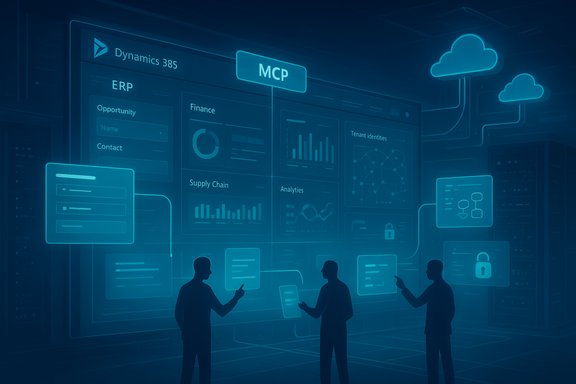
Microsoft’s Dynamics 365 team has pushed the Model Context Protocol (MCP) server for ERP from a narrow, tool-based prototype into a dynamic, analytics-ready runtime—a move that promises to make Dynamics 365 applications agent‑friendly, extensible, and more tightly governed. The company announced a public preview of the dynamic Dynamics 365 ERP MCP server and confirmed a separate MCP server for analytics will enter public preview in December 2025, positioning MCP as the integration fabric that turns ERP from a system of record into a system of action.
Microsoft first introduced an ERP-focused MCP server as a static, curated set of tools to let AI agents call high‑value Dynamics 365 operations. That initial release let early adopters validate agent patterns for finance and supply chain by exposing a fixed catalog of actions. The new announcement signals two main changes: the ERP MCP server will be dynamic—able to expose many more built-in, extension and customization-driven operations at runtime—and Microsoft is adding a dedicated MCP server to make ERP analytics (Business Performance Analytics) agent‑accessible and governed. This is more than an API facelift. MCP provides a standardized protocol that lets agents discover, describe, and call tools and knowledge servers in a consistent way; Microsoft is baking MCP support into Copilot Studio and Dynamics release plans to make agentic integrations a first‑class deployment pattern. The Dynamics release plan and Copilot documentation reflect that MCP is being rolled across multiple Dynamics workloads and is part of the 2025 release waves for public preview and GA timelines.
Microsoft’s announcement is a strategic nudge: ERP systems will no longer be passive repositories but programmable, explainable, and governed platforms where agents can act—if enterprises do the preparatory work required to keep control, compliance, and trust intact.
Source: Microsoft Dynamics 365 ERP MCP Server: Adaptive & Analytics-Ready
 Background / Overview
Microsoft first introduced an ERP-focused MCP server as a static, curated set of tools to let AI agents call high‑value Dynamics 365 operations. That initial release let early adopters validate agent patterns for finance and supply chain by exposing a fixed catalog of actions. The new announcement signals two main changes: the ERP MCP server will be dynamic—able to expose many more built-in, extension and customization-driven operations at runtime—and Microsoft is adding a dedicated MCP server to make ERP analytics (Business Performance Analytics) agent‑accessible and governed. This is more than an API facelift. MCP provides a standardized protocol that lets agents discover, describe, and call tools and knowledge servers in a consistent way; Microsoft is baking MCP support into Copilot Studio and Dynamics release plans to make agentic integrations a first‑class deployment pattern. The Dynamics release plan and Copilot documentation reflect that MCP is being rolled across multiple Dynamics workloads and is part of the 2025 release waves for public preview and GA timelines. Why MCP matters for ERP: a practical primer
What MCP standardizes
- Tool discovery: Agents can discover published operations and metadata rather than rely on brittle point‑to‑point connectors.
- Typed inputs/outputs: Tools carry structured schemas so agent calls are deterministic and traceable.
- Governance primitives: Identity, entitlements, and audit trails are enforced at the MCP boundary rather than scattered across bespoke integrations.
How Microsoft is positioning MCP inside its stack
Microsoft surfaces MCP in two places critical for enterprise adoption:- Copilot Studio — a low‑code/no‑code authoring surface where MCP tools appear as discoverable actions that can be composed into agents. MCP support in Copilot Studio has matured from preview into GA features like tool listing and enhanced tracing.
- Dynamics / Dataverse release plans — Microsoft is embedding MCP servers into Dynamics 365 workloads (Finance, Supply Chain, Sales, Customer Service) and Dataverse so agent integrations can respect ERP security roles and tenant governance. Release plan pages show MCP-related features moving through public preview into general availability windows.
From static to dynamic: what changed and why it matters
The static model (what existed)
The first ERP MCP server prototype launched with a curated set of roughly a dozen high‑value tools (for example: “Find Approved Vendors”, “Release Purchase Requisition Lines”) that agents could call. That approach made early testing and governance easier but was limited in scale: adding or changing tools required code updates and redeployments, and many enterprise workflows simply weren’t covered by that static catalog.The dynamic model (what’s new)
The dynamic Dynamics 365 ERP MCP server now exposes a form‑driven automation model: agents can open server forms, set field values, invoke actions on forms, and save—just as a human user would through the application client. That capability means agents can access nearly any function available to a permitted user across thousands of forms without bespoke connectors or custom APIs. Microsoft describes this as unlocking “hundreds of thousands of ERP functions” while inheriting existing ERP controls for permissions, auditing, and security. Key implications:- Agents can perform complex, cross‑module operations (finance, supply chain, HR, project ops) using the same MCP semantics.
- Extensions and ISV customizations present in the environment are automatically discoverable through MCP, reducing the friction of integrating third‑party solutions.
- Security posture remains tenant‑centric: agent capabilities are scoped to the agent’s security role and the application configuration, preserving least‑privilege principles.
Technical pattern in brief
- Agent authenticates to MCP with a tenant‑bound identity.
- MCP presents a dynamic manifest of available forms and actions based on the agent’s security context.
- Agent opens forms, manipulates fields, and invokes form actions via server APIs.
- ERP enforces the same business logic, validations, and workflows as interactive users; every action is auditable.
Extending MCP to analytics: bringing BI into agent workflows
The second headline is the Dynamics 365 ERP MCP server for analytics. This server exposes Business Performance Analytics content—measures, dimensions, semantic models, and reports—through MCP so agents and analytics tools reason over the same governed definitions of revenue, margin, and cash flow. The stated goals are:- Preventing semantic drift between operational transactions and analytics definitions.
- Making forecasts, variance analyses, and anomaly detection explainable and traceable to the ERP’s source definitions.
- Allowing partners to build analytics extensions that plug into ERP models while maintaining governance and auditability.
Partner ecosystem and early use cases
Microsoft highlighted a range of partners already building MCP‑powered agents. These vendor examples illustrate practical business scenarios and the speed of partner innovation when MCP removes integration work:- RSM — Shop Floor: real‑time production resilience and issue resolution on the shop floor.
- HSO — PayFlow Agent: AP payment status automation and supplier communications.
- Fellowmind — Inbound Load Agent: converts emailed delivery notes into ERP inbound loads.
- Cegeka — Quality Impact Recall Agent: traces quality failures across inventory and customers.
- KPMG — Supplier Performance Insight Agent: blends ERP data with external market signals to score supplier risk.
- Annata, Crowe, SignUp Software and others with domain‑specific agents for service, AP, order processing and downtime mitigation.
Security, governance, and compliance — the non‑negotiables
Microsoft and independent coverage emphasize that MCP centralizes controls that enterprises require for regulated processes. The protocol and Microsoft’s implementation surface several governance primitives:- Identity and least‑privilege: agents inherit Entra (Azure AD) identities and are constrained by ERP security roles.
- Entitlements and licensing: server boundaries can enforce data access rules and licensing entitlements—critical when agents call licensed third‑party datasets.
- Auditability & observability: activity tracing, OpenTelemetry‑style logs, and Copilot Studio’s activity maps help trace agent actions to source data and business events.
- Network controls: MCP connectors can be placed inside VNet boundaries to meet regulatory network isolation requirements.
- Centralizing integration at the MCP boundary concentrates risk as well as controls. Tenant administrators must treat the MCP server as a critical control plane—monitoring for anomalous agent behavior, protecting credentials, and enforcing DLP and retention policies.
- UI‑level automation (form navigation and clicks) increases functional reach but also raises questions about resilience to UI changes; Microsoft’s server‑side APIs and dynamic manifests aim to reduce fragility, but careful testing and observability remain essential.
Risk analysis: practical limits and open questions
Microsoft’s blog and broader coverage present a persuasive technical direction, but several areas merit healthy skepticism and operational planning.- Master‑data hygiene and semantic alignment: Agents acting on ERP depend on clean master data (supplier IDs, product masters, chart of accounts). Without it, automation can magnify errors. Early pilots and data governance are prerequisites for safe scale.
- Explainability vs. hallucination: MCP’s deterministic tooling reduces numeric hallucinations by routing calculations to authoritative services, but any agentic reasoning layer still requires human‑review for high‑stakes decisions. Enterprises should keep human‑in‑the‑loop gates for writebacks and external reporting.
- Economic model and metering: The cost of agent runs, MCP calls, and any licensed data feeds must be modeled. For third‑party datasets exposed via MCP (for example, market data vendors), entitlements, pricing per call, and caching policies will shape the business case. Independent reporting on MCP use with licensed datasets highlights this as an open commercial question.
- Operational blast radius: With agents able to perform broad ERP actions, incident response and fail‑safe designs (quarantine modes, rapid rollback, read‑only deployment windows) must be part of governance playbooks.
Practical guidance for IT teams and implementers
Enterprises that want to pilot or adopt MCP for Dynamics 365 should take a staged approach:- Inventory and prioritize candidate processes for automation (high frequency, low variability tasks like invoice status updates, inbound load creation).
- Lock down master data and remediation processes first—agents amplify both good and bad data.
- Start with read‑only agents that surface insights into Copilot/Teams before enabling write‑back capabilities.
- Configure strict governance controls in Copilot Studio: approved agent catalog, telemetry collection, limits on writeback volume.
- Instrument logging and retention to match audit requirements; exportability of logs is a must for regulated industries.
- Build human‑in‑loop approval gates for financial writes, supplier changes, and any actions that affect external reporting.
Timeline and migration commitments
Microsoft signaled a coordinated roadmap for MCP across Dynamics:- The dynamic Dynamics 365 ERP MCP server is in public preview as announced. The MCP server for analytics is slated for public preview in December 2025. Microsoft also states that all new ERP agents will be built on MCP and existing agents will migrate to MCP by December 2025, with tools on the static MCP server transitioning to the dynamic framework. Organizations should treat those deadlines as planning anchors but verify tenant‑level availability and regional rollout windows in the Dynamics release plan.
Independent context: MCP’s ecosystem momentum
The Model Context Protocol originated as an open standard to make agent‑to‑tool interactions consistent; it has attracted cross‑industry interest and been called the “USB‑C of AI apps” in coverage that highlights the protocol’s role in enabling interoperable agent ecosystems. Major vendors and cloud players (including Microsoft) have integrated MCP into agent tooling and product roadmaps, reinforcing the idea that protocols matter for large enterprise adoption. At the same time, journalists and analysts caution that open protocols also require careful operational guardrails to manage authentication, data leakage, and monetization. Coverage from Reuters and other outlets documents Microsoft’s public support for MCP and the company’s effort to standardize agent interoperability—important context for procurement and risk teams evaluating cross‑vendor agent strategies.The partner playbook: how ISVs and SI‑partners will use MCP
Partners stand to benefit from reduced integration overhead and faster delivery cycles:- Build reusable agent packages that can be deployed across tenants with consistent governance.
- Publish MCP‑backed analytics extensions that reference ERP semantic models, ensuring consistent metrics across reporting and agent reasoning.
- Offer prebuilt domain agents (shop floor automation, supplier performance, AP automation) that customers can adopt quickly via the Agent Store and Copilot Studio connectors.
Recommended pilot checklist (short)
- Define KPIs and acceptable error rates before turning on writeback.
- Limit pilot scope to non‑regulatory, high‑volume activities first.
- Require audit trail exportability and test log reconciliation processes.
- Test agent failback (quarantine and manual takeover) under simulated incidents.
- Validate performance and latency for form navigation patterns at expected volumes.
Conclusion
The dynamic Dynamics 365 ERP MCP server and the forthcoming analytics MCP server mark a significant step in mainstreaming agentic ERP—systems where AI agents can discover, reason over, and act upon ERP data under unified governance. By shifting from a limited, static toolset to a dynamic, form‑driven model and by bringing analytics under the same protocol, Microsoft is offering enterprises the technical scaffolding to build adaptive, explainable, and auditable agent workflows inside the Dynamics and Copilot ecosystems. That said, real business value will depend less on protocol wizardry and more on disciplined operational work: master‑data hygiene, role and entitlement design, telemetry and auditing, pilot validation, and clear commercial models for metering and licensed data. Organizations that pair careful governance with targeted pilots—starting with read‑only insights and moving methodically to controlled writebacks—will be best positioned to capture the productivity and responsiveness gains MCP promises. Independent reporting and Microsoft’s release notes provide ongoing context for availability, feature scope, and recommended practices—check those tenant and regional controls before scheduling production deployments.Microsoft’s announcement is a strategic nudge: ERP systems will no longer be passive repositories but programmable, explainable, and governed platforms where agents can act—if enterprises do the preparatory work required to keep control, compliance, and trust intact.
Source: Microsoft Dynamics 365 ERP MCP Server: Adaptive & Analytics-Ready
