

Microsoft’s pitch is simple but far-reaching: make inventory-to-deliver a live, agent-driven workflow rather than a batch reporting problem, and the rest of the supply chain — procurement, warehousing, transportation, and fulfillment — falls into place more predictably. The company’s recent messaging around an agent-ready Dynamics 365, the Model Context Protocol (MCP) server, and a set of first- and partner-built agents aims to turn that pitch into practice, moving routine, repetitive tasks from humans to governed software agents so operations teams can focus on exceptions and strategy. This article unpacks what Microsoft and partners are shipping, explains how the pieces fit together, evaluates the potential gains in speed and working-capital efficiency, and flags the operational, compliance, and governance work every IT and supply-chain leader must plan for before handing agents control of inventory flows.
Inventory-to-deliver is the operational heart of modern commerce. It includes procurement, receipt and put-away, inventory accuracy and reconciliation, replenishment and rebalancing, picking, packing and shipping, and the post‑shipment customer experience. When one of those links breaks — slow supplier confirmations, mis-slotted product, or suboptimal inbound planning — the visible consequence is a missed promise: late deliveries, stockouts, unhappy customers, and trapped working capital.
Two tectonic trends are forcing organizations to rethink the stack:
Why it matters for inventory-to-deliver: reducing the time between PO issuance and supplier confirmation shrinks lead‑time uncertainty and reduces safety stock needs, directly improving working-capital efficiency.
Caveats and verification: Microsoft lists operational constraints (which mailboxes to monitor, language handling, and human-in-the-loop review) and charges based on Copilot Studio credits; those commercial and configuration details are important to validate in procurement pilots. Vendor-provided productivity numbers should be treated as vendor claims until validated in pilot stores or distribution centers.
Why it matters: the MCP server is what allows a warehouse-optimization agent to reserve stock, a replenishment agent to trigger a transfer, or a supplier agent to update a PO — each action follows the ERP’s existing permission model and audit trail rather than bypassing it.
Operational implications: MCP simplifies integration but increases the need for AgentOps — teams, runbooks, and monitoring that govern agent behavior, roll back changes, and maintain provenance of automated actions. Organizations must map governance responsibilities (who approves what level of automation) and embed those into the MCP configuration and Dynamics security model.
If you lead supply‑chain or ERP operations, act with a mix of ambition and discipline:
Microsoft and its partners have laid out the tools and the initial playbooks; the next step is methodical, carefully governed adoption. If you’re planning pilots, start by scoping a single, high‑value inventory-to-deliver workflow and measure everything — the agents will do the rest only after you’ve proven that the foundation is solid.
Source: Microsoft Agentic AI for inventory to deliver: From procurement to fulfillment - Microsoft Dynamics 365 Blog
 Background: why inventory-to-deliver matters now
Inventory-to-deliver is the operational heart of modern commerce. It includes procurement, receipt and put-away, inventory accuracy and reconciliation, replenishment and rebalancing, picking, packing and shipping, and the post‑shipment customer experience. When one of those links breaks — slow supplier confirmations, mis-slotted product, or suboptimal inbound planning — the visible consequence is a missed promise: late deliveries, stockouts, unhappy customers, and trapped working capital.Two tectonic trends are forcing organizations to rethink the stack:
- The expectation of real-time availability. Customers expect accurate availability and fast delivery windows; businesses must present reliable shipping promises and hold the inventory in the right places.
- The maturation of agentic AI and integration protocols that allow trusted agents to discover, reason about, and act on enterprise data — not just make recommendations.
Overview: the Microsoft stack for agentic inventory-to-deliver
Microsoft’s approach stitches together several layers that are important to understand distinctly:- Dynamics 365 as the single source of truth — the ERP and SCM backplane that hosts catalog, inventory, purchase orders, receipts, and fulfillment logic. Dynamics is the authoritative system agents must read and write to.
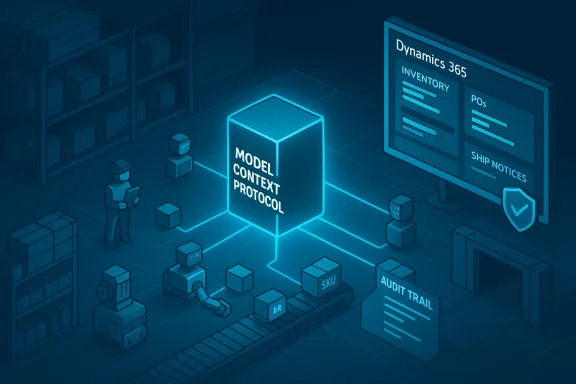
- Model Context Protocol (MCP) servers — a standardized intermediary that exposes business objects and actions to agents in a discoverable, auditable, and permissioned way. MCP is the interoperability layer that lets first‑party, partner, and custom agents operate without brittle point-to-point integrations.
- First‑party agents — Microsoft-supplied agents like the Supplier Communications Agent that automate common procurement tasks (follow‑ups, email parsing, PO updates). These are intended to be enterprise-grade building blocks running inside Dynamics and Copilot Studio.
- Partner and ISV agents — domain specialists (warehouse optimization, inbound load planning, replenishment and allocation agents) that plug into MCP and operate on Dynamics data. Microsoft highlights partners such as MCA Connect, RSM, and Fellowmind as practical examples of agents for slotting, rebalancing, and inbound load optimization.
What’s shipping (and what to expect)
Supplier Communications Agent — procurement automation
Microsoft’s Supplier Communications Agent is a concrete, first-party example of where value can be quickly realized. It automates routine procurement outreach: drafting or sending follow-ups for unconfirmed POs, detecting confirmation or change requests in inbound supplier emails, extracting intent and data from attachments, and proposing updates to purchase orders inside Dynamics 365. The agent is available as a production‑ready preview and is tied to release 10.0.44 of Dynamics 365 Supply Chain Management. Microsoft documentation describes the agent’s two main flows: follow-up automation and “review and apply” logic for inbound supplier emails.Why it matters for inventory-to-deliver: reducing the time between PO issuance and supplier confirmation shrinks lead‑time uncertainty and reduces safety stock needs, directly improving working-capital efficiency.
Caveats and verification: Microsoft lists operational constraints (which mailboxes to monitor, language handling, and human-in-the-loop review) and charges based on Copilot Studio credits; those commercial and configuration details are important to validate in procurement pilots. Vendor-provided productivity numbers should be treated as vendor claims until validated in pilot stores or distribution centers.
Dynamics 365 ERP MCP servers — the control plane for agents
The Model Context Protocol (MCP) server is the connective tissue that turns Dynamics 365 into an agentic platform. MCP defines a common language and runtime for agents to discover available actions and safely execute tasks while inheriting ERP security and auditing. Microsoft is rolling out dynamic and analytics MCP servers — the dynamic ERP MCP server is in public preview and aims to expose tens of thousands of ERP functions through a consistent interface so that agents can navigate forms, set fields, open actions, and complete processes programmatically. This move reduces custom integration work for partners and customers while centralizing permissioning and observability.Why it matters: the MCP server is what allows a warehouse-optimization agent to reserve stock, a replenishment agent to trigger a transfer, or a supplier agent to update a PO — each action follows the ERP’s existing permission model and audit trail rather than bypassing it.
Operational implications: MCP simplifies integration but increases the need for AgentOps — teams, runbooks, and monitoring that govern agent behavior, roll back changes, and maintain provenance of automated actions. Organizations must map governance responsibilities (who approves what level of automation) and embed those into the MCP configuration and Dynamics security model.
Partner-built agents: practical examples
Microsoft’s ecosystem already showcases partner agents that solve focused inventory-to-deliver tasks. These are not theoretical: partners are marketing and demonstrating real solutions that integrate with Dynamics over MCP.- Warehouse Advisor Agent (MCA Connect) — uses machine learning and predictive analytics to improve slotting, consolidation, and cycle counting. MCA Connect positions this as a way to reduce travel time, improve pick efficiency, and increase on‑shelf accuracy by recommending slotting and consolidation moves. This agent is particularly relevant to distribution and manufacturing environments where wasted labor and poor slotting materially increase operating costs.
- Inventory Acquisition and Re‑Balancing Agent (RSM) — focuses on analyzing demand signals, supply availability, and stock imbalances to recommend rebalancing and acquisition actions. RSM’s Dynamics offerings already include allocation and model-based replenishment tools; embedded agentic flows can make these decisions more continuous and prescriptive rather than periodic and manual.
- Inbound Load Agent (Fellowmind) — automates inbound logistics by turning emailed delivery notes into inbound loads and composing optimized loads based on demand, capacity, and constraints. The agent removes repetitive data-entry steps and helps logistics teams plan inbound sequencing and dock operations more efficiently. Fellowmind has publicly showcased this agent in Microsoft partner announcements.
The expected business outcomes
When implemented correctly, agentic inventory-to-deliver can deliver measurable results across traditional supply-chain KPIs:- Reduced lead‑time variability — faster supplier confirmations and automated exceptions reduce forecast uncertainty.
- Lower safety stock and holding costs — more predictable inbound confirmations and dynamic rebalancing lower the need for excess inventory.
- Improved labor productivity in DCs — optimized slotting, better consolidation, and smarter load building reduce travel and handling time.
- Fewer stockouts and higher OTIF — proactive rebalancing and rapid inbound planning improve on‑time, in‑full performance.
- Faster incident resolution and lower write-offs — agents that detect quality impacts or recall traces can move items and flag affected customers faster.
Risks, guardrails, and the work that matters most
Agentic automation introduces novel risks beyond traditional automation. Here are the practical categories leaders must address up front.1) Data quality and single source of truth
Agents act on what they can read. If product master data, lead times, or warehouse location attributes are incorrect, agents will magnify, not fix, the problem. Investments in product data, GTIN/SKU hygiene, and canonical inventory records are prerequisites. Microsoft’s guidance and MCP design emphasize canonical product feeds and grounding agents in authoritative data sources.2) Controlled scope and progressive autonomy
Start with narrowly scoped, reversible tasks. For example:- Automate draft email creation for suppliers (human review step).
- Move to automated, templated follow-ups (with business-rule limits).
- Allow limited automated PO updates for low-risk vendors or low-value items.
3) Permissions, audit, and compliance
MCP intentionally funnels agent actions through ERP security and auditing. But governance policies must map to legal and financial controls: who can enable agents to modify purchase orders, release inventory, or change pricing? The operational team must maintain an auditable log and rollback procedures. Microsoft’s MCP and AgentOps guidance are explicit about inheriting ERP permissions, but the implementation and organizational responsibilities remain with the customer.4) Payment and financial risk
When agents touch anything financial (e.g., commit inventory that affects revenue recognition or trigger payments), controls must be equivalent to those for humans. Misapplied promotions, incorrect tax handling, or inadvertent order confirmations carry legal and accounting consequences. Keep financial actions human-supervised until you’ve proven safe operations.5) Model drift and validation
Agents that rely on ML for predictions (demand signals, slotting suggestions) require continuous validation and retraining. Create metrics and guardrails: monitor suggestion acceptance rates, downstream fulfillment error rates, and any impact on customer complaints.6) Vendor and partner dependencies
Many partner agents depend on sophisticated integration. Evaluate the partner’s maturity, operational SLAs, and rollback procedures. Vendor claims about percent improvements are helpful for selection, but insist on referenceable pilots and measurable SLAs before committing at scale.A practical deployment blueprint for IT and supply‑chain leaders
Below is a pragmatic roadmap to adopt agentic inventory-to-deliver capabilities while managing risk.- Define the business outcome and KPIs. Pick one high-impact problem (e.g., reduce PO confirmation lag for top 100 SKUs; reduce inbound dock dwell by X%).
- Baseline current performance. Measure current lead times, PO confirmation latency, pick travel time, and inventory inaccuracies.
- Clean the data. Address SKU and location hygiene, lead-time accuracy, ASN/ASN mapping, and unified product metadata.
- Select a narrow pilot agent. Start with low-risk automation like the Supplier Communications Agent or an inbound-load parser. Validate outputs in human-in-the-loop mode first.
- Run controlled A/B tests. Compare agent-assisted workflows against control groups; measure converted confirmations, reduced manual FTE time, and inventory impact.
- Harden governance. Build permission templates, AgentOps runbooks, alerting, and rollback flows. Ensure finance and legal sign-off before scaling.
- Scale horizontally. Once safe in one business unit or DC, deploy additional agents (slotting, rebalancing, load building) and add continuous monitoring.
- Institutionalize AgentOps. Create a cross-functional team (IT, procurement, supply chain, finance, legal) to monitor agent performance, retrain models, and manage incidents.
How to evaluate partner agents and Microsoft templates
When assessing partner agents, use a standardized scorecard:- Business fit: Does the agent solve the specific, measurable pain you have?
- Data dependencies: What canonical data does it require? How mature must your product master be?
- Security & audit: How does the agent inherit and log Dynamics permissions via MCP?
- Human-in-the-loop options: Can you operate in draft/approval mode before full automation?
- Operational SLAs: What monitoring and rollback options are provided?
- Referenceability: Does the vendor have verified pilots in similar verticals?
Notable strengths (and why they matter)
- A practical path to autonomy: Microsoft’s MCP approach and agent templates reduce integration complexity and let partners deliver focused solutions faster. That lowers time-to-value for common supply-chain pain points.
- Preserves ERP governance: By exposing actions through MCP, agents operate under ERP permissions and auditing, which is critical for finance and compliance teams.
- Ecosystem leverage: Microsoft’s partner ecosystem (MCA Connect, RSM, Fellowmind, and others) brings domain expertise: slotting, allocation, inbound planning and more are already represented. That variety helps companies choose an agent that fits their process rather than retrofit a generic ML model.
Where caution is still required
- Vendor claims vs. live operations: Productivity claims in vendor materials are real selling points, but outcomes will vary widely by data maturity and operational discipline. Treat claims as pilot hypotheses.
- Hidden complexity in edge cases: Agents excel at well‑defined, repeated tasks. The remaining 10–20% of exceptions (vendor disputes, complex product substitution rules, customs complexities) often still require skilled human intervention. Plan escalation paths.
- Regulatory and privacy nuances: In some industries or geographies, automated messaging to suppliers or automated customer-facing actions may have legal or contractual constraints. Validate these before turning agents loose.
- Operational ownership: AgentOps is a new discipline — organizations that think of agents as an IT project rather than an operational capability will struggle to keep agents healthy over time. Build a cross-functional ops model.
Final assessment—what to do next
Agentic AI for inventory-to-deliver is not a futuristic thought experiment; it is a practical, incremental automation pattern that many organizations can pilot today. Microsoft’s Supplier Communications Agent and the MCP server make it possible to automate procurement outreach and expose controlled ERP actions to partner and custom agents. Partner agents from MCA Connect, RSM, and Fellowmind demonstrate that useful, domain-specific automation (slotting, rebalancing, inbound load handling) is already available to Dynamics customers.If you lead supply‑chain or ERP operations, act with a mix of ambition and discipline:
- Start small and measurable. Pick one use case with a direct linkage to inventory holding costs or lost sales.
- Invest in data and governance before scaling. Clean product data and clear AgentOps responsibilities pay off immediately.
- Use human-in-the-loop modes as a validation step. Automate what you can, supervise when you must, and scale as confidence grows.
- Treat partner proofs—slotting agents, rebalancing tools, inbound-load parsers—as accelerators, not replacements for operational buckets and workflows. Validate their claims in your environment.
Microsoft and its partners have laid out the tools and the initial playbooks; the next step is methodical, carefully governed adoption. If you’re planning pilots, start by scoping a single, high‑value inventory-to-deliver workflow and measure everything — the agents will do the rest only after you’ve proven that the foundation is solid.
Source: Microsoft Agentic AI for inventory to deliver: From procurement to fulfillment - Microsoft Dynamics 365 Blog
