

OpenAI, Anthropic and Block have deposited three working pieces of agent plumbing into a new Linux Foundation-backed body — the Agentic AI Foundation (AAIF) — in a bid to impose neutral governance, reduce fragmentation and make the next generation of AI agents safer and more portable across clouds and devices.
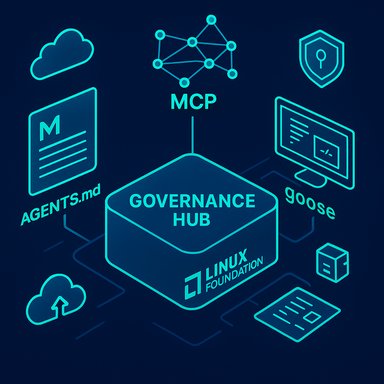
The Agentic AI Foundation is a directed fund hosted by the Linux Foundation that brings together three donated projects as its founding artifacts: AGENTS.md from OpenAI, Model Context Protocol (MCP) from Anthropic, and goose from Block. The stated purpose is straightforward: provide vendor-neutral stewardship for the standards, specs and reference implementations that let agentic systems discover tools, call services, and coordinate multi-step workflows without bespoke, one-off adapters. At launch the AAIF lists platinum-level backing from major cloud and platform players including Amazon Web Services, Google, Microsoft, Bloomberg and Cloudflare alongside the three donating companies. The coalition is unusually broad: it includes direct competitors and cloud incumbents that will both implement and depend on the resulting artifacts. That breadth gives the initiative technical weight — and governance complexity.
Key operational risks:
For Windows professionals and enterprise teams, the practical path forward is clear: pilot conservatively, insist on repository-level manifests and sandboxed MCP access, capture provenance comprehensively, and participate in conformance testing as the AAIF publishes toolkits and registries. Done well, open, vendor-neutral agent standards can unlock a new wave of automation and productivity; done poorly, they can concentrate risk into a few shared components. The AAIF’s next releases — governance charters, conformance suites, and the first independent audits — will show whether the industry has chosen the first path.
Source: YourStory.com https://yourstory.com/ai-story/agentic-ai-foundation-openai-anthropic-linux/
 Background / Overview
The Agentic AI Foundation is a directed fund hosted by the Linux Foundation that brings together three donated projects as its founding artifacts: AGENTS.md from OpenAI, Model Context Protocol (MCP) from Anthropic, and goose from Block. The stated purpose is straightforward: provide vendor-neutral stewardship for the standards, specs and reference implementations that let agentic systems discover tools, call services, and coordinate multi-step workflows without bespoke, one-off adapters. At launch the AAIF lists platinum-level backing from major cloud and platform players including Amazon Web Services, Google, Microsoft, Bloomberg and Cloudflare alongside the three donating companies. The coalition is unusually broad: it includes direct competitors and cloud incumbents that will both implement and depend on the resulting artifacts. That breadth gives the initiative technical weight — and governance complexity. The three founding projects — what they are and why they matter
AGENTS.md (OpenAI)
AGENTS.md is a deliberately simple, git-native convention: a Markdown manifest placed in repositories to give coding agents consistent, machine-readable guidance about a project’s tests, build commands, files to avoid and operational constraints. The format is intentionally lightweight so that agents can read repository‑level intent and obey human‑authored rules rather than guessing from prompts. OpenAI reports that AGENTS.md was released in August 2025 and has been adopted widely — the company states more than 60,000 open-source projects and agent frameworks have added AGENTS.md. That figure is repeated in launch materials. Why it matters: AGENTS.md converts human guidance into a reproducible, repository-scoped contract. For enterprises and maintainers, the format offers a low-friction way to express safety and compliance constraints in a place agents already look — the repo itself. This reduces accidental misbehavior (for example, running destructive commands) and helps make agent results reproducible across different runtime engines. Caveat: adoption numbers are vendor‑reported and measurement methodologies vary; independent count differences in the press indicate the precise figure should be treated as a directional indicator of very rapid uptake rather than a single audited statistic.Model Context Protocol (MCP) — Anthropic
MCP is an HTTP/JSON-style protocol designed to standardize how models and agent runtimes discover, describe and invoke external tools and services (connectors). It defines roles (clients, hosts, servers), a discovery/registry model, invocation semantics and transports — a plumbing layer that aims to make connectors reusable across vendors and runtimes. Anthropic reports MCP is now powering large numbers of public endpoints and is supported by mainstream products such as ChatGPT Apps, Microsoft Copilot, Gemini, Visual Studio Code and others. Anthropic and AAIF launch materials further claim MCP now powers more than 10,000 public MCP servers and that the project has substantial SDK download volumes — metrics used to argue that MCP is already production‑grade infrastructure. Those figures appear in multiple vendor announcements and press reports. Why it matters: without a standard like MCP, every agent runtime needs bespoke connectors to each tool or data source. MCP aims to reduce that cost by letting multiple agent engines call a common connector API with predictable schemas, authorization and observability hooks baked in. That’s a necessary step if agents are to coordinate across clouds, on-prem systems and desktop apps at scale. Caveat: the 10,000+ server metric and download counts are vendor‑reported. They signal major momentum but are not yet independently audited public telemetry; procurement or risk decisions should treat the numbers as indicators rather than certainties.goose (Block)
goose is Block’s open-source, local-first agent framework and reference runtime. It is available on GitHub under an Apache‑2.0 license and is designed to run on a developer’s machine or CI systems while integrating with MCP-style connectors for remote tools. The codebase and docs present goose as a pragmatic, runnable example of how to build secure, auditable agentic workflows: local logs, session storage, extension catalogs and a model-agnostic plugin system. Why it matters: specifications alone are abstract; having a community-run reference runtime demonstrates how real-world semantics should behave. goose provides that runnable testbed — a place to discover implementation mismatches, UX pitfalls and security trade-offs before those issues surface in enterprise deployments.How the standards are intended to work together
In practical terms the three donations are intended to cover distinct layers of the agent stack:- AGENTS.md supplies per-repository instructions and constraints that code agents can read deterministically.
- MCP standardizes how agents discover and securely call tools and data sources, with registries, identity and transport semantics.
- goose provides a reference runtime showing how to orchestrate models, tools and MCP connectors in a local-first, auditable manner.
Governance, membership and the limits of “neutrality”
AAIF’s structure is a familiar Linux Foundation pattern: projects live under a directed fund with a technical steering model, public repositories, and membership tiers that fund operations. At launch the foundation lists a robust platinum membership roster — Amazon Web Services, Anthropic, Block, Bloomberg, Cloudflare, Google, Microsoft and OpenAI among them — plus a broader gold/silver membership slate. That gives the AAIF immediate influence and real-world deployment experience. Strengths of this model:- Rapid bootstrap: platinum members can contribute code, funding and production telemetry to accelerate maturation.
- Platform alignment: cloud and OS vendors can coordinate secure host-level mitigations (registries, proxies, signed connectors), increasing the chance of safe rollouts.
- Influence asymmetry: directed funds and tiered memberships can create de facto control by large funders unless charters and voting rules explicitly protect independent maintainers and smaller contributors. The Linux Foundation has governance machinery to mitigate this, but it is not automatic.
- Vendor‑sourced metrics: adoption and server counts published by the founding companies accelerate confidence, but independent conformance tests and third‑party telemetry will be needed to substantiate claims.
Security, operational and policy implications
Agentic AI changes integration and threat models in three fundamental ways: it makes tool-invocation a primary attack surface, elevates agents to non-human identities that require lifecycle controls, and concentrates semantics so that a compromised connector has outsized impact.Key operational risks:
- Tool poisoning and prompt injection: because connectors and tool schemas are machine‑readable, adversaries can craft inputs or connector responses that cause unintended agent behavior. Protocol-level defenses and runtime sandboxing are essential.
- Connector impersonation: registries and server identity mechanisms are necessary to prevent man‑in‑the‑middle or spoofing attacks against MCP servers. Anthropic’s recent MCP updates add server identity and stateless modes to address these threats, but hosts must enforce them.
- Credential and identity sprawl: agents acting on behalf of users must use short‑lived credentials, just‑in‑time authorization and auditable provenance logs; otherwise an agent compromise gives attackers persistent power.
What this means for Windows developers and enterprise IT
Windows admins and dev teams should treat AAIF’s launch as an inflection point: agentic tooling will accelerate, and platform-level support for MCP and agent registries will soon be a realistic choice for enterprise deployments. Here are practical actions to prepare Windows environments safely and pragmatically.- Inventory current automation and agentic exposures. Identify automation tools, CI/CD pipelines and any internal bots that could be exposed to agent-driven actions. Capture their permissions and audit trails.
- Require repository-level manifests. Adopt AGENTS.md (or equivalent internal policies) in repos where automated agents may run to control commands, file access and test steps. This reduces accidental destructive behavior.
- Pilot on-device MCP registries inside sandboxed VMs. Use proxy-mediated access and signed connectors during pilots to validate server identity and authorization flows before opening MCP access to broad user bases.
- Harden credential lifecycle. Use JIT access tokens, short-lived service-principals and rotation with anomaly detection to reduce attacker dwell time if an agent is compromised.
- Capture full provenance and telemetry. Log prompt + context + tool invocation + result for every agent action and retain those traces for auditing. This is essential for incident response and compliance.
- Participate in conformance tests and audits. Watch AAIF conformance suites and MCP registries and run independent third‑party tests against connectors that your estate depends on.
Governance, conformance and the road to interoperability
Standards do not magically create interoperability; they require:- Clear minimal conformance profiles
- Robust test suites and interoperable reference implementations
- Public registries and conformance badges
- Independent security reviews and bug-bounty programs
What to watch next (12–24 months)
- Publication of AAIF governance charters and maintainer policies — these documents will reveal how membership influence is balanced and how independent reviewers gain standing.
- Release of AAIF conformance suites and public MCP registries — these are necessary to reduce implementation drift.
- Independent audits of adoption metrics — look for third‑party telemetry or neutral researchers reproducing MCP server counts and SDK download figures rather than relying solely on vendor-reported numbers.
- Security incident disclosures and response playbooks — the first large-scale deployments will test the ecosystem’s incident handling and forensic capabilities.
- Platform-level rollouts (Windows, macOS, major Linux distros) of registry and enforcement primitives — this will determine how easily enterprises can adopt MCP-based connectors safely.
Conclusion
The Agentic AI Foundation represents a pragmatic industry pivot: major vendors are intentionally relocating working artifacts — AGENTS.md, MCP and goose — into neutral governance to accelerate interoperability and safety as agentic systems scale from pilots to production. That combination of a protocol (MCP), a manifest convention (AGENTS.md) and a reference runtime (goose) is a sensible starting point for a standards-driven agentic ecosystem. However, the hard work begins now. Key claims about adoption and deployment (for example, AGENTS.md’s 60,000+ projects and MCP’s 10,000+ public servers) come from founding members and press materials; they indicate substantial momentum but are vendor‑reported metrics that require independent verification to be treated as authoritative. Governance design, conformance tests, independent security audits and meaningful participation from non‑corporate stakeholders will determine whether AAIF becomes a durable foundation or another vendor-heavy consortium.For Windows professionals and enterprise teams, the practical path forward is clear: pilot conservatively, insist on repository-level manifests and sandboxed MCP access, capture provenance comprehensively, and participate in conformance testing as the AAIF publishes toolkits and registries. Done well, open, vendor-neutral agent standards can unlock a new wave of automation and productivity; done poorly, they can concentrate risk into a few shared components. The AAIF’s next releases — governance charters, conformance suites, and the first independent audits — will show whether the industry has chosen the first path.
Source: YourStory.com https://yourstory.com/ai-story/agentic-ai-foundation-openai-anthropic-linux/
