

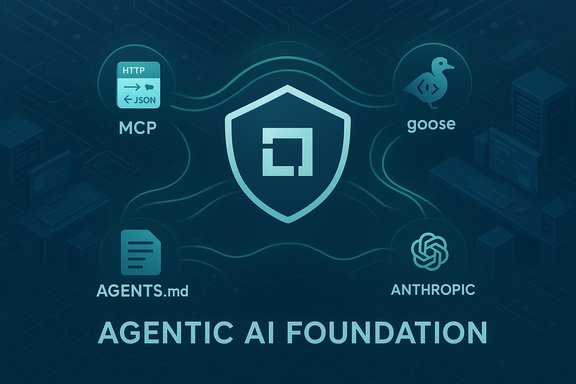
The Linux Foundation’s new Agentic AI Foundation (AAIF) has pulled an unusually broad coalition of rivals into a single, vendor‑neutral effort to standardize the plumbing that will let AI agents discover tools, call services, and cooperate across clouds and devices — with Anthropic’s Model Context Protocol (MCP), Block’s goose framework, and OpenAI’s AGENTS.md placed under the foundation’s stewardship as the first cornerstone projects.
The industry is shifting from chat‑centric models to agentic systems: persistent, goal‑oriented software that plans, sequences multi‑step tasks, and calls external tools to act on behalf of users. That change raises a classic coordination problem — without shared protocols and conventions, multiple vendors will build incompatible agent stacks that fragment the market and impose heavy integration costs on developers. The AAIF aims to head off that fragmentation by stewarding open specifications and reference implementations in a neutral forum. This regrouping is notable for two reasons. First, direct competitors — OpenAI, Anthropic, Google, Microsoft, AWS and others — are agreeing to place key artifacts into common governance. Second, the contributions are not merely aspirational white papers: they are working code, SDKs, and conventions already in active use across developer tooling and enterprise stacks. Those pragmatic assets make the AAIF more likely to shape the day‑to‑day engineering reality of agentic systems.
This is a pragmatic, standards‑first play that addresses tangible engineering frictions. It also surfaces new operational responsibilities: secure discovery, identity for non‑human actors, robust observability, and careful lifecycle management. Enterprises and Windows developers stand to benefit from reduced integration cost and richer agent ecosystems, but those gains will only materialize if governance remains genuinely open, security practices evolve in lockstep, and vendors — large and small — can participate meaningfully.
The AAIF’s launch marks a hopeful step toward an interoperable “agentic web.” Its long‑term success will depend on diligent governance, independent verification of adoption claims, and a community that can hold implementations to high safety and auditability standards while still moving fast.
Source: the-decoder.com Big AI’s biggest names rally around the Agentic AI Foundation to set agent standards
 Background
The industry is shifting from chat‑centric models to agentic systems: persistent, goal‑oriented software that plans, sequences multi‑step tasks, and calls external tools to act on behalf of users. That change raises a classic coordination problem — without shared protocols and conventions, multiple vendors will build incompatible agent stacks that fragment the market and impose heavy integration costs on developers. The AAIF aims to head off that fragmentation by stewarding open specifications and reference implementations in a neutral forum. This regrouping is notable for two reasons. First, direct competitors — OpenAI, Anthropic, Google, Microsoft, AWS and others — are agreeing to place key artifacts into common governance. Second, the contributions are not merely aspirational white papers: they are working code, SDKs, and conventions already in active use across developer tooling and enterprise stacks. Those pragmatic assets make the AAIF more likely to shape the day‑to‑day engineering reality of agentic systems. The three cornerstone projects (what they are and why they matter)
Anthropic’s Model Context Protocol (MCP)
- What it is: MCP is a lightweight HTTP/JSON protocol that standardizes how models and agent runtimes discover and invoke external tools and services. It defines roles (hosts, clients, servers), a tool discovery model, and payload conventions so connectors can be shared between agents and runtimes.
- Why it matters: By replacing bespoke connectors with a common protocol, MCP reduces per‑integration engineering effort and enables multiple agent engines to call the same service endpoints with predictable authorization and payload semantics. Early adoption across major products suggests the design has traction.
- Adoption claims and verification: Anthropic and AAIF launch materials report more than 10,000 public MCP servers and broad product support (Claude, Microsoft Copilot, Gemini, ChatGPT, VS Code, etc.. These figures come from vendor announcements and industry reporting; they signal momentum but are vendor‑reported and not yet independently audited, so treat them as directional indicators rather than finalized market statistics.
Block’s goose framework
- What it is: goose is an open‑source, local‑first agent runtime aimed at developer productivity workflows. It combines language models with extensible tools, local execution semantics, and tight MCP integration to offer a reproducible, model‑agnostic path for building agent workflows on a workstation or CI. The project is available on GitHub under an Apache‑2.0 license and is explicitly designed to interoperate with MCP.
- Why it matters: goose functions as a runnable reference implementation that demonstrates secure, local‑first agent patterns — everything from code generation and testing to deterministic local operations. Reference frameworks like goose are indispensable for driving real‑world interoperability tests and for surfacing security and UX tradeoffs that purely theoretical specs miss.
OpenAI’s AGENTS.md
- What it is: AGENTS.md is a Markdown‑based convention for providing project‑specific instructions and configuration for coding agents. It’s a lightweight manifest format that computational agents can read to understand repository constraints, access rules, and behavioral guidance. OpenAI donated AGENTS.md to AAIF to encourage cross‑project portability.
- Adoption claims and verification: OpenAI states that AGENTS.md has been adopted by more than 60,000 open‑source projects and agent frameworks since its introduction in August 2025. That is a significant adoption claim and appears in multiple launch materials; like other rollout metrics, this figure originates with vendor reporting and should be treated as indicative of strong uptake rather than independently vetted market research.
Why shared standards matter for agentic AI
Standards matter for three practical reasons: interoperability, safety, and ecosystem growth.- Interoperability: shared protocols let agents and services interoperate without bespoke glue code. This reduces integration cost and increases composability — critical when agents may need to coordinate across multiple vendor backends.
- Safety and auditability: a consistent calling convention, discovery mechanism, and manifest format make it possible to bake authorization checks, telemetry hooks, and provenance metadata into the protocol rather than bolting them on ad hoc. That improves auditability across agent fleets and reduces blind spots that emerge with proprietary connectors.
- Ecosystem effects: open standards historically lowered the cost of entry for third‑party tooling and services. If MCP, goose, and AGENTS.md mature under neutral governance, an independent ecosystem of runtime vendors, observability tools, and security auditors can flourish — increasing choice for enterprises and developers.
Governance, membership and what “neutral stewardship” actually means
The AAIF will operate as a directed fund under the Linux Foundation, leveraging that organization’s governance structures and community processes for long‑term stewardship. Founding members and platinum supporters reportedly include the major cloud and platform players: Google, Microsoft, Amazon Web Services, OpenAI, Anthropic, Block, Bloomberg, and Cloudflare among others. This membership list gives AAIF political heft and ensures contributions are likely to align with enterprise deployment needs. Neutral stewardship is valuable, but it is not a panacea. The Linux Foundation’s track record shows that neutral governance can accelerate technical improvements and community contributions; however, large corporate members still exert influence via resources, maintainership, and project governance dynamics. That influence is useful for scale and compatibility work — it is also why neutral governance must be accompanied by transparent contributor and maintainer processes, public roadmaps, and community review to avoid de facto control by the largest backers.Security, operational and policy implications
Moving to a standards‑driven agentic web reduces some risks and opens others. The AAIF and its donated projects expose a set of operational fault lines that engineers and IT leaders must treat as first‑class engineering problems.New attack surface and threat classes
- Tool invocation vectors: standardizing connectors concentrates traffic and semantics; attackers who can poison or impersonate an MCP server gain a powerful lever to influence many agent runtimes. Defenses must include server identity, code signing, and authenticated discovery.
- Prompt injection and “tool poisoning”: giving models structured access to tools creates new prompt injection modes where adversarial inputs manipulate the invocation flow or the tool’s response schema. Multi‑layered validation and sandboxing remain essential.
- Non‑human identities: treating agents as first‑class identities (service principals, short‑lived tokens, conditional access) improves governance — but it also creates a new class of credentials that must be protected with just‑in‑time access, rotation, and anomaly detection.
Operational governance needs
- Observability and provenance: agents must emit detailed traces — prompt + context + tool call + result — so humans can reconstruct decisions. That telemetry requires SIEM integration and standardized audit formats to be useful at enterprise scale.
- Lifecycle management: it’s trivial to spawn many agents. Organizations should enforce agent registration, versioning, retirement, and approval gates to avoid sprawl and unmanaged attack surfaces.
- Human‑in‑the‑loop and evaluators: autonomous agent actions should default to recommendation for high‑impact operations. Deploy an evaluation pipeline that grades agent decisions against ground truth or human review processes before shifting to full automation.
What this means for Windows developers, IT teams, and enterprise architects
Windows‑centric developers and IT leaders should view the AAIF as a structural shift in how integrations and desktop/cloud tooling will be built over the next 24 months. The practical implications:- Integrate MCP support into endpoint and platform controls. Windows and management tooling (for example, Intune, Defender integration, and enterprise browsers) will need to handle MCP discovery and enforce local host policies to prevent unauthorized tool invocations.
- Treat agents as managed identities inside Entra or your identity provider. Use conditional access, least‑privilege and ephemeral tokens for agents that operate on corporate data. This reduces the blast radius if an agent or its credentials are compromised.
- Adopt AGENTS.md or similar repo manifests for any repo that allows agent operations (CI, code suggestions, or autonomous code edits). Putting agent guidance under version control prevents surprises and makes agent behavior reproducible across developer machines and build systems.
- Harden developer environments against local‑first agent misuse. Tools like goose are powerful on‑machine assistants; secure default settings, code review workflows, and secrets scanning must be in place to prevent leakage of secrets or accidental commits.
- Plan for observability and chargeback. Agent operations will consume compute and API credits. Integrate agent telemetry into existing cost and observability pipelines to measure ROI and manage budgets.
Competitive and market dynamics: strengths and risks
Strengths in the AAIF approach
- Rapid interoperability at scale becomes possible when key projects are stewarded under neutral governance. That lowers integration friction for enterprises and accelerates developer productivity across vendor stacks.
- Reference implementations (goose) and simple manifest formats (AGENTS.md) provide practical, low‑friction adoption pathways for engineering teams — not just abstract specifications. This pragmatic orientation improves the odds that standards will be used correctly.
- Neutral stewardship reduces the risk of single‑vendor lock‑in and builds trust among enterprises that are wary of ceding control to one provider. A community‑driven AAIF can incubate third‑party tooling (observability, security, auditors) that increases market competition.
Risks and open questions
- Governance capture: large incumbents have resources to steer projects. Unless governance is genuinely open, community contributors may be marginalized and the projects could drift toward the needs of the biggest donors. Continuous transparency and explicit maintainer policies are necessary to mitigate this.
- Vendor‑reported metrics: adoption numbers cited in launch materials (10,000 MCP servers, 60,000 AGENTS.md projects) are useful signals but remain vendor‑reported. Independent audits, public registries, or neutral telemetry will be needed to validate long‑term claims of ubiquity. Flag these figures as vendor claims until independently verified.
- Standardized security practices are still nascent. Protocols like MCP reduce integration friction but concentrate risk; robust server identity, signed manifests, and hardened discovery services are necessary to prevent large‑scale compromise.
- Regulatory and legal ambiguity: agentic automation raises liability questions (who is responsible for an autonomous agent’s mistake? and cross‑border data flows (agents invoking services in different jurisdictions). Regulatory clarity will lag technical deployments, putting compliance burden on adopters.
Practical recommendations — a concise playbook
- Inventory and classify agent use cases: separate low‑risk, reversible actions (summaries, research) from high‑risk actions (payments, access changes). Require explicit human review for the latter.
- Adopt MCP and AGENTS.md pragmatically: use them where they reduce integration cost, but enforce signed manifests and repository policy checks.
- Treat agents as auditable identities: require short‑lived tokens, least privilege, and centralized lifecycle management. Integrate agent events into SIEM and retention policies.
- Harden developer hosts before enabling local‑first agents: enforce secrets scanning, pre‑commit hooks, and controlled permission scopes for tools like goose.
- Measure outcomes and costs: instrument accuracy, completion rates, and compute/api spend. Use those metrics to gate scale‑up decisions.
Where verification remains important (claims to watch)
- MCP server counts and AGENTS.md adoption figures are currently vendor‑reported; expect independent registries and public telemetry dashboards to emerge as AAIF matures. Treat current large‑scale adoption claims as indicative momentum rather than settled facts.
- The long‑term balance between interoperability and vendor convenience will determine if standards actually reduce lock‑in or simply enshrine a multi‑vendor cartel. Monitor AAIF governance decisions, contributor roles, and the community review process closely.
Conclusion
The Agentic AI Foundation is a consequential, early attempt to place the plumbing of the agent era under neutral stewardship. By donating working projects — MCP for tool discovery, goose as a reference runtime, and AGENTS.md as a simple repo manifest — Anthropic, Block, and OpenAI have fast‑tracked the emergence of vendor‑neutral building blocks that could shape how agentic systems are built and governed.This is a pragmatic, standards‑first play that addresses tangible engineering frictions. It also surfaces new operational responsibilities: secure discovery, identity for non‑human actors, robust observability, and careful lifecycle management. Enterprises and Windows developers stand to benefit from reduced integration cost and richer agent ecosystems, but those gains will only materialize if governance remains genuinely open, security practices evolve in lockstep, and vendors — large and small — can participate meaningfully.
The AAIF’s launch marks a hopeful step toward an interoperable “agentic web.” Its long‑term success will depend on diligent governance, independent verification of adoption claims, and a community that can hold implementations to high safety and auditability standards while still moving fast.
Source: the-decoder.com Big AI’s biggest names rally around the Agentic AI Foundation to set agent standards
