

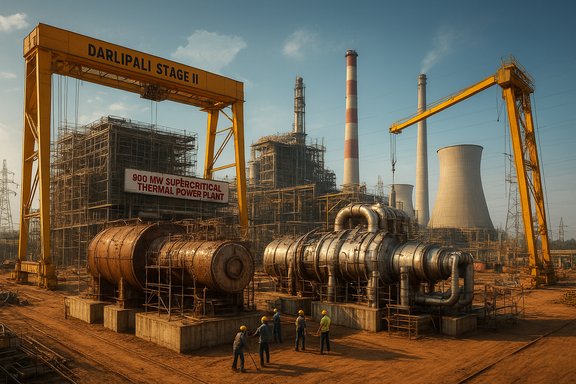
Bharat Heavy Electricals Ltd (BHEL) has won a marquee Engineering, Procurement and Construction (EPC) contract from NTPC Ltd for a 1×800 MW supercritical thermal unit at the Darlipali Supercritical Thermal Power Project (Stage‑II) in Sundargarh district, Odisha — a deal valued at over Rs 6,650 crore (approximately Rs 66.5 billion) with a 48‑month completion target from the Notification of Award issued on 6 November 2025.
BHEL and NTPC sit at the heart of India’s conventional power infrastructure: BHEL is the country’s largest integrated power‑plant equipment manufacturer and a dominant EPC/engineering contractor for thermal plants, while NTPC is India’s largest power producer. This contract — awarded under international competitive bidding — covers end‑to‑end EPC works including design, engineering, equipment supply, erection and commissioning, plus associated civil works for the 800 MW supercritical unit. The formal Notification of Award date and the declared 48‑month Completion of Facilities (COF) are both explicitly noted in company filings and regulatory reporting. This win arrives against a backdrop of improving operating performance at BHEL: the company reported a sharp recovery in Q2 FY26 with consolidated net profit jumping 253% year‑on‑year to Rs 374.89 crore on revenue of about Rs 7,512 crore — metrics markets flagged as a material turnaround. BHEL’s second‑quarter results helped underpin renewed investor interest in the stock. Meanwhile NTPC’s renewable arm, NTPC Green Energy Ltd (NGEL), showed strong quarterly growth — its Q2 FY26 consolidated profit rose by roughly 130% to about Rs 87.59 crore on revenue growth of roughly 21.5% — evidence that NTPC’s group strategy continues to combine conventional baseload build‑outs with accelerated renewable expansion.
Source: Construction World BHEL Wins Rs 66.5 Bn NTPC EPC Order for Odisha Project
 Background
BHEL and NTPC sit at the heart of India’s conventional power infrastructure: BHEL is the country’s largest integrated power‑plant equipment manufacturer and a dominant EPC/engineering contractor for thermal plants, while NTPC is India’s largest power producer. This contract — awarded under international competitive bidding — covers end‑to‑end EPC works including design, engineering, equipment supply, erection and commissioning, plus associated civil works for the 800 MW supercritical unit. The formal Notification of Award date and the declared 48‑month Completion of Facilities (COF) are both explicitly noted in company filings and regulatory reporting. This win arrives against a backdrop of improving operating performance at BHEL: the company reported a sharp recovery in Q2 FY26 with consolidated net profit jumping 253% year‑on‑year to Rs 374.89 crore on revenue of about Rs 7,512 crore — metrics markets flagged as a material turnaround. BHEL’s second‑quarter results helped underpin renewed investor interest in the stock. Meanwhile NTPC’s renewable arm, NTPC Green Energy Ltd (NGEL), showed strong quarterly growth — its Q2 FY26 consolidated profit rose by roughly 130% to about Rs 87.59 crore on revenue growth of roughly 21.5% — evidence that NTPC’s group strategy continues to combine conventional baseload build‑outs with accelerated renewable expansion. Why this order matters
Strategic value for BHEL
- Strengthens BHEL’s EPC backlog with a large, turnkey assignment from NTPC that validates the company’s core competency in thermal plant execution.
- Supports utilisation of BHEL’s manufacturing, testing and site‑engineering bandwidth — a critical factor for near‑term revenue and margin recovery.
- Reinforces BHEL’s role in India’s fossil‑fuel power market even as the broader system ramps renewables and storage.
Strategic value for NTPC and Odisha
- Adds dispatchable baseload capacity adjacent to the existing Darlipali Stage‑I facilities, improving grid stability and regional supply reliability for Odisha’s industrial and domestic demand centers.
- Delivers a standardised, large‑unit thermal resource that can operate alongside NTPC’s growing renewable fleet; in practice, such units are often retained for firming and peaking roles in mixed portfolios.
The technical frame: what is an 800 MW supercritical unit?
Supercritical technology explained
A supercritical thermal power unit operates steam cycles above the critical point of water (pressure and temperature beyond which liquid and vapor phases are indistinguishable). Compared with subcritical plants, supercritical plants:- Achieve higher thermal efficiency, lowering coal consumption per MWh.
- Reduce specific emissions per unit of electricity compared with older designs.
- Require more advanced materials, precision fabrication and control systems.
Execution demands
Delivering an 800 MW supercritical EPC requires integrated execution across:- Long lead‑time equipment procurement (boiler, turbine, generator, high‑voltage transformers).
- Precision fabrication and on‑site erection tolerances.
- High‑skill commissioning teams and multilayer testing (hydrostatic, mechanical, thermal).
- Environmental control systems (ESP, FGD if mandated), ash handling and water management.
Financial and market implications
For BHEL’s near‑term outlook
BHEL’s Q2 FY26 earnings — a net profit of about Rs 375 crore and revenue near Rs 7,512 crore — have reset investor expectations for the company’s earnings trajectory. The Darlipali contract supplements BHEL’s order book and provides a multi‑year revenue stream once manufacturing deliveries and site milestones commence. Key considerations for the market:- Order book growth helps revenue visibility but margins on large EPC projects can fluctuate depending on commodity inflation, warranty claims and subcontractor performance.
- The contract value (over Rs 6,650 crore) is material but will be recognized over the multi‑year project life; investors will watch milestone billing and margin recognition patterns.
- BHEL’s stock reaction has been muted but positive on the Q2 earnings beat; near‑term upliftary sentiment can be tempered by execution risk and payment cycle management.
For NTPC group
Deploying a new 800 MW thermal unit expands NTPC’s dispatchable fleet at a time when its renewables arm is also growing rapidly. NTPC group’s own Q2 results showed resilient operating dynamics even as the company navigates fuel and dispatch challenges. The Darlipali Stage‑II unit will add to capacity that can be optimized in a hybrid portfolio.Execution risks and project challenges
Large EPC projects are complex and face several common risk vectors. Framing these realistically is essential for both market participants and policy watchers.1. Schedule and delivery risk
- The contract sets a 48‑month COF target from 6 November 2025. While achievable with disciplined project management, the schedule depends on timely procurement of long‑lead items, clearance of civil works, and uninterrupted supply chains.
- International competitive bidding can expose vendors to overseas component lead times and currency movements for certain imported items.
2. Supply‑chain and commodity inflation
- Steel, specialty alloys, transformers and heavy electrical components face volatile lead times and price swings. Cost escalation can compress EPC margins unless contracts include adequate pass‑throughs or contingencies.
3. Resource and labour availability
- Deployment of experienced erection, commissioning and QA teams is non‑trivial. Competing projects across India and global markets intensify demand for specialized labour.
4. Regulatory, environmental and social clearances
- Thermal projects face stricter environmental scrutiny concerning emissions, ash management and water use. Even an established site like Darlipali must meet evolving regulatory benchmarks which can trigger design changes or retrofits.
5. Financing and payment cycles
- Public sector clients like NTPC usually maintain structured payment timetables, but milestone certification disputes or change orders can impact cash flow for contractors. Robust contract administration and escrow/retention management are critical.
Environmental and policy context
India’s power sector is in a transitional phase: rapid build‑out of solar and wind capacity, expanding storage pilots, and continuing investment in flexible thermal and gas capacity to ensure grid stability. The Darlipali Stage‑II decision to add an 800 MW supercritical unit is reflective of several policy realities:- Grid reliability and 24×7 power requirements still necessitate dispatchable thermal plants for many regions.
- Supercritical plants offer relatively better thermal efficiency and lower specific CO2 intensity compared with older subcritical units, although they are not a zero‑carbon option.
- The national push to scale renewables is paired with requirements to maintain system inertia and ramping capability — roles that modern thermal assets can fill if retrofitted with flexible operating modes.
What success will look like — milestones to watch
Investors, analysts and energy planners should track a short list of execution and commercial milestones to assess whether the Darlipali Stage‑II contract delivers on promise:- Procurement notices and indents for long‑lead items (boiler, turbine, generator) — early placement reduces lead‑time risk.
- Site mobilization and major civil work commencements — visible progress in the first 6–12 months is a positive sign.
- Regulatory clearances updates and environmental condition acceptance — avoid surprises that delay commissioning.
- Quarterly order book and execution updates from BHEL (regulatory filings/BSE disclosures) — watch for milestone billing schedules and revenue recognition.
- Any contract amendments or change orders — these materially affect final project economics and schedule.
Competitive and strategic implications for the industry
- BHEL’s win underscores the continuing role of domestic OEMs and EPC vendors in India’s heavy power infrastructure despite an influx of international suppliers and competitive pressures.
- For private EPC players and global equipment vendors, the NTPC tender process remains an important revenue channel but also a structural battleground where scale, delivery track record and balance‑sheet strength matter.
- The simultaneous financial strength in BHEL’s Q2 and NGEL’s renewables growth highlight an industry in which legacy equipment vendors can coexist with clean‑energy growth — though each must manage different risk profiles.
Critical assessment: strengths and red flags
Notable strengths
- Institutional validation: An NTPC award is a strong client‑level reference that validates BHEL’s EPC credentials for high‑spec thermal projects.
- Order size and backlog boost: The over‑Rs 6,650 crore contract meaningfully augments BHEL’s order book and revenue visibility over the coming years.
- Operational relevance: Delivering supercritical technology keeps India’s fleet technically modern compared with older subcritical plants, improving system efficiency.
Potential risks and red flags
- Execution & schedule slippage: The 48‑month COF target is ambitious; historical experience in large EPC projects shows that delays are common and costly. Timely procurement and labour deployment are crucial.
- Margin pressure from commodity volatility: Unless contract terms include robust escalation and cost‑pass mechanisms, BHEL could face margin erosion if steel, alloys or logistics costs spike.
- Environmental and regulatory headwinds: Evolving emissions norms or required retrofits can increase capital outlay and delay commissioning.
- Market perception vs. realization: Order announcements can lift sentiment, but value is realized only through milestone billing and margin recognition. BHEL’s Q2 profit beat improved the narrative, but sustained delivery will be the truer test.
Practical takeaways for stakeholders
- For investors: Monitor BHEL’s execution updates and quarterly filings for milestone recognition rather than assuming immediate earnings uplift from the award; focus on cash‑flow and working‑capital trends as the project ramps.
- For policymakers and grid planners: Recognize the hybrid nature of India’s power transition — investments in both renewables and modern thermal units are being pursued simultaneously, and balancing mechanisms are increasingly important.
- For environmental advocates: Engage early on mitigation measures — water use, ash management and emissions control — to ensure new plants meet contemporary sustainability expectations.
- For supply‑chain partners: The order is a call to action: suppliers of heavy electrical equipment, specialty alloys and EPC services should prepare capacity and delivery commitments aligned to long lead‑time schedules.
Conclusion
BHEL’s over‑Rs 6,650 crore EPC award from NTPC for the 1×800 MW Darlipali STPP Stage‑II is a substantive commercial win that both signals and reinforces BHEL’s central role in India’s conventional power infrastructure. The contract complements BHEL’s recent earnings recovery and supports short‑ to medium‑term revenue visibility, while NTPC continues to balance thermal and renewable capacity additions within its broader portfolio. However, the path from award to reliable cash flows is paved with execution, supply‑chain and regulatory risks. Meeting the 48‑month COF, containing margin erosion from commodity and labour market pressures, and conforming to rising environmental standards will determine whether this headline order becomes strategic success or a prolonged operational challenge. Stakeholders should therefore weight the positive strategic signal against the practical realities of large EPC delivery — and treat early project milestones, not only the award announcement, as the truest measures of outcome.Source: Construction World BHEL Wins Rs 66.5 Bn NTPC EPC Order for Odisha Project
