

Bidgely arrives in Valencia this week to put its AI-powered energy intelligence center stage at the IDC European Utilities Xchange, promising utility executives a closer look at how generative AI, appliance-level analytics, and a new vertical AI product stack could reshape customer experience, grid planning, and program delivery across Europe. The demonstrations and executive sessions scheduled for March 2–3, 2026, position Bidgely as a visible player in a crowded market of grid analytics and customer-engagement platforms, and they raise important questions about how utilities should balance operational value, data governance, and the ethics of automated intelligence.
IDC’s European Utilities Xchange convenes senior utility IT and business leaders to discuss the technology priorities that will enable the energy transition. This year’s event, held in Valencia on March 2–3, 2026, foregrounds resilience, decarbonization, and the operationalization of AI across the utility stack. Vendors and utility practitioners alike are focused on turning behind-the-meter telemetry into actionable intelligence that delivers outcomes such as peak reduction, better demand forecasting, increased program enrollment, and lower cost-to-serve.
Bidgely is attending with an agenda that mirrors these priorities: showcasing its UtilityAI platform enhancements, highlighting a new productization of GenAI capabilities for customer-facing services, and promoting UtilityAI Pro — a vertical AI offering intended for deployment inside utility clouds for tighter data governance and model control. The company’s messaging centers on converting AMI (advanced metering infrastructure) and customer data into appliance-level intelligence for precise targeting of time-of-use (TOU) programs, electrification initiatives, and non-wires alternatives.
Bidgely’s pitch is timed to capitalize on both: practical AI applied to AMI plus regulatory drivers that reward precision and accountability in customer programs.
Indicators of success:
That said, the real value will be realized only when utilities pair vendor innovation with disciplined procurement, clear KPIs, and robust governance frameworks. Vendors can provide models and tools, but utilities must retain responsibility for measurement, fairness, and the social contract with customers. Independent validation of appliance-disaggregation accuracy, clear explanations of model limitations, and contractual guarantees around governance and privacy should be non-negotiable.
For utilities attending IDC in Valencia on March 2–3, 2026, Bidgely’s demonstrations warrant attention — not as a silver bullet, but as a representative example of the next-generation utility AI stack. The coming 12–24 months will test whether these tools can consistently deliver verifiable, equitable outcomes at scale. Utilities that approach adoption pragmatically — insisting on outcomes, auditability, and customer transparency — stand to convert promising AI capabilities into lasting operational and societal benefits.
In sum, Bidgely’s showcase at the European Utilities Xchange is a timely reflection of the industry’s pivot toward AI-driven, customer-centric energy management. The technology’s potential is substantial, but realizing it will require sober evaluation, measured deployments, and a steadfast commitment to governance, privacy, and fairness. When those pieces align, utilities can use behind-the-meter intelligence to not only optimize the grid but to become trusted energy advisors in an era of rapid electrification and shifting load profiles.
Source: WBOC TV Bidgely to Showcase AI-Powered Energy Intelligence at IDC European Utilities Xchange
 Background
IDC’s European Utilities Xchange convenes senior utility IT and business leaders to discuss the technology priorities that will enable the energy transition. This year’s event, held in Valencia on March 2–3, 2026, foregrounds resilience, decarbonization, and the operationalization of AI across the utility stack. Vendors and utility practitioners alike are focused on turning behind-the-meter telemetry into actionable intelligence that delivers outcomes such as peak reduction, better demand forecasting, increased program enrollment, and lower cost-to-serve.Bidgely is attending with an agenda that mirrors these priorities: showcasing its UtilityAI platform enhancements, highlighting a new productization of GenAI capabilities for customer-facing services, and promoting UtilityAI Pro — a vertical AI offering intended for deployment inside utility clouds for tighter data governance and model control. The company’s messaging centers on converting AMI (advanced metering infrastructure) and customer data into appliance-level intelligence for precise targeting of time-of-use (TOU) programs, electrification initiatives, and non-wires alternatives.
What Bidgely is Presenting in Valencia
Product lineup and claims
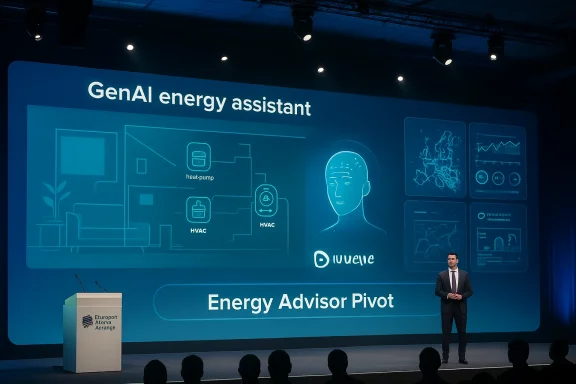
At the core of Bidgely’s showcase is its UtilityAI platform with several headline elements:- GenAI-powered customer assistants designed to answer natural-language queries about home energy use, explain bills, and simulate the financial and energy impacts of electrification choices such as EVs and heat pumps.
- Appliance-level energy profiling, the company’s flagship capability that claims to identify specific appliance usage patterns from AMI data to enable targeted outreach and behavioral programs.
- UtilityAI Pro, a containerized vertical AI product that enables utilities to run Bidgely’s models in their own cloud environments for improved governance and data control.
- Program and grid use cases including TOU adoption optimization, demand response targeting, DER (distributed energy resource) identification, and call-center support tools that reduce cost-to-serve.
Demonstrations and sessions to watch
Bidgely’s on-site agenda in Valencia includes executive sessions and practical workshops aimed at both strategy and implementation:- A keynote on “The ‘Energy Advisor’ Pivot: Leading the Age of Volatility & AI,” focused on reorienting utilities toward customer advisory services.
- A workshop titled “From Rate Design to Megawatts Shifted: A Deep Dive into TOU Success,” which promises concrete examples of how TOU pricing and targeting can materially change load shape.
- A fireside chat and roundtable on aligning UtilityAI Pro and data fabrics for enterprise AI implementation and precise customer targeting.
Why Bidgely’s message matters now
The operational need: converting data into decisions
Utilities have spent the last decade deploying AMI networks and collecting vast volumes of consumption data, but many still lack the operational tools to convert that raw telemetry into repeatable, utility-scale program outcomes. Bidgely’s positioning addresses a real pain point: how to extract accurate, behind-the-meter insights without invasive hardware and then use those insights across customer engagement, planning, and operations.- Utilities increasingly need actionable segmentation to deploy constrained budgets effectively. Appliance-level intelligence promises more precise segmentation than demographic or billing-only approaches.
- Grid planners are under pressure to forecast latent loads (EVs, heat pumps, rooftop solar) at the feeder and transformer level. Accurate behind-the-meter signals can materially change DER interconnection strategies and non-wires alternative evaluations.
- Customer-experience teams are judged by enrollment and satisfaction metrics; tools that reduce call volume and personalize outreach can deliver measurable ROI.
Market timing: AI maturity and regulatory impetus
AI advances — notably in generative and foundation models — have created new user experience possibilities that feel immediate and tangible to consumers. Simultaneously, regulators and market signals in Europe are pushing utilities toward dynamic pricing, electrification incentives, and improved program accountability. Vendors that can package AI into explainable, auditable, and deployable products have a clear opportunity.Bidgely’s pitch is timed to capitalize on both: practical AI applied to AMI plus regulatory drivers that reward precision and accountability in customer programs.
Strengths and tangible benefits
1. Behind-the-meter granularity without hardware proliferation
One of Bidgely’s most compelling technical claims is the ability to infer appliance usage from interval meter data. If accurate, this reduces the need for additional sensors or in-home gateways and lowers deployment friction.- Benefit: Reduced hardware costs and faster program rollout.
- Benefit: Broader reach—small customers without IoT devices become eligible for targeted programs.
2. Workflows that span silos
Bidgely promises use cases across operations, customer service, marketing, and planning rather than a single-point solution.- Benefit: Cross-functional reuse of the same analytics reduces duplication and improves program coherency.
- Benefit: Centralization of AI models via UtilityAI Pro can help ensure consistent customer messaging and program metrics.
3. Enterprise governance and deployment flexibility
UtilityAI Pro, as a containerized vertical AI offering, is designed to run inside utility-controlled environments, addressing a perennial concern: how to leverage vendor models without relinquishing data control.- Benefit: Greater compliance with data residency and GDPR-style requirements.
- Benefit: More control over model lifecycle and auditing for regulators or internal stakeholders.
4. Customer experience uplift through GenAI
Natural-language assistants that explain energy usage and bills have immediate customer-facing value. For many consumers, energy data is inscrutable; human-like explanations can increase engagement and trust.- Benefit: Reduced call volumes and simpler interactions in contact centers.
- Benefit: Higher enrollment in energy-efficiency programs driven by personalized, human-readable insights.
Critical analysis — what to scrutinize
While Bidgely’s claims and roadmap are credible and aligned with market needs, prudent utility buyers and analysts should evaluate several areas closely before committing to enterprise-scale rollouts.1. The accuracy and limits of appliance disaggregation
Appliance disaggregation from AMI is a challenging inference problem. Even the most sophisticated models face limitations depending on meter granularity, sampling rate, and the presence of noise in consumer behavior.- Questions utilities should ask:
- What is the measured accuracy by appliance class (EVs, heat pumps, HVAC, water heaters) under realistic conditions?
- How does accuracy degrade at different meter intervals (e.g., 15-minute vs. hourly)?
- What are the false positive and false negative rates for program eligibility?
2. Data governance and model drift
AI models are sensitive to distributional changes in data. Seasonal behavior, rapid electrification adoption, or new appliance mixes can change the statistical patterns that models rely on.- Risk: Without strong monitoring, models can drift, producing stale or biased insights that misdirect program investments.
- Mitigation: Utilities should require model monitoring, re-training cadence, and provenance logging as contract conditions.
3. Privacy and customer consent
Inferring appliance-level behavior touches on sensitive territory. Even anonymized patterns can feel intrusive to consumers if not handled transparently.- Best practice: Clear opt-in or opt-out mechanisms, straightforward privacy notices, and a demonstrated commitment to minimizing personally identifiable information.
- Regulatory exposure: Data protection regimes in Europe demand stringent controls; utilities must ensure vendor compliance and be ready to demonstrate lawful bases for processing.
4. The “black box” problem and explainability
Generative AI and deep learning models can create high-value outputs but are often opaque. Regulators and customer advocates are increasingly demanding explainability for AI-driven decisions that affect consumers.- Ask vendors for:
- Explainable outputs tied to specific meter signals (e.g., show the meter signature that led to an appliance classification).
- Confidence scores and human-in-the-loop escalation paths for high-impact decisions, such as eligibility denial or tariff assignment.
5. Business case realism
Many utility-grade AI projects stall when the expected savings are overstated or when the integration costs are under-budgeted.- Due diligence: Build a clear measurement framework with baseline metrics, KPIs, and short-term pilots tied to procurement milestones.
- Integration costs: Account for data ingestion, mapping to CIS/MDM systems, change management in call centers, and analytics ops staffing.
Use cases that deliver measurable ROI
Practical pilots and early deployments suggest a handful of use cases where AI-driven energy intelligence often produces direct, measurable outcomes:- TOU adoption and revenue-neutral shifting: Targeting households most likely to shift load can increase program participation and megawatt-hours shifted for a given marketing spend.
- Call center deflection: GenAI bill explainers and proactive notifications can reduce average handling time and call volumes, directly lowering OPEX.
- Electrification targeting: Identifying homes with high baseline loads or fossil-fuel heating allows more efficient promotion of heat pump incentives and EV programs.
- Non-wires alternative planning: Using behind-the-meter signals to identify feeders or substations where flexibility can avoid costly infrastructure upgrades.
Vendor positioning and market context
Bidgely competes in a crowded market that includes meter analytics vendors, DER orchestration platforms, and cloud hyperscalers building vertical utilities offerings. Its competitive differentiators are:- A long focus on appliance-level disaggregation and customer engagement.
- A product strategy that now incorporates generative AI for conversational experiences.
- A move toward delivering containerized, on-premise vertical AI to meet governance expectations (UtilityAI Pro).
- Hyperscalers are increasingly embedding utility-focused AI stacks and partnering with grid software vendors; utilities will need to evaluate vendor lock-in risks.
- Specialized analytics firms may offer deeper niche capabilities (e.g., DER forecasting), making partner ecosystems important.
- Regulatory pressure for auditability may favor vendors who provide model explainability and robust compliance tooling.
Practical procurement and deployment advice
For CIOs, program directors, and procurement teams considering a partnership with Bidgely or similar vendors, the following pragmatic checklist can reduce deployment risk:- Define clear outcome KPIs before procurement: enrollments, load reductions, call volume reductions, or CO2 avoided.
- Require independent accuracy benchmarks for appliance disaggregation and ask for validated trial results from utilities in similar climates and meter configurations.
- Insist on model governance contracts: retraining cadence, drift monitoring, and access to model artifacts for audit.
- Verify data residency and GDPR compliance: ensure contracts specify data handling, retention, and deletion procedures.
- Start with a bounded pilot tied to a real program (e.g., TOU enrollment) and require staged rollouts conditional on KPI achievement.
- Plan integration resources into the budget: mapping to CIS, engagement with call center scripting teams, and training for program managers.
- Secure consumer communication strategies that explain value and consent choices clearly to customers.
Ethical and regulatory considerations
Artificial intelligence in the energy sector sits at the intersection of consumer protection, decarbonization policy, and digital rights. Ethical deployment requires addressing several dimensions:- Transparency: Consumers should be able to understand why they were targeted for an offer and how the AI arrived at its recommendation.
- Fairness: Models must be tested for disparate impacts so that vulnerable or low-income customers are not inadvertently excluded from beneficial programs, or conversely, unfairly targeted for costlier tariffs.
- Accountability: Utilities retain responsibility for customer outcomes and must maintain oversight over vendor models and program logic.
- Security: AI systems that process AMI and customer data are attractive targets; threat modeling and penetration testing must be contractual deliverables.
What success looks like — and the red flags
Success in AI-driven energy intelligence is both operational and cultural.Indicators of success:
- Consistent, measurable program outcomes (e.g., TOU adoption rates and load-shifting validated by meter data).
- Reduced call center costs with maintained or improved customer satisfaction.
- Integration of AI outputs into planning cycles (e.g., DER capacity planning informed by appliance-level load profiles).
- A mature ML ops pipeline that monitors performance and triggers retraining.
- Promises of “perfect” appliance identification without transparent accuracy metrics.
- Contracts that give vendors unilateral control over model updates or prohibit independent auditing.
- Pilots that focus on vanity metrics (e.g., model accuracy in lab settings) rather than customer outcomes.
- Lack of a clear change management plan for front-line staff who will use the AI outputs daily.
Final assessment
Bidgely’s presence at the IDC European Utilities Xchange crystallizes an important commercial and technical trend: AI is moving from experimental proofs-of-concept to vertically packaged offerings that claim to serve the full utility lifecycle — from customer experience to grid planning. The company’s investments in generative AI, enterprise deployment models, and acquisition-led capability expansion position it as a credible option for utilities seeking behind-the-meter intelligence without heavy hardware investment.That said, the real value will be realized only when utilities pair vendor innovation with disciplined procurement, clear KPIs, and robust governance frameworks. Vendors can provide models and tools, but utilities must retain responsibility for measurement, fairness, and the social contract with customers. Independent validation of appliance-disaggregation accuracy, clear explanations of model limitations, and contractual guarantees around governance and privacy should be non-negotiable.
For utilities attending IDC in Valencia on March 2–3, 2026, Bidgely’s demonstrations warrant attention — not as a silver bullet, but as a representative example of the next-generation utility AI stack. The coming 12–24 months will test whether these tools can consistently deliver verifiable, equitable outcomes at scale. Utilities that approach adoption pragmatically — insisting on outcomes, auditability, and customer transparency — stand to convert promising AI capabilities into lasting operational and societal benefits.
In sum, Bidgely’s showcase at the European Utilities Xchange is a timely reflection of the industry’s pivot toward AI-driven, customer-centric energy management. The technology’s potential is substantial, but realizing it will require sober evaluation, measured deployments, and a steadfast commitment to governance, privacy, and fairness. When those pieces align, utilities can use behind-the-meter intelligence to not only optimize the grid but to become trusted energy advisors in an era of rapid electrification and shifting load profiles.
Source: WBOC TV Bidgely to Showcase AI-Powered Energy Intelligence at IDC European Utilities Xchange
