

Bidgely’s appearance as a keynote sponsor and featured speaker at IDC’s European Utilities Xchange on March 2–3 in Valencia crystallizes a larger industry shift: utilities are moving from experimental pilots with horizontal AI tools to verticalized, utility-specific intelligence built directly on smart meter (AMI) data.
The European utilities sector is at a crossroads. Rapid electrification, an expanding fleet of electric vehicles (EVs), accelerating distributed energy resources (DERs), and new regulatory pushes for dynamic pricing and time-of-use (TOU) tariffs are converging on aging distribution networks. That combination increases load volatility and raises coordination, forecasting, and customer-engagement challenges for both energy retailers and Distribution System Operators (DSOs). IDC’s European Utilities Xchange, held in Valencia on March 2–3, 2026, framed these pressures as the central theme for utility executives seeking practical, deployable solutions.
Bidgely used its platform presence and speaking slots at the event to argue that AMI-based, vertical AI—not general-purpose, horizontal GenAI alone—offers the pragmatic route to converting voluminous meter data into operational decisions and customer-facing services. Two sessions led by Bidgely executives highlighted this pivot: Nipun Jain’s keynote on the “Energy Advisor” pivot and a fireside presentation featuring Bidgely’s product leadership on UtilityAI Pro and the company’s data fabric approach.
UtilityAI Pro’s proposition—deploying domain-trained models inside a utility’s cloud and surfacing behind-the-meter intelligence to operations and CX—addresses a genuine need. But buyers must treat headline claims (10× granularity, appliance-level accuracy, and broad household coverage figures) as starting points for rigorous testing, not as procurement substitutes. The promise is real; the pathway to durable, scalable value requires disciplined pilots, strong privacy practices, and enterprise-grade model governance.
For utilities navigating dynamic pricing, electrification, and the proliferation of DERs, the question is not whether AI will play a role—it's whether the AI they choose is built for the grid’s specific realities, and whether their organizations are prepared to govern it. Bidgely’s IDC showcase clarifies one practical route forward, but the ultimate success will depend on measurable accuracy, accountable governance, and a careful, customer-first rollout.
Source: StreetInsider Bidgely to Showcase AI-Powered Energy Intelligence at IDC European Utilities Xchange
 Background
The European utilities sector is at a crossroads. Rapid electrification, an expanding fleet of electric vehicles (EVs), accelerating distributed energy resources (DERs), and new regulatory pushes for dynamic pricing and time-of-use (TOU) tariffs are converging on aging distribution networks. That combination increases load volatility and raises coordination, forecasting, and customer-engagement challenges for both energy retailers and Distribution System Operators (DSOs). IDC’s European Utilities Xchange, held in Valencia on March 2–3, 2026, framed these pressures as the central theme for utility executives seeking practical, deployable solutions.Bidgely used its platform presence and speaking slots at the event to argue that AMI-based, vertical AI—not general-purpose, horizontal GenAI alone—offers the pragmatic route to converting voluminous meter data into operational decisions and customer-facing services. Two sessions led by Bidgely executives highlighted this pivot: Nipun Jain’s keynote on the “Energy Advisor” pivot and a fireside presentation featuring Bidgely’s product leadership on UtilityAI Pro and the company’s data fabric approach.
What Bidgely is presenting: UtilityAI Pro and the vertical AI argument
Bidgely’s public materials and conference agenda position UtilityAI Pro as a “vertical AI” stack purpose-built for utilities. The core messages they promoted at IDC and in recent product releases include:- Deployable utility models: Containerized ML models that run inside a utility’s cloud or preferred data environment (AWS, Azure, Databricks, Snowflake and similar platforms), preserving data governance and residency controls.
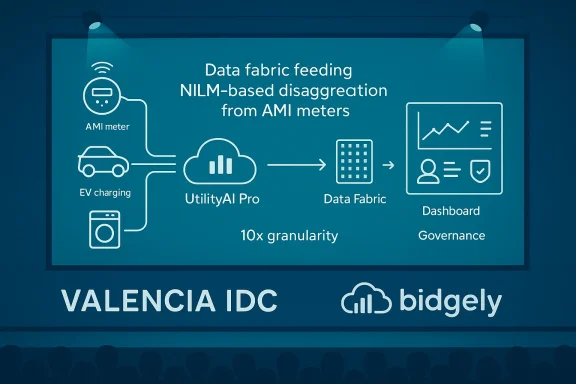
- 10× granularity claim: Product messaging repeatedly states UtilityAI Pro delivers up to 10× greater data granularity on meter, customer, and grid datasets versus typical enterprise deployments—an argument targeted at CIOs who face high integration costs and technical debt.
- Behind‑the‑meter intelligence: Appliance-level disaggregation from AMI, EV and DER detection, and short-term load forecasting designed to inform both operational teams and customer experience (CX) channels.
- Generative/agentic layers: Integration points for GenAI interfaces, copilots, and agentic workflows that surface energy intelligence in call centers, customer portals, and operational dashboards.
- Zero-hardware approach: Emphasis on extracting appliance- and event-level signals solely from meter reads (non-intrusive), avoiding new in-home hardware installs.
Why this matters now
Several concurrent trends make Bidgely’s thesis timely:- Smart meter rollouts across Europe have increased the volume and frequency of behind-the-meter telemetry, creating a rich raw dataset that, in principle, supports higher-resolution analytics.
- Regulators and market operators are testing and implementing dynamic pricing and TOU regimes that require accurate attribution of load and the ability to trust customer-facing nudges.
- DSOs increasingly need granular visibility into low-voltage networks to plan for transformer loading, non-wires alternatives (NWAs), and DER orchestration without deploying invasive hardware at scale.
- Contact centers and customer experience teams are under pressure to reduce call volumes while delivering personalized, actionable advice—something appliance-level insights can supply.
Technical mechanics: what UtilityAI Pro promises, and what to scrutinize
How Bidgely says it works
Bidgely’s platform approach centers on three technical pillars:- Data fabric and in-cloud deployment: The company positions UtilityAI Pro as a set of models and services that can run in a utility’s existing cloud or data lake, minimizing migration and centralizing governance.
- Disaggregation and DER detection: Proprietary ML models perform non-intrusive load monitoring (NILM) on AMI reads to identify appliance signatures, EV charging events, solar self-consumption, and other behind-the-meter phenomena.
- Generative interfaces and operationalization: Output feeds are designed for downstream systems—call centers, ADMS/DERMS, marketing platforms, and executive dashboards—and to power GenAI copilots for staff and customers.
Company claims to note
- Patents and IP: Bidgely emphasizes a portfolio of patents around disaggregation and related methods as competitive moat.
- Scale: Messaging includes figures for large installed bases (tens of millions of meters or homes) and a multi-utility deployment footprint.
- Performance improvement: Claims of improved call-center metrics, program participation and grid planning accuracy are frequent in product materials.
Where to apply scrutiny
- Disaggregation accuracy at AMI granularity: Smart-meter sampling resolution varies widely across regions (15-minute, 30-minute, hourly), and the fidelity of NILM-style disaggregation falls with coarser sample rates. Any utility buying behind-the-meter disaggregation should insist on performance metrics specific to their AMI cadence and sample size. Accuracy claims that don’t specify meter intervals, appliance classes, and confidence bands are incomplete.
- 10× granularity metric: “10× granularity” is a powerful marketing shorthand; utilities should ask for quantitative definitions and reproducible benchmarks. Does it mean 10× more features, 10× more model resolution, or 10× improvement in certain KPIs? Insist on a clear, measurable baseline and test datasets.
- Working with legacy operational stacks: Packaging models as containers helps portability, but integrating those outputs into ADMS, outage management, and billing/CIS systems remains nontrivial. Expect project planning and integration engineering to be material cost centers.
- Generative and agentic layers: Copilots and GenAI interfaces introduce new failure modes—hallucinations, misattribution of savings, or overconfident energy advice. Operational guardrails and human-in-the-loop validation are prerequisites.
Use cases and near-term benefits
Bidgely centers its value proposition on converting AMI intelligence into measurable outcomes. Typical use cases highlighted include:- Customer engagement and TOU adoption: Appliance-level profiles and EV detection enable targeted offers and personalized nudges to encourage load shifting under TOU tariffs.
- Call-center effectiveness: Pre-populated, explainable energy reports and conversational copilots can reduce average handle time and call volumes for billing and consumption queries.
- DER and EV program targeting: Utilities can identify candidate households for managed charging, solar adoption programs, and demand-response recruitment without deploying new metering.
- Grid planning and NWAs: Aggregated appliance and EV load profiles enable tighter low-voltage planning, more accurate transformer loading forecasts, and better identification of non-wires alternatives.
- Revenue protection and loss detection: Disaggregation techniques can flag non-technical losses or anomalous load shapes that warrant investigation.
Strengths: what Bidgely brings to the table
- Domain-specific models: Vertical AI trained on energy-use patterns offers a meaningful advantage over general-purpose LLMs for meter- and appliance-level problems.
- Deployment flexibility: Running models inside a customer’s preferred cloud addresses data sovereignty and governance concerns—important in European markets with strict data residency and privacy norms.
- Established IP: A portfolio of patents around disaggregation suggests sustained R&D investment and a level of technical maturity.
- Tangible, cross-functional use cases: The same intelligence can serve CX, operations, marketing, and planning—supporting enterprise-wide benefits rather than a single siloed win.
- Event and partner footprint: Active participation in industry gatherings and a partner list that spans hyperscalers and platform vendors increases validation opportunities and integration routes.
Risks, unknowns, and governance considerations
Accuracy and variability
Non-intrusive load monitoring depends on sample frequency, appliance diversity, and regional load patterns. Utilities with hourly AMI may not get the same appliance resolution as those with 1–15 minute reads. Expect varying detection confidence across appliance classes and geographic markets. Any accuracy percentage quoted by vendors must be validated against local AMI datasets.Privacy and regulatory exposure
Europe’s privacy framework (GDPR and related guidance) requires careful lawful basis for processing and, in many cases, explicit consumer transparency. Appliance-level inferences are sensitive: identifying an EV or medical device in a home may be legally protected or politically sensitive. Utilities must conduct Privacy Impact Assessments (PIAs) and align with data protection authorities before operationalizing disaggregation outputs in customer-facing channels.Consumer trust and consent
Delivering personalized energy advice tied to billing or pricing changes risks eroding trust if signals are inaccurate. Utilities must ensure explanations are simple, auditable, and offer opt-out or correction mechanisms for customers who dispute inferences.Model governance and explainability
Vertical AI models must be subject to the same lifecycle controls as other utility software: versioning, retraining governance, drift detection, and incident response. Regulatory or audit requests will demand explainability for customer-impacting decisions (e.g., targeting for TOU migration or dynamic price signals).Vendor lock-in and technical debt
Platform approaches that require heavy integration with a vendor’s model API can create lock-in. Containerized deployments reduce this risk, but data schema, feature engineering pipelines, and operational playbooks must remain portable. Utilities should demand exportable model artifacts and reproducible retraining pipelines.Cybersecurity and operational risk
Exposing high-resolution energy intelligence to more systems increases attack surface. Strong identity, access management, encryption-at-rest and in-transit, and privileged access monitoring are non-negotiable.Regulatory landscape and the challenge of TOU adoption
Europe’s regulatory environment is diverse—some nations already encourage dynamic pricing pilots, while others maintain stronger consumer protections. Implementing TOU and dynamic tariffs requires clear public communications and consumer protections; AI-driven personalization can be a force multiplier for adoption, but only if customers trust the underlying inferences.- Transparency rules: Utilities must be ready to explain how an AI-generated recommendation or TOU campaign was created.
- Affordability protections: There’s a political dimension—shifting vulnerable customers onto TOU without safeguards risks backlash.
- Metering standards: Differences in AMI penetration and sampling cadence across countries will directly affect the applicability of NILM-based products.
Practical evaluation checklist for utilities
If your utility is evaluating Bidgely or any vertical AI vendor, consider this pragmatic checklist before procurement:- Define clear KPIs and success criteria: e.g., call volume reduction, percentage uptake of TOU, transformer overload alert accuracy, false positive rates for EV detection.
- Validation with local data: Require vendor trials on a representative sample of your AMI dataset with signed confidentiality agreements and reproducible benchmark results.
- Specify AMI-sampling-aware SLAs: Ensure the vendor documents performance at your meter cadence (hourly vs. sub-hourly).
- Privacy and PIA documentation: Obtain a completed Privacy Impact Assessment and contractual commitments on data use, retention, and deletion.
- Model governance artifacts: Ask for retraining cadence, drift detection methods, and a plan for anomaly handling.
- Explainability and consumer messaging: Review the candidate language and UI that will be used to explain AI-derived findings to consumers.
- Integration plan: Request a technical runbook for integration into CIS, ADMS/DERMS, call-center systems, and marketing automation.
- Exit and portability terms: Ensure you can export models and historical outputs in usable formats if the relationship ends.
- Security and compliance audit: Mandate a third-party security assessment and supply SOC2 / ISO 27001 evidence where applicable.
- Pilot governance and stakeholder alignment: Create a cross-functional steering group (IT, operations, privacy, legal, customer experience) to review pilot results.
Strategic recommendations for DSOs and retailers
- Start with a targeted, measurable pilot that aligns to a specific operational or commercial outcome—don’t attempt to boil the ocean.
- Prioritize use cases where meter data already provides the right signal-to-noise ratio (e.g., EV detection in regions with frequent high-resolution reads).
- Co-design customer communications with customer-experience and legal teams so that personalized recommendations are accurate, transparent, and culturally appropriate.
- Build governance for AI outputs used in operational decisions—ADMS or grid-control actions that rely on inferred DER presence need higher confidence thresholds and human oversight.
- Conduct independent accuracy and fairness audits periodically, and publish summarized findings for regulator and stakeholder transparency.
The market context: where Bidgely fits and what alternatives look like
Bidgely’s vertical approach is one of several industry responses to the challenges facing utilities. Large meter vendors, grid-platform providers, and hyperscalers are all pushing AI-enabled offerings: some embed processing at the meter edge, others partner with analytics vendors, and a few utilities build in-house competencies. Bidgely’s differentiators are its long-running focus on NILM-style disaggregation, patents covering EV and appliance detection, and an explicit packaging strategy aimed at CIOs worried about technical debt. Utilities should weigh this against alternatives that offer:- On-premise edge analytics (lower latency but higher device fleet management cost).
- Hyperscaler-built outcome platforms (scale and integration, but potential data residency or vendor dependency concerns).
- Open-source NILM toolkits (flexible but requiring significant in-house data science investment).
Conclusion
Bidgely’s presence and messaging at IDC European Utilities Xchange underscore an important, industry-level recalibration: the next wave of utility AI will likely be vertical, contextual, and data-governed. For many DSOs and energy retailers, that shift promises measurable operational gains—if, and only if, vendors’ accuracy claims are validated on local AMI datasets, governance and privacy controls are implemented, and communications to customers are transparent and trustworthy.UtilityAI Pro’s proposition—deploying domain-trained models inside a utility’s cloud and surfacing behind-the-meter intelligence to operations and CX—addresses a genuine need. But buyers must treat headline claims (10× granularity, appliance-level accuracy, and broad household coverage figures) as starting points for rigorous testing, not as procurement substitutes. The promise is real; the pathway to durable, scalable value requires disciplined pilots, strong privacy practices, and enterprise-grade model governance.
For utilities navigating dynamic pricing, electrification, and the proliferation of DERs, the question is not whether AI will play a role—it's whether the AI they choose is built for the grid’s specific realities, and whether their organizations are prepared to govern it. Bidgely’s IDC showcase clarifies one practical route forward, but the ultimate success will depend on measurable accuracy, accountable governance, and a careful, customer-first rollout.
Source: StreetInsider Bidgely to Showcase AI-Powered Energy Intelligence at IDC European Utilities Xchange
