

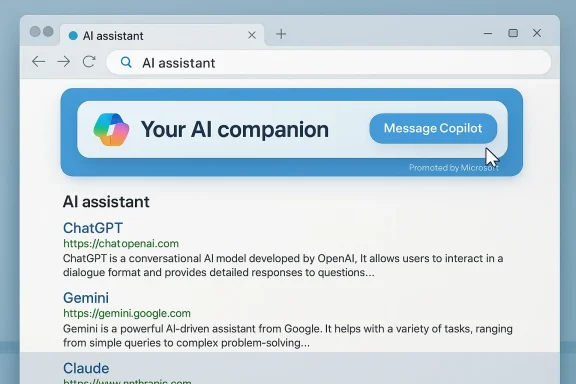
Microsoft’s search engine is now actively steering queries for rival chatbots toward its own assistant: users who type “ChatGPT,” “Gemini,” “Claude,” or similar terms into Bing can be met with a prominent Copilot banner and an inline prompt that invites them to “Message Copilot” instead of immediately visiting the competitor’s site. The move, discovered and documented by multiple outlets and community observers, is both a marketing masterstroke and a lightning rod for user‑experience, competition and regulatory criticism.
I also examined internal community threads and uploaded material about the subject submitted to our site; these internal accounts record similar observations and frame the story as part of a larger Copilot‑push inside Microsoft’s product matrix. That locally provided material aligns with the public reporting and adds user‑experience anecdotes that reinforce the central claim.
Source: Caliber.Az Bing pushes Microsoft Copilot over ChatGPT, Gemini | Caliber.Az
 Background
What is Copilot and why it matters
Microsoft Copilot is the company’s generative‑AI assistant family that sits across Bing, Microsoft Edge, Windows and Microsoft 365. The product line represents Microsoft’s strategy to turn conversational AI into a default interaction layer for search, productivity and enterprise workflows—positioning Copilot not as a standalone app but as a built‑in assistant across its platform stack. This broader strategy (and the renaming of Bing Chat to Copilot in many places) helps explain why Microsoft has both the incentive and the technical ability to push the assistant from search results into everyday use.The broader competitive landscape
The market for conversational assistants is dominated in public attention by OpenAI’s ChatGPT and Google’s Gemini, with Anthropic’s Claude and a handful of other services competing for niche and enterprise users. Each of these players competes not just on model quality but on distribution: which assistant is easiest to reach in the places users already visit. Microsoft’s advantage is built on distribution—Windows, Office, Edge and Bing—while Google’s is integrated into Search and Android; OpenAI’s is platform‑agnostic but benefits from the large ecosystem of apps and integrations that use its models. The banner tactic is an extension of that distribution play: capture intent in the moments users show interest in an alternative and redirect it into your own assistant.The tactic: what was observed
How the Copilot banner appears
Observers report that when users search Bing for the names of rival chatbots—ChatGPT, Gemini, Claude, Grok—the top of the results page can be replaced or visually dominated by a large Copilot module. That module is presented as a prompt box labeled “Your AI companion” or “Message Copilot” and accepts queries directly; submitting that inline field sends the query into Copilot and may open copilot.microsoft.com or invoke Copilot within the browser. The module has a tiny “Promoted by Microsoft” marker in some implementations, but that disclosure is small and easily missed by casual users.Evidence from reporting and community tests
Multiple outlets and community posts documented the behavior, sharing screenshots and first‑hand tests showing the Copilot prompt sitting above the organic result links. Coverage across Windows Latest, PCWorld, TechRadar and others provided consistent descriptions: the Copilot element either appears as a large, centered banner or as a prominent interactive box, and in many tested cases it effectively sits “above” the search results most users expect to see.The user experience consequence
Because the Copilot prompt resembles a search input, casual users can be confused about which assistant they are addressing. In practice, the banner increases the likelihood that a user’s query will be handled by Copilot rather than the third‑party service they intended to reach—exactly the effect Microsoft likely planned. Critics call it deceptive or at least aggressively promotional given the prominence and the ambiguity of the prompt; defenders note that the banner is marked as an advertisement and that platform owners commonly promote their own services.Technical and product context
Why Bing is uniquely positioned to do this
Bing is not just a standalone search site for Microsoft—a Copilot integrated into Bing has direct access to the company’s search index, citation mechanisms and browsing connectors. Microsoft’s Copilot Search and Copilot Mode initiatives are explicitly designed to blend search with conversational assistance, and the company has been iterating on UI experiments (sidebar prompts, New Tab Copilot prompts, integrated avatar experiences) that make the assistant a persistent front‑door to web information and productivity tasks. The banner tactic is an application of those experiments: treat a competitor query as an opportunity to demonstrate the Copilot experience inline.What the banner actually does behind the scenes
When the inline Copilot box appears, it can accept natural‑language input and then either run the query inside the embedded Copilot experience or redirect the user to the Copilot site or sidebar. Technically, that behavior is implemented at the search UI layer: Bing can conditionally render a promoted Copilot module when the query string matches known competitor keywords. Because the element is created and served by Bing itself, it works across browsers and is not limited to Edge—where Copilot has even deeper integration—so it functions wherever Bing is used.Why Microsoft would do this (the strategy)
- Leverage distribution: With hundreds of millions of Windows and Office users, Microsoft benefits from any measure that nudges more searches into Copilot. Turning competitor searches into Copilot experiences is an accelerated path to awareness and trial.
- Lower acquisition friction: Getting users to try an assistant while they already have a question minimizes signup friction and increases the chance of habit formation.
- Monetization and engagement: More Copilot sessions can translate into more consumer or enterprise conversions, data for model improvement and more time in Microsoft properties—each an economic return for Microsoft.
Strengths of the move
Immediate trial and conversion
The single‑most powerful business advantage is immediacy: users don’t have to click through to a different site and may try Copilot by accident or curiosity. That frictionless introduction is far cheaper for Microsoft than advertising on other properties or building third‑party partnerships.Product demonstration in context
The banner presents the product where user intent is already visible—someone searching “ChatGPT” likely wants to try a conversational model. Demonstrating Copilot in that moment is an effective product demo that can highlight web‑connected features like real‑time browsing and citations.Scales across Microsoft properties
Because Copilot is stitched into Edge, Windows and Microsoft 365, the tactic can be amplified with cross‑product prompts (new tab prompts, Edge suggestions, Office add‑ins) to create a multi‑touch conversion pathway.Risks, harms and criticisms
User experience and trust
Designers and consumer advocates argue that a prominent inline prompt that closely resembles a search box risks misleading users. If the “promoted” tag is visually subtle, users may not realize they’ve been redirected into a Microsoft‑branded assistant instead of the independent site they searched for. That can erode trust in both Bing and Copilot when users perceive the interaction as manipulative.Platform self‑preferencing and antitrust exposure
The tactic is a textbook example of platform self‑preferencing: the platform owner uses search placement to promote its own downstream product. Regulators in multiple jurisdictions have scrutinized similar behaviors—most famously in search and app‑store contexts—and critics have suggested this could attract fresh antitrust interest if competitors or regulators conclude the placement distorts competition. Coverage of the banner has explicitly invoked UX and antitrust concerns in multiple outlets.Damage to partner relationships and reputation
Rivals, publishers and partners who rely on predictable search referrals can be harmed if those referral patterns are disrupted. Even if the promoted module is technically an advertisement, the ambiguity of its presentation can sour relationships with publishers whose clicks are suppressed. That reputational cost is harder to quantify but real—particularly for Microsoft’s relationships with large enterprise customers sensitive to perceptions of anti‑competitive behavior.Potential for negative conversion and churn
If users the experience inferior for that particular task, the banner may backfire—converting searchers only to lose them to competitors with better performance in subsequent interactions. In short, the short‑term traffic gain could yield long‑term attrition if the product experience doesn’t match expectations.Cross‑checking the claim: what the coverage shows
I reviewed the reporting and community evidence on this tactic and verified the core claim—Bing rendering a Copilot promotional module in response to searches for rival assistants—with several independent outlets and community reports. Windows Latest and Windows Central were among the first to document the behavior and include screenshots; Forbes and PCWorld amplified the story with analysis of the user‑experience and competitive implications; TechRadar and Tech/Yahoo syndication echoed the user confusion and the small “promoted” disclosure. Those independent corroborations make the reporting reliable: multiple tests and screenshots from different sources all show the same pattern.I also examined internal community threads and uploaded material about the subject submitted to our site; these internal accounts record similar observations and frame the story as part of a larger Copilot‑push inside Microsoft’s product matrix. That locally provided material aligns with the public reporting and adds user‑experience anecdotes that reinforce the central claim.
Legal and regulatory view (what to watch)
- Antitrust and competition law: Regulators will assess whether Bing’s placement of Copilot meaningfully forecloses rivals from competing for user attention in an important distribution channel; similar questions have been central in prior cases involving search and platform owners.
- Advertising disclosure standards: Consumer protection agencies may ask whether the “Promoted by Microsoft” label is sufficiently prominent and clear in practice. If users are likely to be misled, regulators can require changes to disclosure design.
- Platform fairness policy: In some regions, legislation is shaping rules to prevent dominant platforms from abusing their gatekeeper role. If such rules strengthen, Microsoft’s internal playbook for promotions will face tighter constraints.
Practical implications for users, admins and publishers
For everyday users
- Know where you are typing: if you specifically want to use ChatGPT or Gemini, open the vendor site or app directly rather than relying on a search result that might include a Copilot prompt.
- Check disclosure: look for the “Promoted by Microsoft” label if you’re unsure whether the box is an ad.
- Use your preferred search engine or private browsing mode if you want a less promoted result set.
For IT administrators
- Review enterprise defaults: if your organization mandates Edge/Bing defaults, be aware that users searching competitor names may be funneled into Copilot sessions.
- Update training and support materials: educate employees about how Copilot banners behave so they don’t unintentionally share corporate queries with a third‑party assistant.
- Consider policy controls: where applicable, use browser and network controls to route sensitive lookups to vetted resources or to block third‑party sharing.
For publishers, app developers and competitors
- Monitor referral patterns: keep an eye on referral traffic to determine whether the banner reduces clickthroughs to your site.
- Diversify distribution: rely on multiple channels for discovery so a single search‑engine behavior change doesn’t disproportionately impact traffic.
- Raise issues with platforms: if the behavior materially hurts your business, collect data and consider engaging with platform support or industry groups to seek remedy.
Alternatives and countermeasures
- Use direct bookmarks or apps for services you trust rather than relying on search results.
- Employ third‑party search engines that don’t embed Copilot modules.
- Enable privacy‑focused settings or extensions that block promotional modules if they interfere with your workflow.
Critical analysis: was the tactic clever or short‑sighted?
There’s no doubt that the banner is clever from a marketing standpoint: it meets users at the point of intent, minimizes conversion friction and leverages Microsoft’s unique access to search UI. However, the tactic is short‑sighted in several ways.- It trades a potential long‑term brand trust dividend for a short‑term traffic bump. If users feel tricked or disappointed, the net effect may be negative.
- It increases regulatory and reputational risk by presenting a clear example of platform self‑preferencing in a high‑visibility area (search). That risk has real costs—investigations, mandated remedies, and changes to product rules.
- It assumes Copilot’s performance will satisfy trial users. If Copilot cannot reliably meet user expectations across the broad set of queries people bring (and many anecdotal reports suggest users still prefer other assistants in some contexts), then the tactic could accelerate user churn.
What Microsoft might argue
From Microsoft’s perspective, the banner is simply another promotional placement—an ad for a product on its own property—and thus within its rights to serve. The company can point to the small “Promoted by Microsoft” disclosure and argue that competing platforms do similar things (for example, Google highlights Gemini and its own features inside Google Search and Android). Microsoft can also claim that the integration is beneficial to users by showcasing an assistant with web access and citation features. Those defenses are plausible, but they do not address the core UX question of whether the placement is likely to mislead a significant number of users.Recommendations — responsible steps forward
- For Microsoft: increase the prominence and clarity of promotional labeling; experiment with less intrusive placements (sidebars, subtle prompts) that do not impersonate search inputs; measure downstream effects (satisfaction, retention) not just immediate traffic.
- For regulators: monitor behavior patterns and require transparent disclosures when platform owners promote affiliated services in core discovery flows.
- For enterprises and IT leaders: update guidance and security controls to account for in‑search promotional modules that can redirect queries to external assistants.
- For users and journalists: document and publish reproducible tests so the public record reflects the frequency, placement and effect of promotional modules.
Conclusion
The Copilot banner tactic is a revealing example of how the AI era is reshaping the fundamentals of discovery on the web. Microsoft is using its search real‑estate to turn competitor queries into product trials—a strategy that may move numbers quickly but that also invites scrutiny on grounds of user experience, fairness and competition. Multiple independent tests and news outlets corroborate the behavior, and community reports echo its real‑world impact. As conversational assistants become the new interface for information, the architecture of discovery will matter more than ever; platform owners will be judged not only on the capabilities of their models but on how fairly and transparently they steer users toward them.Source: Caliber.Az Bing pushes Microsoft Copilot over ChatGPT, Gemini | Caliber.Az
