

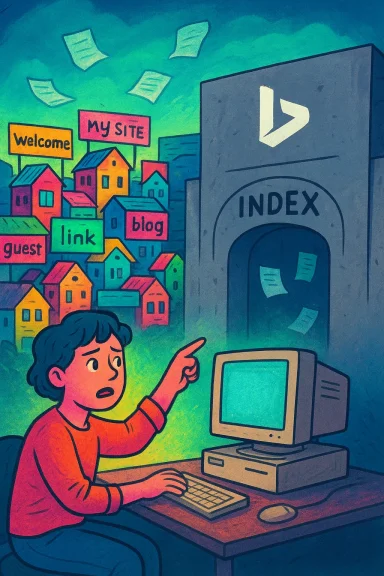
Microsoft’s Bing removed roughly 1.5 million independent websites hosted on Neocities from its search index in January 2026, a sweeping de‑indexing that left thousands of personal and creative sites invisible to Bing users and to other services that rely on Microsoft’s index. The block was first disclosed publicly in a Neocities blog post on January 27, 2026 and reinforced by reporting from Ars Technica, which documented the founder’s attempts to remediate the issue and Microsoft’s limited, partial response.
Neocities launched as a revival of the amateur, hand‑crafted web spirit—an antidote to templated, platform‑driven pages. Over time it grew into a substantial social host for hobbyists, artists, fans, and small projects, hosting on the order of 1.4–1.5 million subdomains and drawing billions of human visits over its history. The platform’s founder, Kyle Drake, maintains a moderation process aimed at removing malicious pages, and the site’s public statement emphasizes that the vast majority of Neocities content is personal, creative, and noncommercial.
Search engines act as the primary discovery mechanism for most web users. When a publisher or host is removed from a major index, the consequences are immediate and material: lost referrals, reduced visibility, and, in some cases, increased exposure to impersonation or phishing if a blocked domain is supplanted by copycat pages that can rank in its stead. For creators who rely on organic searches—or whose audiences use default platform search tied to Microsoft products—the impact can be existential, even when the blocked content is legitimate.
This combination—acknowledgement of enforcement without granular transparency—exposes a core tension for major platforms: how to operate automated defenses at scale while preserving meaningful redress for legitimate site operators. Microsoft’s broader public materials about combating abusive AI‑generated content and nonconsensual imagery underline the company’s investments in safety, yet they also reflect that these same safety mechanisms are increasingly automated and aggressive in scope.
A few policy implications merit attention:
Neocities’ response—publicly disclosing the issue, documenting the population affected, and urging temporary avoidance of Bing—worked in one pragmatic way: it drew attention and prompted partial restoration. That reaction also raises an awkward truth for small hosts: public pressure and press coverage are sometimes the only avenues to surface a problem in the absence of accessible internal escalation.
For creators and community hosts, the lessons are practical and urgent: harden discovery channels, monitor index status, and diversify traffic sources. For search engines and platforms, the lesson is strategic: invest in explainability, rapid human review lanes, and narrowly tailored mitigations so that defending users from abuse does not inadvertently silence entire swaths of legitimate culture.
The internet’s diversity—its hand‑made pages, idiosyncratic projects, and passionate microcommunities—relies on discoverability to survive. Automated defenses are necessary, but they must be paired with transparent, human‑centered remediation. Until that balance is achieved, episodes like Neocities’ will repeat: large platforms will protect users from some harms while imposing another, equally real harm on communities that found safety and joy in being seen.
Source: Technobezz Microsoft Blocks 1.5 Million Neocities Sites from Bing Search Results
 Background / Overview
Neocities launched as a revival of the amateur, hand‑crafted web spirit—an antidote to templated, platform‑driven pages. Over time it grew into a substantial social host for hobbyists, artists, fans, and small projects, hosting on the order of 1.4–1.5 million subdomains and drawing billions of human visits over its history. The platform’s founder, Kyle Drake, maintains a moderation process aimed at removing malicious pages, and the site’s public statement emphasizes that the vast majority of Neocities content is personal, creative, and noncommercial. Search engines act as the primary discovery mechanism for most web users. When a publisher or host is removed from a major index, the consequences are immediate and material: lost referrals, reduced visibility, and, in some cases, increased exposure to impersonation or phishing if a blocked domain is supplanted by copycat pages that can rank in its stead. For creators who rely on organic searches—or whose audiences use default platform search tied to Microsoft products—the impact can be existential, even when the blocked content is legitimate.
What happened: timeline and key facts
- On January 27, 2026, Neocities published a public post stating that Bing had “completely blocked the domain neocities.org, including the front site and all user subdomains,” and warned that the block affected Bing‑powered search engines as well. The post urged users to avoid Bing until the problem was fixed.
- Shortly thereafter, Ars Technica reported that Kyle Drake discovered the problem when Bing‑sourced traffic to Neocities dropped from about half a million daily visitors to zero. Drake submitted multiple support tickets through Bing Webmaster Tools and tried other escalation paths, including purchasing ads to surface a human contact, but he faced what he described as automated or chatbot‑driven support workflows.
- After public reporting, Microsoft appears to have removed at least some inappropriate blocks—Neocities’ front page reappeared in Bing results within a short window—but many individual subdomains remained excluded from the index. Microsoft told reporters that some Neocities content had been delisted for violating policies intended to keep low‑quality or unsafe content out of search, but Microsoft did not identify the specific sites or share concrete examples with Neocities to enable remediation.
- The scale of the blockade—reported as roughly 1.5 million sites—created a domain‑wide effect that prevented site owners from seeing which, if any, of their pages had been flagged or why. Neocities says it repeatedly requested targeted information from Microsoft so it could remove any genuinely problematic pages, but that a lack of transparent guidance and human follow‑through blocked remediation attempts.
Why this matters: scale, the indie web, and default discovery
Search engines are not neutral plumbing; they are the primary gateway most users employ to find people, communities, and resource pages. For a decentralized community like Neocities—where users host their own small sites—search visibility is the modern equivalent of being listed in a phonebook or index of local businesses. A domain‑level block therefore hits the whole ecosystem at once.- Scale: Neocities hosts on the order of 1.4–1.5 million sites, many of which are personal homepages, experimental projects, or fan builds that exist for the pleasure of being found by curious visitors. Removing that corpus from a major index is a blunt instrument with broad side effects.
- Default discovery: Windows and other popular platforms make Bing the default search surface for many users. When the default search engine excludes an entire host, casual discovery—especially by nontechnical audiences—effectively disappears. Because several smaller search services license Bing data, the impact cascades beyond Bing itself. Neocities warned specifically that DuckDuckGo and other Bing‑powered results may fail to show Neocities content.
- Small creators are fragile: Unlike large publishers with engineering teams, independent creators typically lack the resources and technical interfaces to diagnose and remediate indexing issues. Blanket or opaque blocks shift the burden of discovery restoration onto authors who have neither the leverage nor the technical support to resolve platform misclassification quickly.
Technical anatomy: how search engines decide to block domains
Search engines use a mixture of automated signals and human review to protect users from spam, phishing, malware, and low‑quality content. That protection is necessary, but the mechanics create failure modes:- Automated classification at scale. Modern search engines ingest trillions of signals; classifiers flag pages based on patterns associated with abuse—phishing templates, malicious redirects, scraped or auto‑generated content, or large volumes of near‑duplicate pages. When a domain exhibits any of these signals across many subdomains, automated systems can choose a domain‑level mitigation (e.g., delisting a host or applying a wildcard exclusion) to reduce systemic risk quickly.
- Domain vs. page granularity. Blocking a single subdomain or page is operationally precise. Blocking an entire host is operationally blunt. Domain‑level blocks are sometimes the result of an automated decision that sees many indicators at once and opts for a risk‑reduction action that inevitably over‑indexes legitimate content. The Neocities case appears to be such an overbroad mitigation.
- Appeals and human review bottlenecks. The ability for a site owner to receive actionable diagnostic signals—exactly which URLs triggered policy flags, which rules were violated, and how to remediate—is essential for resolving false positives. When support interfaces are automated chatbots or when appeal queues are buried, domain owners cannot complete the remediation loop. Ars’s reporting highlights that Drake’s tickets and attempts to escalate were frustrated by automated systems that did not produce a human, timely response.
- Policy opacity and the “black box” problem. Search platforms often publish high‑level policies about spam, phishing, and low‑quality content, but the concrete thresholds and model features that trigger a delist rarely appear in detail. That opacity protects abuse‑mitigation tactics from adversaries, but it also prevents well‑meaning site operators from understanding specific failures and fixing them at scale.
The human impact: creators, communities, and the risk of harm
The immediate victims of broad de‑indexing are the creators and users of the affected pages. The practical harms include:- Lost referral traffic: Many Neocities creators rely on organic search for discovery. Sudden disappearance from Bing reduces both ad revenue potential (for those who monetize tangentially) and general audience reach.
- Misinformation and impersonation risk: The Neocities blog and Ars reporting highlight an additional hazard: blocked official pages can be supplanted by copycat or phishing pages that compete in search results. If an index excludes the legitimate domain but does not prevent rogue domains from ranking, users may be routed to malicious or fraudulent copies. Neocities reported that a clone of its front page briefly appeared in Bing results, raising concerns about credential theft or confusion.
- Community chilling: When a platform that supports indie creativity can be removed from discovery without notice, it undermines confidence in small‑site hosting and the broader indie web movement, pushing creators toward centralized networks that are more discoverable but less freeform.
- Operational burden on single maintainers: Drake and the Neocities staff reported that remediation required negotiating with an opaque support stack. For smaller hosts with fewer hands on deck, automated blocks are effectively unresolvable without public escalation paths.
Microsoft’s position and public response
Microsoft acknowledged that some Neocities sites had been delisted as part of policy enforcement intended to keep “low‑quality or unsafe” content out of Bing, and the company took action to derank at least one suspicious clone that had been appearing ahead of legitimate content. However, Microsoft did not identify specific sites or provide Neocities with the actionable details needed to remediate flagged content, and it did not commit to a timeline for a full reindexing. Journalistic accounts show that Microsoft did restore Neocities’ front page quickly after public pressure, but many subdomains remained blocked.This combination—acknowledgement of enforcement without granular transparency—exposes a core tension for major platforms: how to operate automated defenses at scale while preserving meaningful redress for legitimate site operators. Microsoft’s broader public materials about combating abusive AI‑generated content and nonconsensual imagery underline the company’s investments in safety, yet they also reflect that these same safety mechanisms are increasingly automated and aggressive in scope.
Risks and systemic implications
The Neocities incident surfaces several systemic risks that go beyond one host:- Collateral damage from automated moderation: Platforms will continue to scale automated checks. Without robust appeals, false positives will grow. The more aggressive the enforcement, the greater the potential collateral damage to niche communities and small sites.
- Overreliance on a single discovery provider: When many secondary search services and consumer defaults rely on one provider’s index, a single error propagates widely. That concentration risk harms diversity of discovery on the web.
- Economic and cultural erosion: Independent cultural artifacts—personal pages, one‑off art projects, fandom micro‑sites—depend on indexing to survive. Blanket blocks accelerate the homogenization of what’s visible on the web, privileging big publishers and platform content.
- Security paradox: An attempt to reduce phishing can unintentionally increase opportunities for impersonation if legitimate pages are removed but malicious imitators are not fully blocked or are quicker to game ranking signals.
- Regulatory and reputational exposure: Large search providers face growing scrutiny about default behaviors and gatekeeping. High‑profile collateral harm to small communities could attract regulatory attention concerning fairness, transparency, and the competitive effects of default settings on major operating systems.
Practical guidance for creators and hosts
If you run small sites or host an indie community, the Neocities incident is a cautionary tale. Here are concrete steps to reduce discovery risk and prepare for index outages:- Check index status regularly.
- Use both Bing Webmaster Tools and Google Search Console to monitor indexed pages and crawl errors.
- Run site:hostedsite.example queries on multiple search engines to detect partial or wholesale delisting.
- Publish sitemaps and canonical tags.
- Sitemaps speed discovery and reindexing. Submit a sitemap to every major search console you use.
- Use rel=canonical carefully to avoid accidental de‑ranking of desired pages.
- Maintain transparent abuse processes.
- Track takedown and abuse reports, remove confirmed malicious pages swiftly, and keep logs in case you need to demonstrate remediation to a search provider.
- Diversify discovery channels.
- Relying solely on organic search is fragile. Cultivate social links, community directories, and newsletters to maintain reach.
- Consider registering with web directories or using platform‑agnostic link collections (webrings, curated lists).
- Preserve backups and mirrors.
- If your site is at risk of being delisted, maintain independent copies or archives that can be re‑published under an alternate host in emergencies.
- Build relationships with platform support early.
- Verify ownership of your domain in webmaster consoles and document your communications with support. When automated tools fail, verified ownership can sometimes shorten manual review queues.
- Educate your audience.
- If you notice discovery failures, tell your visitors how to find you direct (bookmarks, social links) and warn about possible impersonators.
Recommendations for Microsoft and major search providers
Neocities’ experience shows predictable fixes that would reduce damage from large‑scale automated decisions:- Transparent blocking diagnostics: When a domain or site is delisted, providers should offer a precise, actionable diagnostic listing the URLs or classes of URLs flagged and the policy rationale, with specific remediation steps.
- Faster human escalation paths for community hosts: Create a dedicated appeals lane for small hosts and community platforms where domain owners can rapidly contact human reviewers when a domain‑wide mitigation is involved.
- Granular, temporary mitigations: Where possible, prefer page‑ or subdomain‑level actions instead of whole‑domain exclusions. If a domain shows mixed signals, apply conservative or graduated mitigations to minimize collateral harm.
- Audit logging and explanation for models: Maintain internal logs and a minimal explanation interface that lets site owners understand model decisions without exposing exploitable details.
- Cross‑index coordination safeguards: Communicate with major licensees who rely on your index to avoid uncoordinated propagation of domain‑wide blocks that cascade across discovery services.
- Community‑oriented remediation programs: Develop programs that help smaller, volunteer‑run hosts meet the technical expectations of indexing systems—templates for sitemaps, lightweight verification SDKs, and a small‑host support desk.
Broader policy angles: concentration, defaults, and responsibility
The incident also raises public policy questions. When a single vendor’s default (the search engine shipped with an operating system) becomes de facto public infrastructure for discovery, that vendor takes on responsibilities akin to a utility provider. Regulators and policy makers have increasingly examined default settings, gatekeeping behavior, and the distributional effects of platform algorithms.A few policy implications merit attention:
- Market concentration and resilience: Dependence on a single search provider amplifies the effects of any single decision. Encouraging diverse discovery pathways and interoperability can temper these system‑level vulnerabilities.
- Transparency requirements: Regulators could require greater transparency for indexing and moderation decisions when actions have systemic impact, especially where they affect large numbers of small actors.
- Due process and appeal rights: A formal appeal mechanism and service‑level expectations for indexing decisions would introduce accountability without undermining security tools.
- Consumer safety vs. cultural preservation: Policymakers should consider tradeoffs between aggressive content removal for safety and the cultural value of the indie web. Rules that help platforms balance these priorities would be constructive.
Final analysis and outlook
The Neocities de‑indexing episode is not simply a tech support failure; it is an instructive case study in the costs of operating content moderation at planetary scale without sufficiently robust human oversight and remediation channels. The problem is not new—false positives have affected publishers and sites for years—but the scope and cultural implications are growing as discovery concentrates and automated systems broaden their reach.Neocities’ response—publicly disclosing the issue, documenting the population affected, and urging temporary avoidance of Bing—worked in one pragmatic way: it drew attention and prompted partial restoration. That reaction also raises an awkward truth for small hosts: public pressure and press coverage are sometimes the only avenues to surface a problem in the absence of accessible internal escalation.
For creators and community hosts, the lessons are practical and urgent: harden discovery channels, monitor index status, and diversify traffic sources. For search engines and platforms, the lesson is strategic: invest in explainability, rapid human review lanes, and narrowly tailored mitigations so that defending users from abuse does not inadvertently silence entire swaths of legitimate culture.
The internet’s diversity—its hand‑made pages, idiosyncratic projects, and passionate microcommunities—relies on discoverability to survive. Automated defenses are necessary, but they must be paired with transparent, human‑centered remediation. Until that balance is achieved, episodes like Neocities’ will repeat: large platforms will protect users from some harms while imposing another, equally real harm on communities that found safety and joy in being seen.
Source: Technobezz Microsoft Blocks 1.5 Million Neocities Sites from Bing Search Results
