

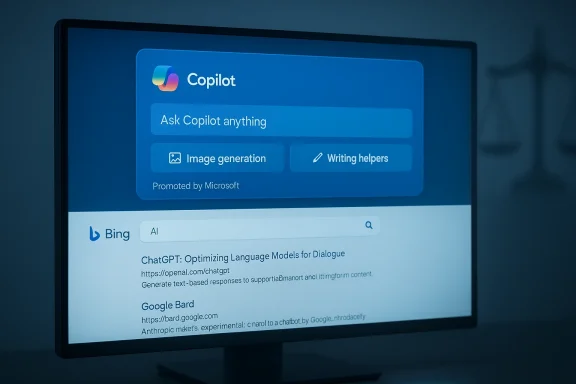
Microsoft’s Bing is now quietly — and conspicuously — steering users toward Copilot when they search for competing AI chat services such as ChatGPT, Gemini, and Claude, a move that has reignited debates over user experience, platform leverage, and potential regulatory scrutiny. Reports and community discoveries show a large, interactive Copilot box or banner placed above (or alongside) traditional search results; the widget is visually dominant, prompts users to try Copilot features directly on the results page, and in some tests appears to mimic the familiar search input, increasing the chance users will submit their queries to Microsoft’s assistant rather than the site they intended to visit.
Microsoft has been steadily embedding Copilot across its products for more than two years. What began as a conversational overlay in Bing evolved into an ecosystem strategy: Copilot features are now integrated into Windows 11, Microsoft Edge, and Microsoft 365, with Microsoft positioning Copilot as an “everyday AI companion” across devices and cloud services. Those product-level pushes set the stage for the latest tactic surface real-estate to advertise and route users toward Copilot when they explicitly search for rival AI tools.
Community forums and internal Windows-forum threads mirrored the media coverage, documenting user experiences, screenshots, and repeated instances where searches for “ChatGPT,” “Gemini,” or even “Google” and “Chrome” returned an oversized Copilot prompt that crowded out normal results. These community records make it clear the behavior is not an isolated A/B test but rather a recurring pattern across multiple users and builds.
Community threads further report the Copilot prompt occasionally greying out the rest of the page and highlighting the Copilot box upon returning to a tab, an interface behavior that amplifies its prominence and nudges users toward engagement.
Legal scholars and journalists have flagged the Copilot promotions as an example of such self-preferencing because Bing is a major entry point to the web for many users, and Microsoft controls both the platform and the promoted service. Coverage by multiple outlets draws parallels to earlier controversies, such as Microsoft’s historical browser-related antitrust issues and more recent platform scrutiny focused on search and app distribution. However, as of publishing, no formal regulatory case or public enforcement action has been announced specifically for this Copilot-in-Bing behavior.
At the time of reporting, there has been no definitive public statement from Microsoft that justifies the behavior as a user-benefit-driven test nor a public commitment to modify the experiment’s disclosure languagilence is notable given the volume of press coverage and community reaction.
Rivals publicly have not always responded with direct legal threats, but industry watchers expect the pattern to be raised in conversations among regulators and may be cited as context in future antitrust analyses if similar tactics persist or broaden.
The pattern echoes earlier promotional behaviors (notably the Edge-when-searching-Chrome episodes), and it will likely attract scrutiny from consumer advocates, rivals, and regulators if it persists or expands. For now, users and site operators can adopt mitigation tactics — and regulators should watch closely for material harm to competition or consumer deception. The long-term question remains whether platform owners should be allowed to convert their control over a discovery surface into persistent advantages for adjacent services — a debate that will now include the new battleground of AI assistants.
In the weeks ahead, expect continued reporting, more community-sourced screenshots and tests, and — quite possibly — formal inquiries if the balance between product innovation and platform fairness tips too far toward the latter.
Source: Zamin.uz Bing released Copilot instead of ChatGPT and Gemini
 Background
Microsoft has been steadily embedding Copilot across its products for more than two years. What began as a conversational overlay in Bing evolved into an ecosystem strategy: Copilot features are now integrated into Windows 11, Microsoft Edge, and Microsoft 365, with Microsoft positioning Copilot as an “everyday AI companion” across devices and cloud services. Those product-level pushes set the stage for the latest tactic surface real-estate to advertise and route users toward Copilot when they explicitly search for rival AI tools.Community forums and internal Windows-forum threads mirrored the media coverage, documenting user experiences, screenshots, and repeated instances where searches for “ChatGPT,” “Gemini,” or even “Google” and “Chrome” returned an oversized Copilot prompt that crowded out normal results. These community records make it clear the behavior is not an isolated A/B test but rather a recurring pattern across multiple users and builds.
What users are actually seeing
The widget: position, size, and function
Users who search Bing for competitor names report seeing a prominent Copilot box that:- Appears above the first organic result, occupying the prime visual real estate on the page.
- Contains an input field inviting the user to “Ask Copilot anything,” sometimes in a design that closely resembles a search box.
- Offers quick action tiles for features such as image generation, writing improvements, and other Copilot tasks — letting users run tasks without leaving the search results page.
Behavior and redirection
Crucially, the Copilot box is not merely a passive advert: it is interactive. If a user types into that Copilot input, the query may be handled by Microsoft’s Copilot service rather than the destination site the user likely intended to reach. Testers and multiple tech ou when the official ChatGPT or Gemini links still appear as top organic results in the list, the Copilot UI’s placement and interactive affordances can divert user queries into Microsoft’s assistant.Community threads further report the Copilot prompt occasionally greying out the rest of the page and highlighting the Copilot box upon returning to a tab, an interface behavior that amplifies its prominence and nudges users toward engagement.
Why the UX matters: design, clarity, and user expectations
At a basic level, search is a trust contract: users type a query and expect clear cues about what will handle their request. That trust is fragile when the UI blends product promotion and functional controls.- Visual mimicry: A Copilot input that resembles the classic search field breaches common expectations — users may assume the text they type will be routed to the site they searched for. Critics call this a dark-pattern adjacent design because it makes the promoted action easier and the non-promoted action marginally harder.
- Disclosure opacity: When the “Promoted by Microsoft” label is small or low-contrast, it reduces transparency about the origin and intent of the element. Observers note that users can easily overlook the disclosure while still being funneled into Copilot.
- Attention economy: The search engine’s prime real estate is being used to surface Microsoft-owned services; that leverage advantage matters because many users rely on the first visible item as their cue to act.
Competition, platform leverage, and regulatory angles
Self-preferencing and regulatory interest
Platform self-preferencing — giving one’s own products prominent placement over rivals — is at the heart of many modern antitrust examinations. Regulators in multiple jurisdictions have scrutinized similar behaviors: preferential placement of services on an operator’s own platform, tying or bundling, and leveraging a dominant position in one market to advantage another.Legal scholars and journalists have flagged the Copilot promotions as an example of such self-preferencing because Bing is a major entry point to the web for many users, and Microsoft controls both the platform and the promoted service. Coverage by multiple outlets draws parallels to earlier controversies, such as Microsoft’s historical browser-related antitrust issues and more recent platform scrutiny focused on search and app distribution. However, as of publishing, no formal regulatory case or public enforcement action has been announced specifically for this Copilot-in-Bing behavior.
Precedents and context
This tactic is not entirely novel in Microsoft’s playbook. Outlets previously documented Bing showing heavy promotions for Microsoft Edge when users searched for competing browsers such as Google Chrome — a move that generated public debate about fairness and disclosure. The Copilot promotion echoes that template: use search placement to redirect users toward Microsoft’s preferred service. Those earlier episodes are widely archived in community threads and tech coverage, and they help form a pattern of behavior that critics and regulators will examine.The technical mechanics and SEO consequences
From a technical perspective, Bing still returns organic results for the queried site (for example, the ChatGPT homepage), but the Copilot module is layered on top as an interactive prompt. That layering creates a two-fold effect:- It preserves the engine’s index integrity while changing the immediate interaction surface a user encounters.
- It creates a new conversion funnel where the search query is captured by the Copilot UI rather than sent to the organic result.
Business logic: whthis
There are plain business reasons for the design choice:- Copilot usage is a strategic KPI for Microsoft’s AI ecosystem, with direct tie-ins to subscription services, Microsoft 365 integration, and Copilot Pro upsells.
- Re-routing queries to Copilot reduces dependency on third-party services and keeps engagement and data collection inside Microsoft’s ecosystem.
- Demonstrating Copilot capabilities in the moment a user expresses interest in another AI assistant is a low-friction way to convert exploration into adoption.
Potential harms and user risks
Confusion and consent
Large, interactive promotional boxes that are functionally indistinguishable from search inputs can confuse users and erode informed consent. If users do not realize they are sending queries to Copilot (and potentially into Microsoft’s telemetry and personalization systems), that can be a privacy concern — particularly for sensitive topics. Community threads and tests have flagged exactly this kind of user confusion.Market effects and innovation
If major discovery channels routinely divert users to in-house services, smaller competitors face a harder climb. Innovation may suffer if independent players cannot reliably surface to user attention. Economists and competition scholars point out that reduced competition in adjacent services can slow improvements and raise prices down the line.Misinformation and trustworthiness
When a platform funnels investigative or news queries into an AI assistant, the quality and transparency of how the assistant constructs answers matters. Microsoft’s Copilot has had recent expansions — including health-focused previews — that make answer quality critically important; any upstream diversion of searches into less transparent or poorly-sourced responses magnifies misinformation risk. Community concerns about Copilot Health and similar features underscore the need for careful governance. ([blogs.microsoft.comsoft.com/blog/2024/10/01/an-ai-companion-for-everyone/)What Microsoft has said (and not said)
Microsoft’s broader messaging around Copilot emphasizes user empowerment through integrated AI across Windows, Edge, and the company’s cloud services. The official Copilot announcements and blog posts outline capabilities and vision, but they do not specifically address the design choices at issue here — namely the preferential placement of Copilot when users search for competing services. Observers and tech outlets have noted the gap between promotional strategy and explicit public explanation for the specific in-search behavior.At the time of reporting, there has been no definitive public statement from Microsoft that justifies the behavior as a user-benefit-driven test nor a public commitment to modify the experiment’s disclosure languagilence is notable given the volume of press coverage and community reaction.
How rivals and observers are reacting
Press outlets and tech commentators have pushed back on the tactic, calling it invasive or confusing, and some framed it as a sign Microsoft is using platform control to capture traffic that would otherwise flow to competitors. Forbes and industry press documented the user-facing details and framed the tactic as a direct competitive nudge at Google and OpenAI users. Community threads on tech forums amplified the reaction with screenshots and user anecdotes.Rivals publicly have not always responded with direct legal threats, but industry watchers expect the pattern to be raised in conversations among regulators and may be cited as context in future antitrust analyses if similar tactics persist or broaden.
How to protect your workflow and your users
For end users and administrators concerned about being diverted or about inadvertent query routing, practical steps exist:- Use a different search engine (or an alternate browser search engine) when you want to guarantee direct navigation to a particular site.
- Look for the “Promoted by Microsoft” disclosure and avoid typing into on-page Copilot inputs if you want to reach the organic result.
- In Edge and Windows settings, review Copilot-related toggles and privacy controls; some users report ways to limit Copilot visibility in widgets and the taskbar. Evidence and community support threads show options and workarounds for reducing Copilot’s in-UI prominence.
- Monitor referral traffic closely for sudden declines in organic click-throughs on queries that match your brand terms.
- Consider messaging and search-engine-optimized landing experiences that anticipate the Copilot funnel, e.g., quick on-page prompts that encourage users to continue with the destination site if they arrive via Copilot.
- Track user behavior and A/B test mitigation strategies to retain users who might be rerouted through Copilot.
- Monitor whether the Copilot module is systematically deprioritizing rivals’ organic results or materially reducing rivals’ referral traffic.
- Assess whether disclosures meet consumer-protection standards for clear labeling of promoted content and whether the practice rises to anti-competitive tying or self-preferencing under applicable law.
Strengths of Microsoft’s approach — and why it works
It’s worth acknowledging why Microsoft would deploy this approach:- Seamless integration: Copilot in Bing creates a seamless surface for users to try advanced AI features (image generation, summarization, code assistance) without leaving the search context.
- Lower friction for trial: By reducing the steps to a first interaction, the Copilot box lowers adoption costs and accelerates product familiarity.
- Ecosystem synergy: Copilot engagement funnels users into Microsoft’s broader services (Office, Azure, Microsoft account features), strengthening cross-product value capture.
Limits, unanswered questions, and verifiability
- The precise percentage of users affected by the Copilot box is not publicly disclosed. Media reporting and community evidence show the feature in multiple A/B tests and rollouts, but Microsoft has not published systematic metrics. That makes assessing the tactic’s real-world market impact difficult without internal data. Reported examples and screenshots are verifiable, but broad claims about market-share shifts should be treated cautiously until supported by telemetry.
- It is not always clear whether the Copilot UI appears universally across all geographies and user segments, or whether it is limited to certain builds, browsers, or logged-in states. Test coverage that we observed includes several independent confirmations but not a full mapping of scope. Community threads help fill that gap but are inherently anecdotal.
Bottom line
Microsoft’s decision to place a heavy, interactive Copilot prompt at the top of Bing results when users search for competitor AI services is a decisive growth tactic: it reduces friction to trying Copilot and channels search intent into Microsoft’s AI surfaces. That approach is effective as a product acquisition strategy but raises legitimate concerns about transparency, user control, and fair competition.The pattern echoes earlier promotional behaviors (notably the Edge-when-searching-Chrome episodes), and it will likely attract scrutiny from consumer advocates, rivals, and regulators if it persists or expands. For now, users and site operators can adopt mitigation tactics — and regulators should watch closely for material harm to competition or consumer deception. The long-term question remains whether platform owners should be allowed to convert their control over a discovery surface into persistent advantages for adjacent services — a debate that will now include the new battleground of AI assistants.
In the weeks ahead, expect continued reporting, more community-sourced screenshots and tests, and — quite possibly — formal inquiries if the balance between product innovation and platform fairness tips too far toward the latter.
Source: Zamin.uz Bing released Copilot instead of ChatGPT and Gemini
