

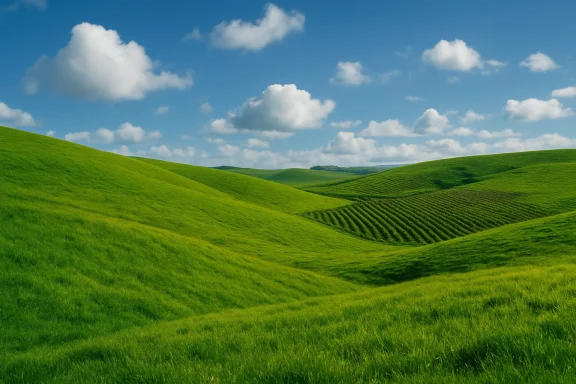
A rainy, lucky moment in California briefly returned one of computing’s most famous images to the real world: a Redditor’s smartphone photo of the Napa/Sonoma hill that inspired Windows XP’s default “Bliss” wallpaper shows the slope looking, for a few minutes, remarkably like the pastoral original millions of users remember. The resurfacing of that single hill — once a stock photograph, later the face of an entire operating system era — is more than a nostalgia hit; it’s a window into how photographs, software, memory, and place intersect in the digital age.
That distribution was literal and global. Windows XP shipped in the tens and hundreds of millions of copies; contemporary reporting and retrospective coverage commonly cite about 400 million copies sold within the first five years. That scale made Bliss an image many hundreds of millions of people saw by default on their monitors, cementing its place in the public consciousness.
Community reaction was predictable and instructive. Some people simply swapped the new photo into their own desktops; others used the moment to talk about changes to the hill over decades — vineyards returning, seasonal browning, landscape-management events like phylloxera cleanups — and what the image means as a cultural artifact. Local residents were reportedly considering revisiting the spot to see whether the hill would remain visually similar after vineyard recovery or pest interventions.
There are positives and pitfalls here. On the one hand, Bliss proves that authentic, well-made photography can outlast fashions and algorithmic trends. The photograph still moves people, decades later. On the other hand, the image’s afterlife also reflects commercial processes — stock licensing, corporate bundling, and the commodification of landscape — that complicate simple narratives of pastoral authenticity. If we’re honest, the Bliss story reveals that photographs are at once art, product, and memory device, and each role has implications for how we treat the places pictured.
Rediscoveries like this one should be a prompt: to celebrate well-made imagery, to remember the real places behind the pixels, and to consider the responsibilities of visitors, designers, and corporations when a private photo becomes public iconography. In the end, Bliss still works precisely because it was, and remains, a very good photograph — but it also works because the software that carried it made the whole world look at the same hill at the same time.
Source: TechSpot The Windows XP Bliss wallpaper still exists, and it briefly looks the same again
 Background
How a roadside photo became the most viewed picture on desktops
In January 1996, photographer Charles O’Rear stopped his truck on a country road in southern Sonoma County — near the Napa–Sonoma county line — and took four frames of a green, rolling hill under a blue sky. The photograph, originally titled Bucolic Green Hills, was shot on medium-format film using a Mamiya RZ67 and Fujifilm Velvia color film, which rendered the scene’s greens and blues with exceptional saturation and depth. O’Rear later put the image into stock circulation; Corbis (the Bill Gates–backed agency) acquired his stock library, Microsoft bought the photograph’s rights around 2000, and the image was renamed Bliss and bundled as the default desktop for Windows XP.That distribution was literal and global. Windows XP shipped in the tens and hundreds of millions of copies; contemporary reporting and retrospective coverage commonly cite about 400 million copies sold within the first five years. That scale made Bliss an image many hundreds of millions of people saw by default on their monitors, cementing its place in the public consciousness.
The recent rediscovery: what happened and why it matters
The Reddit sighting and community response
A Reddit user recently visited the area where O’Rear shot Bliss and posted a new photograph showing the same hill wearing a fresh coat of green after wet seasonal weather. Observers noted the composition echoes the familiar desktop — the hill’s rounded contour and the bright green slope are recognizably similar — though the exact cloud formations and distant haze differ from the 1996 frame. The Reddit post was picked up by technology outlets that framed it as a rare moment when the landscape matched the photograph again.Community reaction was predictable and instructive. Some people simply swapped the new photo into their own desktops; others used the moment to talk about changes to the hill over decades — vineyards returning, seasonal browning, landscape-management events like phylloxera cleanups — and what the image means as a cultural artifact. Local residents were reportedly considering revisiting the spot to see whether the hill would remain visually similar after vineyard recovery or pest interventions.
Why the match is “super rare”
The reason this hillside so seldom resembles the Bliss photograph is practical and ecological. After O’Rear’s shot, parts of Napa and Sonoma returned to vineyard cultivation; at other times, summer droughts browned the grass, and pest outbreaks like phylloxera forced vine removals and replanting, changing the slope’s visual texture. Only during periods when the vines are cleared or dormant and winter rains have turned dormant grass green will the hill briefly resemble the film-era image. That variability explains why a modern smartphone capture can be so striking: it’s the collision of timing, weather, and land-use cycles.The photograph itself: technique, authenticity, and myth
The technical truth behind the colors
Two technical facts explain why O’Rear’s Bliss looks unusually vivid compared to most amateur photos of the same hill. First, he shot on medium-format film (the Mamiya RZ67), which produces a different tonal range and finer image detail than typical 35 mm cameras or smartphone sensors. Second, he used Fujifilm Velvia film — a slide film celebrated for high color saturation, particularly in green and blue channels. Those two elements combine to produce a pristine, hyper-saturated natural look that many viewers have assumed was “Photoshopped” when, in fact, it was achieved largely in-camera with film and a deliberate choice of stock. O’Rear has consistently maintained that he did not digitally alter the original photograph.Debunking the Photoshop myth (and why the myth persists)
The internet loves tidy narratives. One such narrative about Bliss is that Microsoft or the photographer manipulated the image to produce an unreal perfection. That theory endures because the photograph, as presented on early Windows XP desktops, looked improbably pristine against low-resolution monitors; the vivid greens and dramatic blue sky simply felt “too perfect.” But the photograph’s provenance — a seasoned National Geographic photographer shooting medium-format Velvia film in January following winter rains — explains the look without recourse to heavy retouching. Where retouching may have occurred is in reproduction, scanning, or color grading steps between the original transparency and the final digital file Microsoft distributed; those production steps can amplify color and contrast, which reinforces the myth of a digitally created Eden.The cultural anatomy of a wallpaper: why Bliss endured
Simplicity, scale, and placement
What made Bliss uniquely effective as a desktop background was not only the photograph’s technical quality but also its compositional economy. The image’s large sweeps of color, uncluttered foreground, and a horizon low enough to leave a broad, calming area of negative space under a sky are ideal for an interface backdrop. Text, icons, and windows sit legibly against the gentle gradient of the hill without competing with the image’s subject. This practical suitability — combined with Windows XP’s massive adoption — is why a stock photo turned global icon.Nostalgia and distributed memory
The cultural power of Bliss is a lesson in distributed memory. Millions of users experienced the same image over and over, across workplaces, homes, and public spaces. That repetition turned a photograph of a local hillside into a shared visual shorthand for an era: “Windows XP,” “early 2000s computing,” and, for many, a simpler digital environment. The recent Reddit photo recreated not only a landscape but also that distributed memory — and the emotional response that follows when the background image of someone’s youth reenters the physical world. Forums and long-form retrospectives continue to treat Bliss as the archetypal example of how a single design decision can shape user experience at global scale.Microsoft, licensing, and the economics of the image
From stock shelf to global wallpaper
O’Rear’s photo circulated through stock channels; Corbis digitized and marketed the image after acquiring his stock agency. Microsoft negotiated and bought the full rights to Bliss in 2000, payment details kept confidential, though local reporting at the time suggested a substantial, six-figure arrangement. Microsoft’s ownership of the image — and the company’s decision to ship it by default — turned a commercial stock photograph into an owned asset and a de facto piece of the company’s product identity for years.Intellectual property and cultural afterlives
The licensing and bundling of Bliss illuminates how proprietary platforms can convert privately licensed art into public cultural capital. Corporations pay for exclusivity or broad distribution rights, but ownership doesn’t erase the public’s sense of association. For many, the image is inseparable from Microsoft and Windows XP, even though the photograph began its life as a commercial stock image intended for many potential clients. The economics of stock photography, the confidentiality of licensing deals, and the physical provenance of the original transparency all contribute to that tension between private transaction and public iconography.The modern picture-vs.-pixel debate: natural photography vs. synthetic imagery
Windows XP’s natural simplicity versus contemporary wallpaper design
Comparisons between Bliss and modern OS wallpaper practices are instructive. Early desktop backgrounds tended to be actual photographs or simple digital art; today, many major platforms display wallpapers that are heavily retouched, designed by studio artists, or generated by algorithmic tools including AI. The visual language has shifted from photographic docu‑realism toward curated, stylized imagery that prioritizes brand cohesion, abstract shapes, and designer control over literal landscapes. Tech writers and community voices often frame that shift as a loss — a move from “real places” to manufactured visuals — and the Reddit Bliss resurfacing became a symbolic moment for that debate.What’s verifiable — and what’s opinion
It’s important to separate verifiable facts from debatable aesthetics. It is verifiable that Microsoft purchased the Bliss image rights and bundled it with Windows XP, and that many Windows 11-era wallpapers emphasize designer-created abstractions or digitally enhanced imagery. What is harder to quantify is whether that shift is “worse” or “better” than the natural photography of previous eras; such claims are aesthetic and subjective. When writing about changes in wallpaper sourcing — photographic versus generated — we should label assertions about quality and authenticity as subjective while grounding provenance and production facts with concrete references.Risks and responsibilities around rediscovering real-world subjects
Tourism, trespass, and the pastoral gaze
When an image becomes iconic, the real location can become a magnet for visitors. That surge is not always harmless. Privately owned land, fragile ecosystems, and small rural communities can be adversely affected by sudden interest from fans and photographers. The recent Reddit rediscovery appears to have been made from a public vantage point, but as other fan-driven pilgrimages show, increased visitation can strain a place’s infrastructure, disturb agricultural operations (like vineyards), or cause safety issues. Responsible photography and respect for landowners should be part of any narrative celebrating such a rediscovery.Environmental and agricultural realities
The hillside behind Bliss has not been static; viticulture cycles, pest outbreaks (notably phylloxera historically), and climate-driven variability mean the hill’s appearance will continue to change. Romanticizing a film-era image as a permanent landscape risks erasing those ecological dynamics. If the wider conversation about Bliss is to remain constructive, it should acknowledge that the photograph captures a transient moment in a living landscape.Practical takeaways for desktop obsessives and designers
How to get that Bliss feeling on modern hardware
If you want a modern desktop that channels Bliss without lifting the original, consider these technical and design steps:- Choose high-resolution images shot with large sensors or medium-format scans to preserve tonal range.
- Use color-managed workflows (sRGB or display‑profile-aware editing) so greens and blues retain natural saturation without clipping.
- Favor images with generous negative space for icon legibility.
- When editing, apply subtle, film-inspired color curves rather than heavy global saturation to keep depth and avoid a synthetic look.
- Consider rotation or dynamic wallpapers that surface different natural scenes over time, mimicking seasonal shifts.
For designers and UI teams: lessons from Bliss
Design teams choosing system-level backgrounds should consider:- Accessibility: ensure contrast for icons and text.
- Cultural resonance: a single default image can become part of product identity and should be chosen deliberately.
- Respect for provenance: credit photographers and clarify licenses when possible.
- Variability: offer users a curated set that includes authentic photography and studio art, rather than favoring a single visual approach.
Critical reflection: what the resurfacing of Bliss tells us about tech, memory, and place
The Redditor’s lucky shot is more than a viral “then-and-now” tickler; it is a microcase of the relationship between images and the platforms that distribute them. A single photograph, taken with deliberate craft on film, was licensed and distributed by a corporation whose product reached hundreds of millions of users. That image became part of a collective visual lexicon. When the same hill reappears in real life, even momentarily, the overlap of physical place and distributed image prompts questions about authenticity, stewardship, and cultural ownership.There are positives and pitfalls here. On the one hand, Bliss proves that authentic, well-made photography can outlast fashions and algorithmic trends. The photograph still moves people, decades later. On the other hand, the image’s afterlife also reflects commercial processes — stock licensing, corporate bundling, and the commodification of landscape — that complicate simple narratives of pastoral authenticity. If we’re honest, the Bliss story reveals that photographs are at once art, product, and memory device, and each role has implications for how we treat the places pictured.
Conclusion
A short-lived moment of green on a Napa/Sonoma slope briefly answered a quiet question many of us carried: does Bliss still exist in the landscape that inspired it? For a few minutes, the answer was yes — the hill looked like the photograph again. That coincidence reawakened an old cultural touchstone and re-centered a discussion about photography, cultural memory, and the choices platforms make about visual identity. It reminded us that some images remain powerful because they capture both technical craft and the rhythms of a real, changing world.Rediscoveries like this one should be a prompt: to celebrate well-made imagery, to remember the real places behind the pixels, and to consider the responsibilities of visitors, designers, and corporations when a private photo becomes public iconography. In the end, Bliss still works precisely because it was, and remains, a very good photograph — but it also works because the software that carried it made the whole world look at the same hill at the same time.
Source: TechSpot The Windows XP Bliss wallpaper still exists, and it briefly looks the same again