

Microsoft added Microsoft 365 Roadmap item 566997 on July 2, 2026, for a Copilot Studio governance control that lets administrators block AI agents from authenticating tools with a maker’s own credentials, with preview planned for September 2025 and general availability listed for August 2026. The date oddity is not the interesting part; the security model is. Microsoft is acknowledging, in roadmap language, that agent sprawl is no longer just a productivity-management problem. It is now an identity-governance problem with a chat interface.
The feature sounds narrow: stop makers from using their own credentials when configuring agent actions. In practice, it cuts into one of the messiest questions in enterprise AI deployment: when a bot reaches into a system of record, whose authority is it really exercising? That question matters more than the agent’s prose, more than its prompt template, and more than whether a demo looks magical in a conference keynote.
For the first two years of the enterprise AI boom, most public anxiety centered on hallucinations, confidential data leakage, and whether large language models could be tricked into saying or doing something foolish. Those concerns were real, but they were also the easy part of the story to explain. A chatbot that gives a wrong answer is visible; a chatbot that quietly invokes a connector using someone else’s broad access is harder to see and far more interesting to attackers.
Copilot Studio sits directly in that blast radius. It is Microsoft’s low-code environment for building agents that can answer questions, call tools, trigger Power Automate flows, work with connectors, and interact with enterprise systems. That makes it useful precisely because it can do things. It also means a poorly governed agent is not merely a search box with ambitions; it can become an automation layer attached to corporate identity.
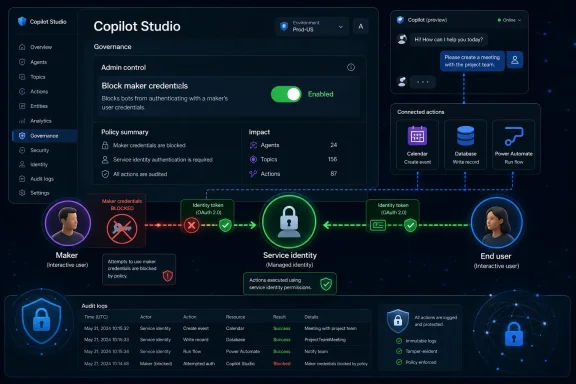
The roadmap item targets the practice of using maker-provided credentials for authentication. In plain English, that means the person who builds the agent can wire a tool or connection so the agent acts using the builder’s identity rather than the end user’s identity or a more controlled service identity. If that maker has access to sensitive finance data, HR systems, ticketing queues, customer records, or privileged operational workflows, the agent can inherit more power than its audience should have.
Microsoft’s stated pitch is security and compliance: prevent unauthorized access, align with regulatory obligations, enforce identity policies, and increase trust in agents at scale. That is the right pitch. It is also a belated admission that AI adoption is running into a very old enterprise rule: convenience becomes risk when identity boundaries are blurry.
The maker’s credentials are attractive because they reduce friction. A builder can connect to a system, prove that the workflow works, and publish an agent without forcing every end user through a complex delegated-authentication setup. For pilots and internal demos, that pattern can feel harmless. The agent answers the question, the flow runs, and nobody has to wait for security architecture meetings.
But that same shortcut turns the maker into a standing authorization proxy. The user may not have permission to a system, but the agent can still return or act on information if its tool is backed by the maker’s access. Worse, the user interface can obscure the distinction. The person chatting with the agent may believe the response reflects their own permissions, while the system is actually using credentials granted to someone else.
That is the precise failure mode administrators fear. It violates least privilege, complicates auditing, and creates a gap between what identity systems say a user can access and what an AI-powered workflow can deliver on that user’s behalf. In a regulated environment, that gap is not a theoretical policy concern. It is the sort of thing that shows up in incident reviews and audit findings.
That distinction matters. End-user credentials preserve the familiar security model: the agent can only access what the user can access. Service principals or managed identities can support controlled application access, but they require explicit design, scoping, monitoring, and lifecycle management. Maker credentials sit awkwardly between those models, because they are personal enough to be overprivileged and reusable enough to become infrastructure.
Microsoft has already been moving Copilot Studio toward more visible governance. The company’s documentation and security guidance emphasize controls around authentication, agent sharing, environment policies, audit logs, and managed environments. The roadmap item fits into that broader pattern: Microsoft is trying to make agent creation palatable to security teams that are not going to approve a thousand citizen-built automations if every one of them can smuggle a maker’s access into production.
The feature is also a message to customers. Microsoft wants Copilot Studio to be seen not merely as a maker tool, but as an enterprise development surface for agents. Enterprise development surfaces need policy. They need defaults that can survive turnover, insider risk, accidental oversharing, and the everyday chaos of organizations where permissions accumulate faster than they are removed.
For administrators, the exact roadmap choreography is less important than the direction of travel. Microsoft is putting a formal general availability marker on a control that many organizations will see as table stakes. If a company is letting business units build agents that invoke connectors and flows, it cannot treat maker credentials as a harmless implementation detail.
The preview-to-GA path also hints at how Microsoft is likely to handle Copilot Studio governance more broadly. Rather than banning risky patterns outright for everyone, Redmond tends to introduce administrative controls, policy toggles, warnings, and managed-environment capabilities. That approach preserves flexibility for smaller teams and demos while giving larger tenants the ability to lock down behavior.
The downside is that optional controls put the burden back on administrators. A feature that exists but is not configured is not a security boundary. The public roadmap may reassure executives that Microsoft is “adding governance,” but the operational question remains whether IT teams will actually enable the restriction, communicate the change, and fix the agents that depended on maker credentials.
That packaging matters because it changes who can create risk. A traditional integration project might involve developers, architects, identity administrators, security review, and change management. A low-code agent can be built by a department employee solving a local problem. That is the point of the product, and it is also the governance challenge.
The risk is not that makers are malicious. Most are trying to get work done. The risk is that a useful proof of concept quietly becomes a production dependency, then gets shared more broadly, then becomes embedded in a business process before anyone maps the access path. By the time security asks whose credentials are being used, the answer may be inconvenient.
This is where agentic systems differ from ordinary documents or dashboards. A dashboard may reveal too much data if permissions are wrong. An agent can reveal data, transform it, trigger actions, and route output elsewhere. If it is authenticated as the wrong identity, the resulting blast radius is not limited to what appears on screen.
Auditability depends on knowing who accessed what and under which authority. If an agent uses the end user’s credentials, logs can generally be interpreted in the familiar model of user-driven access. If an agent uses a properly governed application identity, logs can be tied to a known workload with documented purpose and scope. If an agent uses a maker’s credentials, the audit story becomes muddier.
That muddiness creates practical problems. Did the maker access the data, or did a user invoke an agent that used the maker’s connection? Did the user have a right to see the result? Was the connection intentionally approved for broad use, or did it persist because nobody changed the default? These are not questions compliance teams enjoy answering after the fact.
Blocking maker-provided credentials gives administrators a cleaner control to point to. It narrows the range of permitted authentication patterns and forces builders toward models that align better with policy. That does not eliminate the need for data loss prevention rules, environment strategy, connector governance, and monitoring, but it removes one particularly awkward loophole.
Makers may need to redesign tools to use end-user credentials. Administrators may need to approve connectors, configure Entra ID applications, review consent policies, or create service identities with tightly scoped permissions. Business teams may discover that an agent worked in testing only because the maker had access nobody else did. Those discoveries will feel like breakage, but they are really exposure.
The most contentious cases will involve shared operational workflows. A support agent, for example, may need to create tickets or query a system where end users do not normally have direct access. In those cases, end-user credentials may not be the right model. But the alternative should be a governed workload identity or mediated API, not a builder’s personal account standing in as infrastructure.
This is the broader maturation of Copilot Studio. The product is moving from the “look what a business user can build” phase to the “prove this can survive enterprise controls” phase. That transition is usually painful. It is also necessary if Microsoft wants agents to become durable business software rather than a sprawling collection of impressive demos.
This is also a good moment to revisit environment strategy. Many Power Platform estates grew organically, with different rules for development, testing, and production environments. Agents that can call tools deserve sharper boundaries. A permissive sandbox may be reasonable for experimentation; a production environment with shared agents should have stricter authentication and sharing controls.
Administrators should also look beyond the single setting. Blocking maker credentials reduces one class of risk, but agent governance still depends on connector policies, data loss prevention, app consent rules, audit visibility, endpoint protections, and user education. The control is important because it forces a cleaner identity model, not because it replaces the rest of the security stack.
The most mature organizations will use the rollout to create a standard pattern library. Builders should not have to reinvent authentication every time they add a tool. IT can provide approved approaches for common scenarios: user-delegated access for personal data, service identities for business processes, and restricted APIs for sensitive systems. Governance works best when the secure path is also the easiest path to explain.
That should be clarifying for WindowsForum readers who manage real environments rather than keynote slides. Copilot Studio agents are not just “AI.” They are applications, automations, connectors, permissions, logs, and identities. Treating them as anything less is how organizations end up with a friendly bot that has unfriendly access.
The practical readout is straightforward:
The feature sounds narrow: stop makers from using their own credentials when configuring agent actions. In practice, it cuts into one of the messiest questions in enterprise AI deployment: when a bot reaches into a system of record, whose authority is it really exercising? That question matters more than the agent’s prose, more than its prompt template, and more than whether a demo looks magical in a conference keynote.
 Microsoft Moves the Copilot Fight From Prompt Safety to Identity Control
For the first two years of the enterprise AI boom, most public anxiety centered on hallucinations, confidential data leakage, and whether large language models could be tricked into saying or doing something foolish. Those concerns were real, but they were also the easy part of the story to explain. A chatbot that gives a wrong answer is visible; a chatbot that quietly invokes a connector using someone else’s broad access is harder to see and far more interesting to attackers.Copilot Studio sits directly in that blast radius. It is Microsoft’s low-code environment for building agents that can answer questions, call tools, trigger Power Automate flows, work with connectors, and interact with enterprise systems. That makes it useful precisely because it can do things. It also means a poorly governed agent is not merely a search box with ambitions; it can become an automation layer attached to corporate identity.
The roadmap item targets the practice of using maker-provided credentials for authentication. In plain English, that means the person who builds the agent can wire a tool or connection so the agent acts using the builder’s identity rather than the end user’s identity or a more controlled service identity. If that maker has access to sensitive finance data, HR systems, ticketing queues, customer records, or privileged operational workflows, the agent can inherit more power than its audience should have.
Microsoft’s stated pitch is security and compliance: prevent unauthorized access, align with regulatory obligations, enforce identity policies, and increase trust in agents at scale. That is the right pitch. It is also a belated admission that AI adoption is running into a very old enterprise rule: convenience becomes risk when identity boundaries are blurry.
The Maker Was Never Supposed to Become the Runtime Security Boundary
Low-code platforms have always depended on a bargain. Business users get to build useful things quickly, while IT accepts some loss of central control in exchange for speed. Power Platform, SharePoint workflows, Excel macros, Access databases, and departmental apps all lived somewhere on that spectrum. Copilot Studio inherits that history, but agents change the stakes because they wrap automation in natural language and can be exposed to many more users than the original maker intended.The maker’s credentials are attractive because they reduce friction. A builder can connect to a system, prove that the workflow works, and publish an agent without forcing every end user through a complex delegated-authentication setup. For pilots and internal demos, that pattern can feel harmless. The agent answers the question, the flow runs, and nobody has to wait for security architecture meetings.
But that same shortcut turns the maker into a standing authorization proxy. The user may not have permission to a system, but the agent can still return or act on information if its tool is backed by the maker’s access. Worse, the user interface can obscure the distinction. The person chatting with the agent may believe the response reflects their own permissions, while the system is actually using credentials granted to someone else.
That is the precise failure mode administrators fear. It violates least privilege, complicates auditing, and creates a gap between what identity systems say a user can access and what an AI-powered workflow can deliver on that user’s behalf. In a regulated environment, that gap is not a theoretical policy concern. It is the sort of thing that shows up in incident reviews and audit findings.
The New Control Is a Small Switch With a Large Governance Signal
A tenant or environment-level control that blocks maker-provided credentials will not, by itself, make Copilot Studio safe. It will, however, force a healthier default conversation. Instead of asking whether a maker has enough access to make the agent work, organizations must ask which identity the agent should use at runtime and how that access should be justified.That distinction matters. End-user credentials preserve the familiar security model: the agent can only access what the user can access. Service principals or managed identities can support controlled application access, but they require explicit design, scoping, monitoring, and lifecycle management. Maker credentials sit awkwardly between those models, because they are personal enough to be overprivileged and reusable enough to become infrastructure.
Microsoft has already been moving Copilot Studio toward more visible governance. The company’s documentation and security guidance emphasize controls around authentication, agent sharing, environment policies, audit logs, and managed environments. The roadmap item fits into that broader pattern: Microsoft is trying to make agent creation palatable to security teams that are not going to approve a thousand citizen-built automations if every one of them can smuggle a maker’s access into production.
The feature is also a message to customers. Microsoft wants Copilot Studio to be seen not merely as a maker tool, but as an enterprise development surface for agents. Enterprise development surfaces need policy. They need defaults that can survive turnover, insider risk, accidental oversharing, and the everyday chaos of organizations where permissions accumulate faster than they are removed.
The Timeline Says Preview First, But the Governance Pressure Is Already Here
The roadmap entry lists preview availability for September 2025 and general availability for August 2026, even though the item itself was created and last updated on July 2, 2026. That chronology is awkward on its face. It may reflect a roadmap backfill, a feature already in preview, or Microsoft’s sometimes untidy public-roadmap plumbing.For administrators, the exact roadmap choreography is less important than the direction of travel. Microsoft is putting a formal general availability marker on a control that many organizations will see as table stakes. If a company is letting business units build agents that invoke connectors and flows, it cannot treat maker credentials as a harmless implementation detail.
The preview-to-GA path also hints at how Microsoft is likely to handle Copilot Studio governance more broadly. Rather than banning risky patterns outright for everyone, Redmond tends to introduce administrative controls, policy toggles, warnings, and managed-environment capabilities. That approach preserves flexibility for smaller teams and demos while giving larger tenants the ability to lock down behavior.
The downside is that optional controls put the burden back on administrators. A feature that exists but is not configured is not a security boundary. The public roadmap may reassure executives that Microsoft is “adding governance,” but the operational question remains whether IT teams will actually enable the restriction, communicate the change, and fix the agents that depended on maker credentials.
Agents Make Old IAM Mistakes Easier to Hide
The maker-credentials issue is not new in the abstract. Enterprises have long struggled with shared accounts, embedded passwords, overprivileged service accounts, stale API keys, and personal accounts used as de facto production infrastructure. What Copilot Studio changes is the packaging. The old mistake is now hidden behind an approachable agent builder and a conversational interface.That packaging matters because it changes who can create risk. A traditional integration project might involve developers, architects, identity administrators, security review, and change management. A low-code agent can be built by a department employee solving a local problem. That is the point of the product, and it is also the governance challenge.
The risk is not that makers are malicious. Most are trying to get work done. The risk is that a useful proof of concept quietly becomes a production dependency, then gets shared more broadly, then becomes embedded in a business process before anyone maps the access path. By the time security asks whose credentials are being used, the answer may be inconvenient.
This is where agentic systems differ from ordinary documents or dashboards. A dashboard may reveal too much data if permissions are wrong. An agent can reveal data, transform it, trigger actions, and route output elsewhere. If it is authenticated as the wrong identity, the resulting blast radius is not limited to what appears on screen.
Compliance Teams Will Read This as an Audit-Control Feature
Microsoft’s roadmap language explicitly references regulations such as GDPR and HIPAA. That does not mean flipping this switch magically makes a tenant compliant. It does mean Microsoft understands the audience: organizations deploying agents into regulated workflows need clean stories about identity, authorization, and accountability.Auditability depends on knowing who accessed what and under which authority. If an agent uses the end user’s credentials, logs can generally be interpreted in the familiar model of user-driven access. If an agent uses a properly governed application identity, logs can be tied to a known workload with documented purpose and scope. If an agent uses a maker’s credentials, the audit story becomes muddier.
That muddiness creates practical problems. Did the maker access the data, or did a user invoke an agent that used the maker’s connection? Did the user have a right to see the result? Was the connection intentionally approved for broad use, or did it persist because nobody changed the default? These are not questions compliance teams enjoy answering after the fact.
Blocking maker-provided credentials gives administrators a cleaner control to point to. It narrows the range of permitted authentication patterns and forces builders toward models that align better with policy. That does not eliminate the need for data loss prevention rules, environment strategy, connector governance, and monitoring, but it removes one particularly awkward loophole.
The Trade-Off Is Real: Better Security, More Friction
There is a reason maker-provided credentials exist: they make things easier. When Microsoft gives administrators a way to block them, some agents will become harder to build, harder to publish, or harder to retrofit. That is not a bug in the governance model. It is the cost of making authentication honest.Makers may need to redesign tools to use end-user credentials. Administrators may need to approve connectors, configure Entra ID applications, review consent policies, or create service identities with tightly scoped permissions. Business teams may discover that an agent worked in testing only because the maker had access nobody else did. Those discoveries will feel like breakage, but they are really exposure.
The most contentious cases will involve shared operational workflows. A support agent, for example, may need to create tickets or query a system where end users do not normally have direct access. In those cases, end-user credentials may not be the right model. But the alternative should be a governed workload identity or mediated API, not a builder’s personal account standing in as infrastructure.
This is the broader maturation of Copilot Studio. The product is moving from the “look what a business user can build” phase to the “prove this can survive enterprise controls” phase. That transition is usually painful. It is also necessary if Microsoft wants agents to become durable business software rather than a sprawling collection of impressive demos.
Security Teams Should Treat the Roadmap Item as a Deadline, Not a Footnote
The worst response to this feature would be to wait for general availability and then decide whether it matters. Organizations already experimenting with Copilot Studio should inventory how agents authenticate today. If maker credentials are in use, the next question is whether that was a deliberate design choice or simply the fastest way to get a connector working.This is also a good moment to revisit environment strategy. Many Power Platform estates grew organically, with different rules for development, testing, and production environments. Agents that can call tools deserve sharper boundaries. A permissive sandbox may be reasonable for experimentation; a production environment with shared agents should have stricter authentication and sharing controls.
Administrators should also look beyond the single setting. Blocking maker credentials reduces one class of risk, but agent governance still depends on connector policies, data loss prevention, app consent rules, audit visibility, endpoint protections, and user education. The control is important because it forces a cleaner identity model, not because it replaces the rest of the security stack.
The most mature organizations will use the rollout to create a standard pattern library. Builders should not have to reinvent authentication every time they add a tool. IT can provide approved approaches for common scenarios: user-delegated access for personal data, service identities for business processes, and restricted APIs for sensitive systems. Governance works best when the secure path is also the easiest path to explain.
The Roadmap Item Reveals the Real Shape of Enterprise AI Risk
The most concrete lesson in Microsoft’s update is that AI security is becoming less exotic. The risk is not always a science-fiction model escape or a dazzling prompt injection exploit. Sometimes it is a familiar identity shortcut placed inside a new interface that makes the shortcut easier to scale.That should be clarifying for WindowsForum readers who manage real environments rather than keynote slides. Copilot Studio agents are not just “AI.” They are applications, automations, connectors, permissions, logs, and identities. Treating them as anything less is how organizations end up with a friendly bot that has unfriendly access.
The practical readout is straightforward:
- Microsoft is adding an administrative control for Copilot Studio that blocks agents from using a maker’s own credentials to authenticate tools.
- The roadmap item was created on July 2, 2026, lists preview availability for September 2025, and targets general availability in August 2026.
- The control is meant to push organizations away from personal-credential-based agent access and toward end-user or governed workload identity models.
- Existing agents that rely on maker-provided credentials may need redesign, especially if they were promoted from proof of concept to production without a security review.
- The feature should be evaluated alongside broader Copilot Studio governance, including sharing controls, connector policy, consent management, audit logging, and environment separation.
- The security win is not that agents become harmless, but that administrators get a clearer boundary around whose authority an agent is allowed to exercise.
References
- Primary source: Microsoft 365 Roadmap
Published: 2026-07-02T23:12:48.2177075Z
Loading…
www.microsoft.com - Official source: learn.microsoft.com
Loading…
learn.microsoft.com - Related coverage: obsidiansecurity.com
Loading…
www.obsidiansecurity.com - Related coverage: techradar.com
Experts warn Microsoft Copilot Studio agents are being hijacked to steal OAuth tokens | TechRadar
Microsoft acknowledges the risk, so users should be cautiouswww.techradar.com - Related coverage: beyondscale.tech
Loading…
beyondscale.tech - Official source: cdn-dynmedia-1.microsoft.com
- Official source: adoption.microsoft.com