

Bloom Consulting Services’ announcement that it is expanding its Azure AI Services portfolio by integrating Microsoft Azure AI Foundry is a clear signal that mid‑market Azure partners are moving quickly to package Microsoft’s latest enterprise AI tooling into end‑to‑end offers for customers — and it raises as many operational questions for IT leaders as it promises opportunity.
Bloom Consulting Services, a Nagpur‑based Azure specialist with offices in Singapore and other markets, this week said it has incorporated Azure AI Foundry into its solution ecosystem to help enterprises “design, deploy, and scale AI‑driven solutions with greater speed, governance, and operational control.” The company positions the move as a response to the common challenges organizations face when translating generative AI pilots into production: fragmented toolchains, slow deployment cycles, weak observability, and unclear governance. Bloom’s marketing and product pages already promote Azure AI services, Copilot Studio PoCs, and Foundry‑backed agent solutions, and the new release frames Azure AI Foundry as the backbone of those offerings.
Microsoft’s Azure AI Foundry — the platform Bloom is integrating with — is explicitly built as a model catalog, agent runtime, and governance layer for enterprise AI. Foundry provides managed hosting for a broad catalog of models, a production‑grade agent service for multi‑agent orchestration, observability and model evaluation tooling, and integrations with Microsoft security and governance controls. Those foundational capabilities are what Bloom is repackaging for customers who want managed, industry‑tailored AI agents for scenarios such as intelligent customer support, document intelligence, predictive analytics, and automated decision workflows.
Across Microsoft’s own announcements and technical documentation, Foundry is described as an enterprise‑focused platform for:
Bloom quotes its Co‑Founder, Manish Kungwani, framing the integration as enabling customers to “operationalize AI with greater clarity and confidence.” That message is consistent with how system integrators position governance‑first AI offers: reduce friction between prototyping and production, add SRE and monitoring disciplines, and attach SLAs and compliance guarantees. The company’s public materials also list geographic offices, staff counts, and previous Azure service offerings that support this move.
For partners such as Bloom, the market opportunity is significant: organizations want turnkey solutions with vertical domain expertise, and Foundry gives partners a standardized runtime and governance story to build on. However, competition will be fierce — larger consultancies and Azure specialists with deeper industry benches will market similar Foundry‑based suites. Bloom’s success will hinge on credible case studies, robust engineering practices, and clear SLAs for security and cost control. Bloom’s existing Azure practice and regional footprint give it a foundation to scale those offerings, but the proof will be in validated customer deployments.
That said, platform capability alone is not a guarantee of safe, cost‑effective outcomes. The real work remains upstream (data quality, labeling, process redesign) and downstream (continuous evaluation, incident response, retraining). Buyers should treat a Foundry engagement as a multi‑year operational program, not a one‑time technology purchase. Demand transparency on model choice, governance, and economics; require staged deployments with measurable KPIs; and insist on contractual protections for security and compliance.
In short: Bloom’s announcement is a credible and useful packaging of Microsoft’s Foundry platform for enterprise customers — a potentially valuable offering for organizations that need an Azure partner to carry the load of productionizing AI. But the commercial and operational details matter more than the headline. Enterprises that want the benefits of agentic automation should move forward prudently: validate the partner’s delivery track record, insist on observable guardrails, and make sure the program is funded for the long haul.
Source: openPR.com Bloom Consulting Services Expands Azure AI Services with Azure AI Foundry
 Background / Overview
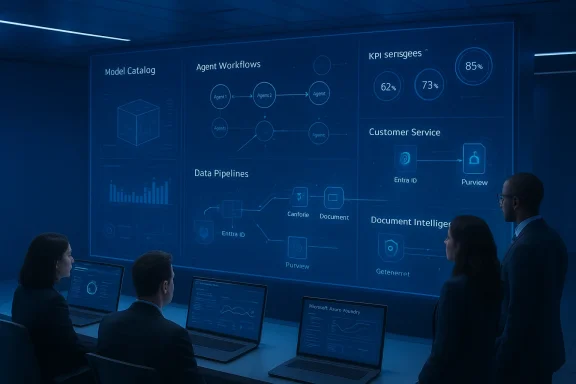
Bloom Consulting Services, a Nagpur‑based Azure specialist with offices in Singapore and other markets, this week said it has incorporated Azure AI Foundry into its solution ecosystem to help enterprises “design, deploy, and scale AI‑driven solutions with greater speed, governance, and operational control.” The company positions the move as a response to the common challenges organizations face when translating generative AI pilots into production: fragmented toolchains, slow deployment cycles, weak observability, and unclear governance. Bloom’s marketing and product pages already promote Azure AI services, Copilot Studio PoCs, and Foundry‑backed agent solutions, and the new release frames Azure AI Foundry as the backbone of those offerings.Microsoft’s Azure AI Foundry — the platform Bloom is integrating with — is explicitly built as a model catalog, agent runtime, and governance layer for enterprise AI. Foundry provides managed hosting for a broad catalog of models, a production‑grade agent service for multi‑agent orchestration, observability and model evaluation tooling, and integrations with Microsoft security and governance controls. Those foundational capabilities are what Bloom is repackaging for customers who want managed, industry‑tailored AI agents for scenarios such as intelligent customer support, document intelligence, predictive analytics, and automated decision workflows.
Across Microsoft’s own announcements and technical documentation, Foundry is described as an enterprise‑focused platform for:
- A centralized model catalog and model cards with benchmark data and governance metadata.
- The Foundry Agent Service for building, orchestrating, and running stateful agents and multi‑agent workflows.
- Observability, evaluation, and “agent red‑teaming” tools to detect bias, correctness, and security failures early in the lifecycle.
- Tight integrations to Microsoft security controls, identity (Entra ID), and enterprise data connectors.
What Bloom is promising: a practical summary
Bloom’s announcement frames the Foundry integration around four enterprise capabilities:- Model access and customization: access to curated model catalogs and the ability to fine‑tune or build domain‑specific agents.
- Data readiness and observability: integrated data prep, labeling workflows, and real‑time monitoring to keep models accurate and traceable.
- Security, compliance, and governance: identity‑based access controls, auditing, and policy enforcement.
- Operational intelligence and reporting: dashboards and KPI tracking to measure business impact.
Bloom quotes its Co‑Founder, Manish Kungwani, framing the integration as enabling customers to “operationalize AI with greater clarity and confidence.” That message is consistent with how system integrators position governance‑first AI offers: reduce friction between prototyping and production, add SRE and monitoring disciplines, and attach SLAs and compliance guarantees. The company’s public materials also list geographic offices, staff counts, and previous Azure service offerings that support this move.
Why Microsoft Azure Foundry matters to enterprises
A unified developer/ops surface for AI
Foundry’s chief appeal is that it unifies previously disjointed steps — model selection, tuning, pipeline orchestration, deployment, and post‑deployment monitoring — into a productized loop designed for teams that must meet enterprise constraints. Microsoft’s product descriptions emphasize a model catalog (with benchmark data and model cards), a model router to pick optimal models, and a managed agent runtime that supports long‑running workflows and agent‑to‑agent communication standards. These features target the very pain points Bloom claims to solve for customers.Production‑grade agent orchestration
Azure AI Foundry Agent Service is built to run stateful, orchestrated agent workflows with built‑in resilience, error handling, and integration points to enterprise data sources (Microsoft lists connectors to services like SharePoint, Microsoft Fabric and more). Where simple chatbots fail — complex approvals, multi‑step financial processes, knowledge‑intensive automation — Foundry’s multi‑agent orchestration is explicitly designed to coordinate specialized agents and maintain context over time. This is central to Bloom’s pitch for industry‑specific agent deployments.Observability, evaluation, and governance
Microsoft has been explicit about adding observability tooling in Foundry: automated evaluation, “agent evaluators” that check for intent and tool usage, and red‑teaming agents to probe for safety and bias issues. Integration with governance platforms (Credo AI, Saidot, Microsoft Purview) and Microsoft’s broader security stack allows enterprises to map AI behaviors back to existing compliance controls — critical for regulated industries such as finance, healthcare, and public sector deployments. These are the controls Bloom says its clients will rely on.How Bloom’s offering fits the market: positioning and value proposition
Bloom is positioning itself as an Azure‑first integrator that turns Microsoft Foundry’s capabilities into verticalized solutions. That positioning follows a well‑worn route:- Enterprises want to adopt generative AI but lack in‑house skills to design agent architectures and manage model governance.
- Hyperscalers (Microsoft) provide the building blocks — compute, model catalog, agent runtime, observability — but customers need packaged services, SLAs, and vertical expertise.
- Partners like Bloom insert themselves as the delivery and operational layer that converts the platform into mission‑specific outcomes.
Technical reality-check: what Foundry gives you — and what it doesn’t
What Foundry reliably provides (verified from Microsoft docs)
- Large catalog of models from multiple providers with model cards and benchmark info. This central catalog is designed to make model selection and comparisons easier.
- A managed agent runtime that supports multistep processes, long‑running workflows, and multi‑agent orchestration with standards for agent‑to‑agent communication.
- Observability and evaluation tooling, including automated evaluators and red‑teaming agents for safety testing.
- Integration with Microsoft security and governance primitives (Entra ID, Defender for Cloud, Purview, third‑party governance tools).
What Foundry does not automatically solve
- Domain‑specific data quality and labeling: Foundry provides tools and connectors, but the hard work of curating high‑quality, compliant, labeled datasets remains largely a customer or partner responsibility. Bloom’s promise of “data readiness” will hinge on the quality of those human processes.
- Organizational change management: Embedding agents into workflows requires process redesign, governance integration, and user training. Platform features reduce friction but don’t remove the need to manage people and processes.
- Guaranteed cost predictability: Model hosting, especially at scale or with fine‑tuning, can be expensive. Microsoft offers reserved capacity options and model router cost optimizations, but partners’ commercial packaging must be examined carefully to understand long‑term cost models.
Risk assessment: governance, compliance, vendor risk, and operational risk
Security and data residency
Microsoft’s security messaging for Foundry highlights tenant isolation and the principle that customer data is not used to train provider models unless explicitly configured. These are strong controls, but enterprises must validate deployment patterns (e.g., private endpoints, VNet integration, data egress policies) to ensure regulatory requirements are met — particularly in sectors with strict data residency rules. If Bloom offers Foundry Local or Sovereign cloud options (Microsoft has marketed Foundry Local offerings), that should be documented and contractually validated.Governance and explainability
Foundry’s observability and evaluation tools are helpful, but explainability still depends on how models are used and how outputs are audited. For high‑stakes decisions (credit, hiring, medical triage), enterprises must maintain human‑in‑the‑loop controls and documented evaluation processes. Bloom’s offering promises dashboards and KPIs — useful — but buyers should require details on evaluation metrics, retraining cadence, and audit logs.Vendor lock‑in and model provenance
Using Foundry ties you to Microsoft’s hosting and management layer, and many model providers included in Foundry operate under non‑Microsoft terms. Enterprises should:- Demand clear model cards and license terms.
- Confirm exit strategies and portability (how to move workloads or switch models).
- Understand cost implications of migrating off Foundry later.
Operational and safety risks
Multi‑agent systems increase complexity. While Foundry provides guardrails, multi‑agent orchestration multiplies potential failure modes — from cascading errors to unexpected tool usage. Bloom and similar integrators must demonstrate rigorous agent testing, staged rollouts, and incident playbooks. Microsoft’s Agent Framework and red‑teaming tooling help, but they are complements to, not replacements for, mature engineering and SRE practices.What to ask Bloom (or any Foundry integrator) before you buy
If your enterprise is evaluating Bloom’s new Foundry‑based services, insist on clear answers to the following list. These are practical due‑diligence questions every procurement and IT owner should require:- Deployment model and data residency: Will workloads be in commercial Azure, Azure Sovereign/Local, or a private Foundry deployment? How is data isolated?
- Model provenance and licensing: Which models will be used, who owns them, and what are the license obligations? Are model cards and benchmark reports available for all candidate models?
- Governance integration: How will audit logs, approval workflows, and policy enforcement be implemented? Which governance tools (Purview, Credo AI, Saidot) will be used?
- Cost model and SLAs: What are the pricing components (inference, hosting, fine‑tuning, data ingress/egress), and what SLAs does Bloom commit to for uptime, response time, and security incident response?
- Operational readiness: What is the runbook for model drift, incident response, and retraining? How frequently will evaluation and bias checks occur?
- Human‑in‑the‑loop and approvals: Where in the workflow are human approvals enforced, and how are those approvals audited?
- Portability and exit plan: If you decide to leave Foundry, what controls and data exports are provided? How portable are agent workflows and training artifacts?
Practical deployment patterns Bloom will likely implement (and why they matter)
Bloom’s marketing suggests a packaged approach that enterprises can adopt in stages. These practical patterns are consistent with Foundry best practices and represent low‑to‑medium risk paths for adoption.1) Discovery + PoC (6–12 weeks)
- Rapid proof‑of‑concept using Copilot Studio for user‑facing agents.
- Small, well‑scoped dataset, defined KPIs, and a sandboxed Foundry tenant.
- Focus on latency, safety checks, and integration points with core systems.
2) Controlled pilot with observability
- Expand the pilot to include the Foundry Agent Service for one or two operational workflows.
- Configure agent evaluators and red‑team probes; instrument tracing with OpenTelemetry.
- Establish retraining cadence and data‑quality pipelines.
3) Production rollout with governance
- Migrate successful pilots to production with VNet integrations, private endpoints, and access controls.
- Integrate with enterprise governance tools and create role‑based deployment processes.
- Establish SLOs and incident response playbooks.
Industry implications and partner landscape
Microsoft’s Foundry is rapidly becoming a central node in the enterprise AI ecosystem — a place where model vendors, governance toolmakers, and system integrators intersect. Major model providers and startups are making their models available through Foundry, and Microsoft has been public about bringing frontier models and third‑party families (Anthropic, xAI, Mistral, Hugging Face catalogs) into its catalog. That broad model availability is a double‑edged sword: more choice, but also more governance complexity.For partners such as Bloom, the market opportunity is significant: organizations want turnkey solutions with vertical domain expertise, and Foundry gives partners a standardized runtime and governance story to build on. However, competition will be fierce — larger consultancies and Azure specialists with deeper industry benches will market similar Foundry‑based suites. Bloom’s success will hinge on credible case studies, robust engineering practices, and clear SLAs for security and cost control. Bloom’s existing Azure practice and regional footprint give it a foundation to scale those offerings, but the proof will be in validated customer deployments.
Strengths and weaknesses of Bloom’s announcement
Notable strengths
- Timely alignment with major platform capabilities. By adopting Azure AI Foundry, Bloom is using Microsoft’s most recent enterprise tooling rather than stitching together ad‑hoc components. This reduces integration risk for customers.
- Clear enterprise framing. The focus on governance, observability, and operational KPIs matches what regulated customers actually need.
- Vertical use case focus. Targeting customer support, document intelligence, and predictive workflows maps closely to high‑value enterprise automation opportunities.
Potential weaknesses and open questions
- Vagueness on economics and SLAs. The announcement emphasizes capabilities but does not disclose pricing models, reserved capacity commitments, or contractual remedies — all essential for enterprise procurement. This is a common gap in partner press releases, but a material one for buyers.
- Unclear sovereign/local deployment guarantees. For regulated customers (healthcare, finance, government), the availability of Foundry Local or air‑gapped options and Bloom’s ability to deliver them needs explicit confirmation. Microsoft has been shipping on‑prem/sovereign options, but partners must demonstrate experience implementing them.
- Operational maturity requirements. Running multi‑agent systems at scale demands robust SRE, testing frameworks, and long‑term model maintenance budgets. Bloom will need to show those capabilities with customer references.
Recommended checklist for IT leaders evaluating Foundry‑based engagements
- Require a technical onboarding plan that includes tenant topology (VNet, private endpoints), model provenance, and threat model.
- Demand documented governance: model cards, evaluation metrics, retraining cadence, and incident response playbooks.
- Insist on cost‑transparency: break out inference, hosting, data, and management fees.
- Validate portability: test exports of training artifacts, knowledge stores, and agent definitions.
- Stage deployments: pilot → controlled pilot with observability → production with SLAs.
- Seek third‑party validation: require security and compliance attestations (SOC2, ISO, or sectoral equivalents).
Closing analysis — opportunity vs. reality
Bloom Consulting Services’ move to integrate Azure AI Foundry into its Azure AI Services portfolio makes strategic sense: Foundry is Microsoft’s package for enterprise model cataloging, agent orchestration, observability, and governance. For enterprises, the combination — a hyperscaler platform plus an Azure‑first integrator — offers a promising path to move from experimentation to production without rebuilding the stack from scratch.That said, platform capability alone is not a guarantee of safe, cost‑effective outcomes. The real work remains upstream (data quality, labeling, process redesign) and downstream (continuous evaluation, incident response, retraining). Buyers should treat a Foundry engagement as a multi‑year operational program, not a one‑time technology purchase. Demand transparency on model choice, governance, and economics; require staged deployments with measurable KPIs; and insist on contractual protections for security and compliance.
In short: Bloom’s announcement is a credible and useful packaging of Microsoft’s Foundry platform for enterprise customers — a potentially valuable offering for organizations that need an Azure partner to carry the load of productionizing AI. But the commercial and operational details matter more than the headline. Enterprises that want the benefits of agentic automation should move forward prudently: validate the partner’s delivery track record, insist on observable guardrails, and make sure the program is funded for the long haul.
Quick takeaways (for executives and IT decision‑makers)
- If you want to accelerate production AI on Azure, Bloom’s Foundry‑based services are a relevant vendor to assess. They align with the capabilities Microsoft built Foundry to deliver.
- Don’t skip governance and observability conversations. They’re the primary differentiator between a safe rollout and costly failures.
- Ask for proof — not promises. Demand references, documented SLAs, and migration/exit plans before committing to a multi‑year rollout.
- Budget for ongoing operational costs. Model hosting, monitoring, and retraining are recurring line items that can eclipse initial development costs.
Source: openPR.com Bloom Consulting Services Expands Azure AI Services with Azure AI Foundry
