

Microsoft’s Copilot is no longer a sidebar novelty — it’s a platform and an operational challenge, and O’Reilly’s new Copilot and Agent Administration Fundamentals (Exam AB-900) course aims to put administrators and builders on a firm footing for that reality. The offering promises a pragmatic mix of administration, security, and hands‑on agent building using Copilot Studio, framed around the AB‑900 certification. That combination — governing who gets access, how tenant data is protected, and how to build agents that survive production security review — is exactly the skillset enterprises need as Copilot and agentic automation move from pilots to everyday workflows. erview
Microsoft’s formal certification for this domain, AB‑900: Copilot and Agent Administration Fundamentals, is now listed on Microsoft Learn and targets basic administrative skills for Copilot and agents: identity, governance, tenant grounding, and core admin tasks. The official exam page spells out the scope and logistics: it’s a fundamentals assessment with a recommended study guide, proctored delivery, and a 45‑minute exam window. The skills measured include identifying Microsoft 365 core objects, understanding data protection and governance in the Copilot era, and performing basic administrative tasks for Copilot and agents.
Parallel to the certification, Microsoft’s product architecture for agents has matured into a set of control surfaces and authoring experiences that matter to administrators:
Microsoft’s exam and product docs indicate the most critical admin responsibilities will include:
If you’re building a learning path inside your organization:
Source: O'Reilly Media Copilot and Agent Administration Fundamentals (Exam AB-900)
Microsoft’s formal certification for this domain, AB‑900: Copilot and Agent Administration Fundamentals, is now listed on Microsoft Learn and targets basic administrative skills for Copilot and agents: identity, governance, tenant grounding, and core admin tasks. The official exam page spells out the scope and logistics: it’s a fundamentals assessment with a recommended study guide, proctored delivery, and a 45‑minute exam window. The skills measured include identifying Microsoft 365 core objects, understanding data protection and governance in the Copilot era, and performing basic administrative tasks for Copilot and agents.
Parallel to the certification, Microsoft’s product architecture for agents has matured into a set of control surfaces and authoring experiences that matter to administrators:
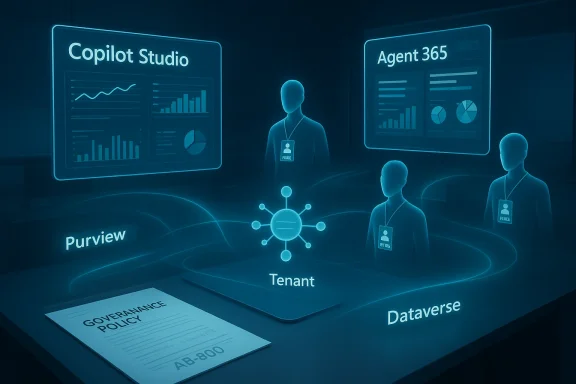
- Copilot Studio: the official low‑code/visual environment for creating, tuning, and publishing agents; it includes publishing pipelines, test tooling, and paid consumption models for production agents.
- Agent 365: the control plane Microsoft positions as the enterprise registry for agents — discovery, lifecycle management, observability, and policy enforcement.
- Entra Agent IDs / Agent Users: first‑class identities for agents that allow least‑privilege controls, sponsorships, and auditable identiti
- Model Context Protocol (MCP) / Dataverse grounding: standardized connectors and grounding primitives intended to let agents interact with tenant dcy‑aware ways.
 What the AB‑900 curriculum promises (and what it actually means for admins)
Practical remit: admin, security, and agent building
O’Reilly’s description and the AB‑900 framing place three themes at the center of training: administration (who gets access and how), security safe), and agent building (creating custom agents that pass security review and operate correctly). That trinity is the operational reality many organizations now face: Copilot tools are powerful, but without governance they can produce compliance and leakage incidents.Microsoft’s exam and product docs indicate the most critical admin responsibilities will include:
- Configuring Copilot entitlements and seat assignments.
- Managing model routing and provider choices (tenant‑level toggles that can affect which external model providers are used).
- Applying Microsoft Purview classification and DLP controls to agent artifacts and agent‑accessed content.
- Registering and governing agent identities via Entra and Agent 365.
- Instrumenting telemetry and SIEM pipelines for agent activity logging and forensic readiness.
Hands‑on agent building via Copilot Studio
A notable aspect of the course is the practical tutorial approach — building, publishing, and governing a simple Copilot agent in Copilot Studio. Microsoft’s documentation confirms that Copilot Studio supports end‑to‑end agent authoring and publishing, including connectors, entity extraction, and runtime configuration; enterprises can publish agents internally or make them available through cataloging mechanisms that tie into Agent 365. Copilot Studio also exposes consumption models and Copilot Credit billing, which administrators must plan for.Why this matters: the enterprise operational picture
Agents as managed identities and production services
The key architectural change is that agents are being modelled like other managed services: they receive Entra identities, can be sponsored by a human owner, and are visible in a tenant inventory. That shift helps solve the “shadow agent” problem — the uncontrolled proliferation of agent artifacts and automations — but it also means IT must adopt AgentOps practices: lifecycle management, vulnerability scanning, and FinOps for model consumption. Microsoft’s Entra Agent ID docs and Agent 365 materials make these operational primitives explicit.Data grounding and Purview integration
Enterprises asked an obvious question: where does my data go? The answer in Microsoft’s product materials is layered: agents should be grounded to tenant data via Graph/Dataverse, administrators can control model routing and which model providers are allowed for tenant workloads, and Microsoft claims integration points with Purview for classification and DLP. However, operationalizing those promises requires deliberate configuration: admins must map .agent artifacts into DLP, ensure connectors respect sensitivity labels, and validate logging and retention for eDiscovery. The course content explicitly drills into those governance controls because misconfiguration here creates immediate risk.Cost and FinOps
Copilot and agent invocation are billable items. Copilot credits, per‑call model costs, and premium compute for on‑device inferencing (Copilot+ devices with NPUs) can all create unexpected spending unless teams budget, cap, and monitor consumption. The Microsoft Copilot Studio pricing model (Copilot Credits packs and pay‑as‑you‑go) is a concrete reminder that administrative duty extends into finance.Strengths: Where Copilot+Agents genuinely help enterprises
- Productivity gains on repeatable tasks. Role‑specific agents (meeting facilitators, project managers, knowledge agents) can automate multi‑step, cross‑document workflows that were previously manual and brittle, speeding outputs and reducing human drudgery. Early enterprise case studies and pilots show measurable time savings when agents are scoped correctly.
- A consistent governance model is emerging. By assigning Entra Agent IDs, introducing Agent 365 as a registry, and providing Copilot Studio as an authoring/control plane, Microsoft gives organizations the primitives to treat agents like other managed services — a necessary step for scale. These primitives make it possible to apply conditionpolicies, and audit trails.
- Low‑code authoring accelerates time to value. Copilot Studio’s low‑code approach reduces friction between business owners and IT. When combined with templates and validation workflows, it lets teams prototype useful agents quickly and iterate based on telemetry.
- Observability and plan‑view auditability. Recent product notes emphasize that Agent Mode and the Agent Workspace surface stepwise plans and progress badges, making agent actions more inspectable and reversible than earlier "black‑box" generative outputs. This transparency is a meaningful control for compliance and human‑in‑the‑loop governance.
Risks and blind spots — what the AB‑900 candidate must understand
No platform is without tradeoffs. The training rightly focuses a sizable portion of its attention on governance, because real risks are not hypothetical.1) Shadow agents and sprawl
Low‑friction creation means dozens (or hundreds) of tenant agents can proliferate quickly. Each .agent file and published connector is a new surface for data access and potential leakage. Administrators must inventory agents, assign sponsors, and enforce retirement and review cycles — otherwise the organization gains productivity and loses control. Community guidance included in practitioner materials warns of this exact outcome.2) Prompt injection, memory poisoning, and agent chaining attacks
Agents introduce new attack vectors: a malicious document can embed crafted instructions; an agent may call another higher‑privileged agent to escalate actions; or persistent context can be poisoned through long‑lived memories. Recent security research and incident disclosures show real exploits targeting agent flows. Practical mitigation requires adversarial testing, input sanitization, and runtime policy enforcement. The course emphasizes threat modeling and red‑team exercises for precisely these reasons.3) Third‑party model providers and data residency
Microsoft’s multi‑model strategy means some Copilot invocations may be routed to third‑party model providers under Microsoft’s contractual frameworks. That routing can affect regional guarantees and compliance boundaries (for example, EU data residency concerns). Admins must validate which models their tenant uses and whether specific workloads are allowed to leave defined boundaries. This operational nuance is often underappreciated until an audit or legal review.4) OAuth token theft and social engineering (real‑world incidents)
Researchers have demonstrated social‑engineering tactics that abuse legitimate Copilot Studio flows to harvest OAuth consent or token grants. The threat is practical: malicious “Topics” or crafted interactions in Studio can trick users into approving accrity researchers have issued advisories, and mitigation is non‑trivial — requiring admin enforcement of app consent policies, conditional access, and monitoring for suspicious app registrations. The threat underlines that governance is not only technical but also about change control and user training.5) Cost overruns and unpredictable consumption
Without FinOps discipline, organizations can see unexpected charges nvocations, large context windows, or repeated batch jobs. Practical guidance from enterprise practitioners is to budget Copilot Credits, implement environment caps, and use chargeback models to align consumption with value. The course’s emphasis on FinOps is therefore not optional.Practical playbook — what admins should do now (step‑by‑step)
Below is a condensed, actionable checklist that aligns with what AB‑900 and the O’Reilly course teach — and what real tenants are doing in their pilots.- Int review
- Map current Copilot seats and who can create agents. Confirm who has publishing privileges in Copilot Studio.
- Create an Agent Governance policy
- Define ownership (sponsor), approval gates, retention, and deprecation rules for agents. Register each published agent in a catalog.
- Configure Entra Agent IDs and least privilege
- Assign agent identities to all production agents, require sponsor metadata and short‑lived credentials where feasible, and enforce conditional access for agents accessing sensitive resources.
- Grounding and Purview mapping
- Ensure agents’ connectors respect Purview sensitivity labels; mapo existing DLP policies; verify that logs capture which model was invoked and what tenant data was included.
- Pilot with scoped, read‑only agents first
- Start with agents that only read approved datasets and produce reports; instrument telemetry and SIEM exports for 30–90 days before enabling write actions.
- Red‑team agent flows
- Run prompt injection, reprompt, and social engineering tests, including OAuth consent abuse scenarios; integrate findings into Copilot Studio validation checks.
- FinOps: caps and alerts
- Implement monthly Copilot Credit budgets, model routing defaults to cheaper models for predictable workloads, and monitoring dashboards with alerts for unusual consumption.
- Training and templates
- Provide role‑based guides for agent creators and end users. Ship validated templates for common workflows (meeting facilitation, intake forms, knowledge summarization) to reduce ad‑hoc, risky agent creations.
How AB‑900 (and an admin course) fits into your team’s certification and training roadmap
AB‑900 is a fundamentals certification; it’s not a deep engineering credential. Treat it as a practical baseline for administrators and compliance officers who will steward Copilot adoption. Microsoft’s exam page highlights that the exam assesses conceptual knowledge and basic administrative tasks — candidates should complement the certification with hands‑on labs in Copilot Studio and tenant practice for full operational readiness. (learn.microsoft.com)If you’re building a learning path inside your organization:
- Pair AB‑900 study with role‑based labs (Copilot Studio build/deploy) and an AgentOps tabletop exercise.
- Add threat modeling and red‑teaming modules specific to prompt injection and OAuth consent risks.
- Require at least one “production shadow” audit in the first 90 days of enabling agent creation for a business unit.
Critical assessment: Where the vendor messaging is strong — and where you must be skeptical
Microsoft has shipped a credible set of primitives: identities, authoring, a control plane, and observability. Those are necessary ingredients for agent governance. But implementation details matter — and that’s where administrators must apply a skeptical, evidence‑based approach.- Strength: The control plane model (Agent 365) and Entra Agent IDs bring enterprise‑grade identity and lifecycle controls to agent management. If your tenant implements these features, you gain tooling that maps to existing governance workflows.
- Caveat: Vendor ROI claims (hundreds of productivity hours saved) are real in many pilots but are highly context dependent. Treat vendor numbers as planning signals and validate them in controlled pilots. PwC and other case studies are encouraging, but not universally transferrable.
- Risk: Product previews and model routing nuances can break expected compliance properties (regional model use, subprocessors). Don’t assume parity between preview and GA behavior; verify tenant model routing and contractual protections for regulated data.
- Security reality: Exploits and social‑engineering attacks against Copilot Studio and agent flows are documented in the wild. This is not theoretical adversarial testing — defenders must harden consent policies and monitor app registrations immediately.
What to expect during a Copilot/agent rollout: phased roadmap
A pragmatic rollout follows phases that map directly to the course content and governance themes:- Discovery & policy definition (0–4 weeks)
- Inventory Copilot seats, identify pilot LOBs, define agent governance policy and sponsor model.
- Pilot & telemetry (1–3 months)
- Build 2–3 scoped agents (read‑only), enable telemetry, and test sufficiency of logs and Purview mapping.
- Scoped write actions & production gating (3–6 months)
- Enable write actions for a small set of vetted agents; require security review and release gating through Copilot Studio.
- Scaling & AgentOps (6–12 months)
- Move to Agent 365 for fleet‑scale management, enforce lifecycle policies, and deploy FinOps controls across departments.
Final verdict — who should take AB‑900 and how to get the most from it
AB‑900 and the O’Reilly Copilot course are valuable for three audiences:- IT administrators and compliance officers who must govern Copilot adoption and want a structured, vendor‑neutral grounding in admin responsibilities. The exam clarifies what admins should know about entitlement, Purview integration, and agent lifecycle controls.
- Developer leads and platform engineers who will adopt Copilot Studio for internal agent templates and need to understand the production‑readiness expectations and security reviews that governance teams will require.
- Security and risk teams that must model new threat vectors (prompt injection, consent abuse, agent chaining) and set up detection and incident playbooks. The practical labs and red‑team guidance in the course are particularly useful here.
Conclusion
Copilot agents will change how knowledge work gets done — but they also change the unit of IT management. AB‑900 and O’Reilly’s practical course workshop that reality by combining admin fundamentals, governance tooling, and hands‑on agent building. For organizations, the practical implications are clear: establish AgentOps, treat agents as managed identities and production services, and bake governance into the lifecycle from day one. The platform primitives Microsoft has released — Copilot Studio, Agent 365, Entra Agent IDs, and Purview integration — create a viable path to scale, but real safety and value come from disciplined rollout plans, adversarial testing, and financial governance. For administrators and leaders, the AB‑900 curriculum is a timely map: it tells you what to learn, what to test, and how to avoid the leaks and surprises that cost organizations far more than the productivity they might gain.Source: O'Reilly Media Copilot and Agent Administration Fundamentals (Exam AB-900)
