

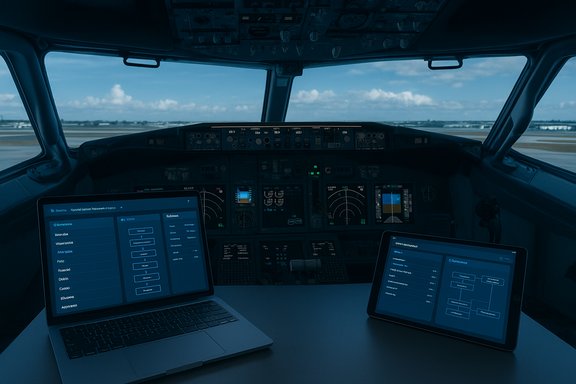
Boeing has quietly rebranded consumer-grade, photoreal 3D simulation into a formal training product by launching the Virtual Airplane Procedures Trainer (VAPT), a cloud‑backed procedures‑first pilot training system built on Microsoft Flight Simulator technology and hosted on Microsoft Azure—a move that promises to put high‑fidelity cockpit rehearsal onto laptops and iPads while re‑shaping how airlines approach simulator familiarization and procedural training.
Microsoft Flight Simulator has long blurred the line between entertainment and near‑professional simulation with globe‑scale photogrammetry, live weather and highly detailed cockpits. Boeing’s new Virtual Airplane product suite formalizes that trend: the first application, the Virtual Airplane Procedures Trainer (VAPT), was unveiled at the European Aviation Training Summit and is explicitly described by Boeing as being “powered by Microsoft Azure and Microsoft Flight Simulator.” Boeing frames the product not as a replacement for certified flight training devices, but as a lightweight, accessible tool to rehearse cockpit procedures and reduce familiarization time before pilots step into full‑flight simulators.
Boeing Global Services CEO Chris Raymond called the launch a reflection of Boeing’s push into digital innovation and “much‑needed flexibility” for pilot training, while Microsoft’s Dayan Rodriguez described the partnership as advancing the “future of flight” with safety as a core focus. These direct statements appear in Boeing’s press materials and were echoed across industry reporting.
The partnership also raises important industry questions about boundaries: how far can consumer‑grade engines be extended before certification standards must be updated, who takes responsibility for model fidelity, and how procurement teams should balance cost savings with safety and compliance obligations. The industry will watch early adopter airlines closely to see whether VAPT achieves measurable gains in simulator throughput and training quality.
Operators and regulators should treat VAPT as an important new tool in the blended‑training toolbox: capable of improving readiness and reducing low‑value simulator hours, but not a silver bullet. Measured pilots, robust validation, and conservative integration into approved syllabi will determine whether this technically impressive collaboration becomes a genuine safety and efficiency win for commercial aviation.
Source: Windows Report Boeing partners with Microsoft to turn 3D-Style Game Simulation into Pilot Training System
 Background
Microsoft Flight Simulator has long blurred the line between entertainment and near‑professional simulation with globe‑scale photogrammetry, live weather and highly detailed cockpits. Boeing’s new Virtual Airplane product suite formalizes that trend: the first application, the Virtual Airplane Procedures Trainer (VAPT), was unveiled at the European Aviation Training Summit and is explicitly described by Boeing as being “powered by Microsoft Azure and Microsoft Flight Simulator.” Boeing frames the product not as a replacement for certified flight training devices, but as a lightweight, accessible tool to rehearse cockpit procedures and reduce familiarization time before pilots step into full‑flight simulators.Boeing Global Services CEO Chris Raymond called the launch a reflection of Boeing’s push into digital innovation and “much‑needed flexibility” for pilot training, while Microsoft’s Dayan Rodriguez described the partnership as advancing the “future of flight” with safety as a core focus. These direct statements appear in Boeing’s press materials and were echoed across industry reporting.
What Boeing announced — the essentials
- Product name: Virtual Airplane Procedures Trainer (VAPT) — the first application in a broader Virtual Airplane family.
- Technology stack: Microsoft Flight Simulator for the visual and cockpit engine; Microsoft Azure for cloud services, distribution, telemetry, and scale.
- Initial platform support: Boeing 737 MAX, delivered as native clients for Windows (computers) and iPad devices; Boeing says additional Boeing models will follow.
- Core features highlighted by Boeing:
- High‑fidelity 3D cockpit simulations delivered to lightweight devices to practice checklists, flows and non‑handling procedures.
- An intuitive authoring tool that lets training operators author, customize and distribute lesson content at scale.
- Telemetry and analytics to measure lesson completion and learning outcomes.
Why the partnership makes sense technically
Leverage an existing, proven engine
Microsoft Flight Simulator supplies a mature rendering pipeline, global photogrammetry, live weather and a proven developer ecosystem. Those capabilities let Boeing deliver visually credible airport and approach views—important when the training target includes visual cues, airport identification and cockpit‑to‑outside references. Using Flight Simulator accelerates development and avoids the massive investment required to build world‑scale scenery and streaming infrastructure from scratch.Cloud backbone for scale and management
Microsoft Azure provides enterprise features operators expect from SaaS training platforms: identity and access management, content distribution (CDN), telemetry ingestion for learning analytics, and compliance tooling used by large airlines. Azure’s global footprint supports multi‑region deployments and potentially lowers latency for streamed content, while central hosting simplifies version control and authorized lesson distribution. Boeing’s public materials explicitly list Azure as a principal technology partner.Authoring and distribution as a differentiator
Boeing emphasizes a self‑service authoring tool that lets airline training teams create, configure and push operator‑specific lessons instantly. For airlines this capability is valuable: it allows rapid dissemination of temporary procedures, SOP changes, and tailored remedial scenarios without extensive simulator reprogramming. The authoring pipeline is central to Boeing’s pitch that VAPT standardizes procedures across fleets.What VAPT is designed to teach — and what it is not
VAPT is explicitly a procedures and familiarization trainer. Practically, that means its sweet spot is cognitive and procedural learning:- Checklist flows, callouts and SOP sequencing.
- Systems logic and cockpit interaction patterns (switches, panels, mode logic).
- Non‑handling failures and decision‑making drills.
- Airport recognition, approach geometry and cockpit‑to‑outside visual cues.
Immediate benefits Boeing and Microsoft highlight
- Accessibility and scale: pilots can rehearse procedures on devices they already own or carry—laptops and iPads—removing friction and expanding access beyond simulator bays.
- Familiarization efficiency: operators can reduce low‑complexity familiarization time on expensive full‑flight simulators, potentially freeing simulator hours for handling training and certified tasks.
- Operational agility: training teams can push urgent procedure updates, flight‑deck bulletins or targeted lessons across a distributed pilot population with audit trails.
- Cost and throughput: by shifting predictable, checklist‑driven rehearsal to lighter devices, airlines may reduce per‑pilot training costs and increase throughput of cadets and recurrent programs. Independent industry summaries explicitly highlight this operational rationale.
Critical analysis: strengths, caveats and open questions
Strengths — why this is notable
- OEM endorsement of consumer‑grade simulation: Boeing formally tapping Microsoft Flight Simulator establishes a commercial bridge between entertainment‑grade engines and enterprise training—an endorsement that will accelerate adoption and ecosystem development.
- Rapid productization: leveraging an existing engine and cloud stack dramatically shortens time‑to‑market for a feature‑rich training tool, allowing Boeing to offer a polished, airline‑grade package sooner than if it had built everything from scratch.
- Operator control: the self‑service authoring tool aligns with training managers’ need for rapid, auditable, operator‑specific content control—a core requirement for large airlines and ATOs.
Caveats and potential risks
- Regulatory credit and certification: VAPT is not a certified FSTD. Any operator hoping to use desktop procedure rehearsal as formal credit will face regulatory scrutiny. Rules differ by jurisdiction (EASA, FAA and national authorities) and the device class must be evaluated against specific qualification criteria. Operators should expect VAPT to be a complement until regulators explicitly allow desktop‑grade devices into creditable training roles. This is a material limitation and should temper claims of immediate cost substitution.
- Model fidelity and traceability: while Flight Simulator is visually advanced, certified training demands traceable, validated system models and failure‑mode fidelity. Boeing will need to demonstrate that any aircraft systems behavior used in training scenarios is properly validated against normative data and that the authoring and versioning processes preserve audit trails. Public materials do not yet disclose validation rigour or independent verification processes; these are critical for training organizations to accept VAPT within regulated syllabi.
- Data privacy and telemetry governance: VAPT collects lesson telemetry and user metrics to support learning analytics. That raises questions about data ownership, retention, regional residency (data sovereignty), and how airlines can extract or archive training records for regulatory audits. Boeing published a privacy and data‑processing notice, but operators will require contractual clarity—especially for airlines with strict data‑governance rules or specific procurement requirements.
- Operational dependency on Azure and Microsoft: delivering a fleet‑scale SaaS training product tied to Azure introduces platform dependency (availability, regional outages, service changes). Airlines and ATOs will demand robust SLAs, offline modes or local caching strategies to ensure training availability in low‑bandwidth or restricted networks. Boeing’s materials imply hybrid streaming and caching architectures, but the public launch materials stop short of granular technical guarantees.
- Liability and safety boundaries: because the tool alters how pilots prepare for simulator sessions, contractual and legal questions will arise about the tool’s role in training outcomes. Airlines and regulators will need to define responsibility lines if a pilot trained primarily with VAPT performs poorly in a subsequent certified evaluation. Clear guidance and conservative integration into syllabi will be needed to reduce risk.
Unverified or partially substantiated claims (flagged)
Several secondary reports and commentary have speculated about detailed features—such as exact counts of supported airports, guaranteed offline modes, Jeppesen chart integration, or precise session lengths (5–15 minutes). Those specifics either do not appear in Boeing’s primary press release or are presented without full technical disclosure. Treat these as unverified until Boeing publishes detailed product documentation or confirms them in operator‑facing materials.Regulatory and training implications
For airlines and Approved Training Organizations (ATOs)
- VAPT can be integrated into pre‑sim familiarization programs and recurrent procedural refresher workflows to reduce low‑value simulator hours and standardize SOP delivery.
- ATOs must plan for how VAPT content and telemetry will be captured in their learning management systems (LMS) and how records will be presented to auditors.
- Expect regulators to want validation evidence that VAPT lessons produce measurable learning transfer and do not inadvertently encourage shortcuts in simulator‑based psychomotor training.
For regulators
Regulators will face pressure to assess and possibly define new device categories or guidance for tablet/desktop‑based procedural trainers. Historically, regulators have allowed graded credit under tightly defined device qualification frameworks; adopting VAPT into those frameworks will require performance evidence, validation protocols, and operational limitations to be established. Boeing’s careful messaging positions VAPT as complementary to avoid premature regulatory claims—but active dialogue with authorities will be necessary for longer‑term, accredited use.Market and strategic analysis
Why Boeing is doing this
- Software & services growth: OEMs increasingly pursue recurring revenue from software, digital tools and services. VAPT is a clear example of Boeing packaging simulation into SaaS for airlines—a high‑margin, scalable product compared with hardware‑heavy simulator sales.
- Competitive positioning: by partnering with Microsoft, Boeing gets rapid access to a global cloud and simulation ecosystem, which accelerates product credibility and reach against specialized training vendors and independent sim developers.
- Addressing capacity constraints: global simulator scarcity and rising pilot demand make tools that reduce pre‑sim churn commercially attractive to airlines and training centers.
Strategic risks and competitor reactions
- Specialized simulator manufacturers and training vendors may respond by emphasizing certified device fidelity and by accelerating features that preserve regulatory credit.
- Cloud dependency and platform lock could become bargaining points—airlines will negotiate on IP, data portability, and offline capabilities.
- If the product fails to deliver measurable simulator time reductions, adoption will be limited to adjunct, non‑credit tasks and the commercial upside will be diminished.
Practical recommendations for operators considering VAPT
- Evaluate VAPT initially as a pre‑sim familiarization and procedures rehearsal tool—not as a replacement for certified device hours.
- Require Boeing to demonstrate traceable validation for any systems and failure behaviors used in lessons, including version control and SBOM (software bill of materials) transparency.
- Insist on contractual guarantees for data portability, retention, and the ability to export training records to local LMSs and regulatory archives.
- Test VAPT in a controlled pilot cohort to measure learning transfer: define key metrics (time‑to‑competence, error rates in simulator sessions, instructor debrief outcomes) and demand proof of efficacy.
- Clarify offline modes and cached content behavior during procurement to ensure training continuity in low‑connectivity environments.
Broader implications for the simulation ecosystem
This announcement is a significant milestone in the long arc that took flight simulation from hobbyist software into an enterprise training pipeline. By formalizing and commercializing a Flight Simulator‑backed product, Boeing and Microsoft are accelerating the normalization of hybrid training models—where cognitive rehearsal is distributed to low‑cost devices and high‑fidelity certified simulators are reserved for handling and regulatory assessments.The partnership also raises important industry questions about boundaries: how far can consumer‑grade engines be extended before certification standards must be updated, who takes responsibility for model fidelity, and how procurement teams should balance cost savings with safety and compliance obligations. The industry will watch early adopter airlines closely to see whether VAPT achieves measurable gains in simulator throughput and training quality.
Conclusion
Boeing’s Virtual Airplane Procedures Trainer is a pragmatic, strategically timed product that leverages Microsoft Flight Simulator’s visual and systems engine plus Azure’s cloud capabilities to deliver procedures‑first pilot rehearsal on everyday devices. The strength of the offering lies in accessibility, operator control through authoring tools, and the pragmatic framing as a pre‑sim complement rather than a replacement for certified devices. Those attributes make VAPT a credible tool to relieve simulator bottlenecks and standardize procedural training—provided Boeing and Microsoft can satisfy regulators, demonstrate validation rigor, and resolve operational questions about data governance and offline reliability.Operators and regulators should treat VAPT as an important new tool in the blended‑training toolbox: capable of improving readiness and reducing low‑value simulator hours, but not a silver bullet. Measured pilots, robust validation, and conservative integration into approved syllabi will determine whether this technically impressive collaboration becomes a genuine safety and efficiency win for commercial aviation.
Source: Windows Report Boeing partners with Microsoft to turn 3D-Style Game Simulation into Pilot Training System
